— Lanceurs d’alerte à Minamisōma

Blog : Fukushima 福島第一

11 novembre 2016

J’ai pris connaissance il y a quelques jours d’une carte qui m’a tout de suite interpellé. Elle affiche des mesures de la radioactivité à la fois précises et inquiétantes. Ne connaissant pas le japonais, j’ai demandé à Kurumi Sugita, présidente de l’association Nos voisins lointains 3.11, de me traduire le texte.


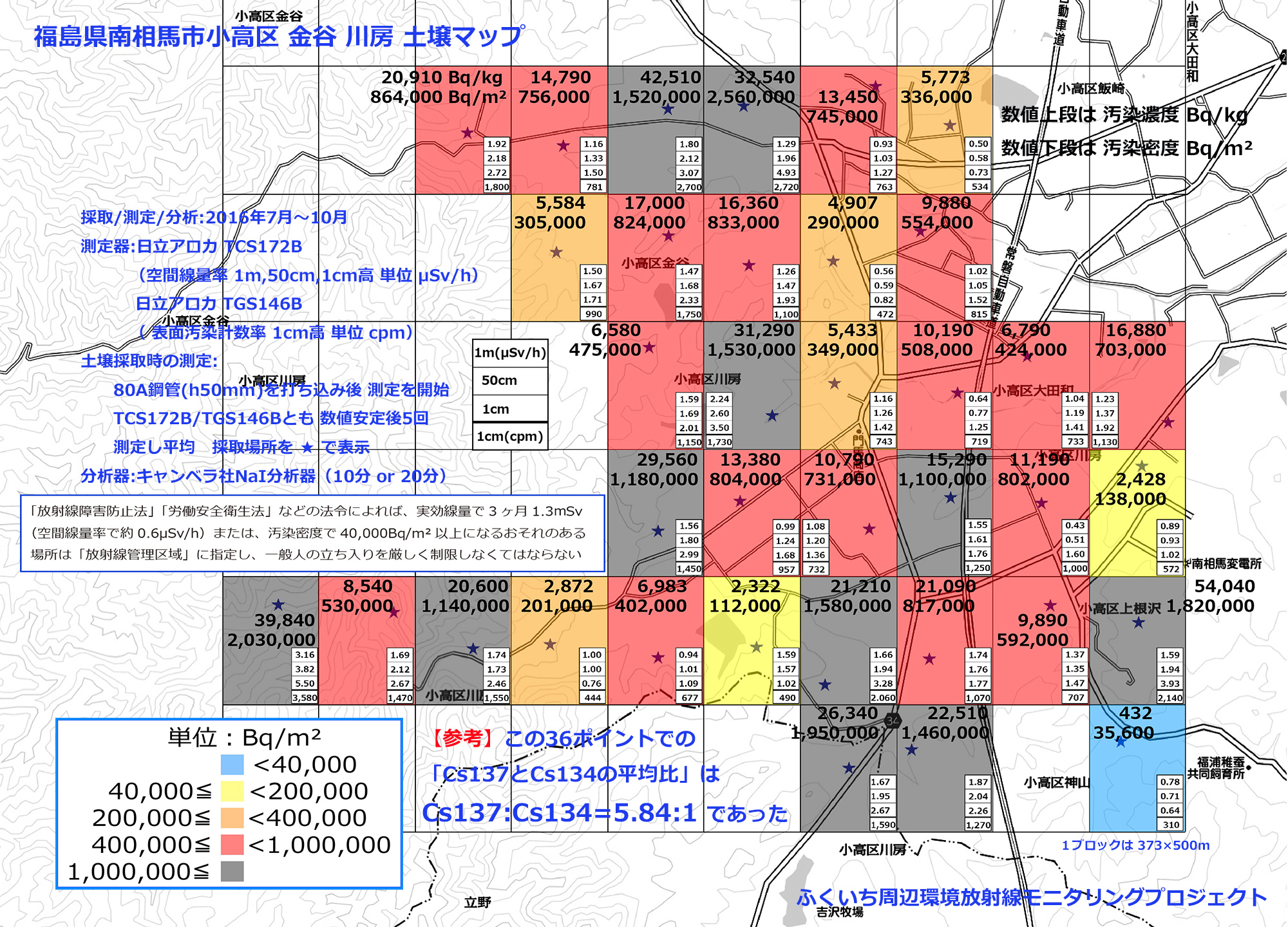
Elle a tout de suite accepté et m’a expliqué de quoi il s’agissait : « Le Projet de mesure de la radioactivité environnementale autour de la centrale nucléaire de Fukushima Daiichi (Fukuichi shûhen kankyôhôshasen monitoring project) est mené par une équipe de bénévoles relativement âgés (qui sont moins radiosensibles que les jeunes) pour réaliser des mesures de radioactivité avec un maillage serré de 75 x 100 m pour la radioactivité dans l’air et 375 x 500 m pour la contamination du sol. Les mesures de radioactivité ambiante et du sol sont réalisées principalement dans la ville de Minamisōma et aux alentours. Ils essaient de réaliser des mesures détaillées afin de montrer aux habitants les conditions réelles de leur vie, et également d’accumuler des données en vue de l’analyse des dommages sanitaires et environnementaux qui peuvent se montrer à long terme. »


Grâce à la traduction de Kurumi et avec l’accord de M. Ozawa, auteur du document, j’ai pu réaliser une version française de cette carte que vous trouverez ci-dessous.

Carte de l’équipe de M. Ozawa (traduction Kurumi Sugita)

Carte de l’équipe de M. Ozawa (traduction Kurumi Sugita)

Dans le cadre de la normalisation des territoires contaminés en zones habitables, l’ordre d’évacuation de l’arrondissement d’Odaka de la ville de Minamisōma a été levé le 12 juillet 2016, excepté la zone qui longe Namie (hameau d’Ohatake où habite un seul ménage) classée comme zone de “retour difficile”.

Situation de la zone étudiée

Situation de la zone étudiée

La carte de contamination examine les secteurs de Kanaya et Kawabusa de l’arrondissement d’Odaka, à une quinzaine de kilomètres de l’ex-centrale de Fukushima Daiichi. M. Ozawa, l’ingénieur qui a lancé cette enquête, a choisi la précision des mesures, c’est-à-dire qu’il s’emploie à mesurer la radioactivité avec des radiamètres à scintillation de laboratoire : Hitachi Aloka TCS172B, Hitachi Aloka TGS146B et Canberra NaI Scintillation Detector.


L’originalité de sa carte tient autant à la qualité de réalisation qu’à l’abondance de renseignements : on peut y lire, pour chacun des 36 prélèvements effectués, des mesures en Bq/m², en Bq/kg, en µSv/h à trois hauteurs différentes du sol (1 m, 50 cm, 1 cm) et en cpm (coups par minute) à la hauteur de 1 cm. Pour qui connaît un peu la radioactivité, ce sont des informations très précieuses. Habituellement, les mesures sont données en l’une ou l’autre unité, mais jamais simultanément avec 4 unités. Les organismes officiels devraient prendre exemple sur cette manière de travailler.


Les mesures que dévoile la carte sont très inquiétantes. Elles montrent que la terre a un niveau de contamination qui ferait d’elle un déchet radioactif dans n’importe quel pays non contaminé. Comme l’écrit M. Ozawa, ces terrains devraient être considérés comme une « zone contrôlée », c’est-à-dire un espace sécurisé, comme dans les centrales nucléaires, où l’on doit vérifier constamment les doses reçues. Dans les faits, c’est pire que dans une centrale car au Japon, on demande aux habitants évacués depuis 5 ans et demi de rentrer chez eux alors que l’on sait pertinemment qu’ils seront irradiés (jusqu’à 20 mSv/an) et contaminés (par inhalation et ingestion).

L'équipe de Fukushima Daiichi Monitoring Project lors d'une prise de mesure à Minamisoma cet été. On reconnaît sur les blousons le logo du laboratoire japonais indépendant Chikurin, partenaire de l’ACRO (Photo David Boilley).

L’équipe de Fukushima Daiichi Monitoring Project lors d’une prise de mesure à Minamisoma cet été. On reconnaît sur les blousons le logo du laboratoire japonais indépendant Chikurin, partenaire de l’ACRO (Photo David Boilley).

Cette recherche citoyenne est remarquable à plus d’un titre :


– Elle est indépendante de toute organisation. Aucun lobby n’intervient pour modifier ou atténuer telle ou telle mesure. Ce sont juste des données brutes, prises par des gens honnêtes, en recherche de vérité.


– Elle respecte un protocole scientifique, expliqué sur la carte. Il y aura toujours des gens pour critiquer tel ou tel aspect de la démarche, mais celle-ci est rigoureuse et objective.


– Elle prend des mesures à 1 m du sol mais aussi à 1 cm du sol. Cette démarche est plus logique car les hommes marchent sur le sol jusqu’à présent non ? Les cartes de contamination du Japon montrent souvent des mesures à 1 m du sol, ce qui ne reflète pas la réalité et semble être fait pour minimiser les faits. En effet, la mesure est souvent deux fois plus élevée à 1 cm du sol qu’à 1 m.


– Elle agit comme un révélateur. M. Ozawa et son équipe sont des lanceurs d’alerte. Leurs cartes disent : faites attention ! Des lois se contredisent au Japon. Ce que prétend le gouvernement, à savoir qu’une dose de 20 mSv/an ne produira pas d’effet sanitaire, n’est pas forcément la vérité. Si vous revenez, vous allez bel et bien être irradiés et contaminés. La France se prépare à la même forfaiture, à savoir qu’ « elle est en train de transposer en droit national les dispositions de la directive 2013/59/Euratom : les autorités françaises ont retenu la borne supérieure de l’intervalle : 100 mSv pour la phase d’urgence et 20 mSv pour les 12 mois suivants (et pour les années suivantes rien ne garantit que ce niveau de référence ne sera pas reconduit). Ces valeurs s’appliquent à tous, y compris les nourrissons, les enfants et les femmes enceintes ! » (source Criirad)


Le gouvernement japonais demande aux habitants de rentrer chez eux et supprime les indemnités aux évacués. Les JO approchent, la région de Fukushima doit être perçue comme « normale » pour que les sportifs et les supporters du monde entier n’aient pas peur, quitte à sacrifier la santé des populations locales. Il faut donc faire connaître la carte de M. Ozawa pour que les futures campagnes publicitaires n’étouffent pas la réalité des faits.


Pierre Fetet


____________________


Pour en savoir plus :


M. Ozawa dans un reportage de la RTBF

La poussière qui s’envole avec ses radionucléides à Minamisōma

Article sur le retour en zone contaminée du blog Nos voisins lointains 3.11

http://nosvoisins311.wixsite.com/voisins311-france/single-post/2016/08/22/Le-retour-aux-zones-contamin%C3%A9es


Les données concernant les mesures à Minamisōma

http://www.f1-monitoring-project.jp/open_deta.html


Site internet de l’équipe militante :

http://www.f1-monitoring-project.jp/index.html


Adresse de la carte d’origine (HD)

http://www.f1-monitoring-project.jp/dirtsfiles/20161104-Odaka-Kanaya-Kawabusa-s.jpg

Lanceurs d'alerte à Minamisōma

Cet article et sa carte ont été traduits en anglais par Hervé Courtois à cette adresse :

https://nuclear-news.net/2016/11/12/the-minamisoma-whistleblowers-fukushima/


Voici la traduction de la carte en anglais :

Lanceurs d'alerte à Minamisōma

http://www.fukushima-blog.com/2016/11/alerte-a-minamisoma.html

— Citizen scientists find high levels of radiation where government asks residents to re-settle — the Minamisoma whistleblowers, Fukushima

From the Fukushima 311 Watchdogs

November 12, 2016

A few days ago Pierre Fetet learned of a map which immediately called his attention.

That map displays at the same time precise and unsettling measurements. Not knowing Japanese, Pierre Fetet asked Kurumi Sugita, the president of Nos voisins lointains 3.11 association, to translate for him the text. She immediately accepted and explained to him what it was:

“The project to measure environmental radioactivity around the Fukushima Daiichi nuclear power plant (Fukuichi shuhen kankyôhôshasen monitoring project) is conducted by a team of relatively old volunteers (who are less radiosensitive than youth) to perform radioactivity measurements with a tight mesh size of 75 x 100 m for radioactivity in air and 375 x 500 m for soil contamination. Measurements of ambient radioactivity and soil radioactivity are carried out mainly in the city of Minamisōma and its surroundings. They try to make detailed measurements so as to show the inhabitants the real conditions of their lives, and also to accumulate data for the analysis of long-term health and environmental damages.”

Thanks to the Kurumi Sugita’s translation and with the agreement of Mr. Ozawa, author of the document, Pierre Fetet was able to make a French version of this map, which I translated into english here below:

Minamisoma contamination map oct 2016.jpg

Map of Mr. Ozawa’s team (translation first by Kurumi Sugita, then by Hervé Courtois)

In the context of the normalization of contaminated areas into habitable areas, the evacuation order of the Odaka district of the city of Minamisōma was lifted on 12 July 2016, except the area bordering Namie (Hamlet of Ohatake where a single household lives) classified as a “difficult return” area.

minamisoma-contamination-map-oct-2016-2

Situation of the study area

The contamination map examines the Kanaya and Kawabusa areas of the Odaka district, about fifteen kilometers from the former Fukushima Daiichi nuclear power plant. Mr. Ozawa, the engineer who launched this investigation, has chosen the precision of the measurements, that is to say laboratory scintillation radiometers are used to measure radioactivity: Hitachi Aloka TCS172B, Hitachi Aloka TGS146B and Canberra NaI Scintillation Detector.

The originality of this map is due as much to the quality of its realization as to the abundance of its informations: it can be read, for each of the 36 samples taken, measurements in Bq / m², in Bq / kg, in μSv / h at three different soil heights (1 m, 50 cm, 1 cm) And in cpm (counts per minute) at the height of 1 cm. For those who know a little about radioactivity, these informations are very valuable informations. Usually, measurements are given in either unit, but never simultaneously with 4 units. Official organizations should learn this way of working.

The measures revealed by the map are very disturbing. They show that the earth has a level of contamination that would make it a radioactive waste in any uncontaminated country. As Mr. Ozawa writes, these lands should be considered a “controlled zone”, that is to say a secure space, as in nuclear power plants, where the doses received must be constantly checked. In fact, it is worse than inside of a nuclear power plant because in Japan the inhabitants evacuated since five and a half years are now asked to return home, whereas it is known that they will be irradiated (Up to 20 mSv / year) and contaminated (by inhalation and ingestion).

This citizen research is remarkable in more ways than one:

  • It is independent of any organization. There is no lobby to alter or play down this or that measure. These are just raw data, taken by honest people, in search of truth.
  • It respects a scientific protocol, explained on the map. There will always be people to criticize this or that aspect of the process, But this one is rigorous and objective.
  • It takes measurements 1 m from the ground but also 1 cm from the ground. This approach is more logical because until now men are walking on the ground no? The contamination maps of Japan often show measurements at 1 m from the ground, Which does not reflect reality and seems to be done to minimize the facts. Indeed, the measurement is often twice as high at 1 cm from the ground as at 1 m.
  • It acts as a revealing map. Mr. Ozawa and his team are whistleblowers. Their maps say: Watch out ! Laws contradict each other in Japan. What the government claims, namely that a dose of 20 mSv / year will not produce any health effect, is not necessarily the truth. If you come back, you are going to be irradiated and contaminated.

France is preparing for the same forfeiture, namely that ‘it is transposing into national law the provisions of Directive 2013/59 / Euratom: the French authorities retained the upper limit of the interval: 100 mSv for the emergency phase and 20 mSv for the following 12 months (And for the following years there is no guarantee that this reference level will not be renewed). These values apply to all, including infants, children and pregnant women! ” (source Criirad)

The Japanese government is asking residents to return home and abolishing compensation for evacuees. The Olympics are coming, Fukushima must be perceived as “normal” so that the athletes and supporters of the whole world won’t be afraid, even if it means sacrificing the health of the local population. It is therefore necessary to make known the map of Mr. Ozawa so that future advertising campaigns do not stifle the reality of the facts.

Pierre Fetet

Data on measurements at Minamisōma

http://www.f1-monitoring-project.jp/open_deta.html

Website of the measuring team:

http://www.f1-monitoring-project.jp/index.html

Address of the original map (HD)

http://www.f1-monitoring-project.jp/dirtsfiles/20161104-Odaka-Kanaya-Kawabusa-s.jpg

3-ob_8977f5_20161104-odaka-kanaya-kawabusa-s.jpg

Source : Article of Pierre Fetet

http://www.fukushima-blog.com/2016/11/alerte-a-minamisoma.html

(Translation Hervé Courtois)

https://dunrenard.wordpress.com/2016/11/12/the-minamisoma-whistleblowers-fukushima/

— 2016.11.18 復興特「加害者の都合のいいように一方的に線引きするようなやり方が許されるんだったら、この世は地獄ですよ」

https://www.taro-yamamoto.jp/

2016年11月22日

○山本太郎君 ありがとうございます。自由党の山本太郎です。会派を代表し、質問します。

二〇一一年三月十一日に出された原子力緊急事態宣言、東電事故発生から五年八か月たった今も、現在も解除はされていません。本日は、ここにいらっしゃる先生方が十分に御存じの話をいたします。

まずは、放射線管理区域について。放射線管理区域とは、病院のレントゲン室、研究施設、原子力発電所など専門の知識を持った放射線業務従事者が仕事で出入りする区域です。

お尋ねします。放射線管理区域にはルールがありましたよね。その区域内で飲食、飲み食いってできるんですか。


○政府参考人(田中誠二君) お答えいたします。

電離放射線障害防止規則により、放射性物質を経口摂取するおそれのある作業場所においては飲食が禁止されております。


○山本太郎君 もちろん飲み食いは禁止ということは、当然寝泊まりなんてできないということですよね。成人でも十時間以上の滞在は許されません。

電離放射線障害防止規則、電離則というものがあるのは皆さん御存じのとおり。これは病院や研究施設、原子力発電所などで働く放射線業務従事者の皆さんを守るための規則ですよね。

資料の一、電離則の第三条には管理区域、つまり放射線管理区域を定める内容が書かれている。三条の一、二、どっちかに該当したら管理区域ということで標識も立てなさいよ、そのように書かれている。その一と二を私が読んでみたいと思います。

一、外部放射線による実効線量と空気中の放射性物質による実効線量との合計が三月間、三か月ですね、三月間につき一・三ミリシーベルトを超えるおそれのある区域。二、放射性物質の表面密度が別表第三に掲げる限度の十分の一を超えるおそれのある区域。三か月で一・三ミリシーベルトの線量で放射線管理区域と呼ぶそうです。そして、三条の二に出てきた表面密度は別表でとありました。

資料の二です。ここで言う表面密度を平方メートルで換算すると幾らになるでしょうか。


○政府参考人(田中誠二君) 一平方メートル当たりで計算いたしますと、四万ベクレルとなります。


○山本太郎君 一平方メートル当たり四万ベクレルで放射線管理区域ということでした。空間線量だけでなく表面の汚染、つまり土壌などに沈着したもの、要は、環境中に存在するそのほかの要因にもしっかりと目を向け、区域として管理することが放射線業務従事者を守るために必要とされている、そういうことなんですよね。

放射線管理区域は、空間線量だけではなく放射性物質の表面密度も規定されている。つまり、線源がきっちりと管理されていて、それによる被曝という状況と、放射性物質があちこちに散らばっている状況というのはまた別のリスクだからですよね。

Continue reading

— Retournez, habitez, vivez, reconstruisez, c’est quoi cette histoire ! MP Taro Yamamoto

Nos Voisins Lointains 3.11

Taro YAMAMOTO

12/12/2016|

Taro YAMAMOTO, du parti libéral, est membre de la Chambre des conseillers. Il est un des rares membres parlementaires qui défendent les droits des victimes de l’accident de la centrale nucléaire de TEPCO Fukushima Daiichi.

L’association Nos Voisins Lointains 3-11 a traduit les questions de Taro YAMAMOTO à la Commission spéciale de reconstruction de la Chambre des députés au 18 novembre 2016*. Le contenu de ses questions révèle la situation inhumaine à laquelle sont confrontées les victimes dans le cadre de la politique de retour du gouvernement japonais.

Le vidéo des questions de Taro YAMAMOTO (en japonais).


  • Taro YAMAMOTO

Je vous remercie. Je suis Taro YAMAMOTO du parti libéral. Je voudrais poser des questions en tant que représentant d’un groupe parlementaire.

Décrété le 11 mars 2011, l’état d’urgence nucléaire n’est pas encore levé à ce jour, 5 ans et 8 mois depuis l’accident à la centrale nucléaire de TEPCO Fukushima Daiichi. Aujourd’hui, je vais aborder un sujet connu parfaitement par Mesdames et Messieurs les Députés ici présents.

Je vais commencer par le sujet de la zone contrôlée de radioactivité. Il s’agit de la zone délimitée fréquentée par des travailleurs possédant la connaissance professionnelle, exposés aux risques liés aux rayonnements ionisants, telle que une salle de radiographie, un laboratoire de recherche, une centrale nucléaire, etc.

Voici ma question. Il y a des règles qui s’appliquent aux zones contrôlées de radioactivité, n’est ce pas. Peut-on y manger et boire ?

  • Expert du gouvernement (Seiji TANAKA)

Voici la réponse. Suivant l’ordonnance sur la prévention des risques liés aux rayonnements ionisants**, il est interdit de manger et boire sur les lieux de travail où existe le risque d’assimiler des substances radioactives par voie orale.

  • Taro YAMAMOTO

Bien entendu, il est interdit d’y boire ou manger. Donc, il est évident que ce n’est pas possible d’y passer la nuit, n’est ce pas ? Même pour les adultes, il n’est pas permis d’y demeurer plus de 10 heures.

Vous connaissez bien l’existence de l’ordonnance. Il s’agit d’une règle à respecter afin de protéger les travailleurs exposés aux risques liés aux rayonnements ionisants dans des établissements tels que les hôpitaux, les laboratoires de recherche et les centrales nucléaires, n’est ce pas ?

On y trouve la définition de la zone contrôlée de radioactivité. Il s’agit de l’article N°3 de l’ordonnance dans le dossier N°1.  On peut y lire que si la situation correspond soit à la définition décrite dans l’article 3/1 soit à celle précisée dans 3/2, la zone est considérée comme zone contrôlée, et qu’il faut y poster un panneau de signalisation. Je vais lire les parties 1 et 2 de cet article.

1 : la zone dans laquelle le total de la dose effective due à la radiation externe et celle due aux substances radioactives dans l’air risque de dépasser 1,3mSv par trimestre – sur une durée de trois mois ! On appelle la zone « la zone contrôlée de radioactivité » lorsque la dose atteint 1,3mSv sur une durée de trois mois.

Dans la partie 3/2, on réfère à la densité à la surface dans le tableau attaché.

Voici le dossier N°2. Quelle sera-t-elle si on fait la conversion de la densité à la surface par m2 ?

  • Expert du gouvernement (Seiji TANAKA)

La conversion donne 40 000Bq/ m2.

  • Taro YAMAMOTO

Ainsi, avec 40 000Bq/ m2, la zone est classée comme « zone contrôlée de radioactivité ». Il faut donc bien surveiller non seulement la radioactivité dans l’air mais aussi la contamination de surface, c’est-à-dire la dose au sol des substances radioactives, autrement dit les autres éléments existant dans l’environnement, et gérer la zone délimitée afin de protéger les travailleurs des risques liés aux rayonnements, n’est ce pas ?

La zone contrôlée de radioactivité est définie à la fois par le débit de dose de la radioactivité ambiante et par la densité à surface des substances radioactives. Le point est que le risque dans une situation où les substances radioactives sont dispersées est tout à fait autre que celui dans la situation où les sources de rayonnement sont bien identifiées et gérées.

Or, actuellement l’ordre d’évacuation appliqué aux zones d’évacuation suite à l’accident de la centrale nucléaire est levé lorsque le débit de dose de radioactivité ambiante devient inférieur à 20mSv/an.

Voici ma question. Concernant la contamination, en dehors du débit de dose de radioactivité ambiante, y a-t-il des conditions à tenir compte pour lever l’ordre d’évacuation ? Veuillez répondre par un oui ou un non.

  • Expert du gouvernement (Takeo HOSHINO)

Voici la réponse.

Concernant les conditions nécessaires pour la levée de l’ordre d’évacuation, quant aux mesures de radioactivité, il n’y a que la certitude que le cumul annuel de débit de dose de radioactivité ambiante soit inférieur à 20mSv.

  • Taro YAMAMOTO

Vous n’avez pas compris. Je vous ai demandé de répondre par un oui ou un non. Y a-t-il d’autres conditions que le débit de dose de la radioactivité ambiante ? Pour lever l’ordre d’évacuation en dessous de 20mSv/an, quelles sont les conditions concernant la contamination?

Le fait est que concernant la contamination, il n’y a pas d’autres conditions que le débit de dose de la radioactivité dans l’air. C’est anormal. Vous, qui appartenez à cette Commission comprenez certainement à quelle mesure cette situation est anormale. Dans la définition de la zone contrôlée de radioactivité, en dehors de débit de dose de radioactivité dans l’air, on tien compte des substances dispersées puis déposées, c’est-à-dire de la contamination dans le sol etc., ce qui fait que le critère de 40 000Bq/m2 est établi pour la contamination à surface. Cependant, dans le cadre de la politique de retour pour faire revenir les populations aux territoires où le débit de dose cumulé annuel est inférieur à 20mSv/an, la condition de contamination de sol n’est pas considérée comme nécessaire. Cette dernière ne constitue pas un critère d’évaluation, le seul critère étant le débit de dose de la radioactivité ambiante. Les politiciens et les fonctionnaires qui considèrent cette situation régulière ne méritent pas de recevoir les salaires payés à partir des recettes des impôts. Notre travail est de protéger la vie et la propriété du peuple. Or, vous allégez les conditions. Vous créez à votre gré une règle moins rigoureuse que celle appliquée aux travailleurs possédant la connaissance professionnelle de la radioactivité. Que faites vous !

Suite à l’accident de Tchernobyl, des lois ont été établies en Russie, en Biélorussie et en Ukraine, et on y mesure à la fois le débit de dose de radioactivité dans l’air et la contamination du sol. Pourquoi ? Cela va sans dire. C’est parce que c’est difficile de saisir la quantité d’irradiation subie par la population seulement avec les mesures de la radioactivité ambiante. En Ukraine, avec 5mSv/an, mesure correspondant à celle de la zone contrôlée de radioactivité, la population est évacuée, et même avec 1mSv/an qui correspond à la limite du débit de dose moyen pour le public, les habitants ont le droit d’évacuer. Cette loi dite loi Tchernobyl est encore en vigueur.

En revanche, quelle est la situation au Japon ? Selon la décision du Cabinet du mois de juin 2015, l’ordre d’évacuation est levé si le débit de dose dans l’air est inférieur à 20mSv/an. Il n’y a pas de problème ! A titre d’exemple, si on demeure 24h dans une zone contrôlée de radiation, on est exposé à la dose de 5,2mSv/an. Or, le critère de la levée de l’ordre et du retour de la population est de 20mSv/an ou moins. Le zonage est déterminé par la dose 4 fois supérieure à celle de la zone contrôlée de radioactivité. Retournez, habitez, vivez, reconstruisez, c’est quoi cette histoire ! Je ne peux trouver d’autre expression que « complètement tordu». Peut on encore appeler ça l’État ? Je pense qu’il vaut mieux l’appeler la mafia. C’est tellement inhumain !

Continue reading

— Taro Yamamoto MP: Defending the rights of Fukushima victims, humanitarian and environmental crisis — debate in Japan’s Parliament (VIDEO)

Global Research, January 01, 2017
Fukushima 311 Watchdogs 14 December 2016
jkllm

Taro Yamamoto of the Liberal Party is a member of the Chamber of Deputies. He is one of the few parliamentary members defending the rights of victims of the TEPCO Fukushima Daiichi nuclear power plant disaster.

The Association Nos Voisins Lointains 3-11 translated the questions of Taro Yamamoto to the Chamber of Deputies’ Special Commission on Reconstruction on 18 November 2016*.

The content of his questions reveals the inhuman situation faced by the victims in the framework of the Japanese government’s return policy .

Taro Yamamoto’s questions (video in Japanese)

See Transcript Below

● Taro Yamamoto

Thank you. I am Taro Yamamoto from the Liberal Party. I would like to ask questions as the representative of a parliamentary group.

Declared on 11 March 2011, the state of nuclear emergency has not yet been lifted to date, 5 years and 8 months after the accident at the TEPCO Fukushima Daiichi nuclear power plant. Today, I will address a subject that is well known by the members here present.

I will start with the subject of the radioactivity controlled area. This is a demarcated area frequented by workers with professional knowledge who are exposed to the risks associated with ionizing radiation, such as an X-ray room, a research laboratory, a nuclear power plant and so on.

Here is my question. There are rules that apply to controlled areas of radioactivity, are not they? Can we eat and drink in such a controlled area?

● Government expert (Seiji Tanaka)

Here is the answer. According to the Ordinance on the Prevention of Risks from Ionizing Radiation**, eating and drinking are prohibited in workplaces where there is a risk of ingesting radioactive substances orally.

● Taro Yamamoto

Of course, it is forbidden to drink or eat there. So it’s obvious that it’s not possible to spend the night there, is it? Even adults cannot stay for more than 10 hours.

You are well aware of the existence of this Ordinance. This is a rule that must be respected in order to protect workers exposed to risks related to ionizing radiation in establishments such as hospitals, research laboratories and nuclear power plants, isn’t it?

It contains the definition of a radioactivity controlled area. This is Article 3 of the Ordinance in File No. 1. It states that if the situation corresponds to the definition described in Article 3/1 or to that specified in Article 3/2, the zone shall be considered as a controlled area and a sign shall be posted there. I will read parts 1 and 2 of this article.

1: The area in which the total effective dose due to external radiation and that due to radioactive substances in the air is likely to exceed 1.3mSv per quarter – over a period of three months! When the dose reaches 1.3mSv over a period of three months, a zone is called “controlled radioactivity zone”.

Part 3/2 refers to the surface density in the attached table.
Here is File No. 2. What will it be if we do the conversion of the density of the surface per m2?

● Government expert (Seiji Tanaka)

The conversion gives 40,000Bq/m2

● Taro Yamamoto

Thus, with 40 000Bq / m2, the zone is classified as a “controlled zone of radioactivity”. It is therefore necessary to monitor not only radioactivity in the air but also the surface contamination, ie the ground dose of radioactive substances, ie other elements in the environment, and to manage the area in order to protect workers from radiation-related risks, isn’t it?

A radioactivity controlled area is defined both by the dose rate of the ambient radioactivity and by the surface density of the radioactive substances. The point is that the risk in a situation where the radioactive substances are dispersed is quite different from that in the situation where the radiation sources are well identified and managed.

At present, the evacuation order applied to the evacuation zones following the nuclear power plant accident is lifted when the ambient radioactivity dose rate becomes less than 20mSv / year.

Here is my question. Concerning contamination, apart from the dose rate of ambient radioactivity, are there any conditions to take into account in order to lift the evacuation order? Please answer yes or no.

● Government expert (Takeo Hoshino)

Here is the answer.

Concerning the conditions necessary for the lifting of the evacuation order, as far as the radioactivity measurements are concerned, it is only the certainty that the annual cumulative dose rate of ambient radioactivity is less than 20 mSv.

● Taro Yamamoto

You did not understand. I asked you to answer yes or no. Are there any other conditions other than the dose rate of ambient radioactivity? To lift the order of evacuation below 20mSv / year, what are the conditions regarding the contamination?

The fact is that regarding contamination, there are no other conditions than the dose rate of the radioactivity in the air. This is abnormal. You, who belong to this Commission, certainly understand to what extent this situation is abnormal.

In the definition of a radioactivity controlled zone, apart from the dose rate of radioactivity in the air, account is taken of the substances dispersed and then deposited, that is to say contamination in the soil etc., which means a criterion of 40 000Bq / m2 is established for surface contamination.

However, in the return policy to return populations to territories where the annual cumulative dose rate is less than 20mSv / year, the condition of soil contamination is not considered necessary.

The latter is not an evaluation criterion, the only criterion used is the dose rate of the ambient radioactivity. Politicians and officials who consider this to be a regular situation do not deserve to receive wages paid from tax revenues.

Our job is to protect the life and property of the people. Now, you lighten those conditions. You create, at your discretion, a rule that is less stringent than that applied to workers with a professional knowledge of radioactivity. What are you doing !

Following the Chernobyl accident, laws have been established in Russia, Belarus and Ukraine, measuring both the dose rate of radioactivity in the air and the contamination of the soil. Why ?

Continue reading

— Beyond Nuclear calls for NRC to name U.S. reactors with potentially defective Areva parts

From Beyond Nuclear
December 28, 2016

Beyond Nuclear is calling for the U.S. Nuclear Regulatory Commission to name the U.S. reactors that might be operating with defective parts imported from France. While potentially affected French reactors have closed down as a safety precaution, the U.S. NRC has refused to even name the affected reactors let alone mandate precautionary closures until the parts are checked. Beyond Nuclear is filing an emergency enforcement 2.206 petition and a Freedom of Information Act Request to demand that the NRC release the full list of reactors with flawed parts; inform the affected reactor communities of the risks; and require the shutdown of reactors with potentially defective reactor components.

As Beyond Nuclear’s Kevin Kamps stated in our press release:“Every one of those potentially defective parts are safety-significant and could lead to meltdown if they fail.”

A Greenpeace France report indentified 19 U.S. reactors at 11 sites that could be operating with defective safety-essential components from Areva’s Le Creusot forge in France. They are:

Prairie Island in Minnesota; North Anna and Surry in Virginia; Three Mile Island in Pennsylvania; Arkansas One in Arkansas; Turkey Point and St Lucie in Florida; DC Cook in Michigan; Salem in New Jersey; Callaway in Missouri; and Millstone in Connecticut. The Crystal River reactor in Florida was also listed but is now permanently closed.

— Ukraine in full-blown collapse: 19 nuclear reactors at risk

The mainstream news claims Russian aggression caused the crisis in Ukraine. The same mainstream news also claims that the Fukushima disaster was a short-lived incident, and neither the Pacific Ocean nor the public have ever been in danger. 
Global Research has a section on Ukraine with extensive documentation on what happened and is still happening. 
Global Research, December 27, 2016
ClubOrlov 22 December 2016

With all the action in Syria, the Ukraine is no longer a subject for discussion in the West. In Russia, where the Ukraine is still a major problem looming on the horizon, and where some 1.5 million Ukrainian refugees are settling in, with no intentions of going back to what’s left of the Ukraine, it is still actively discussed. But for the US, and for the EU, it is now yet another major foreign policy embarrassment, and the less said about it the better.

In the meantime, the Ukraine is in full-blown collapse—all five glorious stages of it—setting the stage for a Ukrainian Nightmare Before Christmas, or shortly after.
Phase 1. Financially, the Ukrainian government is in sovereign default as of a couple of days ago. The IMF was forced to break its own rules in order to keep it on life support even though it is clearly a deadbeat. In the process, the IMF stiffed Russia, which happens to be one of its major shareholders; what gives?

Phase 2. Industry and commerce are approaching a standstill and the country is rapidly deindustrializing. Formerly, most of the trade was with Russia; this is now over. The Ukraine does not make anything that the EU might want, except maybe prostitutes. Recently, the Ukraine has been selling off its dirt. This is illegal, but, given what’s been happening there, the term “illegal” has become the stuff of comedy.

Phase 3. Politically, the Ukrainian government is a total farce. Much of it has been turned over to fly-by-night foreigners, such as the former Georgian president Saakashvili, who is a wanted criminal in his own country, which has recently stripped him of his citizenship. The parliament is stocked with criminals who bought their seat to gain immunity from prosecution, and who spend their time brawling with each other. Prime Minister Yatsenyuk was recently hauled off the podium by his crotch; how dignified is that? He seemed unfazed. Where are his testicles? Perhaps Victoria Nuland over at the US State Dept. is keeping them in a jar. This sort of action may be fun to watch on Youtube, but the reality is quite sad: those who “run” the Ukraine (if the term still applies) are only interested in one thing: stealing whatever is left.

Phase 4. Ukrainian society (if the term still applies) has been split into a number of warring factions. This was, to some extent, inevitable. What happens if you take bits of Poland, Hungary, Romania and Russia, and stick them together willy-nilly? Well, results may vary; but if you also spend $5 billion US (as the Americans did) turning the Ukrainians against Russia (and, since they are mostly Russian, against themselves), then you get a complete disaster.

Phase 5. Cultural collapse is quite advanced. The Ukraine once had the same world-class educational system as Russia, but since independence they switched to teaching in Ukrainian (a made-up language) using nonexistent textbooks. The kids have been taught a bogus history hallucinated by rabid Ukrainian nationalists. They’ve been told that Russia is backward and keeping them back, and that they deserve to be happy in the EU. (Just like the Greeks? Yeah…) But now the population has been reduced to levels of poverty not commonly seen outside of Africa, and young people are fleeing, or turning to gangsterism and prostitution, to merely survive. This doesn’t make for a happy cultural narrative. What does it mean to be “a Ukrainian” now? Expletives deleted. Sorry I asked.

Now, here’s what it all really means. With so much going wrong, the Ukraine has been unable to secure enough natural gas or coal supplies to provide a supply cushion in case of a cold snap this winter. A few weeks of frosty weather will deplete the supply, and then pipes will freeze, rendering much of the urban areas unlivable from then on (because, recall, there is no longer any money, or any industry to speak of, to repair the damage). That seems bad enough, but we aren’t quite there yet.

You see, the Ukraine produces over half of its electricity using nuclear power plants. 19 nuclear reactors are in operation, with 2 more supposedly under construction. And this is in a country whose economy is in free-fall and is set to approach that of Mali or Burundi! The nuclear fuel for these reactors was being supplied by Russia. An effort to replace the Russian supplier with Westinghouse failed because of quality issues leading to an accident. What is a bankrupt Ukraine, which just stiffed Russia on billions of sovereign debt, going to do when the time comes to refuel those 19 reactors? Good question!

But an even better question is, Will they even make it that far? You see, it has become known that these nuclear installations have been skimping on preventive maintenance, due to lack of funds. Now, you are probably already aware of this, but let me spell it out just in case: a nuclear reactor is not one of those things that you run until it breaks, and then call a mechanic once it does. It’s not a “if it ain’t broke, I can’t fix it” sort of scenario. It’s more of a “you missed a tune-up so I ain’t going near it” scenario. And the way to keep it from breaking is to replace all the bits that are listed on the replacement schedule no later than the dates indicated on that schedule. It’s either that or the thing goes “Ka-boom!” and everyone’s hair falls out.

How close is Ukraine to a major nuclear accident? Well, it turns out, very close: just recently one was narrowly avoided when some Ukro-Nazis blew up electric transmission lines supplying Crimea, triggering a blackout that lasted many days. The Russians scrambled and ran a transmission line from the Russian mainland, so now Crimea is lit up again. But while that was happening, the Southern Ukrainian, with its 4 energy blocks, lost its connection to the grid, and it was only the very swift, expert actions taken by the staff there that averted a nuclear accident.

I hope that you know this already, but, just in case, let me spell it out again. One of the worst things that can happen to a nuclear reactor is loss of electricity supply. Yes, nuclear power stations make electricity—some of the time—but they must be supplied with electricity all the time to avoid a meltdown. This is what happened at Fukushima Daiichi, which dusted the ground with radionuclides as far as Tokyo and is still leaking radioactive juice into the Pacific.

And so the nightmare scenario for the Ukraine is a simple one. Temperature drops below freezing and stays there for a couple of weeks. Coal and natural gas supplies run down; thermal power plants shut down; the electric grid fails; circulator pumps at the 19 nuclear reactors (which, by the way, probably haven’t been overhauled as recently as they should have been) stop pumping; meltdown!

If this winter stays very, very warm, then the “19 Fukushimas” scenario just may be averted. This is not impossible: we’ve been seeing one freakishly warm winter after another, and each passing month is setting new records. The future is looking hot—as in very warm. Let us pray that it doesn’t also turn out to be hot—as in radioactive.

— CPUC hearing Dec. 8 on Diablo Canyon “retirement”

From cpuc.ca.gov

Public Workshop Notice:

PG&E’s Application Retirement of Diablo Canyon Power Plant – (A.16-08-006)

December 8, 2016
10 am – 3 pm

California Public Utilities Commission
505 Van Ness Avenue,
Auditorium (Corner of Van Ness Avenue and McAllister Street)
San Francisco, CA 94102

The purpose of this workshop is to:
(1) to get clarification of PG&E’s proposal and the reasoning behind the proposal and how PG&E is determining its planning needs,
(2) to inform the parties of the proposed process for the IRP proceeding in order to determine if some or all replacement procurement should be deferred to IRP, and
(3) to understand PG&E’s proposal and reasoning for their proposed cost allocation, including costs allocated to CCA and DA customers.

For questions about this workshop, please contact Suzanne Casazza at Suzanne.casazza@cpuc.ca.gov or (415) 703-5906

Additional hearings are scheduled:

04/18/17
10:00 a.m.
ALJ Allen Comr Picker
A.16-08-006 (EH) – Application of Pacific Gas and Electric Company for Approval of the Retirement of Diablo Canyon Power Plant, Implementation of the Joint Proposal, And Recovery of Associated Costs Through Proposed Ratemaking Mechanisms (U39E), Commission Courtroom, San Francisco
(Also April 19 – 21 and April 24 – 28)

— 1 meter tsunami at Fukushima reactors; cooling system at Fukushima Daini failed; fears of nuclear waste leakage; more quakes possible

From ENE News
November 21, 2016

Kyodo News, Nov 22, 2016 (emphasis added):  BREAKING NEWS: 1 meter tsunami observed at Fukushima reactors… URGENT: M7.3 quake hits northeastern Japan, tsunami warning issued

NHK, Nov 22, 2016: [Officials] are urging residents of coastal areas to evacuate to higher ground following a powerful earthquake… The Japan Meteorological Agency says the magnitude 7.4 earthquake hit off Fukushima … Heavy swaying could be felt as far away as [Tokyo]…

Japan Times, Nov 22, 2016: An earthquake with a preliminary magnitude of 7.3 off the coast of Fukushima Prefecture rocked widespread areas early Tuesday, triggering tsunami warnings… People have been warned to evacuate immediately to high ground in Fukushima…

NHK, Nov 22, 2016: [An] official Koji Nakamura spoke with reporters after an earthquake with an estimated magnitude of 7.4 struck off the coast of Fukushima… Nakamura said tsunami waves are being observed in various coastal areas, and that damage could occur… He urged residents to flee… Nakamura also warned that another quake of a similar scale could occur within a week, which may also generate a tsunami.

Guardian, Nov 21, 2016: Fukushima: tsunami waves arrive after 7.4 magnitude earthquake… A 60cm (2ft) tsunami was observed at Fukushima’s Onahama Port and a 90cm (3ft) tsunami at Soma… A spokesman for [JMA said] that the tide level was still rising… the Fukushima Daini Reactor 3 cooling system had stopped operating

Bloomberg, Nov 21, 2016: NHK warned bigger tsunami waves could hit the coast. Workers at the Fukushima Dai-Ichi nuclear plant… were evacuated

The Australian, Nov 22, 2016: [The JMA] has just upgraded it to a 7.4… cooling equipment for the spent nuclear fuel pool in the reactor No. 3 of Tepco’s Fukushima No. 2 power plant has stopped‘Please flee immediately’ — An announcer on public broadcaster NHK is urging residents along the coast to move to high ground. “Please flee immediately,” the male voice says, with great urgency… So far, several tsunami waves, the biggest measuring 90 centimetres (three feet) have hit… [JMA says] waves have been “observed offshore and therefore are expected to be higher by the time of arrival in coastal areas’’… Footage of Japanese television appears to show rapid movement of water on the coast. [Tepco] is checking its nuclear plants in Fukushima for damage… Television footage showed ships moving out to sea from Fukushima harbours.

Sydney Morning Herald, Nov 22, 2016: A series of tsunami waves have been observed along the coastline… 60-centimetre tsunami was observed at the Port of Onahama, at Iwaki, Fukushima. NHK said back-wash has been reported at the port, as the sea level decreases for the approach of a tsunami. The second and third waves of the tsunami are likely to be higherthan the first wave, NHK reported. Tsunami waves may reach their maximum height a few hours or more after the initial wave, JMA said.

Yahoo News, Nov 22, 2016: ‘Evacuate immediately’: Tsunami warnings after 7.3 quake hits Japan… A surge about 90 centimetres high was reported at Soma about an hour after the quake. A wave of about 60cm has been recorded at Fukushima, with more expected. Residents near the Fukushima coast have been told to leave. Emergency broadcasters in Japan are warning of a wave of up to three metres, and possibly higher.

KQED, Nov 21, 2016: A major earthquake [has] triggered tsunamis… [JMA] has reported tsunami waves as high as 1.4 meters — about 4 feet — so far.

The Mirror, Nov 21, 2016: Cooling systems at nuclear reactor have FAILED… The breakdown at the Daini plant has sparked fears nuclear waste may leak

RT, Nov 21, 2016: According to the Nuclear Regulatory Agency the cooling system servicing the Unit 3 spent fuel pool is not able to circulate water to cool the nuclear fuel… the system might have been “shaken” during the earthquake, according to nuclear agency officials…

NHK, Nov 22, 2016: Japan’s Prime Minister Shinzo Abe has said the government will do all it can to deal with the effects of a powerful earthquake that struck on Tuesday… He also instructed officials to grasp the extent of the damage and to do their utmost to respond to the disaster.

Watch broadcasts: NHK | Yahoo | Guardian

http://enenews.com/urgent-emergency-at-fukushima-after-rocked-by-m7-4-quake-tsunami-wave-hits-destroyed-nuclear-plants-cooling-systems-at-reactor-failed-prime-minister-we-must-grasp-extent-of-damage-ex


— Tell EPA — Stop dangerous radioactive drinking water

From the Nuclear Information and Research Service

November 21, 2016

In July, thousands of us took action to stop dangerous new radiation guidance for drinking water. The EPA refused to listen, and now this guidance could be approved anytime–unless we act now!

Environmental Protection Agency (EPA) Administrator Gina McCarthy is on the verge of approving radiation levels hundreds and thousands of times higher than currently allowed in drinking water and at cleaned-up Superfund sites. These mis-named “Protective” Action Guides for Drinking Water (Water PAGs)  dramatically INCREASE allowable radioactivity in water. Enormous levels of invisible but deadly radioactive contamination would be permitted in drinking water for weeks, months or even years after a nuclear accident or “incident.” The PAGs are not for the immediate phase after a radioactive release but the next phase–which could last for years–when local residents may return home to contaminated water and not know the danger.

Take action now: Protect drinking water from dangerous radiation levels!

There are two quick actions to take today:

  1. Tell your EPA Regional Administrator (see map and list below) to ask EPA Administrator Gina McCarthy why she is raising radiation levels allowed in drinking water.
  2. Send a message to Administrator McCarthy yourself asking her not to approve these dangerous radiation levels in drinking water.

We have stopped PAGs like these from being approved before–and we can do it again. EPA insiders attempted to push these dangerous guides through in the waning days of the Bush administration, and public pressure like this got the agency to pull them back. Now we have to do it again!

Click here to take action now.

Thanks for all you do!

Diane D’Arrigo
Radioactive Waste Project Director

More Information

The PAGs protect the polluters from liability, not the public from radiation. CHECK out this NBC4 News Story.

These PAGs are a bad legacy. Approving them now is a deceptive way to circumvent the Safe Drinking Water Act, Superfund cleanup levels, and EPA’s history of limiting the allowable risk of cancer to 1 in a million people exposed (or at most 1 in 10,000 in worst-case scenarios).

The PAGs don’t just affect water!

  • They markedly relax long-term cleanup standards.
  • They set very high and outdated radiation levels allowable in food.
  • They eliminate requirements to evacuate people vulnterable to high radiation doses to the thyroid and skin.
  • They eliminate limits on lifetime whole body radiation exposures.
  • And they recommend dumping radioactive waste in municipal garbage dumps not designed for such waste.

Outrageously, EPA is expanding the kinds of radioactive ‘incidents’ that would be allowed to give off these dangerously high levels and doses. PAGs originally applied to huge nuclear disasters like the nuclear power meltdowns at Fukushima or a dirty bomb BUT NOW they could ALSO apply to less dramatic releases from nuclear power reactors or radio-pharmaceutical spills, nuclear transport accidents, fires or any radioactive “incident” that “warrant[s] consideration of protective action.”

EPA REGIONS and REGIONAL ADMINISTRATORS

Region 1 Administrator Curt Spalding
(617) 918-1010
spalding.curt@epa.gov;

Region 2 Administrator Judith Enck
(212) 637-5000
enck.judith@epa.gov

Region 3 Administrator Cecil Rodrigues
(215) 814-2683
Rodrigues.cecil@Epa.gov

Region 4 Administrator Heather McTeer Toney
(404) 562-9900
McTeertoney.heather@Epa.gov

Region 5 Acting Administrator Robert A. Kaplan
(312) 886-3000
Kaplan.robert@Epa.gov

Region 6 Administrator Ron Curry
(214) 665-2100
Curry.ron@Epa.gov

Region 7 Administrator Mark Hague
(913) 551-7006
Hague.mark@Epa.gov

Region 8 Administrator Shaun McGrath
(303) 312-6532
McGrath.shaun@Epa.gov

Region 9 Acting Administrator Alexis Strauss
(415) 947-8000
Strauss.alexis@Epa.gov

Region 10 Administrator Dennis McLerran
(206) 553-1234
mclerran.dennis@epa.gov

For more info, contact Diane D’Arrigo at NIRS: dianed@nirs.org or 301-270-6477

http://org2.salsalabs.com/o/5502/t/0/blastContent.jsp?email_blast_KEY=1378216

http://www.nirs.org