Take Action Now on Fukushima and Nuclear Radiation Hazards!

To become informed on the history of the March 2011 Fukushima disaster and spreading radiation, go to the archives of  ENE News at 
https://web.archive.org/web/20181019142635/http://enenews.com/

See this timeline of wildlife and ocean impacts through 2015. 

This situation continues to be an emergency, with increasing radioactive contamination of air, sea, water sources, and land. A news media blackout prevents vital news updates. Many actions are needed to alert the public to this active situation and solve the growing radiation which is harming all life worldwide.

Nuclear energy and nuclear power plants put the health and future of the planet at risk every day.

Get informed!

Get the word out!

Take action!

— How radioactive is our ocean? Testing at San Luis Obispo County, California

From Mothers for Peace

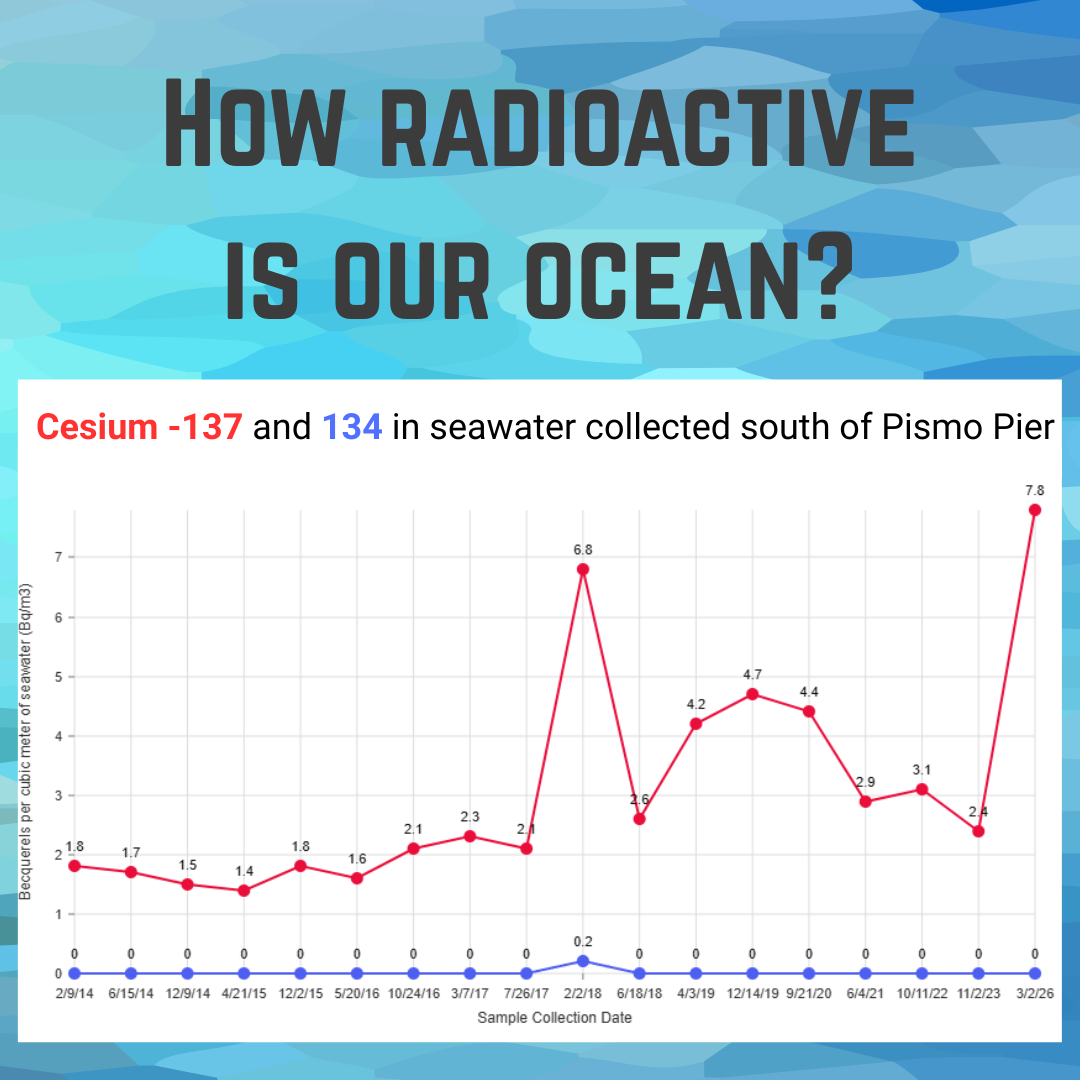
Beginning on February 9, 2014, San Luis Obispo Mothers for Peace (SLOMFP) has been taking 5-gallon samples of seawater at the Pismo Beach Pier and sending that water to the Woods Hole Oceanographic Institute (WHOI) to be tested for cesium-134 and cesium-137. The focus on cesium is because it was one of the most abundant radioactive contaminants released, and some forms can remain in the environment for decades. Cesium-134 has a relatively short half-life of about two years, meaning it decays more quickly and is a strong indicator of recent contamination. In contrast, cesium-137 has a much longer half-life of about thirty years, allowing it to persist in the environment for decades and accumulate over time. 

It is important to note that, prior to massive earthquake and subsequent tsunami in 2011, there were already measurable amounts of radioactive fallout in the ocean from the testing of nuclear weapons that peaked in the 1960s. For cesium-137, levels in Pacific Ocean surface waters were generally below 2.0 Becquerels per cubic meter (Bq/m3). 

As we continued to take samples about every six months, we saw the levels of cesium-137 rise. Between July 2017 and February 2018, the cesium-137 level rose from 2.1 Bq/m3 to 6.8 Bq/m3. Cesium-134 was also detected for the first time. This increase, as well as our finding of cesium-134 in these elevated samples, provided clear evidence that Fukushima contamination had reached our shores. 

We have taken eight samples and sent them to WHOI for testing since 2018. The cesium-137 levels did drop down but not to the same levels they were before the spike. They went from being in the 2s to being in the 4s then began to drop a little more between 2021 and 2023. There was then a gap in sampling between November 2023 and March 2026. The results from March 2026 show a significant increase, with cesium-137 levels rising by 5.4 Bq/m³ compared to the previous sample. This sharp increase raises serious concerns and warrants further investigation. 

Notably, Japan began discharging treated but still radioactive wastewater from Fukushima into the Pacific Ocean on August 24, 2023. The timing of this discharge and the subsequent increase detected in our March 2026 sampling underscores the urgent need for expanded, transparent, and independent monitoring of ocean water along the California coast.

https://mothersforpeace.org/april-2026-how-radioactive-is-our-ocean/

— Mothers for Peace warns legislators that an extension of Diablo Canyon would cost Californians more than $2 Billion

From Mothers for Peace

Mothers for Peace and its allies call on California Governor Newsom, Speaker Rivas and Pro Tem Limón and Legislators to halt backroom negotiations and hold full public hearings before any vote to extend the nuclear plant’s life to 2045.

SAN LUIS OBISPO, CA — A backroom deal is taking shape in Sacramento that could keep the Diablo Canyon Nuclear Power Plant running until 2045—and stick California taxpayers and ratepayers with billions of dollars in costs and risk. Mothers for Peace, along with more than fifty other environmental and consumer organizations, is demanding that any proposal to extend the plant’s operations beyond its agreed-upon 2030 closure date be subject to full public hearings, independent fiscal analysis, and open legislative debate.

The coalition has formally written to Governor Gavin Newsom, Assembly Speaker Robert Rivas, Senate Pro Tem Toni Limón, and members of the California Legislature, warning them not to repeat the closed-door process that generated Senate Bill 846 in 2022. That last-minute deal extended Diablo Canyon’s operational life to 2030 and has already proven financially damaging to Californians.

“We’ve seen this movie before—a last-minute deal and no public input that has Californians left holding the bill, Linda Seeley, Mothers for Peace spokesperson, said. “Extending Diablo Canyon for another 15 years will cost billions more in public funding, create long-term ratepayer obligations, and cause serious safety risks. Californians deserve transparency, not another deal negotiated in the dark,” she added.

The warning from SB 846

Mothers for Peace, which has fought to close Diablo Canyon for more than 50 years, points to SB 846 as a blueprint for what goes wrong when the Legislature operates behind closed doors. The bill was introduced, negotiated, and enacted in the final days of the 2022 legislative session, with no meaningful public review or policy committee deliberation.

The consequences are already severe. The state’s $1.4 billion loan to support Diablo Canyon operations is effectively spent—approximately $1.33 billion has been disbursed directly to PG&E, and there is growing evidence it will never be repaid. To add insult to injury, a University of California, Santa Barbara study released recently, found that PG&E, Diablo Canyon’s owner, inflated the capital upgrade and operational costs used to justify the deal. And SB 846’s failure to reconstitute the plant’s Unitary Tax has left the San Luis Coastal Unified School District with a $10 million budget deficit.

The loan is only the beginning. Layered on top are a $100 million annual management fee paid simply for keeping the plant running, performance payments, volumetric payments projected to yield PG&E an additional $1.4 billion, and a $300 million ratepayer-funded Liquidated Damages Account. Together, these mechanisms represent more than $2 billion in additional public exposure beyond the original loan, while shifting nearly all financial risk away from PG&E and onto ratepayers and taxpayers.

Even with potential federal Department of Energy support, analysts project taxpayers could still be responsible for at least $659 million in unrecovered costs—and this is just through 2030. No estimates are available for the costs beyond that date.

All of this while PG&E posted a record profit of $2.59 billion in 2025—its third consecutive year of record earnings—as California ratepayers already pay some of the highest electricity rates in the nation.

A deal taking shape behind closed doors

Despite the Legislature’s policy committee deadline looming, no bill has been publicly amended to include a Diablo Canyon extension. However, there is still time for a bill to become the vehicle for a deal to include the extension. Alternatively, the extension could emerge as a last-minute trailer bill in the June budget, bypassing policy committees entirely. Both scenarios, the groups argue, would be just as unacceptable as the SB 846 process.

State Sen. Ben Allen, chair of the committee on energy, utilities and communications, expressed concern about a backroom deal. He told KQED: “if there is a need to keep Diablo online, I want to have real frank conversations about what we’re doing to improve clean energy buildout so that we won’t be so reliant on this money pit that requires subsidies by ratepayers statewide, not just PG&E customers.”

Safety and fiscal risks demand open debate

A 15-year extension would also leave unresolved serious safety concerns, including reactor embrittlement, spent nuclear fuel management, and seismic risk as the plant sits on a web of earthquake fault lines.

“SB 846 didn’t just hand PG&E a financial windfall—it stripped away the oversight designed to protect the public. Expedited permitting and curtailed environmental review mean state agencies cannot fully evaluate what they’re approving,” Diane Curran, attorney for Mothers for Peace, said.  These unresolved safety issues—reactor embrittlement, seismic risk, spent fuel with nowhere to go—aren’t just safety concerns. Under this deal’s structure, every one of them is also a financial liability that lands on taxpayers and ratepayers, not PG&E,” Curran explained.

Mothers for Peace is calling on the Legislature to:

  • Hold full policy committee hearings in both chambers on any Diablo Canyon extension proposal.
  • Conduct budget committee review given the detrimental fiscal implications for taxpayers and ratepayers.
  • Commission independent analysis of all safety, environmental, and fiscal risks, including seismic risk, reactor embrittlement, and spent fuel management.
  • Ensure meaningful public participation and transparency before any vote is taken.
  • Reject any last-minute gut-and-amend legislation or end-of-session budget maneuvers that bypass proper deliberation.

“The question before the Legislature is simple: will California once again enter a deal negotiated in the dark that places the financial burden on taxpayers and ratepayers while shielding PG&E from risk? Californians deserve better,” Seeley said.

You can read the full letter to the Legislature here. Along with the letter, a cost fact sheet and report from Rao Konidena were attached.
— 2025 reports on health impacts of living near nuclear power plants

From Mothers for Peace

Before We Extend Diablo Canyon, We Owe Our Children Clear Answers

Those of us who live in San Luis Obispo County take pride in our community. We value clean air, open space, strong schools and a safe place to raise children. That is part of what makes this region special. It is why so many of us chose to live here and why we work to protect what we have.

Which is why repeated public health warnings deserve careful attention — not dismissal.

Concerns about health impacts near Diablo Canyon are not new. A March 2, 2014 report titled “Report on Health Status of Residents in San Luis Obispo and Santa Barbara Counties Living Near the Diablo Canyon Nuclear Reactors” by Joseph Mangano, MPH, MBA, examined cancer and other health indicators in communities closest to the plant. That report identified elevated rates of certain cancers and recommended continued monitoring and further study. More than a decade later, comprehensive long-term health monitoring still has not occurred.

Recent research strengthens those concerns.

In December 2025, Harvard University published a study, “Residential proximity to nuclear power plants and cancer incidence in Massachusetts, USA (2000–2018)”, which examined cancer incidence near nuclear power plants in Massachusetts. Researchers found elevated cancer risks among residents living closer to reactors, particularly older adults, and documented that risk declined with distance. The authors emphasized the importance of continued epidemiologic monitoring as reactors age and licenses are extended.

That study did not focus on California. But its findings reinforce concerns raised here at home.

A peer-reviewed study published November 12, 2025, “Worsening Infant Health in San Luis Obispo County and the Diablo Canyon Nuclear Reactors,” by Joseph Mangano, MPH, MBA, examined long-term local health trends. It found that outcomes once better here than the California average have steadily eroded.

Before Diablo Canyon began operating, our county’s infant mortality rate was 16 percent lower than the state average. Now, that advantage has disappeared. Premature births, once well below the state rate, rose above it. Birth defect rates in recent years were more than double the California average, ranking third highest among large counties. Childhood cancer rates, once significantly lower than statewide levels, have moved closer to them.

These are not one-year spikes. They are long-term trend changes. And they matter because they affect our youngest and most vulnerable residents.

Taken together, the 2014 and 2025 Mangano studies and the recent Harvard findings point in the same direction: communities living near operating nuclear reactors deserve rigorous, transparent and ongoing health evaluation. When warning signals appear across different studies, time periods and states, the responsible response is investigation.

San Luis Obispo County does not fit the profile of a community struggling with the usual drivers of poor birth outcomes. We have relatively low poverty and unemployment, high education and income levels and good access to medical care. Many known risk factors are lower here than statewide. Yet our early-life health advantage has faded.

No one is claiming these findings prove cause and effect. But public health protection does not require absolute proof before asking serious questions, especially when children’s health is involved.

Before any extension moves forward, San Luis Obispo County deserves an independent, site-specific public health assessment conducted transparently and reviewed publicly. That is not anti-nuclear. It is pro-accountability — and it is what our children, grandchildren, great-grandchildren and all future generations deserve. 

If we are considering operating Diablo Canyon for another 20 years, we must first really know what the last 40 years have meant for the health of families who live here. How many premature births, birth defects, childhood and adult cancers are we willing to accept if Diablo Canyon continues running for another twenty years?

https://mothersforpeace.org/2025-reports-on-the-health-impacts-of-living-near-diablo-canyon-nuclear-plant/

— Pine Ridge Uranium is real threat; Trump tries to fast-track Dewey-Burdock uranium project

From Lakota People’s Law Project
April 19, 2026

This [US] administration has put two things on a fast track to destruction. The hot button war over Iran’s uranium destroys peace and prosperity. The rush to mine Black Hills uranium destroys people and the sacred. Both are based on manufactured crisis. Both bypass democratic oversight. Both are moving at the speed of executive commands because if either one slowed down long enough for the people to really weigh in, the answer would be no. 

Congress never authorized the war in Iran. They voted four times so far and failed to stop it. The Lakota people never consented to uranium extraction from treaty land. We’ve fought it for over 20 years and we’re still fighting. 

Today’s fresh Hell we are forced to face down: the Dewey-Burdock uranium project, 50 miles from Pine Ridge, in the aquifer above our reservation. It was just put on Trump’s emergency federal fast-track permitting dashboard with a mere thirty-day review period starting last week.

Watch my video and take action: send your message to Burgum: “Stop fast tracking mining on Native treaty lands.”

The BLM’s draft Environmental Assessment that is supposed to protect the public was prepared under executive pressure to compress review timelines from years to weeks. It defers most of its analysis to a 12-year-old study. The 1868 Fort Laramie Treaty is mentioned zero times. The Programmatic Agreement resolving cultural harm to Lakota sacred sites won’t even be executed until six weeks after the comment period closes. That is not environmental review, that is a forced march.

The fast track to war bypassed Congress. The fast track to extraction bypassed the treaty. In the end, the only force that can sideline this runaway train is the consent of the governed. Here is what you can do right now:

First: Tell Secretary of the Interior Doug Burgum directly. We need him to reverse the Pe’ Sla drilling permit, pull Dewey-Burdock off the fast-track program, and suspend all extractive permits on treaty lands until real consultation and a full environmental review are done. Use our existing action page. It’s fast and easy to make all three demands in one customizable letter to Burgum online here.

Second: Submit a public comment to the BLM on the Dewey-Burdock Environmental Assessment before May 14. See below for a short template message based on our assessment of the real legal failures of this review. Customize it and add your comment to the public record to make a difference when this goes to court.

Remember, the 1868 Fort Laramie Treaty is the law of this land. Emergency orders don’t override it. Executive dashboards don’t override it. Your voice will have the final say. Use it.

Wopila tanka — In solidarity and struggle,
Chase Iron Eyes
Executive Director
Lakota People’s Law Project
Sacred Defense Fund

P.S. Here’s the boiled-down single paragraph template as a starting point to make your public comment submission to the BLM on Dewey-Burdock. It’s short enough for the online form field, and substantive enough to matter legally:

I oppose approval of the Dewey-Burdock Uranium ISR Plan of Operations (DOI-BLM-MT-C040-2026-0009-EA) and urge the BLM to withhold approval until a full, lawful review is completed. This draft Environmental Assessment is legally compromised on multiple grounds: it asks the public to comment before the Programmatic Agreement resolving cultural harm to Lakota sacred sites is executed, inverting the Section 106 process required by the National Historic Preservation Act; it analyzes only 4.2 acres while ignoring the 10,580-acre uranium operation those acres exist to enable, in violation of NEPA’s prohibition on project segmentation; it uses pre-existing groundwater contamination as a reason to minimize further harm to the same aquifer that flows toward Pine Ridge Reservation; and it contains no environmental justice analysis for the Native communities most at risk. The 1868 Fort Laramie Treaty, which governs the United States’ relationship to these lands, is mentioned zero times. I urge the BLM to extend the comment period, prepare a full Environmental Impact Statement, conduct meaningful government-to-government consultation with the Oglala Sioux Tribe, and withhold approval until all legal requirements are met.

https://action.lakotalaw.org/action/black-hills-mining

1868 Fort Laramie Treaty
https://www.archives.gov/milestone-documents/fort-laramie-treaty

— Harvard study: cancer risk may increase with proximity to nuclear power plants

From Harvard T.H. Chan School of Public Health

By Maya Brownstein
December 18, 2025

In Massachusetts, residential proximity to a nuclear power plant (NPP) was associated with significantly increased cancer incidence, with risk declining by distance, according to a new study led by Harvard T.H. Chan School of Public Health.

The study was published Dec. 17 in Environmental Health. It was conducted by researchers in the Department of Environmental Health, including corresponding author Yazan Alwadi, PhD student, and senior author Petros Koutrakis, professor of environmental sciences.

Despite widespread—and potentially expanding—reliance on nuclear power in the U.S., epidemiologic research investigating the health impacts of NPPs remains limited. Meanwhile, the results of studies conducted internationally vary significantly. To broaden the evidence base, the researchers assessed proximity of Massachusetts zip codes to nuclear power plants and 2000-2018 cancer incidence data collected by the Massachusetts Cancer Registry. They controlled for confounders such as air pollution and sociodemographic factors.

The researchers estimated that about 20,600 cancer cases in the state—roughly 3.3% of all the cases included in the study—were attributable to living near an NPP, with risk declining sharply beyond roughly 30 kilometers from a facility. The risk of developing cancer attributable to living near an NPP generally increased with age.

According to the researchers, the findings highlight the importance of acknowledging and addressing nuclear energy’s health impacts, particularly at a time when its expansion is being promoted as a solution to climate change.

Read the study:

Residential proximity to nuclear power plants and cancer incidence in Massachusetts, USA (2000–2018)

https://hsph.harvard.edu/news/cancer-risk-may-increase-with-proximity-to-nuclear-power-plants/

— Webinar: The Impact of Radiation on Health, on the Anniversary of Three Mile Island Disaster – 25 March 2026

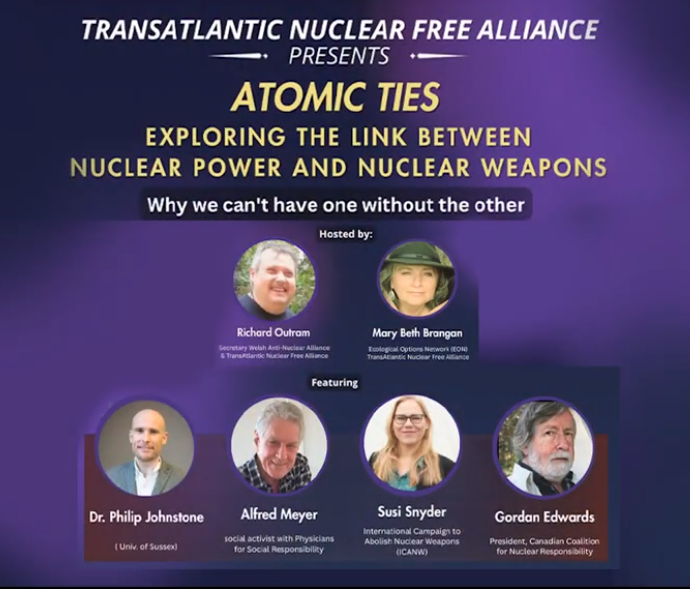
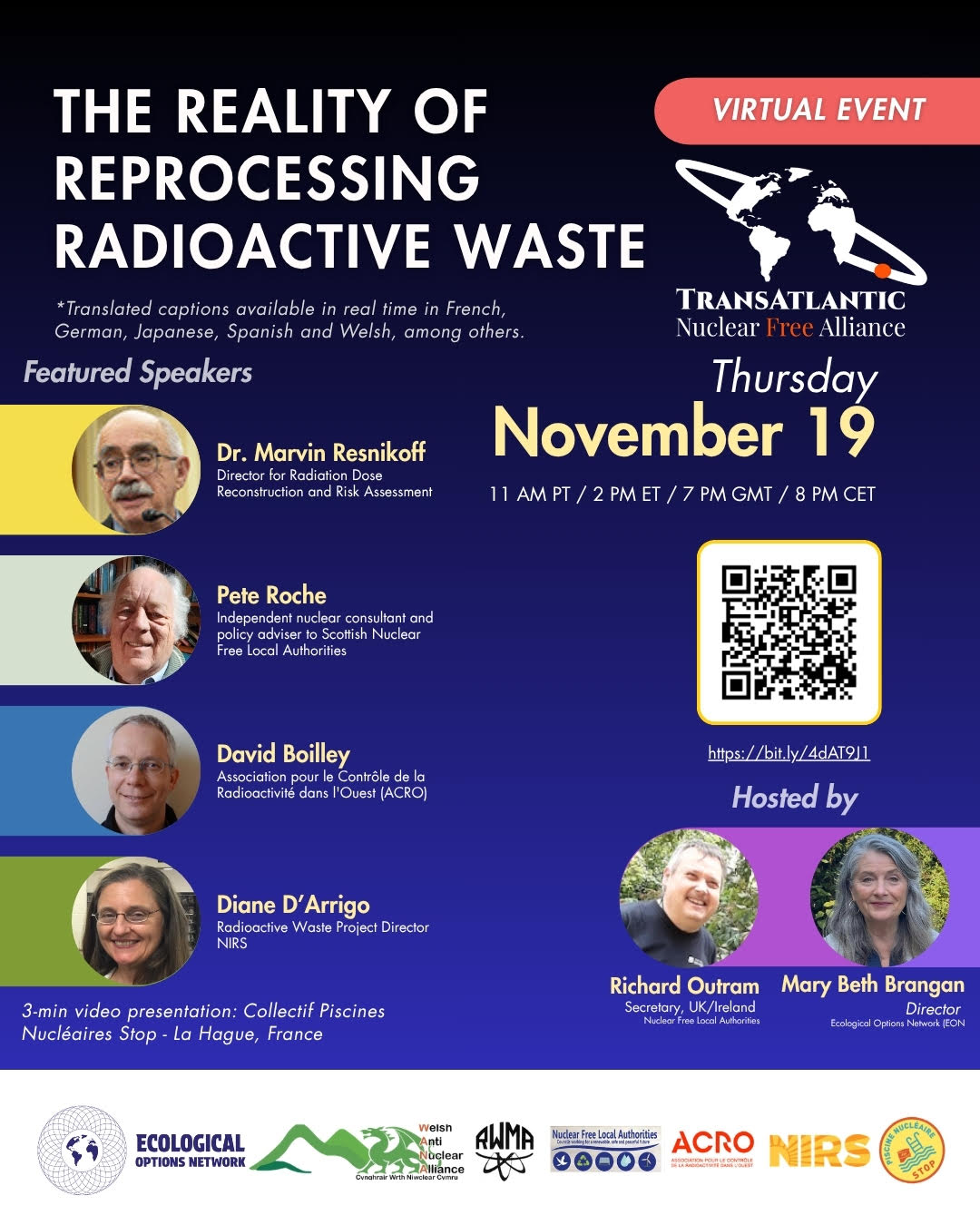
The Transatlantic Nuclear Free Alliance (TNFA) enters 2026, building on our collaboration with Richard Outram, former NFLA/MFP Chapter Secretary, now representing TNFA and the Welsh Anti-Nuclear Alliance (WANA), with a series of global webinars focused on critical issues impacting our local and global communities.

Sign up to watch SOS – The San Onofre Syndrome:  https://forms.gle/4ozqrpfxXYBi4nsd6

25 March 2026 Webinar

Speakers:

  • Mary Olson, Generational Radiation Project (GRIP) USA
  • Eric Epstein, Three Mile Island Alert (TMIA) USA
  • Ian Fairlie, Independent Consultant on Radioactivity in the Environment UK
  • Gordon Edwards, Canadian Coalition for Nuclear Responsibility CAN
  • Richard Outram, Welsh Anti-Nuclear Alliance (WANA) UK
  • Mary Beth Brangan, (moderator) Ecological Options Network USA

Recording and Transcript: View on YouTube here.  (Note: Automatic translation is enabled for subtitles in multiple languages.)

Panelists’ Presentation Slides: Access the panelists’ files here

Learn more or stay connected:
https://www.ianfairlie.org
https://www.radiationproject.org
https://www.tmia.com
https://www.ccnr.org/index.html

Looking Ahead – Please mark your calendars for our upcoming sessions:
July: Exploring the links between nuclear weapons and nuclear power.
November: The folly of reprocessing lethal radioactive waste.

The first webinar focused on the impact of Radiation on Health. The event took place on 25 March 2026, commemorating the 47th Anniversary of the Three Mile Island disaster.

Our distinguished panel of international speakers shared insights into the generational impacts of radioactivity and the current state of environmental safety.We are at an alarming “full circle” moment. With plans to restart Three Mile Island for Big Tech, the question remains: have we truly accounted for the long-term health legacy of 1979?

Join us 47 years later to look at the data the industry overlooks.

— Campaign to stop Diablo Canyon

From Mothers for Peace

NOW IS OUR TIME TO STOP DIABLO CANYON!

Decision-makers are moving quickly to extend operation, and so must we. Join our efforts to protect Central Coast Communities for future generations.

URGENT CHALLENGE

Diablo Canyon nuclear plant was scheduled to retire in 2024 and 2025. However, Senate Bill 846 – passed in 2022 – has enabled extended operation. State and federal subsidies have been granted to support this effort. Pacific Gas & Electric Company has applied to the Nuclear Regulatory Commission for a 20-year license extension, although SB 846 asks for only 5 years.

WE NEED YOUR HELP

Donations are needed to pay for our attorneys, consultants, and expert witnesses. You can make a tax-deductible one-time or monthly donation online or mail checks to: San Luis Obispo Mothers for Peace, PO Box 3608, San Luis Obispo, CA 93403

Tax ID # 95-3080124

Attend meetings and support our efforts. Sign up for our Action Alerts on the Homepage!

WHAT ARE WE DOING?

Mothers for Peace, in collaboration with its partner organizations, is actively opposing extended operation of Diablo Canyon at every opportunity. Our legal team and experts represent us at the:

  • Nuclear Regulatory Commission
  • California Public Utilities Commission
  • California Coastal Commission
  • Regional Water Quality Control Board
  • Diablo Canyon Independent Safety Committee
  • 9th Circuit Court of Appeals

PARTNER ORGANIZATIONS

  • Friends of the Earth
  • Environmental Working Group
  • Samuel Lawrence Foundation
  • Committee to Bridge the Gap
  • Environmental Defense Center

THE ISSUES

The Nuclear Regulatory Commission (NRC) exempted Pacific Gas & Electric Company (PG&E) from its Timely Renewal Rule, disregarding its own rules by approving continued operation of the Diablo Canyon reactors past their expiration dates without the required environmental reviews or opportunity for public hearings.

Unit 1’s reactor vessel was built with faulty material so is vulnerable to embrittlement. An embrittled reactor vessel can shatter like glass and cause a catastrophic meltdown. Despite this, PG&E has not tested for embrittlement for over 20 years – and the NRC has approved the exemptions.

The California Public Utilities Commission has approved extended operation without all the information required by SB 846 – and despite evidence that Diablo’s energy is not needed to avoid summer blackouts. There is new seismic evidence to show that the earthquake faults that run directly under the plant are vertical thrust faults, meaning they could cause much more ground motion than formerly estimated.

Diablo’s Once-Through Cooling System is out of compliance with the Clean Water Act. The facility circulates 2.5 billion gallons of seawater each day, releasing it back into the ocean 20º warmer and killing more than one billion fish in early life stages.

Extended operation of Diablo Canyon means the generation and onsite storage of even more high-level radioactive waste in an active seismic area.

Join our efforts to STOP DIABLO!

More information, brochures, and links at https://mothersforpeace.org/campaign-to-stop-diablo/

— Hunters Point Naval Shipyard, SF — contamination and reports

From Committee to Bridge the Gap

A History of Extensive Radioactivity Use

ON JULY 16, 1945, THE USS INDIANAPOLIS DEPARTED Hunters Point Naval Shipyard carrying components of a bomb code-named “Little Boy,” including half of the highly enriched uranium then in existence in the world. Two hours later, after receiving word that the “Trinity” test of the first nuclear explosion on earth had succeeded earlier that day at Alamogordo, New Mexico, the Indianapolis was allowed to leave San Francisco harbor carrying its cargo to the island of Tinian in the Pacific. On August 6, a plane christened the Enola Gay left Tinian and dropped the assembled atomic bomb on Hiroshima.

About a year later, the nuclear arms race returned to Hunters Point. The first post-war nuclear tests, called OPERATION CROSSROADS, were conducted at the Bikini Atoll in the Marshall Islands in the Pacific, involving 42,000 sailors and more than 240 target and support ships. The tests went badly awry, contaminating the ships. More than 80 of the most contaminated ships, from this and subsequent tests, were brought back for “decontamination” to Hunters Point, then, as now, a predominantly low-income Black community. This process involved sandblasting the radioactivity off the ships in the open air, transferring the contamination from the ships to the surrounding area.

In 1989, Hunters Point was made a Superfund site, listed as one of the most polluted places in the country. Since then, the cleanup has been botched beyond description. CBG, working with Public Employees for Environmental Responsibility, pried out of EPA and made available to the news media EPA documents concluding that the Navy’s contractor had apparently fabricated or otherwise falsified radioactivity measurements at 90-97% of the survey units at the site. $250 million in taxpayer money was wasted; the tests would have to be redone.

CBG has issued a series of detailed reports (which you can find on the column to the left) on the problems at Hunters Point, which have been given significant press attention (e.g., front page of the San Francisco Chronicle, major TV news stories on NBC Bay Area). These studies— based on intensive research by CBG staffers Devyn Gortner, Maria Caine, Taylor Altenbern, Haakon Williams, and Audrey Ford, and a score of interns—disclosed that the problems went far beyond the fabrication of measurements. CBG revealed that radioactivity use at the site was far more extensive than generally realized, with numerous pathways for transporting contamination throughout the entire shipyard and into the neighboring community; that 90% of sites at Hunters Point had not been tested at all; that for those sites that were, 90% of the radionuclides of concern were not tested for. We showed that the cleanup standards employed by the Navy were decades out of date and far, far weaker than current EPA standards, which are required to be used at Superfund sites.

We disclosed that the Navy, after having promised to remove the contamination so that the site could be released for unrestricted residential use, shifted gears and decided to leave much of the contamination and just cover it with thin layers of soil or asphalt. Because the site is planned to be the largest redevelopment project in San Francisco history since the 1906 earthquake, those thin covers will have to be torn up and the contaminated soil beneath them excavated to build the more than 12,000 homes planned, exposing and lofting the contamination into the air. Drs. Howard Wilshire and William Bianchi prepared companion reports that showed that plant roots and burrowing animals would also bring the contamination back to the surface. We have prepared detailed critiques of testing plans by the Navy and the health department showing that they were incapable of detecting contamination at the levels requiring cleanup.

Three quarters of a century after the nuclear arms race set sail from Hunters Point, the toxic legacy remains for that impacted community, a victim of environmental injustice. We will continue our efforts to assist them, as they frankly have no one on their side from the parties responsible—the Navy, its contractors, and the captured regulators. Hunters Point is a striking reminder that the nuclear arms race threatens us globally and locally.

[This is in addtion to the Navy’s nuclear waste dump offshore San Francisco and the radioactive USS Independence which the Navy filled with nuclear waste and sank south of San Francisco, near Half Moon Bay in what is now the Monterey Bay National Marine Sanctuary.]

Hunters Point Reports

Report 1: Hunters Point Naval Shipyard: The Nuclear Arms Race Comes Home – October 2018

Report 2: The Great Majority of Hunters Point Sites Were Never Sampled for Radioactive Contamination — And the Testing That Was Performed Was Deeply Flawed – October 2018

Report 3: Hunters Point Shipyard Cleanup Used Outdated and Grossly Non-Protective Cleanup Standards – October 2018

Report 4: FROM CLEANUP TO COVERUP: How the Navy Quietly Abandoned Commitments to Clean Up Hunters Point Naval Shipyard and is Instead Covering Up Much of the Contamination – August 2019

Companion Reports Issued with Report 4:

Plant Uptake of Radionuclides and Toxic Chemicals from Contaminated Soils Below a Shallow Soil Cover by William Bianchi, PhD, August 2019

Bioturbation, Erosion, and Seismic Activity Make Shallow Soil Covers Ineffective at Isolating Contamination by Howard Wilshire, PhD, August 2019

Additional CBG Hunters Point Critiques:  

Critique of the Navy’s Draft Fifth Five-Year Review – May 2024

Critique of the Navy’s Protectiveness Review of its HPNS Building Cleanup Standards – November 2019

Critique of the Navy’s Protectiveness Review of its HPNS Soil Cleanup Standards – September 2019

Critique of the Navy’s Draft Five Year Review – September 2018

Critique of the California Department of Public Health Work Plan for a Partial Gamma Survey of Parcel A-1 Hunters Point Naval Shipyard – July 2018

Critique of the Work Plan for Retesting of Parcel G Hunters Point Naval Shipyard – August 2018

Critique of the Navy’s Parcel F Proposed Plan for Offshore Sediment Cleanup Hunters Point Naval Shipyard Superfund Site – May 2018

https://www.committeetobridgethegap.org/hunters-point-reports1/

— Implications of Weakening Radiation Protection Standards – Dan Hirsch Presentation to NRC, July 2025

Three days before he died, Dan Hirsch gave this presentation to the NRC.

From Committee to Bridge the Gap

On July 16, 2025, Dan Hirsch, President of Committee to Bridge the Gap, gave a presentation to the NRC about the devastating consequences that would result from abandoning the linear no-threshold model of low-dose radiation exposure. Dan urged the NRC to tighten, not weaken, radiation protection standards.

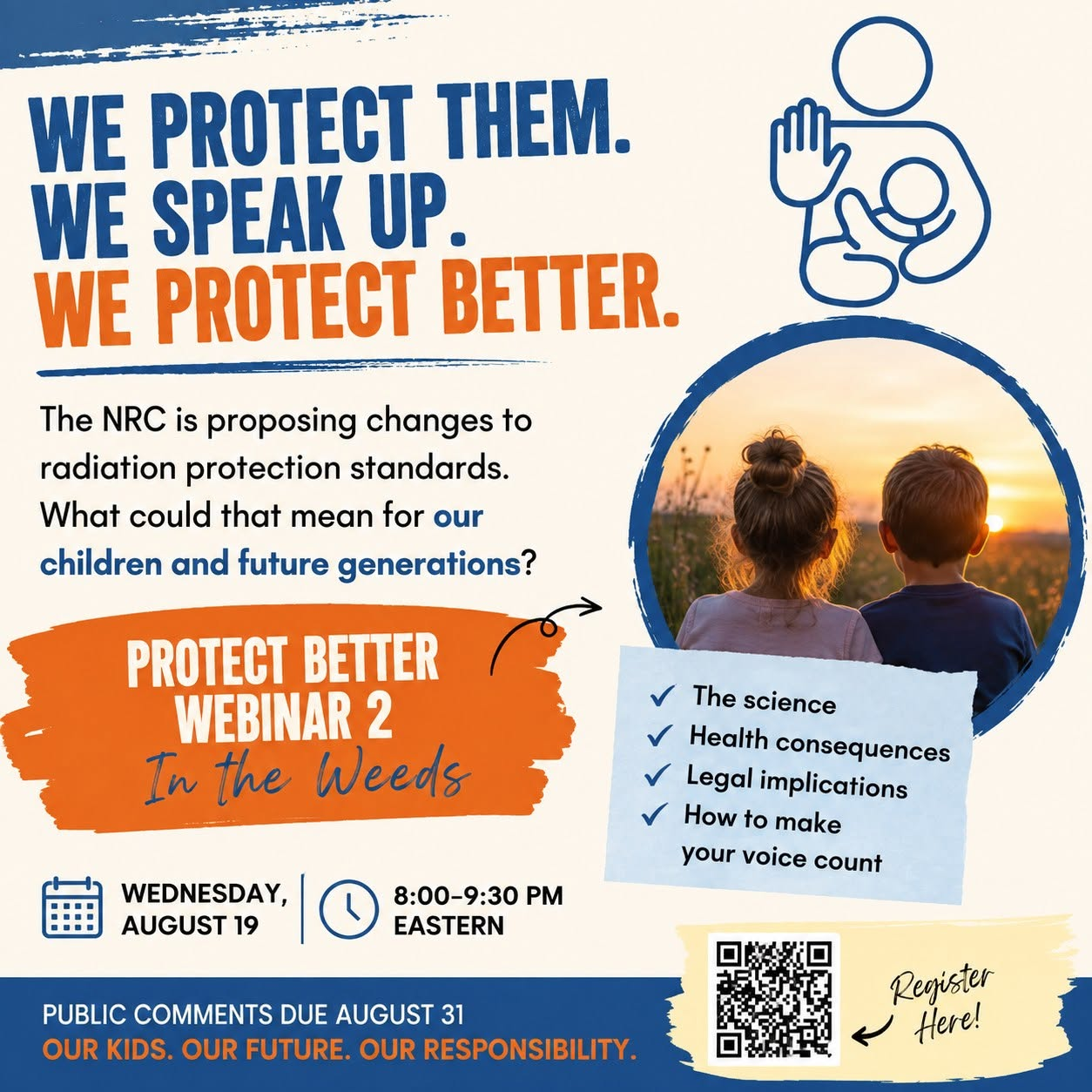
Dan’s presentation was part of NRC’s public meeting to receive public input about President Trump’s Executive Order 14300 Section 5(b), which directs the NRC to “reconsider” its use of the linear no-threshold model of low-dose radiation exposure. The linear no-threshold model has long been the bedrock of radiation protection; without it, the public could be exposed to levels of radiation 100x to 1,000x higher than is allowed today.

Download the slides from Dan’s presentation by clicking here.

In 2021, Dan gave a presentation on a related topic – the long history of underestimating radiation risks – to the National Academies of Science, Engineering, and Medicine. Check out this 2021 presentation by clicking here.

https://www.committeetobridgethegap.org/2025/08/11/implications-of-weakening-radiation-protection-standards-dan-hirsch-presentation-to-nrc/

— September 25: Transatlantic Nuclear-Free Alliance webinar

From SOS: The San Onofre Syndrome

Zoom link to join the discussion:

https://us02web.zoom.us/j/84018027407?pwd=9UbwW3JuJNMPayz5AR7wsqtaz8FR6t.1

Sign up to watch the film for free:

https://docs.google.com/forms/d/e/1FAIpQLSeW5As8dGMLyhTD6XNZSWeWQM5w5FSgbLcm-zu7PM2FBI5MEA /viewform

SOS – The San Onofre Syndrome: Nuclear Power’s Legacy
Ecological Options Network
P.O. Box 1047, Bolinas, CA 94924
415-868-1900 – office