— Taro Yamamoto MP: Defending the rights of Fukushima victims, humanitarian and environmental crisis — debate in Japan’s Parliament (VIDEO)

Global Research, January 01, 2017
Fukushima 311 Watchdogs 14 December 2016
jkllm

Taro Yamamoto of the Liberal Party is a member of the Chamber of Deputies. He is one of the few parliamentary members defending the rights of victims of the TEPCO Fukushima Daiichi nuclear power plant disaster.

The Association Nos Voisins Lointains 3-11 translated the questions of Taro Yamamoto to the Chamber of Deputies’ Special Commission on Reconstruction on 18 November 2016*.

The content of his questions reveals the inhuman situation faced by the victims in the framework of the Japanese government’s return policy .

Taro Yamamoto’s questions (video in Japanese)

See Transcript Below

● Taro Yamamoto

Thank you. I am Taro Yamamoto from the Liberal Party. I would like to ask questions as the representative of a parliamentary group.

Declared on 11 March 2011, the state of nuclear emergency has not yet been lifted to date, 5 years and 8 months after the accident at the TEPCO Fukushima Daiichi nuclear power plant. Today, I will address a subject that is well known by the members here present.

I will start with the subject of the radioactivity controlled area. This is a demarcated area frequented by workers with professional knowledge who are exposed to the risks associated with ionizing radiation, such as an X-ray room, a research laboratory, a nuclear power plant and so on.

Here is my question. There are rules that apply to controlled areas of radioactivity, are not they? Can we eat and drink in such a controlled area?

● Government expert (Seiji Tanaka)

Here is the answer. According to the Ordinance on the Prevention of Risks from Ionizing Radiation**, eating and drinking are prohibited in workplaces where there is a risk of ingesting radioactive substances orally.

● Taro Yamamoto

Of course, it is forbidden to drink or eat there. So it’s obvious that it’s not possible to spend the night there, is it? Even adults cannot stay for more than 10 hours.

You are well aware of the existence of this Ordinance. This is a rule that must be respected in order to protect workers exposed to risks related to ionizing radiation in establishments such as hospitals, research laboratories and nuclear power plants, isn’t it?

It contains the definition of a radioactivity controlled area. This is Article 3 of the Ordinance in File No. 1. It states that if the situation corresponds to the definition described in Article 3/1 or to that specified in Article 3/2, the zone shall be considered as a controlled area and a sign shall be posted there. I will read parts 1 and 2 of this article.

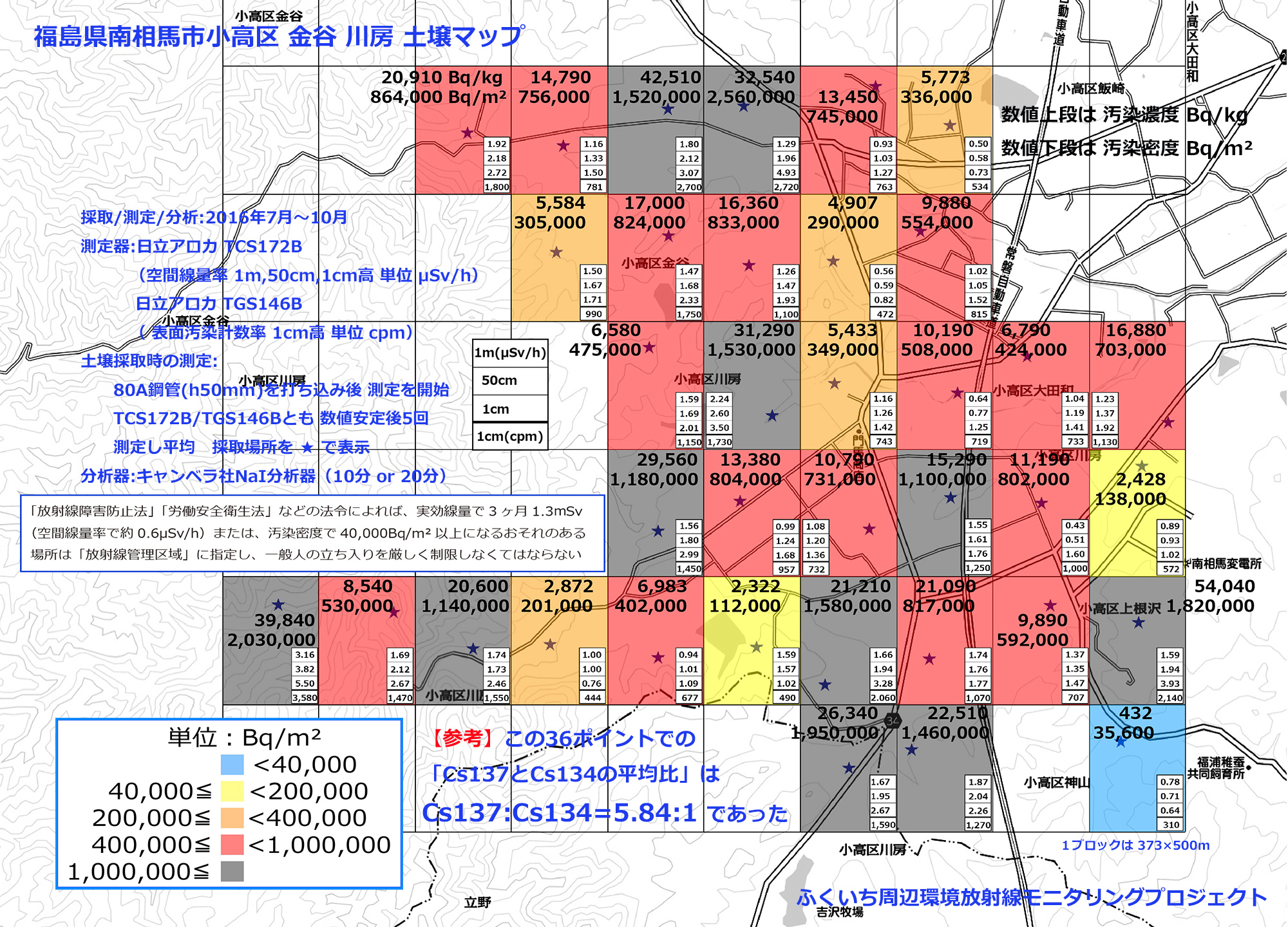
1: The area in which the total effective dose due to external radiation and that due to radioactive substances in the air is likely to exceed 1.3mSv per quarter – over a period of three months! When the dose reaches 1.3mSv over a period of three months, a zone is called “controlled radioactivity zone”.

Part 3/2 refers to the surface density in the attached table.
Here is File No. 2. What will it be if we do the conversion of the density of the surface per m2?

● Government expert (Seiji Tanaka)

The conversion gives 40,000Bq/m2

● Taro Yamamoto

Thus, with 40 000Bq / m2, the zone is classified as a “controlled zone of radioactivity”. It is therefore necessary to monitor not only radioactivity in the air but also the surface contamination, ie the ground dose of radioactive substances, ie other elements in the environment, and to manage the area in order to protect workers from radiation-related risks, isn’t it?

A radioactivity controlled area is defined both by the dose rate of the ambient radioactivity and by the surface density of the radioactive substances. The point is that the risk in a situation where the radioactive substances are dispersed is quite different from that in the situation where the radiation sources are well identified and managed.

At present, the evacuation order applied to the evacuation zones following the nuclear power plant accident is lifted when the ambient radioactivity dose rate becomes less than 20mSv / year.

Here is my question. Concerning contamination, apart from the dose rate of ambient radioactivity, are there any conditions to take into account in order to lift the evacuation order? Please answer yes or no.

● Government expert (Takeo Hoshino)

Here is the answer.

Concerning the conditions necessary for the lifting of the evacuation order, as far as the radioactivity measurements are concerned, it is only the certainty that the annual cumulative dose rate of ambient radioactivity is less than 20 mSv.

● Taro Yamamoto

You did not understand. I asked you to answer yes or no. Are there any other conditions other than the dose rate of ambient radioactivity? To lift the order of evacuation below 20mSv / year, what are the conditions regarding the contamination?

The fact is that regarding contamination, there are no other conditions than the dose rate of the radioactivity in the air. This is abnormal. You, who belong to this Commission, certainly understand to what extent this situation is abnormal.

In the definition of a radioactivity controlled zone, apart from the dose rate of radioactivity in the air, account is taken of the substances dispersed and then deposited, that is to say contamination in the soil etc., which means a criterion of 40 000Bq / m2 is established for surface contamination.

However, in the return policy to return populations to territories where the annual cumulative dose rate is less than 20mSv / year, the condition of soil contamination is not considered necessary.

The latter is not an evaluation criterion, the only criterion used is the dose rate of the ambient radioactivity. Politicians and officials who consider this to be a regular situation do not deserve to receive wages paid from tax revenues.

Our job is to protect the life and property of the people. Now, you lighten those conditions. You create, at your discretion, a rule that is less stringent than that applied to workers with a professional knowledge of radioactivity. What are you doing !

Following the Chernobyl accident, laws have been established in Russia, Belarus and Ukraine, measuring both the dose rate of radioactivity in the air and the contamination of the soil. Why ?

Continue reading

— Beyond Nuclear calls for NRC to name U.S. reactors with potentially defective Areva parts

From Beyond Nuclear
December 28, 2016

Beyond Nuclear is calling for the U.S. Nuclear Regulatory Commission to name the U.S. reactors that might be operating with defective parts imported from France. While potentially affected French reactors have closed down as a safety precaution, the U.S. NRC has refused to even name the affected reactors let alone mandate precautionary closures until the parts are checked. Beyond Nuclear is filing an emergency enforcement 2.206 petition and a Freedom of Information Act Request to demand that the NRC release the full list of reactors with flawed parts; inform the affected reactor communities of the risks; and require the shutdown of reactors with potentially defective reactor components.

As Beyond Nuclear’s Kevin Kamps stated in our press release:“Every one of those potentially defective parts are safety-significant and could lead to meltdown if they fail.”

A Greenpeace France report indentified 19 U.S. reactors at 11 sites that could be operating with defective safety-essential components from Areva’s Le Creusot forge in France. They are:

Prairie Island in Minnesota; North Anna and Surry in Virginia; Three Mile Island in Pennsylvania; Arkansas One in Arkansas; Turkey Point and St Lucie in Florida; DC Cook in Michigan; Salem in New Jersey; Callaway in Missouri; and Millstone in Connecticut. The Crystal River reactor in Florida was also listed but is now permanently closed.

— Ukraine in full-blown collapse: 19 nuclear reactors at risk

The mainstream news claims Russian aggression caused the crisis in Ukraine. The same mainstream news also claims that the Fukushima disaster was a short-lived incident, and neither the Pacific Ocean nor the public have ever been in danger. 
Global Research has a section on Ukraine with extensive documentation on what happened and is still happening. 
Global Research, December 27, 2016
ClubOrlov 22 December 2016

With all the action in Syria, the Ukraine is no longer a subject for discussion in the West. In Russia, where the Ukraine is still a major problem looming on the horizon, and where some 1.5 million Ukrainian refugees are settling in, with no intentions of going back to what’s left of the Ukraine, it is still actively discussed. But for the US, and for the EU, it is now yet another major foreign policy embarrassment, and the less said about it the better.

In the meantime, the Ukraine is in full-blown collapse—all five glorious stages of it—setting the stage for a Ukrainian Nightmare Before Christmas, or shortly after.
Phase 1. Financially, the Ukrainian government is in sovereign default as of a couple of days ago. The IMF was forced to break its own rules in order to keep it on life support even though it is clearly a deadbeat. In the process, the IMF stiffed Russia, which happens to be one of its major shareholders; what gives?

Phase 2. Industry and commerce are approaching a standstill and the country is rapidly deindustrializing. Formerly, most of the trade was with Russia; this is now over. The Ukraine does not make anything that the EU might want, except maybe prostitutes. Recently, the Ukraine has been selling off its dirt. This is illegal, but, given what’s been happening there, the term “illegal” has become the stuff of comedy.

Phase 3. Politically, the Ukrainian government is a total farce. Much of it has been turned over to fly-by-night foreigners, such as the former Georgian president Saakashvili, who is a wanted criminal in his own country, which has recently stripped him of his citizenship. The parliament is stocked with criminals who bought their seat to gain immunity from prosecution, and who spend their time brawling with each other. Prime Minister Yatsenyuk was recently hauled off the podium by his crotch; how dignified is that? He seemed unfazed. Where are his testicles? Perhaps Victoria Nuland over at the US State Dept. is keeping them in a jar. This sort of action may be fun to watch on Youtube, but the reality is quite sad: those who “run” the Ukraine (if the term still applies) are only interested in one thing: stealing whatever is left.

Phase 4. Ukrainian society (if the term still applies) has been split into a number of warring factions. This was, to some extent, inevitable. What happens if you take bits of Poland, Hungary, Romania and Russia, and stick them together willy-nilly? Well, results may vary; but if you also spend $5 billion US (as the Americans did) turning the Ukrainians against Russia (and, since they are mostly Russian, against themselves), then you get a complete disaster.

Phase 5. Cultural collapse is quite advanced. The Ukraine once had the same world-class educational system as Russia, but since independence they switched to teaching in Ukrainian (a made-up language) using nonexistent textbooks. The kids have been taught a bogus history hallucinated by rabid Ukrainian nationalists. They’ve been told that Russia is backward and keeping them back, and that they deserve to be happy in the EU. (Just like the Greeks? Yeah…) But now the population has been reduced to levels of poverty not commonly seen outside of Africa, and young people are fleeing, or turning to gangsterism and prostitution, to merely survive. This doesn’t make for a happy cultural narrative. What does it mean to be “a Ukrainian” now? Expletives deleted. Sorry I asked.

Now, here’s what it all really means. With so much going wrong, the Ukraine has been unable to secure enough natural gas or coal supplies to provide a supply cushion in case of a cold snap this winter. A few weeks of frosty weather will deplete the supply, and then pipes will freeze, rendering much of the urban areas unlivable from then on (because, recall, there is no longer any money, or any industry to speak of, to repair the damage). That seems bad enough, but we aren’t quite there yet.

You see, the Ukraine produces over half of its electricity using nuclear power plants. 19 nuclear reactors are in operation, with 2 more supposedly under construction. And this is in a country whose economy is in free-fall and is set to approach that of Mali or Burundi! The nuclear fuel for these reactors was being supplied by Russia. An effort to replace the Russian supplier with Westinghouse failed because of quality issues leading to an accident. What is a bankrupt Ukraine, which just stiffed Russia on billions of sovereign debt, going to do when the time comes to refuel those 19 reactors? Good question!

But an even better question is, Will they even make it that far? You see, it has become known that these nuclear installations have been skimping on preventive maintenance, due to lack of funds. Now, you are probably already aware of this, but let me spell it out just in case: a nuclear reactor is not one of those things that you run until it breaks, and then call a mechanic once it does. It’s not a “if it ain’t broke, I can’t fix it” sort of scenario. It’s more of a “you missed a tune-up so I ain’t going near it” scenario. And the way to keep it from breaking is to replace all the bits that are listed on the replacement schedule no later than the dates indicated on that schedule. It’s either that or the thing goes “Ka-boom!” and everyone’s hair falls out.

How close is Ukraine to a major nuclear accident? Well, it turns out, very close: just recently one was narrowly avoided when some Ukro-Nazis blew up electric transmission lines supplying Crimea, triggering a blackout that lasted many days. The Russians scrambled and ran a transmission line from the Russian mainland, so now Crimea is lit up again. But while that was happening, the Southern Ukrainian, with its 4 energy blocks, lost its connection to the grid, and it was only the very swift, expert actions taken by the staff there that averted a nuclear accident.

I hope that you know this already, but, just in case, let me spell it out again. One of the worst things that can happen to a nuclear reactor is loss of electricity supply. Yes, nuclear power stations make electricity—some of the time—but they must be supplied with electricity all the time to avoid a meltdown. This is what happened at Fukushima Daiichi, which dusted the ground with radionuclides as far as Tokyo and is still leaking radioactive juice into the Pacific.

And so the nightmare scenario for the Ukraine is a simple one. Temperature drops below freezing and stays there for a couple of weeks. Coal and natural gas supplies run down; thermal power plants shut down; the electric grid fails; circulator pumps at the 19 nuclear reactors (which, by the way, probably haven’t been overhauled as recently as they should have been) stop pumping; meltdown!

If this winter stays very, very warm, then the “19 Fukushimas” scenario just may be averted. This is not impossible: we’ve been seeing one freakishly warm winter after another, and each passing month is setting new records. The future is looking hot—as in very warm. Let us pray that it doesn’t also turn out to be hot—as in radioactive.

— CPUC hearing Dec. 8 on Diablo Canyon “retirement”

From cpuc.ca.gov

Public Workshop Notice:

PG&E’s Application Retirement of Diablo Canyon Power Plant – (A.16-08-006)

December 8, 2016
10 am – 3 pm

California Public Utilities Commission
505 Van Ness Avenue,
Auditorium (Corner of Van Ness Avenue and McAllister Street)
San Francisco, CA 94102

The purpose of this workshop is to:
(1) to get clarification of PG&E’s proposal and the reasoning behind the proposal and how PG&E is determining its planning needs,
(2) to inform the parties of the proposed process for the IRP proceeding in order to determine if some or all replacement procurement should be deferred to IRP, and
(3) to understand PG&E’s proposal and reasoning for their proposed cost allocation, including costs allocated to CCA and DA customers.

For questions about this workshop, please contact Suzanne Casazza at Suzanne.casazza@cpuc.ca.gov or (415) 703-5906

Additional hearings are scheduled:

04/18/17
10:00 a.m.
ALJ Allen Comr Picker
A.16-08-006 (EH) – Application of Pacific Gas and Electric Company for Approval of the Retirement of Diablo Canyon Power Plant, Implementation of the Joint Proposal, And Recovery of Associated Costs Through Proposed Ratemaking Mechanisms (U39E), Commission Courtroom, San Francisco
(Also April 19 – 21 and April 24 – 28)

— 1 meter tsunami at Fukushima reactors; cooling system at Fukushima Daini failed; fears of nuclear waste leakage; more quakes possible

From ENE News
November 21, 2016

Kyodo News, Nov 22, 2016 (emphasis added):  BREAKING NEWS: 1 meter tsunami observed at Fukushima reactors… URGENT: M7.3 quake hits northeastern Japan, tsunami warning issued

NHK, Nov 22, 2016: [Officials] are urging residents of coastal areas to evacuate to higher ground following a powerful earthquake… The Japan Meteorological Agency says the magnitude 7.4 earthquake hit off Fukushima … Heavy swaying could be felt as far away as [Tokyo]…

Japan Times, Nov 22, 2016: An earthquake with a preliminary magnitude of 7.3 off the coast of Fukushima Prefecture rocked widespread areas early Tuesday, triggering tsunami warnings… People have been warned to evacuate immediately to high ground in Fukushima…

NHK, Nov 22, 2016: [An] official Koji Nakamura spoke with reporters after an earthquake with an estimated magnitude of 7.4 struck off the coast of Fukushima… Nakamura said tsunami waves are being observed in various coastal areas, and that damage could occur… He urged residents to flee… Nakamura also warned that another quake of a similar scale could occur within a week, which may also generate a tsunami.

Guardian, Nov 21, 2016: Fukushima: tsunami waves arrive after 7.4 magnitude earthquake… A 60cm (2ft) tsunami was observed at Fukushima’s Onahama Port and a 90cm (3ft) tsunami at Soma… A spokesman for [JMA said] that the tide level was still rising… the Fukushima Daini Reactor 3 cooling system had stopped operating

Bloomberg, Nov 21, 2016: NHK warned bigger tsunami waves could hit the coast. Workers at the Fukushima Dai-Ichi nuclear plant… were evacuated

The Australian, Nov 22, 2016: [The JMA] has just upgraded it to a 7.4… cooling equipment for the spent nuclear fuel pool in the reactor No. 3 of Tepco’s Fukushima No. 2 power plant has stopped‘Please flee immediately’ — An announcer on public broadcaster NHK is urging residents along the coast to move to high ground. “Please flee immediately,” the male voice says, with great urgency… So far, several tsunami waves, the biggest measuring 90 centimetres (three feet) have hit… [JMA says] waves have been “observed offshore and therefore are expected to be higher by the time of arrival in coastal areas’’… Footage of Japanese television appears to show rapid movement of water on the coast. [Tepco] is checking its nuclear plants in Fukushima for damage… Television footage showed ships moving out to sea from Fukushima harbours.

Sydney Morning Herald, Nov 22, 2016: A series of tsunami waves have been observed along the coastline… 60-centimetre tsunami was observed at the Port of Onahama, at Iwaki, Fukushima. NHK said back-wash has been reported at the port, as the sea level decreases for the approach of a tsunami. The second and third waves of the tsunami are likely to be higherthan the first wave, NHK reported. Tsunami waves may reach their maximum height a few hours or more after the initial wave, JMA said.

Yahoo News, Nov 22, 2016: ‘Evacuate immediately’: Tsunami warnings after 7.3 quake hits Japan… A surge about 90 centimetres high was reported at Soma about an hour after the quake. A wave of about 60cm has been recorded at Fukushima, with more expected. Residents near the Fukushima coast have been told to leave. Emergency broadcasters in Japan are warning of a wave of up to three metres, and possibly higher.

KQED, Nov 21, 2016: A major earthquake [has] triggered tsunamis… [JMA] has reported tsunami waves as high as 1.4 meters — about 4 feet — so far.

The Mirror, Nov 21, 2016: Cooling systems at nuclear reactor have FAILED… The breakdown at the Daini plant has sparked fears nuclear waste may leak

RT, Nov 21, 2016: According to the Nuclear Regulatory Agency the cooling system servicing the Unit 3 spent fuel pool is not able to circulate water to cool the nuclear fuel… the system might have been “shaken” during the earthquake, according to nuclear agency officials…

NHK, Nov 22, 2016: Japan’s Prime Minister Shinzo Abe has said the government will do all it can to deal with the effects of a powerful earthquake that struck on Tuesday… He also instructed officials to grasp the extent of the damage and to do their utmost to respond to the disaster.

Watch broadcasts: NHK | Yahoo | Guardian

http://enenews.com/urgent-emergency-at-fukushima-after-rocked-by-m7-4-quake-tsunami-wave-hits-destroyed-nuclear-plants-cooling-systems-at-reactor-failed-prime-minister-we-must-grasp-extent-of-damage-ex


— Tell EPA — Stop dangerous radioactive drinking water

From the Nuclear Information and Research Service

November 21, 2016

In July, thousands of us took action to stop dangerous new radiation guidance for drinking water. The EPA refused to listen, and now this guidance could be approved anytime–unless we act now!

Environmental Protection Agency (EPA) Administrator Gina McCarthy is on the verge of approving radiation levels hundreds and thousands of times higher than currently allowed in drinking water and at cleaned-up Superfund sites. These mis-named “Protective” Action Guides for Drinking Water (Water PAGs)  dramatically INCREASE allowable radioactivity in water. Enormous levels of invisible but deadly radioactive contamination would be permitted in drinking water for weeks, months or even years after a nuclear accident or “incident.” The PAGs are not for the immediate phase after a radioactive release but the next phase–which could last for years–when local residents may return home to contaminated water and not know the danger.

Take action now: Protect drinking water from dangerous radiation levels!

There are two quick actions to take today:

  1. Tell your EPA Regional Administrator (see map and list below) to ask EPA Administrator Gina McCarthy why she is raising radiation levels allowed in drinking water.
  2. Send a message to Administrator McCarthy yourself asking her not to approve these dangerous radiation levels in drinking water.

We have stopped PAGs like these from being approved before–and we can do it again. EPA insiders attempted to push these dangerous guides through in the waning days of the Bush administration, and public pressure like this got the agency to pull them back. Now we have to do it again!

Click here to take action now.

Thanks for all you do!

Diane D’Arrigo
Radioactive Waste Project Director

More Information

The PAGs protect the polluters from liability, not the public from radiation. CHECK out this NBC4 News Story.

These PAGs are a bad legacy. Approving them now is a deceptive way to circumvent the Safe Drinking Water Act, Superfund cleanup levels, and EPA’s history of limiting the allowable risk of cancer to 1 in a million people exposed (or at most 1 in 10,000 in worst-case scenarios).

The PAGs don’t just affect water!

  • They markedly relax long-term cleanup standards.
  • They set very high and outdated radiation levels allowable in food.
  • They eliminate requirements to evacuate people vulnterable to high radiation doses to the thyroid and skin.
  • They eliminate limits on lifetime whole body radiation exposures.
  • And they recommend dumping radioactive waste in municipal garbage dumps not designed for such waste.

Outrageously, EPA is expanding the kinds of radioactive ‘incidents’ that would be allowed to give off these dangerously high levels and doses. PAGs originally applied to huge nuclear disasters like the nuclear power meltdowns at Fukushima or a dirty bomb BUT NOW they could ALSO apply to less dramatic releases from nuclear power reactors or radio-pharmaceutical spills, nuclear transport accidents, fires or any radioactive “incident” that “warrant[s] consideration of protective action.”

EPA REGIONS and REGIONAL ADMINISTRATORS

Region 1 Administrator Curt Spalding
(617) 918-1010
spalding.curt@epa.gov;

Region 2 Administrator Judith Enck
(212) 637-5000
enck.judith@epa.gov

Region 3 Administrator Cecil Rodrigues
(215) 814-2683
Rodrigues.cecil@Epa.gov

Region 4 Administrator Heather McTeer Toney
(404) 562-9900
McTeertoney.heather@Epa.gov

Region 5 Acting Administrator Robert A. Kaplan
(312) 886-3000
Kaplan.robert@Epa.gov

Region 6 Administrator Ron Curry
(214) 665-2100
Curry.ron@Epa.gov

Region 7 Administrator Mark Hague
(913) 551-7006
Hague.mark@Epa.gov

Region 8 Administrator Shaun McGrath
(303) 312-6532
McGrath.shaun@Epa.gov

Region 9 Acting Administrator Alexis Strauss
(415) 947-8000
Strauss.alexis@Epa.gov

Region 10 Administrator Dennis McLerran
(206) 553-1234
mclerran.dennis@epa.gov

For more info, contact Diane D’Arrigo at NIRS: dianed@nirs.org or 301-270-6477

http://org2.salsalabs.com/o/5502/t/0/blastContent.jsp?email_blast_KEY=1378216

http://www.nirs.org

— Vietnam likely to abandon nuclear program

From Sputnik

November 21, 2016

Vietnam may completely abandon its nuclear program during its legislative session, a senior diplomat from one the Association of Southeast Asian Nations (ASEAN) told RIA Novosti Monday.

BANGKOK, November 21 (Sputnik) — Vietnam’s National Assembly is currently deciding on the future of the state’s nuclear program, with the final vote expected at the close of the session on Tuesday. Vietnam has been making moves to suspend nuclear projects in the country, scrapping Russian and Japanese-backed projects over recent weeks. “The decision to suspend the nuclear energy development program has already been taken. Right now the formal wording is being decided on, whether this will be a delay to the schedule of the program or a total rejection of nuclear energy. It appears that the latter is probable,” the diplomat, who had previously served in Vietnam, said.

Global economic turmoil, as well as falling growth rates inside the country, have prompted the Vietnamese government to reconsider its priorities in the energy mix, according to the diplomat, who stressed that this is the official position and is likely to be true.

Russia planned to supply two units for a power plant project in the southern Ninh Thuan province. Its launch was planned for 2020 before Vietnam asked to move the start of construction to that year. In early November, the Vietnamese government announced its decision to withdraw from the contract due to a tight fiscal situation. Vietnam is the latest in a line of several countries to suspend nuclear development in the wake of the 2011 Fukushima Daiichi accident, which led to an ongoing collapse in uranium prices and skepticism in the nuclear industry.

https://sputniknews.com/asia/201611211047666991-vietnam-nuclear-program/

— Tsunami warning issued after 7.3 magnitude earthquake in Japan

From Sputnik

11-22-16 (Japan Time)

Residents near the Fukushima coast are being urged to flee to high ground after a 7.3 magnitude earthquake struck the area early on Tuesday.

The epicenter of the earthquake was approximately 67 kilometers northeast of Iwaki, according to the US Geological Survey.

The Japanese Meteorological Center has warned that there is a risk of a tsunami at any moment. MORE DETAILS TO FOLLOW

https://sputniknews.com/asia/201611221047688394-tsunami-warning-japan-earthquake/

— Germany: “Nightmare” problems with nuclear waste causes public distrust in disposal plan

“There were people who said it wasn’t a good idea to put radioactive waste down here, but nobody listened to them.”
Annette Parlitz, spokeswoman, Federal Office for Radiation Protection (BfS).

From New Scientist

By Fred Pearce in Asse, Germany
January 29, 2016

Major problems at a salt mine where 126,000 drums of radioactive debris are stored are fuelling public distrust of long-term waste disposal plans, reports Fred Pearce from Asse, Germany

Half a kilometre beneath the forests of northern Germany, in an old salt mine, a nightmare is playing out.

A scheme to dig up previously buried nuclear waste is threatening to wreck public support for Germany’s efforts to make a safe transition to a non-nuclear future.

Enough plutonium-bearing radioactive waste is stored here to fill 20 Olympic swimming pools. When engineers backfilled the chambers containing 126,000 drums in the 1970s, they thought they had put it out of harm’s way forever.

But now, the walls of the Asse mine are collapsing and cracks forming, thanks to pressure from surrounding rocks. So the race is on to dig it all up before radioactive residues are flushed to the surface.

It could take decades to resolve. In the meantime, excavations needed to extract the drums could cause new collapses and make the problem worse.

“There were people who said it wasn’t a good idea to put radioactive waste down here, but nobody listened to them,” says Annette Parlitz, spokeswoman for the Federal Office for Radiation Protection (BfS), as we tour the mine.

This is just one part of Germany’s nuclear nightmare. The country is also wrestling a growing backlog of spent fuel.

And it has to worry about vast volumes of radioactive rubble that will be created as all the country’s 17 nuclear plants are decommissioned by 2022 – a decision taken five years ago, in the aftermath of Japan’s Fukushima disaster. The final bill for decommissioning power plants and getting rid of the waste is estimated to be at least €36 billion.

Some 300,000 cubic metres of low and intermediate-level waste requiring long-term shielding, including what is dug from the Asse mine, is earmarked for final burial at the Konrad iron mine in Lower Saxony.

What will happen to the high-level waste, the spent fuel and other highly radioactive waste that must be kept safe for up to a million years is still debated.

Later this year, a Final Storage Commission of politicians and scientists will advise on criteria for choosing a site where deep burial or long-term storage should be under way by 2050.

But its own chairman, veteran parliamentarian Michael Muller, says that timetable is unlikely to be met. “We all believe deep geology is the best option, but I’m not sure if there is enough [public] trust to get the job done,” he says.

Lack of trust

Many anti-nuclear groups are boycotting the commission.

Although they agree Germany must deal with its own waste, they don’t trust the process of choosing a site. They fear that the authorities are secretly fixed on reviving plans for burial at Gorleben, another Lower Saxony salt dome.

Currently, 113 flasks containing high-level waste are housed in a temporary store there.

One flask of high-level waste contains as much radioactivity as 30 Hiroshima bombs,” says Wolfgang Ehmke, who has been a campaigner for 40 years. “We cannot bury this waste here in northern Germany [because] there could be 10 ice ages, with glaciers scraping away the rocks, before the waste is safe.”

The protesters have wide popular support. And the problems at the Asse salt mine have led to further distrust of engineers and their solutions.

The abandoned mine was bought by the German government in 1965, ostensibly to research the suitability of salt domes for disposing of radioactive waste. Yet after two years, without waiting for scientific reports, the authorities secretly turned it into a cheap and supposedly permanent nuclear dump.

By then, 90 per cent of the mine’s 5 million cubic metres of salt had been excavated, and the mine was already buckling under the weight of the rocks above, says Ingo Bautz of the BfS, who oversees activities at the site.

As the walls bent, cracks formed. And because the miners had dug to within 10 metres of the impervious rock, in 1988, underground water started to trickle in.

The true state of affairs only became public knowledge in 2008. Despite hurried backfilling of much of the mine, the degradation continues. Brine seeps in at a rate of around 12,000 litres a day, threatening to flush radioactive material to the surface. “It is a disastrous situation,” says Jochen Flasbarth, state secretary at the Federal Ministry of the Environment.

Painfully slow

In 2011, the BfS ruled that the waste had to be removed. But the task is hard and likely to take decades. Just checking the state of the 13 chambers holding the waste drums is painfully slow. Engineers drilling to reach them through 20 metres of rock don’t know whether the drums have leaked, and of course they cannot risk a release of radioactivity.

Since work started in 2012, just one borehole has been completed into one of the chambers. Engineers say they will need to sink a second shaft and open up big new galleries where the drums can be made safe before they are retrieved.

But exploratory drilling has revealed that the salt dome is not as big as thought, says Bautz.

And unless care is taken to keep clear of the geological barrier, the excavations risk allowing more water in. “We can’t rule out that the mine could flood,” he says. “If that happened, retrieval would be impossible. We would backfill it all.”

Nothing will be moved until at least 2033, says Bautz. Meanwhile the bills keep rising. It costs €140 million a year just to keep the mine safe for work to continue. The final bill will run into many billions.

Is it worth it? Many experts fear that digging up the drums, with consequent risks of radioactive leaks, could create a much greater hazard than leaving them where they are.

A former top official on the project, geochemist Michael Siemann, told the media in 2012 that safe retrieval was unrealistic. “Many people know this, but no one wants to say it.”

“There could be a conflict between protecting future generations and creating risks for today,” Bautz concedes.

Germany may ultimately perform a service to the world if it can pioneer solutions that other nuclear countries may look to in the future, including the UK, which is struggling with its own waste legacy.

But if Germans ever thought that abandoning nuclear power would end their nuclear problems, they couldn’t have been more wrong.

Read more: Waste away: Nuclear power’s eternal problem

Fred Pearce’s costs during the field trip to the mine were paid for by Clean Energy Wire, an independent non-profit media service.

https://www.newscientist.com/article/2075615-radioactive-waste-dogs-germany-despite-abandoning-nuclear-power/

Posted under Fair Use Rules.

Two-headed sharks — “more are turning up worldwide”: National Geographic

Article below. First, a few comments.

“…[W[ild sharks’ malformations could come from a variety of factors, including viral infections, metabolic disorders, pollution, or a dwindling gene pool due to overfishing…” Where is perhaps the single greatest source of mutation — ionizing radiation?

The serious, growing radioactive contamination of the ocean, including from Fukushima, all the nuclear power plants, and nuclear waste dumping in the ocean, is completely missing from that list. That indicates how great the scandal and cataclysm that establishment-linked scientists are trying to hide.

Radiation is only mentioned once in this article, dismissed as a possibility for mutation of a lab-raised shark. But if contaminated water from the ocean is used for the lab tanks, then why wouldn’t radioactivity have caused this mutation since developing organisms are especially vulnerable to very small amounts of toxins?

Note the back and forth between “more mutated fish” and “few and far between”. 

The claim ‘the rates are not higher; it’s because of better detection methods,’ used to soothe the public on so many other issues, is used here as well.

And the massive pollution of the Caribbean by the BP oil spill and the chemicals used in its aftermath are also completely omitted.

This is not science. This is an industry-friendly puff piece to titillate. Overfishing? Ridiculous. And if the ocean is down to that few number of sharks, then the ocean is in a far, far worse state that these people are willing to tell. Reduced ocean life is also a direct symptom of contamination including from Fukushima.

From National Geographic

Two-Headed Sharks Keep Popping Up—No One Knows Why

by Joshua Rapp
November 2016

Scientists are discovering more mutated fish, possibly due to genetic abnormalities from overfishing.

Two-headed sharks may sound like a figment of the big screen, but they exist—and more are turning up worldwide, scientists say.

A few years ago off Florida, fishermen hauled in a bull shark whose uterus contained a two-headed fetus. In 2008, another fisherman discovered a two-headed blue shark embryo in the Indian Ocean.

And a 2011 study described conjoined twins discovered in blue sharks caught in the Gulf of California and northwestern Mexico. Blue sharks have produced the most recorded two-headed embryos because they carry so many babies—up to 50 at at time, says study leader Felipe Galván-Magaña, of the National Polytechnic Institute in Mexico.

Now, Spanish researchers have identified an embryo of an Atlantic sawtail catshark with two heads, according to a new study in the Journal of Fish Biology. While raising sharks for human-health research in the laboratory, a team noticed the unusual embryo in a see-through shark egg.

The catshark embyro was not your average two-headed beast—it’s the first such specimen known from an oviparous shark species, or a shark that lays eggs.

Researchers opened the egg to study the specimen, and study leader Valentín Sans-Coma says it’s unknown whether the deformed animal would have survived. Because it’s the first such conjoined twin found in egg-laying sharks, its likely that such offspring don’t live long enough for people to find them.

Mutation Causes

Two-headed sharks have been few and far between, so it’s tough to know what’s behind the mutations. (See more shark pictures.)

Sans-Coma and colleagues say a genetic disorder seems to be the most plausible cause for the two-headed catshark, since the embryos were grown in a lab among nearly 800 specimens. To the best of their knowledge, the eggs were not exposed to any infections, chemicals, or radiation.

But wild sharks’ malformations could come from a variety of factors, including viral infections, metabolic disorders, pollution, or a dwindling gene pool due to overfishing, which leads to inbreeding, and thus genetic abnormalities. (See “New Diseases, Toxins Harming Marine Life.”)

For another recent study, marine scientist Nicolas Ehemann examined two such specimens: A smalleye smooth-hound shark and a blue shark, found by fishermen off Venezuela’s Margarita Island. The animals, which would not have survived, are the first two-headed sharks found in the Caribbean Sea, according to Ehemann’s research bulletin.

Overfishing to Blame?

Ehemann, a master’s student at the National Polytechnic Institute in Mexico, believes that if the two-headed fetuses are more prevalent in nature, then overfishing is a strong culprit as it may cause the gene pool to shrink.

Galván-Magaña, who authored the 2011 study, doesn’t think two-headed sharks are more common—but rather that there are more scientific journals around to publish accounts.

Galván-Magaña has seen other bizarre sharks, too, including a “cyclops” shark, caught off Mexico in 2011, with a single, functioning eye at the front of its head. The dusky shark fetus’s single eye is the hallmark of a congenital condition called cyclopia, which occurs in several animal species, including people.

Meanwhile, Ehemann says shark deformities are a difficult topic to research because the specimens are so rare.

“I would like to study these things, but it’s not like you throw out a net and you catch two-headed sharks every so often,” he says. “It’s random.”

http://news.nationalgeographic.com/2016/11/sharks-two-headed-oceans-mutations/

Posted under Fair Use Rules.