The seeds from the release of our film, SOS – The San Onofre Syndrome: Nuclear Power’s Legacy, continue to blossom. We are delighted to know it was credited as a key catalyst for the groundbreaking new series of studies by Harvard researcher Dr. Yazan Alwadi.
The Findings: The first study in his series reveals a definite increase in rates of fatal cancers for populations living in proximity to nuclear reactors across the entire U.S., providing hard, actionable data for the public and decision-makers.
Public comments to the Nuclear Regulatory Commission are due August 31.
What kind of world are we leaving our children?
As parents, grandparents, great-grandparents, aunts, uncles, and loved ones, we have a responsibility to protect those who cannot speak for themselves — and those who aren’t even here yet.
The NRC is proposing changes to radiation protection standards that could affect how radiation risks are evaluated and how well workers and communities are protected.
Our children and future generations deserve better protection, not weaker standards.
For our kids. For our grandchildren. For generations we will never meet.
Sponsored by the ProtectBetter campaign of the Stop Radiation Pollution Coalition. Protectbetter.org
Unfortunately, this is wishful thinking. No doubt the BBC reporter was seeking a ‘feelgood’ headline but he was ill-informed. The fact is that nuclear reactors remain dangerous for decades after they have been closed, even with their fuels removed.
This is because closed reactors continue to emit radioactive tritiated water vapour and discharge tritiated liquid water for decades. (Tritium is the radioactive isotope of hydrogen with a half-life of 12.3 years.) Some also emit radioactive gaseous carbon-14 as well. (Carbon 14 is the radioactive isotope of carbon with a half-life of 5,760 years.)
In more detail, official UK emissions data reveal, for example, that the Trawsfynydd nuclear reactor which was closed in 1991 still emitted 13.6 billion Bq of tritium in 2023 more than 32 years later. And the same goes for long-closed reactors at all closed Magnox and AGR stations. Another example is the Canadian NPD reactor at Rolphton, Ontario which was closed in 1988. Five years later, high residual concentrations of tritium up to 82,000 Bq/g were found in its concrete bioshields. The tritium concentration was much higher than the ~300 Bq/g for C-14 – the next highest nuclide (Krasznai, 1993).
Here is a table showing UK emission/discharge data for 2023 (the latest available year) from DEFRA’s annual RIFE report.
(One becquerel (Bq) = one nuclear disintegration per second)
Annual HTO Releases (Bq) from nuclear reactors in 2023 from tables A.1.1 and A1.2 of Appendix 1 of RIFE 29 (2023). GBq/a (billion Bq/a)
Nuclear Station
Year closed
tritiated water vapour
tritiated water
total tritium
Total C-14 gaseous
Winfrith
1995
4.56
0.36 + 0.07
4.99
0.13
Winfrith (waste treatment)
294
N/A
294
–
Berkeley
1989
5.57
0.07
5.6
1.52
Bradwell
2002
6.10
1.2
7.3
0.42
Chapelcross
2004
1,700
nil
1,700
NA
Dungeness A
2006
54.9
1.87
56.8
0.39
*Dungeness B
2018
95.4
1.71
97.1
9.32
Hinkley A
2000
17.2
3.47
20.7
0.53
*Hinkley B
2022
90.9
241
332
0.21
Hunterston A
1989
0.37
–
0.37
0.06
*Hunterston B
2022
95.3
2.85
98.2
21.5
Oldbury
2012
13.5
0.09
13.6
0.65
Sizewell A
2006
18.9
0.26
19.2
340
Trawsfynydd
1991
13.6
3.83
17.4
1.44
Wylfa
2015
52.0
0.06
52.1
0.86
*some fuel still being removed in 2023
Why is tritium (and some C-14) still being emitted from these old reactors?
The short answer is that much tritium (and some C-14) is created in the concrete and metal structures of nuclear reactors during their operating years, which later slowly oozes out for decades.
The longer answer (not widely acknowledged by nuclear utilities) is complicated. During their operating years tritium (H-3) is produced in all nuclear reactors as it is both an activation product and a tertiary fission product. This happens in both water-cooled and gas-cooled reactors. In PWRs and BWRs, tritium from the cooling circuits (in the form of water and water vapour) enters the porous concrete matrices of the reactor shells and their containment structures during the ~30 year lifetimes of the reactors. In Magnox and AGRs, the hydrogen atoms in the hydration water of the chemical constituents of their concrete structures become activated. When all types of reactors are closed, tritium slowly oozes out of their concrete structures and containment shields for decades.
In more detail, the tritium concentrations in closed reactors are due to neutron activation of hydrogen, deuterium and Li-6 impurities in fuels, concrete structures, and metal structures . It also arises from tertiary fission (fission yield 0.01%) and diffusion from high levels of tritium in the cooling water and moderator in HWRs and LWRs (Kim et al, 2008). As stated by Kim ( 2009)
“During the lifetime of nuclear sites tritium becomes incorporated into the fabric of the buildings. When nuclear decommissioning works and environmental assessments are undertaken it is necessary to accurately evaluate tritium activities in a wide range of materials prior to any waste sentencing.”
Conventional computer models unfortunately give unreliable predictions of tritium concentrations in closed reactors. Older neutron codes alone (eg, ORIGEN-1 from Oak Ridge) incorrectly predict tritium levels. As stated by Kim et al (2008)
“Without an appreciation that two forms of tritium exist in concrete reactor bioshields, the H-3 content of samples may be severely underestimated using conventional analytical approaches”.
The two forms are strongly-bound and loosely-bound tritium. The former mainly originates from neutron capture on trace (1 part per 20,000) lithium (Li-6) within mineral phases, and requires temperatures in excess of 700 °C to achieve quantitative recovery. The weakly bound form of tritium can be liberated at significantly lower temperatures (100 °C) as HTO and is associated with dehydration of hydrous mineral components. ”
Kim et al (2008) added
“These findings exemplify the need to develop robust radioactive waste characterization procedures in support of nuclear decommissioning programs”.
These high tritium concentrations diffuse out of concrete only very slowly with diffusion rates through concrete of ~2 cm2 per year (Krasznai, 1993). This is confirmed by the evidence of continued high emissions of tritium from decommissioned reactors decades after their cessation.
Metals
In metals, tritium is retained by absorption of free water in the hydrated surface oxidation layer, by H ingress into bulk metal and also as lattice-bound tritium produced by neutron activation (Nishikawa M et al, 2006).
Croudace et al (2014) also found that significant tritium was incorporated in non-irradiated metals (eg stainless steel and copper), following prolonged exposure to tritiated water vapour (HTO) or tritium/hydrogen gas (HT) in nuclear facilities. In irradiated metals, an additional type of tritium was formed internally through neutron capture reactions. The amount formed depended on the concentration and distribution of trace lithium and boron in the metal. For example, steel containment vessels used for >20 years “exhibit tritium burdens greatly exceeding those predicted by simple gas solution in the parent metal” (Corcoran et al, 2017).
Investigation into the location of, and activity release from, vessel materials indicate the existence of two major tritium sources:- (i) bulk metal where in-depth contamination arises from diffusion/solution; and (ii) a highly active surface layer, responsible for holding the main tritium inventory (Corcoran et al, 2017) .
Conclusions
The conclusions are that closed reactors are not just ugly, redundant, hulks on the landscape: they are dangerous ones too. The public should be alerted to the radioactive emissions from disused reactors. Also nuclear power utilities should re-examine the computer models used to predict nuclide emission rates from disused reactors.
Croudace IW, Warwick PE, and Kim DJ (2014) Using Thermal Evolution Profiles to Infer Tritium Speciation in Nuclear Site Metals: An Aid to Decommissioning Anal. Chem., 2014, 86 (18), pp 9177–9185.
Kim DJ, Warwick PE and Croudace IW (2008) Tritium Speciation in Nuclear Reactor Bioshield Concrete and its Impact on Accurate Analysis. Anal. Chem., 2008, 80 (14), pp 5476–5480. http://pubs.acs.org/doi/abs/10.1021/ac8002787
I’m an independent consultant on radioactivity in the environment living in London UK. I’ve studied radiation and radioactivity at least since the Chernobyl accident in 1986. I’ve a degree in radiation biology from Bart’s Hospital in London and my doctoral studies at Imperial College in London and (briefly) Princeton University in the US concerned the radiological hazards of nuclear fuel reprocessing. I formerly worked as a civil servant on the regulation of radiation risks from nuclear power stations. From 2000 to 2004, I was head of the Secretariat of the UK Government’s CERRIE Committee on internal radiation risks. Since retiring from Government service, I have been a consultant on radiation matters to the European Parliament, local and regional governments, environmental NGOs, and private individuals. My areas of interest are the radiation doses and risks arising from the radioactive releases at nuclear facilities.
From Planetarian Perspectives By Mary Beth Brangan, James Heddle – EON April 10, 2025
Key: Purple = Statewide Bans Green = Bans Repealed Orange = Partial Bans Map source : US Department of Energy.
Attempt to Reverse 1976 Moratorium
[Background: California’s 1976 Nuclear Safeguards Act prohibits new nuclear power plants in California unless there is technology to permanently deal with the lethal and extremely long-lived radioactive waste produced by nuclear reactors.]
Despite multiple earthquake faults surrounding the three California nuclear reactor coastal sites harboring huge amounts of radioactive waste in tsunami zones, with no plan to deal with the tons of waste, a bill has been introduced in the state Assembly to increase nuclear use in our state. This also despite the devastating fires that occur regularly in California increasing the already staggering risks of nuclear reactors and the lethal long lived waste they produce.
Assemblymember Dr. Juaquin Arambula (D – Fresno) with main co-sponsors Assemblymember Diane Dixon (R – Orange) and Assemblymember Josh Hoover (R- Sacramento) introduced AB 305 . It would overturn California’s longstanding nuclear moratorium to allow for the construction of Small Modular Reactors (SMRs).
Nuclear Recidivism – Not Only In California
This is part of a national and international pattern. Recidivist nuclear revival forces have mounted coordinated national rollback efforts on state’s prohibitions on building new nuclear plants. Push for new nuclear build outs is happening through the Governor’s Association, as if it were ALEC. Pro-nuclear consortia are being formed with clusters of 10 states as a group.
On the international level, plans to decommission 7 nuclear plants in Spain, for instance, are also being rolled back. There activists are using our documentary SOS, The San Onofre Syndrome: Nuclear Power’s Legacy, in their efforts to ensure they are shut down and not given extended licenses, such as happened here in California with Diablo Canyon….
As of December 11, 2024, 9 states still had nuclear moratoriums. Four states have already repealed moratoriums that had previously been in place:
Wisconsin (2016)
Kentucky (2017)
Montana (2021)
West Virginia (2022)
Activists in Oregon are mounting a huge fight to protect their moratorium.
We in California must join together to stop the insanity of producing more lethal radioactive waste lasting hundreds of thousands to many millions of years without any idea of how to keep it from ruining all life on earth.
Please Join Others in Taking Action!
Send letters of opposition by Tuesday, April 15!
The bill has just been scheduled for a hearing in the Assembly Natural Resources Committee on April 21; letters are due to the committee by close of business next Tuesday, April 15.
Please send letters to oppose AB 305!
Here is a Sample letter with links on how to submit to the California legislators:
The Honorable Isaac G. Bryan, Chair
Assembly Committee on Natural Resources
1020 N Street, Room 164
Sacramento, CA 95814
Re: AB 305 (Arambula) Oppose
Dear Chair Bryan,
I oppose AB 305 by Assemblymember Arambula. This bill would override California’s wise 1976 Nuclear Safeguards Act, which prohibits new nuclear power plants in California unless there is technology to permanently deal with the lethal and extremely long-lived radioactive waste produced by nuclear reactors.
However, over 80 years after beginning to accumulate this extraordinarily dangerous waste, there exists no technology to adequately deal with it and no permanent repository.
The bill would allow construction and operation of so-called ‘small’ modular nuclear reactors. These reactors, however, are not small and according to research from Stanford University, would produce even more waste per energy unit as current reactors and would be even harder to handle.1
Transporting this lethal waste is exceedingly dangerous and storing it onsite in communities is a huge risk, though this is necessary to eliminate the transportation risk. The waste is highly corrosive and irradiates everything it contacts. Currently used canisters are thin and last only a matter of a few decades before cracking while within them, the irradiated fuel continues to degrade and become more fragile and prone to accidents. Many of the fission products remain lethal for thousands and millions of years, yet must be sequestered from the environment.
Producing more of these radioactive substances, with no technology to protect the environment and population from it, is totally irresponsible. There are other ways to generate electricity far less harmful.
Please vote no on AB 305. Maintain our sensible Nuclear Safeguards Act.
Sincerely,
(your name)
1) “Our results show that most small modular reactor designs will actually increase the volume of nuclear waste in need of management and disposal, by factors of 2 to 30 for the reactors in our case study,” said study lead author Lindsay Krall, a former MacArthur Postdoctoral Fellow at Stanford University’s Center for International Security and Cooperation (CISAC)
Authors: Mary Beth Brangan and James Heddle co-direct EON, the Ecological Options Network.
The multi-award winning EON feature documentary SOS – The San Onofre Syndrome: Nuclear Power’s Legacy, was chosen as the opening film in the 13th annual Global Nonviolent Film Festival, where it also received the Organizers’ Award for ‘BEST ACTUALITY SUBJECT – Feature Documentary’.
SOS has won awards in several other international festivals, and is available for viewing worldwide. The film was produced by Mary Beth Brangan and directed by Brangan, Heddle, and Morgan Peterson, who also served as editor. SOS is a trans-generational family co-creation of two senior filmmakers and a millennial mom with two young daughters.
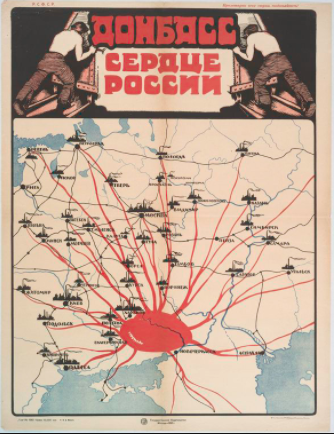
“Donbass, the Heart of Russia.” 1921 poster has two coal miners at top, and the map serves well today to show how suicidal blocking the coal trains was.
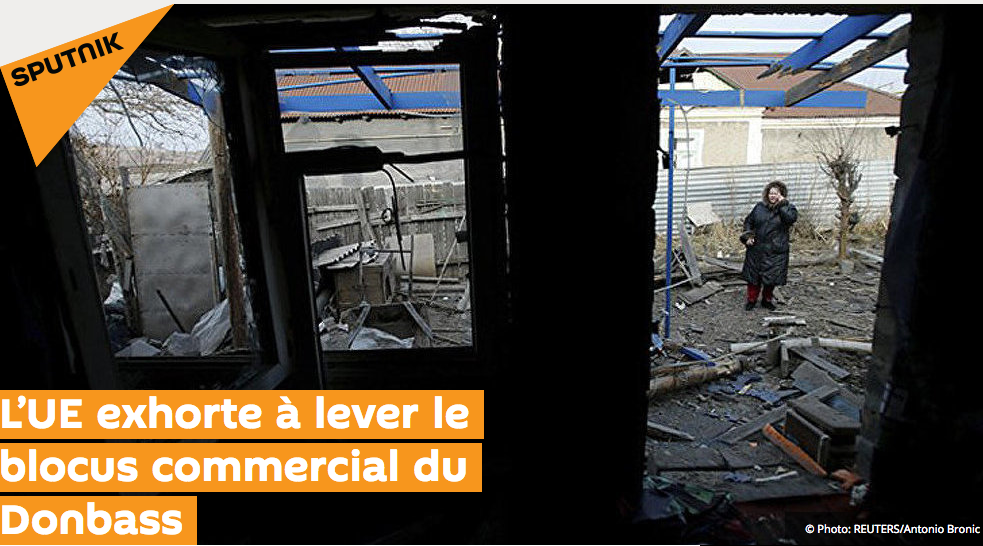
This is Sputnik France’s illustration for this report. “The EU urges lifting the Commercial blockade of Donbass.” And the picture’s hidden label reads “Instead of aid, blockade.”
Faced with the prospect of revolving power outages in Ukraine, the European Union has at last taken note of the commercial blockade of the Donbass, with Kiev no longer receiving the anthracite coal absolutely necessary for the Ukrainian power stations.
The commercial blockade of the Donbass
a) violates the rights of Ukrainians living in the territories that are currently beyond the control of Kiev, and
b) is likely to trigger an energy crisis in the country, warns the representation of the European Union in Ukraine, adding that the organizers of the blockade must immediately lift it.
The blockade of the railway connections with Donbass started at end of January, when a group of veterans of the volunteer battalions participating in the hostilities [on the side of the Kiev regime], with deputies of the Supreme Rada (Ukrainian parliament), blocked traffic on the railway line.
The organizers of the blockade claimed that any trade with the self-proclaimed People’s Republics of Donetsk (DNR) and Lugansk (LNR) was illegal, and that all goods transported were therefore contraband.
The railway blockade has led to problems in getting anthracite coal from the Donbass, causing difficulties in Ukraine’s energy sector. As a result, Kiev is already considering revolving power cuts in most parts of the country.
Articles are in Russian. As they are translated, they will be posted.
From Fort Russ:
Ukrainian energy crisis: state of emergency declared
February 15, 2017 –
– Rusvesna – Translated by James Harmon
The Cabinet of Ministers declared a state of emergency today within the Ukrainian energy system.
The decision was made due to the blockade of coal supplies originating from the Donbass.
“The decision made,” – said Prime Minister Vladimir Groisman, “Due to this coal shortage, is completely artificial and the list of names of people who have done this, know the whole of Ukraine”.
However, Groisman added; “It is unacceptable to make the people of Ukraine suffer simply to fight the government.”
The mainstream news claims Russian aggression caused the crisis in Ukraine. The same mainstream news also claims that the Fukushima disaster was a short-lived incident, and neither the Pacific Ocean nor the public have ever been in danger.
Global Research has a section on Ukraine with extensive documentation on what happened and is still happening.
With all the action in Syria, the Ukraine is no longer a subject for discussion in the West. In Russia, where the Ukraine is still a major problem looming on the horizon, and where some 1.5 million Ukrainian refugees are settling in, with no intentions of going back to what’s left of the Ukraine, it is still actively discussed. But for the US, and for the EU, it is now yet another major foreign policy embarrassment, and the less said about it the better.
In the meantime, the Ukraine is in full-blown collapse—all five glorious stages of it—setting the stage for a Ukrainian Nightmare Before Christmas, or shortly after.
Phase 1. Financially, the Ukrainian government is in sovereign default as of a couple of days ago. The IMF was forced to break its own rules in order to keep it on life support even though it is clearly a deadbeat. In the process, the IMF stiffed Russia, which happens to be one of its major shareholders; what gives?
Phase 2. Industry and commerce are approaching a standstill and the country is rapidly deindustrializing. Formerly, most of the trade was with Russia; this is now over. The Ukraine does not make anything that the EU might want, except maybe prostitutes. Recently, the Ukraine has been selling off its dirt. This is illegal, but, given what’s been happening there, the term “illegal” has become the stuff of comedy.
Phase 3. Politically, the Ukrainian government is a total farce. Much of it has been turned over to fly-by-night foreigners, such as the former Georgian president Saakashvili, who is a wanted criminal in his own country, which has recently stripped him of his citizenship. The parliament is stocked with criminals who bought their seat to gain immunity from prosecution, and who spend their time brawling with each other. Prime Minister Yatsenyuk was recently hauled off the podium by his crotch; how dignified is that? He seemed unfazed. Where are his testicles? Perhaps Victoria Nuland over at the US State Dept. is keeping them in a jar. This sort of action may be fun to watch on Youtube, but the reality is quite sad: those who “run” the Ukraine (if the term still applies) are only interested in one thing: stealing whatever is left.
Phase 4. Ukrainian society (if the term still applies) has been split into a number of warring factions. This was, to some extent, inevitable. What happens if you take bits of Poland, Hungary, Romania and Russia, and stick them together willy-nilly? Well, results may vary; but if you also spend $5 billion US (as the Americans did) turning the Ukrainians against Russia (and, since they are mostly Russian, against themselves), then you get a complete disaster.
Phase 5. Cultural collapse is quite advanced. The Ukraine once had the same world-class educational system as Russia, but since independence they switched to teaching in Ukrainian (a made-up language) using nonexistent textbooks. The kids have been taught a bogus history hallucinated by rabid Ukrainian nationalists. They’ve been told that Russia is backward and keeping them back, and that they deserve to be happy in the EU. (Just like the Greeks? Yeah…) But now the population has been reduced to levels of poverty not commonly seen outside of Africa, and young people are fleeing, or turning to gangsterism and prostitution, to merely survive. This doesn’t make for a happy cultural narrative. What does it mean to be “a Ukrainian” now? Expletives deleted. Sorry I asked.
Now, here’s what it all really means. With so much going wrong, the Ukraine has been unable to secure enough natural gas or coal supplies to provide a supply cushion in case of a cold snap this winter. A few weeks of frosty weather will deplete the supply, and then pipes will freeze, rendering much of the urban areas unlivable from then on (because, recall, there is no longer any money, or any industry to speak of, to repair the damage). That seems bad enough, but we aren’t quite there yet.
You see, the Ukraine produces over half of its electricity using nuclear power plants. 19 nuclear reactors are in operation, with 2 more supposedly under construction. And this is in a country whose economy is in free-fall and is set to approach that of Mali or Burundi! The nuclear fuel for these reactors was being supplied by Russia. An effort to replace the Russian supplier with Westinghouse failed because of quality issues leading to an accident. What is a bankrupt Ukraine, which just stiffed Russia on billions of sovereign debt, going to do when the time comes to refuel those 19 reactors? Good question!
But an even better question is, Will they even make it that far? You see, it has become known that these nuclear installations have been skimping on preventive maintenance, due to lack of funds. Now, you are probably already aware of this, but let me spell it out just in case: a nuclear reactor is not one of those things that you run until it breaks, and then call a mechanic once it does. It’s not a “if it ain’t broke, I can’t fix it” sort of scenario. It’s more of a “you missed a tune-up so I ain’t going near it” scenario. And the way to keep it from breaking is to replace all the bits that are listed on the replacement schedule no later than the dates indicated on that schedule. It’s either that or the thing goes “Ka-boom!” and everyone’s hair falls out.
How close is Ukraine to a major nuclear accident? Well, it turns out, very close: just recently one was narrowly avoided when some Ukro-Nazis blew up electric transmission lines supplying Crimea, triggering a blackout that lasted many days. The Russians scrambled and ran a transmission line from the Russian mainland, so now Crimea is lit up again. But while that was happening, the Southern Ukrainian, with its 4 energy blocks, lost its connection to the grid, and it was only the very swift, expert actions taken by the staff there that averted a nuclear accident.
I hope that you know this already, but, just in case, let me spell it out again. One of the worst things that can happen to a nuclear reactor is loss of electricity supply. Yes, nuclear power stations make electricity—some of the time—but they must be supplied with electricity all the time to avoid a meltdown. This is what happened at Fukushima Daiichi, which dusted the ground with radionuclides as far as Tokyo and is still leaking radioactive juice into the Pacific.
And so the nightmare scenario for the Ukraine is a simple one. Temperature drops below freezing and stays there for a couple of weeks. Coal and natural gas supplies run down; thermal power plants shut down; the electric grid fails; circulator pumps at the 19 nuclear reactors (which, by the way, probably haven’t been overhauled as recently as they should have been) stop pumping; meltdown!
If this winter stays very, very warm, then the “19 Fukushimas” scenario just may be averted. This is not impossible: we’ve been seeing one freakishly warm winter after another, and each passing month is setting new records. The future is looking hot—as in very warm. Let us pray that it doesn’t also turn out to be hot—as in radioactive.
It ended, with no apparent sense of irony, on April Fools’ Day. Obama’s much-heralded ‘Nuclear Security Summit’ came to a close on April 1st in Washington, D.C., having drawn representatives from about 50 countries…minus Russia, which declined to attend citing a “shortage of mutual cooperation” and the exclusion of some of its allies from the invitation list.
Compared to the lofty vision outlined in Obama’s famous 2009 Prague speech of a ‘world without nuclear weapons,’ the POTUS conference marked a sad measure of how far short of his stated intentions his actual accomplishments have fallen.
To be fair, by no means all of that failure can be said to be Obama’s fault. There are many counter-forces.
There’s a global system that profits handsomely from the combined nuclear energy-weapons-waste economy.
There’s a worldwide elite whose members derive much power and privilege from it.
There’s the domestic ‘deep state’ system of the ‘defense and security’ industry with its revolving door to government, which is heavily invested in the permanent war economy.
Then there are the people the President has chosen to surround himself with, some of whom disagree with him and work to undermine his stated policies.
It remains to be seen if the controversial ‘Iran Deal’ will stand as a signature accomplishment of Obama’s tenure. But the facts remain that, despite his boasts that he has ‘reduced’ the U.S. nuclear arsenal, the actual cuts amount to a mere 5% – from 4,950 operational nuclear warheads to 4,700, according to the Federation of American Scientists. As former Defense Secretary William Perry points out, that’s more than enough to destroy the world many times over.
And, as Perry and other former U.S. officials disapprovingly observe, Obama’s plan to spend over $1 trillion to ‘upgrade’ America’s stockpile of nuclear bombs and their delivery systems not only makes their use more likely, but has also triggered a New Arms Race.
Finally, the President’s ‘all of the above’ energy policy treats nuclear energy generation as ‘clean,’ ignoring the massive carbon footprint of the atomic fuel chain that makes uranium essentially a fossil fuel. It also gives massive funding and support to developing a new generation of nuclear reactors, as well as marketing existing U.S. designs world-wide to such clients as warring Arab oil states. https://www.foreignaffairs.com/articles/middle-east/2015-05-25/nuclear-power-people
12 Unspeakable Realities
Those who advocate for nuclear energy as a response to climate change, or for new nuclear weapons in pursuit of ‘national security,’ must ignore or deny an overwhelming burden of facts from the history and legacy of these nuclear technologies so far.
Sen. James Inhofe, S. 2795: “The existing fleet of nuclear reactors in the United States is operating safely and securely.“
From Mining Awareness
April 29, 2016
It is perfectly possible that Inhofe, Booker, Crapo et. al. are simply lazy, stupid and ignorant in pushing a bill (S. 2795) claiming that US nuclear reactors are “operating safely and securely”. Maybe they’ve just observed that the US NRC does exactly what the nuclear industry wants anyway so should indeed have funding cut. It is actually pretty funny that all the workers at US NRC that have sold their soul to the nuclear devil have their jobs on the cutting block anyway. So, the proposal to cut funding to the US NRC is actually pretty funny. Watch and learn before you sell your soul to the devil. However, many NRC workers will just go home to their countries of origin, leaving the children of the American Revolution and others who have no other home stuck with their nuclear crimes. But, why not just totally shut down the US NRC?
http://www.c-span.org/video/?408515-1/hearing-nuclear-energy&start=5937 Why is the entire panel pro-nuclear? Read about them at the bottom of this post. Second from the left is Ashley Finan who works for the so-called “ Clean Air Task Force”, but has promoted the use of nuclear power in the Canadian tar sands industry.
The electrical defects for all but one US nuclear power station are so serious that 7 brave NRC electrical engineers put themselves at risk by demanding something be done immediately. They were ignored. These brave seven were led by an American from India who loves America. And, maybe he’s just smart enough to understand that the world environment is interconnected too.
This claim about the safety and security of US Nuclear Power Stations and push for nuclear deregulation is oddly coming from a Senator (Inhofe) from Oklahoma where there are no operating nuclear power stations, though Oklahoma is the location of the infamous Kerr-McGee site where Karen Silkwood worked.