Decision-makers are moving quickly to extend operation, and so must we. Join our efforts to protect Central Coast Communities for future generations.
URGENT CHALLENGE
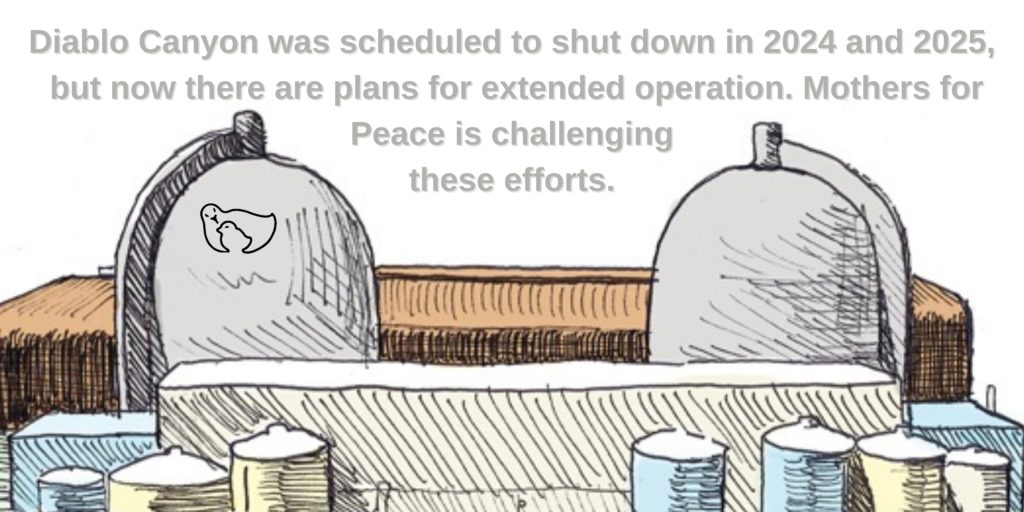
Diablo Canyon nuclear plant was scheduled to retire in 2024 and 2025. However, Senate Bill 846 – passed in 2022 – has enabled extended operation. State and federal subsidies have been granted to support this effort. Pacific Gas & Electric Company has applied to the Nuclear Regulatory Commission for a 20-year license extension, although SB 846 asks for only 5 years.
WE NEED YOUR HELP
Donations are needed to pay for our attorneys, consultants, and expert witnesses. You can make a tax-deductible one-time or monthly donation online or mail checks to: San Luis Obispo Mothers for Peace, PO Box 3608, San Luis Obispo, CA 93403
Tax ID # 95-3080124
Attend meetings and support our efforts. Sign up for our Action Alerts on the Homepage!
WHAT ARE WE DOING?
Mothers for Peace, in collaboration with its partner organizations, is actively opposing extended operation of Diablo Canyon at every opportunity. Our legal team and experts represent us at the:
Nuclear Regulatory Commission
California Public Utilities Commission
California Coastal Commission
Regional Water Quality Control Board
Diablo Canyon Independent Safety Committee
9th Circuit Court of Appeals
PARTNER ORGANIZATIONS
Friends of the Earth
Environmental Working Group
Samuel Lawrence Foundation
Committee to Bridge the Gap
Environmental Defense Center
THE ISSUES
The Nuclear Regulatory Commission (NRC) exempted Pacific Gas & Electric Company (PG&E) from its Timely Renewal Rule, disregarding its own rules by approving continued operation of the Diablo Canyon reactors past their expiration dates without the required environmental reviews or opportunity for public hearings.
Unit 1’s reactor vessel was built with faulty material so is vulnerable to embrittlement. An embrittled reactor vessel can shatter like glass and cause a catastrophic meltdown. Despite this, PG&E has not tested for embrittlement for over 20 years – and the NRC has approved the exemptions.
The California Public Utilities Commission has approved extended operation without all the information required by SB 846 – and despite evidence that Diablo’s energy is not needed to avoid summer blackouts. There is new seismic evidence to show that the earthquake faults that run directly under the plant are vertical thrust faults, meaning they could cause much more ground motion than formerly estimated.
Diablo’s Once-Through Cooling System is out of compliance with the Clean Water Act. The facility circulates 2.5 billion gallons of seawater each day, releasing it back into the ocean 20º warmer and killing more than one billion fish in early life stages.
Extended operation of Diablo Canyon means the generation and onsite storage of even more high-level radioactive waste in an active seismic area.
Update from Mothers for Peace, May 25, 2025: PG&E has now pulled the capsule, but it will take 12-18 months to test the capsule for embrittlement.
From Mothers for Peace March 18, 2025
Diablo Canyon Nuclear Plant Unit 1’s reactor vessel was built with faulty material, so it’s vulnerable to embrittlement. An embrittled reactor vessel can shatter like glass and cause a catastrophic meltdown. Despite this, PG&E has not tested for embrittlement for over 20 years.
PG&E has now committed to removing Capsule B from Unit 1 to test for embrittlement during the upcoming April outage. Previous attempts to remove this capsule have been unsuccessful.
On March 18, 2025, Mothers for Peace sent a letter to the CEO of PG&E, Patti Poppe, setting forth its expectation that Capsule B will finally be removed during this upcoming April outage and subsequently tested for embrittlement so we will learn if it’s safe to operate.
We are compelled to send this letter because of previous failures by PG&E to test the Diablo Canyon Nuclear Plant for embrittlement. We agree with the 9th Circuit Court of Appeals when they state:
We share Petitioners’ concerns about the public health and safety implications of repeatedly postponing Capsule B’s withdrawal. It has been about two decades since PG&E withdrew and tested a surveillance capsule from the Unit 1 reactor vessel—and even longer since a surveillance capsule withdrawn from Unit 1 generated credible data. Although Unit 1’s operating license has now officially expired, the reactor continues to operate under the NRC’s “timely 10 renewal” rule because PG&E has submitted a license renewal application. San Luis Obispo Mothers for Peace, 100 F.4th at 1056–58 (citing 10 C.F.R. § 2.109(b)). Capsule B remains a key source of data for the license renewal period. Under the current schedule, PG&E is slated to remove Capsule B in the spring of 2025 and use it to inform the company’s pending license renewal application for Unit 1. Any further delay in Capsule B’s withdrawal will mean that PG&E lacks a critical data source about the future integrity of the reactor vessel, without which a future license renewal may be subject to legal challenge.
San Luis Obispo Mothers for Peace v. NRC, 2025 U.S. App. LEXIS 1104 at *10 (9th Cir.) January 17, 2025
Background: Read about the Mothers for Peace brief filed in March 2024.
Award-Winning UCLA Earthquake Scientist Files Declaration to the NRC Requesting Shutdown of Diablo Canyon.
SAN LUIS OBISPO, CA – MAY 15, 2025 – A leading earthquake expert has called for the immediate shutdown of California’s last operating nuclear power plant, warning that a proposed decision by the NRC dismissing seismic risks at Diablo Canyon is incomplete and illogical and fails to address significant evidence that seismic risks are too high to meet federal safety standards.
In a formal declaration submitted today to the Nuclear Regulatory Commission (NRC) Petition Review Board (PRB), Dr. Peter Bird, Emeritus Professor of Earth Sciences at UCLA, states that continued operation of the Diablo Canyon Power Plant (DCPP) presents “an unacceptable risk of a serious earthquake-caused accident,” and that the NRC is obligated to shut it down under its own safety guidelines.
Dr. Bird’s declaration criticized the NRC for refusing to open an enforcement proceeding sought a year ago by environmental organizations. Instead, the NRC parroted unsupported and illogical claims by PG&E that the reactors are safe to operate and ignored Dr. Bird’s strong evidence and analysis demonstrating that the risk of an earthquake-caused core damage accident at DCPP is high enough to warrant immediate shutdown under the NRC’s own guidance.
“I continue to hold the view that the risk of a serious earthquake-caused accident at DCPP is unacceptable, and that immediate shutdown is warranted under NRC’s existing guidelines,” wrote Dr. Bird, a globally recognized authority in earthquake modeling with nearly five decades of experience.
Submitted on behalf of petitioners San Luis Obispo Mothers for Peace (SLOMFP), Friends of the Earth (FoE) and the Environmental Working Group (EWG), Dr. Bird’s declaration criticized the NRC for failing to conduct a competent and independent review of “grave concerns regarding the severe risk of an earthquake-induced accident during continued operation of Diablo Canyon nuclear reactors.”
Dr. Peter Bird now serves as Professor of Geophysics and Geology, Emeritus at UCLA with 49 years of experience in seismic activity and earthquake modeling. Holding a doctorate in Geophysics from MIT, Dr. Bird is the founding architect of the Global Earthquake Activity Model (2015).
The Bird declaration to the NRC warns that PG&E’s modeling for seismic activity “assumes that a majority of large earthquakes affecting Diablo Canyon are strike-slip and disregards the significant contribution of thrust faulting earthquake sources under the Diablo Canyon site.”
The nuclear reactors at Diablo Canyon, owned and operated by Pacific Gas & Electric (PG&E), were slated to close in 2024 and 2025 when its operating licenses were set to retire because the plants would eventually become “too expensive to operate” compared to available renewable energy resources. The “Joint Proposal” to shut Diablo Canyon, signed by environmental groups, unions, and PG&E was certified by the CA Public Utilities Commission (CPUC) in 2018. It did not address the unacceptably high risk for a seismic-induced reactor meltdown. However, the reactors’ licenses were extended after California Governor Gavin Newsom brokered a deal with PG&E, offering a $1.4 billion taxpayer-funded subsidy to keep the DCPP operational.
Hallie Templeton, an attorney for FoE, said: “Allowing Diablo Canyon to operate without a competent and independent review of the seismic risks addressed in the petition puts millions of California residents in danger and risks a major radioactive disaster, akin to Fukushima, along the California coast. PG&E can’t say they haven’t been warned.”
Diane Curran, legal counsel for SLOMFP, said: “We are very disappointed with the NRC’s proposed decision to allow DCPP to keep operating without a full review of the significant seismic risk to the reactors. It would be irrational and irresponsible for the NRC to permit PG&E to operate DCPP, especially with an aging and deteriorating Unit 1 reactor vessel, without addressing the concerns brought forward by one of the world’s top seismic experts. Listen to the science!”
Bernadette Del Chiaro, Senior Vice President, California at EWG, said: “The potential environmental and human health consequences of a major radioactive disaster along the California coast, similar to the 2011 Fukushima Daiichi incident, are simply unacceptable. It is imperative that all possible precautions are taken to ensure the structural integrity and operational safety of a nuclear facility located in an area with ‘unacceptable risk of earthquakes. The risks highlighted in the petition warrant an unbiased and expert evaluation to determine the true extent of the potential dangers to Californians. To keep Diablo open without this crucial review would place countless lives in jeopardy.”
In March, Pacific Gas and Electric Company filed an application with the California Public Utilities Commission to recover costs for extended operations at Diablo Canyon — A.25-03-015.
San Luis Obispo Mothers for Peace, et al. v. United States Nuclear Regulatory Commission, et al.
Our attorney, Diane Curran, will be arguing before the Ninth Circuit Court of Appeals in Phoenix, AZ regarding the NRC’s denial of a hearing request for the operating license held by Pacific Gas and Electric Co. for Unit 1 of the Diablo Canyon nuclear plant.
Halloween Fright: Thanks to a trick instead of a treat by Governor Newsom, an aging nuclear monster still haunts the Central Coast of California
November 2 was set to mark the closure of Diablo Canyon Nuclear Power Plant Unit 1, but SB 846 extended the aging reactor’s life through 2030. New data from the Governor’s office on renewable battery storage shows there’s no need for Diablo.
San Luis Obispo, CA — November 2 was meant to deliver a long-expected treat to Californians: the closure of Unit 1 nuclear reactor at Diablo Canyon Nuclear Power Plant on the expiration date of its 40-year license. But thanks to a surprise trick by Governor Gavin Newsom played on the California State Legislature in 2022, the reactor will continue operating indefinitely without critical seismic upgrades and safety tests. The reactor’s owner, Pacific Gas and Electric Co. (PG&E), has also failed to install cooling towers essential to meet Clean Water Act standards for protecting marine life.
Until September 2022, California residents could anticipate the timely closure of Diablo Canyon’s reactors. Under a hard-fought 2016 agreement between PG&E, labor unions, environmental groups, and others, Unit 1 was set to shut down on November 2, 2024, followed by Unit 2 in 2025. But in a last-minute move on September 1, 2022, pressured by the Governor, the State Legislature passed Senate Bill 846, extending Diablo Canyon’s operations to 2030. PG&E, meanwhile, went further, applying for a 20-year license extension—going four times beyond the five years specified in SB 846.
Despite the Governor’s warnings of power outages without Diablo Canyon, no such disruptions have occurred. Even during this past summer’s record-breaking heat waves, California’s energy grid met demand, demonstrating the success of renewable resources and battery storage. This stability shows that California can maintain a reliable grid without a hazardous nuclear plant.
In fact, since the Legislature’s 2022 vote, California has rapidly expanded its renewable capacity. By October 2024, data from the California Energy Commission and Public Utilities Commission showed an estimated capacity of 13,391 MW of battery storage—well above the 2,200 MW produced by Diablo Canyon’s reactors. Touting these gains, the Governor’s office stated on October 15 that this growth of California’s battery storage capacity “marks a 30% increase since April 2024, underscoring the state’s swift progress in building out clean energy infrastructure, especially during a summer marked by record-breaking heat.”
Linda Seeley, spokesperson for Mothers for Peace, remarked: “SB 846 prioritized an unfounded energy need over public health and environmental safety, disregarding both seismic risks and the growing embrittlement of Unit 1’s pressure vessel.” She added, “California has the tools to ensure reliable, clean energy through renewables and battery storage. We don’t need to compromise health and safety to keep the lights on.”
Diane Curran, attorney for the group, stated that both PG&E and the Nuclear Regulatory Commission (NRC) have failed to ensure the safety of the embrittled Unit 1 pressure vessel, a critical safety component that holds the reactor core. “The NRC is also allowing Unit 1 to operate past Nov. 2 despite serious concerns that earthquake faults under Diablo Canyon, which were discovered after it was built, could cause a nuclear accident,” Curran said.
She noted that the group’s concerns have been documented in testimony to state and federal regulators by Dr. Digby Macdonald, Professor Emeritus of nuclear materials science at the University of California and Dr. Peter Bird, Professor Emeritus of Geosciences at UCLA. For a detailed explanation by Dr. Bird of the seismic dangers facing Diablo Canyon, watch the video here.
November 2 should have been the Halloween treat Californians deserved, not the trick we received. When Halloween is over, this monster will continue to loom, threatening the health, safety, environment, and well-being of residents of the Golden State.
Vistra Energy is demolishing part of the former PG&E power plant at Moss Landing in Monterey County, California, and building a large lithium-ion battery storage facility there. According to very credible reports from people that worked for PG&E and GE, GE built a breeder nuclear reactor for PG&E at Moss Landing in the late 1960s. If true, that could pose significant radioactive contamination risks to demolition workers and the surrounding environment. Demolition must be immediately halted.
The public isn’t aware that a nuclear reactor of any type exists or existed at Moss Landing, but according to sources, GE nuclear power division in San Jose designed and built a breeder reactor for PG&E at Moss Landing in 1968, and it began operation in approximately 1969. It was a very expensive reactor, and it was not for power generation. It operated until the mid to late 1970s when it was shut down for unknown reasons. The control room, and possibly the reactor itself, were underneath the #6 or #7 535-foot smoke stacks. There was an access stairwell to the underground reactor control room, with a metal railing surround. After the reactor was shut down, the control room access was still visible.
A former worker at Moss Landing witnessed small planes periodically flying through the steam of the smoke stacks, presumably taking air samples. That person was told the smoke stack emissions were only steam, but any reactor emissions might have been vented out the tall stacks.
When a person who helped build the reactor later went to work for PG&E in the 1980s and inquired about the reactor and how it was functioning, PG&E employees told the person, “It doesn’t exist,” and “Shut the f*** up or you’re finding a new job”. That next weekend, PG&E filled in the access stairwell with concrete and cut off the metal railing at ground level.
One former employee went to Monterey County Planning Department to research if permits had been issued for the reactor and didn’t find any record of permits. In response to FOIA requests, the NRC also did not find any responsive records on the reactor, meaning they have no records or they have no records they will disclose to the public.
A breeder reactor is for the purpose of making plutonium for the military and for nuclear bombs. PG&E and GE operated a breeder reactor together at Vallecitos beginning in 1957. This type of reactor does not produce energy. One source suggested the Moss Landing reactor was to make off-the-books plutonium.
If the reactor existed, it was operated by PG&E at the same time as the company was operating the Humboldt Bay Nuclear Power Plant, called by Science Magazine “the dirtiest of the nation’s power reactors” [1]. It would have had the same safety problems, the same lack of AEC/NRC oversight, and potentially the same high radioactive emissions and contamination to the surrounding area. The area around the power plant and underground, including any control room and ground water, may be highly polluted with radioactive elements including hot particles and plutonium, considered by experts to be the deadliest of poisons, with no safe level of ingestion or inhalation. Contamination would pose hazards to local residents, to the waterways and ocean, to groundwater, to agricultural products, and to workers on the site.
State, federal, and local authorities have been notified of the situation including NRC, DOE, CDC ATSDR, California DTSC, CalEPA, CDPH, Monterey County EHIB, and the Monterey County Board of Supervisors, but to date, they have taken no known steps to investigate the situation or have refused to do so. Nuclear and environmental experts, civic groups, non-profit organizations, and other resources have also been informed about this situation,
Meanwhile, Vistra Energy continues demolishing equipment and buildings at the site.
Action steps needed now:
— Demolition work at Moss Landing by Vistra and other companies must be halted immediately due to the danger to workers and the surrounding environment from possible contaminated equipment and buried radioactive materials, pending an investigation.
— A thorough and public investigation must take place immediately into the complete history of PG&E’s uses and facilities at Moss Landing and the existence and extent of any radioactive contamination there.
— Removal and remediation of any and all contaminated soils and machinery, including excavation, must be undertaken by licensed professionals with full transparency. And any soil and debris already removed must be tracked and dump sites notified of its possible contamination.
— If radioactive gases were vented through the smoke stacks, their level of radioactive contamination must be assessed.
— The risk of fire and explosion of the lithium-ion batteries onsite adds another element of risk to any onsite radioactive contamination and potential dispersal offsite. This may necessitate the shut-down of the battery energy storage facilities until an investigation is completed.
Letter to Sen. Sam Blakeslee Regarding Diablo’s Recertification
by Cindy Sage 23 March 2011
I have some thoughts for you, as you go after Diablo’s recertification.
Let me tell you what it is like to fly from Singapore to Hong Kong to SF and back to SB in one day. Because of catastrophic radiation threats from ‘the safest nuclear reactors in the world’ in Japan.
Our daughter, her husband and 22-month old evacuated from Tokyo last Tuesday to Singapore via Osaka and Shanghai. They’ve lived in Tokyo for two years, and the baby was born there.
I flew to Singapore for a week to help them.
These are thoughts now, about California, coming back home. Flying back over the green hills of SLO and SB counties from San Francisco, you think “we don’t even have 160 miles between us and Diablo”. That is the distance between Tokyo and Fukushima’s Daiichi nuclear plant that now has four reactors in partial meltdown and thousands of spent fuel rods in empty cooling ponds seeping and belching radiation directly into the air and the seawater. The government acknowledges this will likely continue for weeks and months to come. And, the threat of full meltdown of one, or more, of these four reactors and/or the cooling ponds for spent fuel is not ruled out yet.
Tokyo has thirty million people in one city alone that cannot be moved, or properly informed because they will panic and bring further chaos to an overloaded government.
One hundred and sixty miles away is less than one day’s airflow up the SLO and Santa Ynez valleys to major population areas.
Remember the SB fires? Burning upslope and inland by day, and back downslope at night, carrying fire, smoke and ash in an endless zig-zag pattern? Remember only the rain could really stop the fires? In Tokyo, the rain will bring down the radioactivity. During the Gap fire, we sat at Playa Azul at an outdoor table, and the ash fall was so thick it coated the food and floated black in the margaritas. We had to leave the food on the table and go because we couldn’t breathe and couldn’t eat it.
For a week, people in Tokyo prayed that 160 miles was far enough away. Heck, its the distance from Bakersfield to LA, right? I heard that from seriously smart, educated Americans, waiting it out. But events have to unfold, and the chaos involved and unnecessary anguish are heartbreaking for the families. The slow leakage of information that prevents stampeding and improves the government’s ability to control events also sacrifices many in the process.
“Our expectations had a scientific basis, but conditions were exceeded.” VP of TEPCO, Tokyo Electric Power Company, March 23rd, CNN interview.
Based on the now-demonstrated failure of at least four of Japan’s nuclear reactors to withstand ‘design’ events that were calculated on the basis of only one catastrophic failure at a time, we know this kind of thinking is outdated and monumentally risky for California as well. Japan planned for earthquakes, but not multiple, cascading events that ran out of control, prevented planned emergency responses, and caused them to throw away the rule-book in favor of ‘hail mary’ passes like flooding with seawater, one helicopter squirt at a time. Japan’s TEPCO didn’t even realize for a week that they had cooling ponds running dry that held thousands of leaking radioactive spent fuel rods. Because they couldn’t even get into or close to their own plants to survey the damage.
Not until the effort was militarized, and people could be ordered to go into the hot zone did we begin to see the damage, and understand the colossal breaches of containment and destroyed plants and cooling equipment. That is not in the rule-book. They had no response. Now, Daiichi’s reactor 3 in chronic, uncontrollable release-mode, and it contains plutonium as well as radioactive cesium and iodine. The other three reactors are in partial meltdown, and even government press releases say they cannot rule out complete meltdowns as yet.
Japan continues to deal with the aftermath – major aftershocks, continuing loss of power, loss of back-up power, loss of triple-backup power, fires, radioactive meltdown and seepage, intentional steam releases of radioactive materials directly into the air to prevent catastrophic hydrogen buildup, inadvertent radiation releases from explosions that happen on a regular basis anyway, the spreading plume, the hopeful weather patterns carrying the radiation ‘somewhere else’, the inevitable recirculation of radiation back over Tokyo and central Japan, the lack of equipment to properly test air, water, food and the people evacuating the hot zones.
What pieces of information are reliable? What is the subtext of unfolding US Embassy and State Dept and military advisories? What ‘indicators’ do you hold out as the trigger for “what to do next”? Do you wait until the US government moves the USS George Washington aircraft carrier out of Yokohama as happened Monday, because it is SOUTH of Tokyo? Is that a bad sign? Do you wait for the US State Department to issue potassium iodide pills to all employees and their dependents as happened Monday? Or, the radiation is twice the infant limit in Tokyo groundwater as happened Tuesday? If you wait, will the trains and planes be full, and ticket prices quadruple normal fares – effectively prohibiting travel for families with kids? What can you believe? What is hype or spin? What does it mean when the evacuation zones seem to be based more on what the government can handle sheltering people, rather than what the radiation levels should be dictating? You can’t effectively evacuate 30 million people all at once, even if the exposures are extreme and otherwise dictate that it should be done immediately.
Getting, judging, and reacting to incomplete, conflicting and incomprehensible information is an impossible task for people in a crisis, who are also dealing with emergency flights, emergency housing, trains that don’t run, sick babies, traveling spouses, planes that are full, empty store shelves, bank accounts that cannot be accessed due to power outages, overloaded telecom systems that don’t work, aftershocks, grief, fear, passports that can’t be located, cell phones that are cancelled or don’t work in other countries, missed connections in foreign airports where there are no diapers, no food, no sleep, no information, wondering if/when people will not be allowed to fly if they test positive for radiation contamination. When is it too late to evacuate? IF you go back, can you get out again?
People with means and money have nearly insurmountable difficulties. People without means and money simply pray and go into deep denial. They are publicly praised by the government for their fortitude, while they can do nothing but await their fate with stoicism.
A week ago, military dependents and ex-pats in Tokyo working for US, German, French, Spanish and other international corporations were formally advised by their employers it would be prudent to evacuate Tokyo. But, there was no health threat. WHO said so.
Ticket prices skyrocketed in Asian countries. Booking evacuation flights and trains became very difficult to impossible. Families split up. Serviced hotel and apartment units in Hong Kong, Singapore and other flee-zones were snapped up by corporations for evacuated ex-pat families…. the one we stayed in went to 97% occupancy in a week.
These families are now trying to figure out if/when they can return. Hour by hour, day by day, parsing the messages in the media coverage. I did this yesterday. And, all last week. I’m still doing it this morning, by skype. Only uncertainty is certain.
Lessons learned? What I can tell you is that I think Diablo should be shut down now. Period. Taken off-line. The Hosgri fault, and perhaps other unrecognized faults, and the likelihood (not just the remote potential) for major earthquakes, tsunami, loss of cooling systems, and proximity to major population zones are clear indicators now that this plant should be mothballed.
The clear underestimation of design earthquake in the original Diablo design, and the failure to anticipate and provide credible protection against predictable, multiple, cascading natural disasters is basis enough not to recertify, and to take it off-line now. Germany is taking some of its older reactors off-line. Why not California?
We don’t get 30% of our power from nuclear in California. We have other options. Japan does not, so they have to accept rolling blackouts for the foreseeable future. They have to accept the long-term consequences including loss of transportation and public services infrastructure, food and water shortages due to radiation contamination, loss of industrial output, loss of communications, banking, and other vital services, contamination of beef and dairy herds and row crops, and embargos and bans by other countries on the import of leafy green vegetables and dairy products from Japan.
Try that on central coast farmers, ranchers, viticulturists and other growers in the agricultural industry.
Talk to Bakersfield, Fresno and the central Valley growers, too, because they’ll be in the hot zone as well.
Japan doesn’t even have enough meters to measure the safety of food and water. Most people shop everyday for foodstuffs and walk to get there. They have to go outside to live. To re-supply their tiny refrigerators.
When summer comes, can you imagine being inside with your kids, unable to turn on the air conditioning or get fresh air because of radiation contamination? Imagine this in 86 degree weather with 90% humidity?
That is best case, and assumes there is enough power for any air conditioning at all.
PG&E has a similar history of malfeasance and misleading regulators and the public as does TEPCO. The parallels are clear – both utilities have demonstrated failures in maintaining critical infrastructure, conducting required safety tests, and providing honest and timely information to regulators and the public about risks to health and safety. The time for wishful thinking is over.
Sam, you have no idea how comforting it is to know you’ve got the scientific and geotechnical background AND the political position to make this issue a front-burner.
###
Published in the SLO Coast Journal, April 2011
Cindy Sage is an owner of Sage Associates, an environmental consulting firm located in Santa Barbara, California. She is a Research Fellow at Orebro University’s School of Health and Medical Sciences, Department of Oncology, Orebro, Sweden (2008-2010) and Guest Lecturer (2011). Her journal publications appear in Bioelectromagnetics, Biomedicine and Pharmacology, and Reviews on Environmental Health. Her articles have appeared in San Francisco Medicine, the Real Estate Law Journal, Electricity Journal. the German journal Environment•Medicine•Society, the Land Use and Environment Forum of the California Continuing Education of the Bar and has she authored numerous articles on EMF policy and public health issues in contemporary print media. She is an author of the Seletun Scientific Statement (2010), Seletun, Norway. Sage Associates has conducted more than 1000 professional studies since 1982 on projects involving electromagnetic fields (both ELF and RF). Invited presentations have been made in London, Switzerland, Austria, Italy, Canada and the United States and include: the Emergency Conference on the Adequacy of the ICNIRP Public Safety Limits (hosted by Coghill Labs at the Royal Society of London, 2007); the London International Leukemia Conference (2004), conference presentations at the Bioelectromagnetics Society annual meetings (1991 – 2006), the First World Congress on Breast Cancer in Kingston, Ontario, Canada (1997), Witness at the International Hearing and contributor to the Global Action Plan for Breast Cancer (1997), presenter at the Etiology Working Group, National Action Plan for Breast Cancer at the Workshop on Electromagnetic Fields, Light-at-night and Breast Cancer Washington DC (1997), and the National Breast Cancer Coalition Fund Environmental Policy Summit in Washington, DC (1998). She is a full Member of the Bioelectromagnetics Society. Ms. Sage is a founder of the BioInitiative Working Group (2006) and co-editor of the BioInitiative Report; A Rationale for a Biologically-based Public Exposure Standard for Electromagnetic Fields (2007). She is co-chair of the Collaborative for Health and the Environment EMF Working Group.
San Luis Obispo, CA, October 4, 2023 — San Luis Obispo Mothers for Peace (MFP) and Friends of the Earth (FoE) today deplored a decision of the Commissioners of the Nuclear Regulatory Commission (NRC) for demonstrating a complete lack of concern for the safety and security of the people living near the Diablo Canyon Nuclear Power Plant.
Disregarding expert evidence presented by MFP and FoE that the Diablo Canyon Unit 1 pressure vessel is at risk of dangerous embrittlement due to decades of neglect by Pacific Gas and Electric Co. (PG&E) and lax oversight by the NRC technical staff, the Commissioners refused to grant the groups’ hearing request or to order the immediate shutdown of the reactor for comprehensive testing of the reactor vessel’s condition.
Instead, the Commissioners bucked the groups’ shutdown request back to the agency’s technical staff to consider whether to take enforcement action against PG&E.
“We are appalled that the Commissioners are entrusting this important safety review to the same agency staff who for fifteen years has given PG&E repeated extensions of deadlines for essential tests and inspections,” said Diane Curran, attorney for MFP. Curran noted that the groups had intentionally petitioned the Commissioners, as the highest officers of the NRC, to exercise their legal responsibility for oversight of the technical staff.
Nevertheless, the groups vowed to persevere. Hallie Templeton, Legal Director for FoE, said, “We plan to continue our rigorous watchdogging of PG&E and the NRC.” She added, “The Commissioners’ decision has raised a red flag to all of us. Anyone, including California politicians, who thinks the safety of Diablo Canyon can be entrusted to the federal government unquestioningly has just received a big wakeup call.”
Linda Seeley, spokesperson for MFP, renewed the group’s call to the State of California to “go back to the original plan to close Diablo Canyon when it reaches its 40-year operating license limit in 2024 (Unit 1) and 2025 (Unit 2). Enough is enough.”
My Humboldt Diary: A True Story of Betrayal of the Public Trust is a must-read exposé by whistleblower and former nuclear worker Bob Rowen documenting PG&E’s practices at Humboldt Bay Nuclear Power Plant near Eureka, California and retaliation against workers and others who raised safety issues, and the contamination from the plant, still unaddressed today.
“This book — My Humboldt Diary: A True Story of Betrayal of the Public Trust — is more than a telling of the story about PG&E’s Humboldt Bay Nuclear Power Plant. It is Bob Rowen’s account of what happened during his Humboldt Bay ordeal that turned him against nuclear power, caused him to become disenchanted with America’s system of justice, and made him realize how powerful and sinister America’s nuclear juggernaut truly is. His Diary explains why we must not allow even one more nuclear power plant to be built.”
PG&E / U.S. Atomic Energy Commission (predecessor of the Nuclear Regulatory Commission) claimed: “Nuclear energy is safe, clean, and economical.”
The Pacific Gas and Electric Company also claimed: “Everything we’ve done at Humboldt Bay has been in a fishbowl.”
Author Bob Rowen says, “Nothing could be further from the truth!”
“My Humboldt Diary reveals the all too often intertwined nefarious behavior of corporate America and government. It provides historical knowledge for understanding the horrible legacy of the ill-fated Humboldt Bay Nuclear Power Plant. PG&E’s Humboldt Bay nuclear facility cost $33 million to build. The plant operated for a total of 13 years with many shutdowns during its operating life. The cost of decommissioning the plant is now approaching a BILLION dollars with no real end in sight.”




 Heal Fukushima