— Mothers for Peace warns legislators that an extension of Diablo Canyon would cost Californians more than $2 Billion

From Mothers for Peace

Mothers for Peace and its allies call on California Governor Newsom, Speaker Rivas and Pro Tem Limón and Legislators to halt backroom negotiations and hold full public hearings before any vote to extend the nuclear plant’s life to 2045.

SAN LUIS OBISPO, CA — A backroom deal is taking shape in Sacramento that could keep the Diablo Canyon Nuclear Power Plant running until 2045—and stick California taxpayers and ratepayers with billions of dollars in costs and risk. Mothers for Peace, along with more than fifty other environmental and consumer organizations, is demanding that any proposal to extend the plant’s operations beyond its agreed-upon 2030 closure date be subject to full public hearings, independent fiscal analysis, and open legislative debate.

The coalition has formally written to Governor Gavin Newsom, Assembly Speaker Robert Rivas, Senate Pro Tem Toni Limón, and members of the California Legislature, warning them not to repeat the closed-door process that generated Senate Bill 846 in 2022. That last-minute deal extended Diablo Canyon’s operational life to 2030 and has already proven financially damaging to Californians.

“We’ve seen this movie before—a last-minute deal and no public input that has Californians left holding the bill, Linda Seeley, Mothers for Peace spokesperson, said. “Extending Diablo Canyon for another 15 years will cost billions more in public funding, create long-term ratepayer obligations, and cause serious safety risks. Californians deserve transparency, not another deal negotiated in the dark,” she added.

The warning from SB 846

Mothers for Peace, which has fought to close Diablo Canyon for more than 50 years, points to SB 846 as a blueprint for what goes wrong when the Legislature operates behind closed doors. The bill was introduced, negotiated, and enacted in the final days of the 2022 legislative session, with no meaningful public review or policy committee deliberation.

The consequences are already severe. The state’s $1.4 billion loan to support Diablo Canyon operations is effectively spent—approximately $1.33 billion has been disbursed directly to PG&E, and there is growing evidence it will never be repaid. To add insult to injury, a University of California, Santa Barbara study released recently, found that PG&E, Diablo Canyon’s owner, inflated the capital upgrade and operational costs used to justify the deal. And SB 846’s failure to reconstitute the plant’s Unitary Tax has left the San Luis Coastal Unified School District with a $10 million budget deficit.

The loan is only the beginning. Layered on top are a $100 million annual management fee paid simply for keeping the plant running, performance payments, volumetric payments projected to yield PG&E an additional $1.4 billion, and a $300 million ratepayer-funded Liquidated Damages Account. Together, these mechanisms represent more than $2 billion in additional public exposure beyond the original loan, while shifting nearly all financial risk away from PG&E and onto ratepayers and taxpayers.

Even with potential federal Department of Energy support, analysts project taxpayers could still be responsible for at least $659 million in unrecovered costs—and this is just through 2030. No estimates are available for the costs beyond that date.

All of this while PG&E posted a record profit of $2.59 billion in 2025—its third consecutive year of record earnings—as California ratepayers already pay some of the highest electricity rates in the nation.

A deal taking shape behind closed doors

Despite the Legislature’s policy committee deadline looming, no bill has been publicly amended to include a Diablo Canyon extension. However, there is still time for a bill to become the vehicle for a deal to include the extension. Alternatively, the extension could emerge as a last-minute trailer bill in the June budget, bypassing policy committees entirely. Both scenarios, the groups argue, would be just as unacceptable as the SB 846 process.

State Sen. Ben Allen, chair of the committee on energy, utilities and communications, expressed concern about a backroom deal. He told KQED: “if there is a need to keep Diablo online, I want to have real frank conversations about what we’re doing to improve clean energy buildout so that we won’t be so reliant on this money pit that requires subsidies by ratepayers statewide, not just PG&E customers.”

Safety and fiscal risks demand open debate

A 15-year extension would also leave unresolved serious safety concerns, including reactor embrittlement, spent nuclear fuel management, and seismic risk as the plant sits on a web of earthquake fault lines.

“SB 846 didn’t just hand PG&E a financial windfall—it stripped away the oversight designed to protect the public. Expedited permitting and curtailed environmental review mean state agencies cannot fully evaluate what they’re approving,” Diane Curran, attorney for Mothers for Peace, said.  These unresolved safety issues—reactor embrittlement, seismic risk, spent fuel with nowhere to go—aren’t just safety concerns. Under this deal’s structure, every one of them is also a financial liability that lands on taxpayers and ratepayers, not PG&E,” Curran explained.

Mothers for Peace is calling on the Legislature to:

  • Hold full policy committee hearings in both chambers on any Diablo Canyon extension proposal.
  • Conduct budget committee review given the detrimental fiscal implications for taxpayers and ratepayers.
  • Commission independent analysis of all safety, environmental, and fiscal risks, including seismic risk, reactor embrittlement, and spent fuel management.
  • Ensure meaningful public participation and transparency before any vote is taken.
  • Reject any last-minute gut-and-amend legislation or end-of-session budget maneuvers that bypass proper deliberation.

“The question before the Legislature is simple: will California once again enter a deal negotiated in the dark that places the financial burden on taxpayers and ratepayers while shielding PG&E from risk? Californians deserve better,” Seeley said.

You can read the full letter to the Legislature here. Along with the letter, a cost fact sheet and report from Rao Konidena were attached.

— Gov. Gavin Newsom tricked California, voided November 2 shutdown at harmful, aging Diablo Canyon

From Mothers for Peace

FOR IMMEDIATE RELEASE

Media Contacts:

  • Linda Seeley: Mothers for Peace, lindaseeley@gmail.com
  • Diane Curran: Harmon, Curran, Spielberg, & Eisenberg, dcurran@harmoncurran.com

October 31, 2024

Halloween Fright: Thanks to a trick instead of a treat by Governor Newsom, an aging nuclear monster still haunts the Central Coast of California 

November 2 was set to mark the closure of Diablo Canyon Nuclear Power Plant Unit 1, but SB 846 extended the aging reactor’s life through 2030. New data from the Governor’s office on renewable battery storage shows there’s no need for Diablo.

San Luis Obispo, CA — November 2 was meant to deliver a long-expected treat to Californians: the closure of Unit 1 nuclear reactor at Diablo Canyon Nuclear Power Plant on the expiration date of its 40-year license. But thanks to a surprise trick by Governor Gavin Newsom played on the California State Legislature in 2022, the reactor will continue operating indefinitely without critical seismic upgrades and safety tests. The reactor’s owner, Pacific Gas and Electric Co. (PG&E), has also failed to install cooling towers essential to meet Clean Water Act standards for protecting marine life.

Until September 2022, California residents could anticipate the timely closure of Diablo Canyon’s reactors. Under a hard-fought 2016 agreement between PG&E, labor unions, environmental groups, and others, Unit 1 was set to shut down on November 2, 2024, followed by Unit 2 in 2025. But in a last-minute move on September 1, 2022, pressured by the Governor, the State Legislature passed Senate Bill 846, extending Diablo Canyon’s operations to 2030. PG&E, meanwhile, went further, applying for a 20-year license extension—going four times beyond the five years specified in SB 846.

Despite the Governor’s warnings of power outages without Diablo Canyon, no such disruptions have occurred. Even during this past summer’s record-breaking heat waves, California’s energy grid met demand, demonstrating the success of renewable resources and battery storage. This stability shows that California can maintain a reliable grid without a hazardous nuclear plant.

In fact, since the Legislature’s 2022 vote, California has rapidly expanded its renewable capacity. By October 2024, data from the California Energy Commission and Public Utilities Commission showed an estimated capacity of 13,391 MW of battery storage—well above the 2,200 MW produced by Diablo Canyon’s reactors. Touting these gains, the Governor’s office stated on October 15 that this growth of California’s battery storage capacity “marks a 30% increase since April 2024, underscoring the state’s swift progress in building out clean energy infrastructure, especially during a summer marked by record-breaking heat.” 

Linda Seeley, spokesperson for Mothers for Peace, remarked: “SB 846 prioritized an unfounded energy need over public health and environmental safety, disregarding both seismic risks and the growing embrittlement of Unit 1’s pressure vessel.” She added, “California has the tools to ensure reliable, clean energy through renewables and battery storage. We don’t need to compromise health and safety to keep the lights on.” 

Diane Curran, attorney for the group, stated that both PG&E and the Nuclear Regulatory Commission (NRC) have failed to ensure the safety of the embrittled Unit 1 pressure vessel, a critical safety component that holds the reactor core. “The NRC is also allowing Unit 1 to operate past Nov. 2 despite serious concerns that earthquake faults under Diablo Canyon, which were discovered after it was built, could cause a nuclear accident,” Curran said. 

She noted that the group’s concerns have been documented in testimony to state and federal regulators by Dr. Digby Macdonald, Professor Emeritus of nuclear materials science at the University of California and Dr. Peter Bird, Professor Emeritus of Geosciences at UCLA. For a detailed explanation by Dr. Bird of the seismic dangers facing Diablo Canyon, watch the video here.  

November 2 should have been the Halloween treat Californians deserved, not the trick we received. When Halloween is over, this monster will continue to loom, threatening the health, safety, environment, and well-being of residents of the Golden State.

##

https://mothersforpeace.org/october-31-2024-halloween-fright/

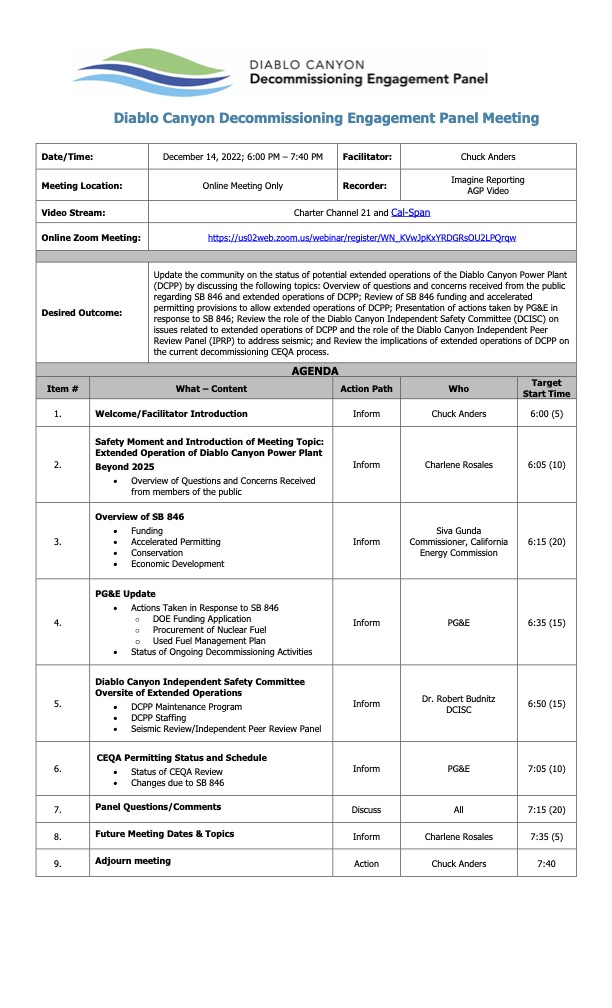
— December 14, 2022, Diablo Canyon Decommissioning Engagement Panel meeting

The Diablo Canyon Decommissioning Engagement Panel (DCDEP) hosted an informational online webinar on Wednesday, December 14, 2022 to update the community on the status and proposed schedule for the continued operation of the Diablo Canyon Power Plant (DCPP) and implications on decommissioning activities, such as, repurposing, land use, and environmental permitting.  The online meeting included presentations by PG&E, the California Energy Commission and the Diablo Canyon Independent Safety Committee.  Members of the community submitted questions and concerns prior to the meeting.  In preparation for the meeting, PG&E prepared a brief summary of SB 846 and the status of activities relating to the extended operation of DCPP.diablocanyonpanel(dot)org/wp-content/uploads/2022/11/SB-846-PGE-Summary-11_23_22.pdf

View meeting agenda, meeting recording and presentation materials —
diablocanyonpanel(dot)org/2022-panel-meetings/#12-14-22-panel-mtg

– – – –

From Mothers for Peace SLO prior to the meeting —

Topics include: review of SB 846 funding and accelerated permitting provisions to allow for extended operations; actions already taken by PG&E; the role of the Diablo Canyon Independent Safety Committee; the role of the Diablo Canyon Independent Peer Review Panel to address seismic issues; and implications of extended operations on the current decommissioning CEQA process.

No public comment will be allowed, but you may submit written comments at any time [to the Panel].
diablocanyonpanel[dot]org/submit-comment/

Talking Points:

  • There is supposedly a list being developed of deferred maintenance projects and the associated estimated costs. Who is participating in the compilation of this list? When will it be available to the public? Who will oversee these projects?
  • There is much controversy over the seismic safety of Diablo Canyon. What agency(ies) is/are responsible for the independent analysis of seismic dangers? How and when will the public be informed of the findings?
  • Explain the plans for how the high level radioactive waste will be stored as a result of the proposed extended operation. How will the fuel pools and the Independent Spent Fuel Storage Installation be managed? 
  • SB 846 allows 5 years of extended operation. But the 2018 agreement to shutter the reactors in 2024 and 2025, signed and approved by the CPUC and the NRC, was ignored and reversed. What assurance does the public have that the plant would operate for 5 additional years and no more?

PG&E’s Summary of SB 846 and the status of activities relating to extended operation
diablocanyonpanel(dot)org/wp-content/uploads/2022/11/SB-846-PGE-Summary-11_23_22.pdf

https://mothersforpeace.org/december-14-2022-meeting-of-the-diablo-canyon-decommissioning-engagement-panel/