— Mortality events are becoming larger, but most are unstudied, uncounted; scientists have never seen these conditions before, can’t explain cause of sea star disease; ocean conditions the new normal by 2046

The vast majority of die-offs are like the ones here — unstudied, uncounted or reported only in newspapers. Still, scientists tracking the largest mass mortality events have found that the ones they can count are becoming larger — killing more birds, fish and marine invertebrates.

…the sea stars’ pandemic began before the anomalously warm “Blob” of water appeared in the Gulf of Alaska, spreading across places with vastly different environmental conditions, linked to temperature in some places but not others.

Last winter, tens of thousands of murres starved to death. This summer, the remaining murres abandoned their nesting colonies and failed to raise chicks.

…a phytoplankton community with…smaller cells

…How weird is all this? And does it all fit together?

…”The system is just really variable,” said Katrin Iken, a marine biologist at the University of Alaska Fairbanks. “It’s hard to pick out a change that is different than that variability.”

So, variability is the problem????

…”Mother Nature [???] is giving us this huge natural [???]experiment,” [Kris] Holderied [oceanographer with the National Oceanic and Atmospheric Administration, NOAA] said. “The conditions we’ve been seeing, we’ve never seen them before. They’re three or four standard deviations above the normal — but by 2046, this will be normal.”

The enormous monster in the room — how long can the pseudo-scientific community avert its eyes?

From ADN

Kachemak Bay has seen massive die-offs of sea stars and other species. What’s going on?

by Erin McKittrick
November 14, 2017

JAKOLOF BAY — I came to the beach to count sea star corpses. You might know them as starfish — stiff, five-pointed bodies like a child’s drawing of a star, crayon-bright. About 10 species once were common in the intertidal zone here, with different colors and shapes and numbers of rays — hundreds of which had been dismembered and scattered over the beach, as if a monster had stalked through before us, tearing their bodies apart.

The monster is sea star wasting disease. Broken patches on the skin turn into fissures, with brown globs of sea star insides leaking through the cracks. Within days, the stars turn limp, fall off rocks, shed arms and melt away into soft, wet puddles.

The tide sweeps over them, scattering their last remains. We’re left with an absence, another mystery, and an ocean that seems to be shifting too quickly for anyone to keep up.

A few months earlier, my kids and I kicked the eagle-scavenged carcasses of murres off one of our favorite camping spots before heading down to low tide among a mass of then-alive sea stars. The birds were leftovers of last winter’s die-off, when tens of thousands of murres starved to death and washed up along beaches all over Southcentral and Southwest Alaska. Biologists counted more dead seabirds than they ever had before, but there were more than anyone could count, leading to the second consecutive summer of empty nesting colonies, a silencing of the usual raucous chatter of sex and birth.

It was also the second summer in a row with no clams or clammers on Ninilchik beaches, and no young clams to promise a recovery. Otters washed up dead on the shores of Kachemak Bay. Dead whales rotted on the surface, and live whales lingered in our fjords late into last winter, months past their usual departure.

Eagle-scavenged murre carcasses found in summer 2016 (Ground Truth Trekking photo)

How weird is all this? And does it all fit together?

“That’s the question we’re all trying to answer,” said Kris Holderied, oceanographer with the National Oceanic and Atmospheric Administration, or NOAA. While we talked, whitecaps swept down Cook Inlet, where she had hoped to be out on a boat, monitoring the ocean. Rain spattered against the roof, and punctuated the cellphone signal with brief gaps of static. It fell on the ocean, and flowed from the rivers, creating a layer of freshwater that floated and spread across the Gulf of Alaska.

“The last two winters, we never had the big cold-air outbreak, cooling the northern Gulf of Alaska. It rained all winter long, and that freshwater stabilized the water column. Not only are you not cooling it, but it stops nutrients from mixing, and changes what happens with the plankton.”

Blooms of a plankton called Alexandrium, associated with warm water, burst into Kachemak Bay, giving us our first high levels of paralytic shellfish poisoning (PSP) toxin recorded in more than a decade.

Pseudo-nitzschia, another blooming plankton, left domoic acid, another neurotoxin, in its wake. Holderied’s research focuses on the most basic parts of the ocean — the temperature, the nutrients and these smallest pieces of life. From there, currents swirl and plankton are swallowed by a complex food web of largely unseen creatures, until there’s something dramatic enough for us to notice.

Vanishing sea stars

Katie Aspen Gavenus, a naturalist with the Center for Alaskan Coastal Studies, was one of the first to notice the dying sea stars.

Gavenus’ job has her out in tidepools all summer, teaching schoolchildren and guests about the creatures. She could always make an impression with a sunflower star. Bright orange to deep purple, these stars are larger than the lid of a 5-gallon bucket, with up to two dozen creeping arms. They’re voracious predators, simultaneously fuzzy, spiny and slimy to the touch, gliding over the kelp beds with startling speed.

“I picked up one that appeared to be completely healthy, and I was showing it to some guests — a family — supporting it with two hands,” she said. “Then a ray fell off. Then another one. I knew what was happening, but I didn’t know how to explain it to them — that it was dying in front of their eyes.”

Soon there were no more sunflower stars to be found. Other species followed. Gavenus returned to the sea star plots naturalists had been surveying since 2014, recording melting sea stars, and then almost no sea stars at all.

Dismembered arms from a rainbow star that succumbed to wasting. (Ground Truth Trekking photo)

She reported dead sea stars to researchers in California, as she’d reported dead seabirds to researchers in Washington state. “Sometimes this summer, it felt like I was doing nothing but counting dead animals.”

Temperatures spiked this summer in Kachemak Bay at around 57 degrees, several degrees higher than the usual summer peak and warmer than any summer since 2005. In the middle of August, the Kachemak Bay Research Reserve warned of toxic mussels in the Homer harbor, just when the sea stars were beginning to succumb. Wasting had been present here at a low level for years. Perhaps higher temperatures finally caused it to break into a full-scale plague.

It’s a simple story — but it’s too simple. Farther south, the sea stars’ pandemic began before the anomalously warm “Blob” of water appeared in the Gulf of Alaska, spreading across places with vastly different environmental conditions, linked to temperature in some places but not others.

The bodies of these dying stars teem with a virus called SSaDV (sea star-associated densovirus), but the healthy stars have it too, as do museum-preserved stars from as far back as 1942. None of the scientists I spoke to could explain what sparked the current plague, which broke out in the summer of 2013, leaping up and down the coast from Washington to California to Oregon, British Columbia and Alaska.

“It’s probably a pathogen plus environmental factors,” said Melissa Miner, a researcher with University of California, Santa Cruz who’s been tracking the outbreak for years. “Some people are looking at ocean acidification as well.”

Aquariums signal problems

In some places, the first people to notice sea star wasting were workers in aquariums, where stars in kiddie touch tanks melted away, infected by the filtered, pumped-in ocean. Water is a sea star’s blood. It enters through a pore on the top of the animal, and moves through a series of canals, operating the thousands of tiny tube feet through a system of hydraulics.

The same water soon becomes the blood of its neighbor. As land creatures, we live in our protective bags of skin. But in the ocean, currents sweep up pathogens and toxins, plankton and larvae, connecting distant places and creatures.

The vast majority of die-offs are like the ones here — unstudied, uncounted or reported only in newspapers. Still, scientists tracking the largest mass mortality events have found that the ones they can count are becoming larger — killing more birds, fish and marine invertebrates. Fewer die-offs are caused by cold stress, while more are now caused by harmful algal blooms, by disease or by several simultaneous factors.

Sea stars are brainless, heartless and inedible. They might still be important. Decades ago, scientists removing ochre stars from the beach watched mussels grow over the rocks, and invented the concept of a “keystone species.” The loss of sea stars may cascade through the entire intertidal ecosystem. Or juveniles may carpet the rocks, quickly growing to replace what was lost. Miner has seen evidence of both futures in her long-term monitoring sites — beaches with babies, beaches empty.

Blood star (Henricia leviscula) on a rock (Ground Truth Trekking photo)

We don’t know what will happen with the sea stars. We don’t even know what is happening with the sea stars. The scientists I spoke to didn’t know why the Kachemak Bay sea stars died this summer — they didn’t even know it had happened. There are so few scientists in Alaska, scrabbling for funding, fighting the weather and dealing with a huge and complicated ocean. Plus, Alaska’s 34,000 miles of tidal shoreline, according to NOAA, is nearly four times more than the No. 2 state of Florida.

“The system is just really variable,” said Katrin Iken, a marine biologist at the University of Alaska Fairbanks. “It’s hard to pick out a change that is different than that variability.”

Some strands braid together neatly. Last winter, tens of thousands of murres starved to death. This summer, the remaining murres abandoned their nesting colonies and failed to raise chicks.

But what about sea star viruses?

Or herring drifting into Kachemak Bay from Prince William Sound to feed humpback whales and winter kings?

Or a phytoplankton community with bigger numbers and smaller cells?

Or shifts in kelp beds?

All these braid together like my daughter’s hair after a week in the wilderness — a confusion of snarled knots and flyaway strands and tucked in bits of spruce twig.

New normal?

 We’re probably missing strands. Most of the ocean is invisible and unnoticed — built of species neither cute, iconic nor commercially harvested.

Kachemak Bay is better monitored than most. Mandy Lindberg, a biologist with NOAA, hopes that remote-sensing networks can be deployed across the state to catch some of what we’re missing: “We need instruments that send data and imagery. It’s more important now because of all these weirdnesses with the climate.” [NOAA wants to use microwave radiation sensors to “monitor” the situation? This will cause further harm to this very fragile environment.]

“Mother Nature is giving us this huge natural experiment,” Holderied said. “The conditions we’ve been seeing, we’ve never seen them before. They’re three or four standard deviations above the normal — but by 2046, this will be normal.”

This summer, I walked the beaches with a little yellow notebook in my pocket. It’s full now, scribbled with geeky little lists of each species I found at low tide — sometimes 70 in a single morning. They were records of new things I learned. Perhaps they’re also records of things that will never be the same. I used those lists when I uploaded my observations to the citizen-science site tracking sea star wasting. My pin marks showed up on the map. They made me feel important. It was unnerving, exciting and sad all at the same time.

Change is fascinating.

In October, my son and I walked down the beaches of Jakolof Bay, hands tucked into our pockets to protect against the frost. The crabs hunched motionless in the cold, and the corpses of birds and sea stars had been long since swept away. I spotted a glimpse of pink and plunged my arm into the water to pull up a single rainbow star, the only one I’d seen in a month. Three of its five arms were tiny regenerating stubs. We speculated about its brush with death, and whether this single survivor could become the grandmother to future generations. Its tube feet reached out to grip the rock. I made a mark in my notebook, and then put it back — extra carefully.

Erin McKittrick is a writer, adventurer and scientist based in Seldovia. She’s the author of “A Long Trek Home: 4,000 Miles by Boot, Raft and Ski,” the children’s book “My Coyote Nose and Ptarmigan Toes” and “Small Feet, Big Land: Adventure, Home and Family on the Edge of Alaska.” Her next book, “Mud Flats and Fish Camps: 800 Miles around Alaska’s Cook Inlet,” is due out in spring 2017. You can find her at GroundTruthTrekking.org.

https://www.adn.com/alaska-life/we-alaskans/2016/11/13/kachemak-bay-has-witnessed-massive-die-offs-of-sea-stars-and-other-species-whats-going-on/

Posted under Fair Use Rules.

— Details on the EPA plan; agency hid proposed increases to “avoid confusion”; PAG levels 100s-1000s times Clean Drinking Water standards

From Public Employees for Environmental Responsibility

For Immediate Release: Dec 22, 2016
Contact: Kirsten Stade (202) 265-7337

RADICAL DRINKING WATER RADIATION RISE CONFIRMED IN EPA PLAN

EPA Hid Planned Exposure Levels 1,000s of Times Safe Drinking Water Act Limits


Washington, DC — In the last days of the Obama Administration, the U.S. Environmental Protection Agency is about to dramatically increase allowable public exposure to radioactivity to levels thousands of times above the maximum limits of the Safe Drinking Water Act, according to documents the agency surrendered in a federal lawsuit brought by Public Employees for Environmental Responsibility (PEER). These radical rollbacks cover the “intermediate period” following a radiation release and could last for up to several years. This plan is in its final stage of approval.

The documents indicate that the plan’s rationale is rooted in public relations, not public health. Following Japan’s Fukushima meltdown in 2011, EPA’s claims that no radioactivity could reach the U.S. at levels of concern were contradicted by its own rainwater measurements showing contamination from Fukushima throughout the U.S. well above Safe Drinking Water Act limits. In reaction, EPA prepared new limits 1000s of times higher than even the Fukushima rainwater because “EPA experienced major difficulties conveying to the public that the detected levels…were not of immediate concern for public health.”

When EPA published for public comment the proposed “Protective Action Guides,” it hid proposed new concentrations for all but four of the 110 radionuclides covered, and refused to reveal how much they were above Safe Drinking Water Act limits. It took a lawsuit to get EPA to release documents showing that –

  • The proposed PAGs for two radionuclides (Cobalt-60 and Calcium-45) are more than 10,000 times Safe Drinking Water Act limits. Others are hundreds or thousands of times higher;
  • According to EPA’s own internal analysis, some concentrations are high enough to deliver a lifetime permissible dose in a single day. Scores of other radionuclides would be allowed at levels that would produce a lifetime dose in a week or a month;
  • The levels proposed by the Obama EPA are higher than what the Bush EPA tried to adopt–also in its final days. That plan was ultimately withdrawn; and
  • EPA hid the proposed increases from the public so as to “avoid confusion,” intending to release the higher concentrations only after the proposal was adopted. The documents also reveal that EPA’s radiation division even hid the new concentrations from other divisions of EPA that were critical of the proposal, requiring repeated efforts to get them to even be disclosed internally.

“To cover its embarrassment after being caught dissembling about Fukushima fallout on American soil, EPA is pursuing a justification for assuming a radioactive fetal position even in cases of ultra-high contamination,” stated PEER Executive Director Jeff Ruch, noting that New York Attorney General Eric Schneiderman has called for the PAGs to be withdrawn on both public health and legal grounds. “The Safe Drinking Water Act is a federal law; it cannot be nullified or neutered by regulatory ‘guidance.’”

Despite claims of transparency, EPA solicited public comment on its plan even as it hid the bulk of the plan’s effects. Nonetheless, more than 60,000 people filed comments in opposition.

“The Dr. Strangelove wing of EPA does not want this information shared with many of its own experts, let alone the public,” added Ruch, noting that PEER had to file a Freedom of Information Act lawsuit to force release of exposure limits. “This is a matter of public health that should be promulgated in broad daylight rather than slimed through in the witching hours of a departing administration.”

###


View ultra-high proposed PAG allowable concentrations

(and explanation for the chart)

See briefing memo explaining why EPA wants water PAGs

Read letter of opposition from New York Attorney General

Revisit PEER lawsuit

— Obama administration final gift: EPA adopts huge increase in allowable drinking water contamination

From Public Employees for Environmental Responsibility

For Immediate Release: Jan 19, 2017
Contact: Kirsten Stade (202) 265-7337

FIG LEAVES NO COVER FOR DRINKING WATER RADIATION ROLLBACK

Final Approval for Radical Radiation Rise in Water Supplies after Nuclear Release


Washington, DC — In a not so lovely parting gift, the Obama administration today formally adopted a policy of allowing public exposure to radioactivity following a nuclear release at levels many times the maximum limits of the Safe Drinking Water Act. Last-minute modifications ladled in by the U.S. Environmental Protection Agency (EPA) to address public health concerns afford scant comfort, according to Public Employees for Environmental Responsibility (PEER).

The “Protective Action Guide (PAG) for Drinking Water after a Radiological Incident” was finalized today by its publication in the Federal Register. This policy lets the public consume water containing radiation at levels hundreds and thousands of times what is permitted for the more than 100 chemical elements that can emit radiation (radionuclides) under the Safe Drinking Water Act.

“Since this policy authorizes leaving people in contaminated zones and not providing them bottled or other potable drinking water for long periods, it should be called a ‘Protective Inaction Guide,’” stated Jeff Ruch, Executive Director of PEER which had to sue EPA to force release of information specifying what levels of which radionuclides EPA would permit public exposure to. “Under this policy, affected Americans would be guinea pigs in an untimed radiation experiment.”

In its final action, the EPA claims to have tightened the policy with respect to duration of public exposure, the nature of the triggering event and protections for infants and nursing mothers. PEER disputes the accuracy and efficacy of these supposed mitigations for the following reasons:

  • Duration. These rollbacks cover the “intermediate period” after the radiation release has been brought under control (not necessarily stopped but no longer growing). EPA now contends that this period may last for “week to months but not longer than a year.” However, the PAG itself states that the early, intermediate and late “phases cannot be represented by precise periods of time” and suggests their duration be viewed as “in terms of activities, rather than time spans.” Nor does EPA specify what happens if this intermediate period extends beyond a year;
  • Trigger. EPA now says application of the PAG is limited to “nationally significant radiological contamination incidents” but does not define the term. The PAG itself states that it covers “a wide range of incidents,” not just reactor accidents but also spills. By contrast, the EPA website FAQ posting says the PAG applies in “any radiological emergency”; and
  • Sensitive Populations. The PAG allows 500 millirems (mrem) of radiation exposure for the general population but only 100 mrem for the most sensitive populations (e.g., infants, children, pregnant women and nursing women). But EPA never explains how non-nursing children will get only one-fifth the radiation their parents receive in situations lacking clean drinking water.

“EPA’s qualifications tacitly concede the dangers to public health but do little to solve them,” added Ruch, noting that PEER is considering a lawsuit to nullify the PAG. “Among other legal vulnerabilities, this policy flies in the face of the anti-backsliding requirements of the Safe Drinking Water Act.”

###

View the Federal Register notice

Examine redline showing recent EPA rewrites

See EPA’s public relations motivation for the PAG

Look at the full Drinking Water PAG

Read the non-explanatory EPA blog posting

http://www.peer.org/news/news-releases/fig-leaves-no-cover-for-drinking-water-radiation-rollback.html

— Les réacteurs nucléaires ont redémarré au détriment de la sûreté,« Un accident de type Fukushima est possible »

Reporterre

By Marie Astier
8 janvier 2017

En raison de la vague de froid, la demande d’électricité est à son maximum, justifiant selon EDF, le redémarrage sans tarder de réacteurs inspectés par l’Autorité de sûreté du nucléaire. L’association l’Observatoire du nucléaire s’inquiète de cette célérité, selon elle au détriment de la sûreté. Elle a saisi la justice pour invalider trois remises en marche.

- Actualisation – Le Conseil d’État, par une décision du 18 janvier 2017, rejette les requêtes de l’association Observatoire du nucléaire, qui contestait la légalité des autorisations de redémarrage des réacteurs nucléaires Dampierre 3, Gravelines 2 et Tricastin 3, délivrées par l’Autorité de sûreté nucléaire à EDF. L’Observatoire du nucléaire contestait le redémarrage de ces réacteurs dans lesquels ont été constatés des malfaçons (lire article ci-dessous). Dans sa décision, le juge des référés estime que EDF a pris les précautions nécessaires et en particulier « des mesures conservatoires d’exploitation visant à réduire le risque de rupture brutale en réalisant des modifications de l’exploitation réacteurs ».
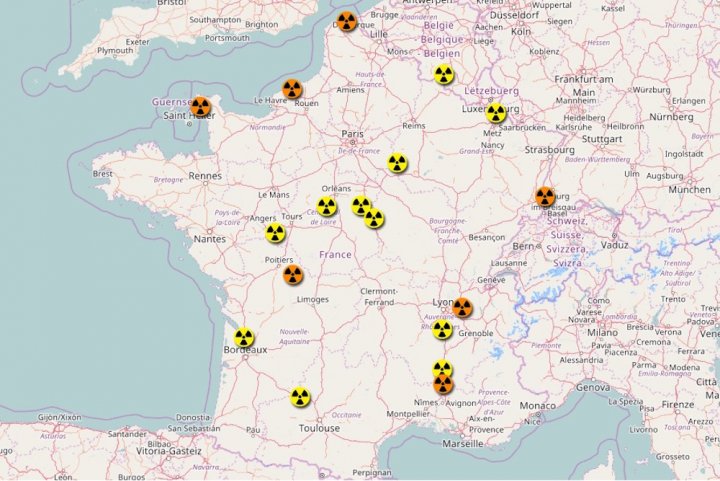

Reporterre a actualisé sa carte du parc nucléaire, détaillant la situation centrale par centrale.

Pour faire face à la vague de froid, a-t-on redémarré certains réacteurs nucléaires trop vite, faisant fi de la sûreté ? Météo France annonce – 6,4°C en moyenne ce mercredi en France métropolitaine, et le pic de 19 h devrait nécessiter l’appel d’une puissance de 95.000 mégawatts.

La demande en électricité est à son maximum, alors que cinq réacteurs nucléaires sont toujours à l’arrêt, contre un seul l’an dernier à la même période. Déjà en novembre, Réseau de transport d’électricité (RTE), qui est chargé d’assurer la fourniture de l’énergie en France, avertissait que la pointe serait « plus délicate à assurer que lors des hivers précédents, en raison de l’indisponibilité de plusieurs sites de production ».

En effet, de multiples arrêts de réacteurs nucléaires ont dû être programmés au cours de l’année 2016, après la révélation en avril, puis en juillet, de dizaines d’anomalies dans la conception des pièces équipant les réacteurs nucléaires. Reporterre vous a relaté en détail toute l’affaire. Après contrôle, l’Autorité de sûreté nucléaire (ASN) autorise EDF à redémarrer les réacteurs les uns après les autres.

« Un accident de type Fukushima est possible »

« Mais il y a eu des pressions sur l’ASN. Voyant venir la vague de froid, EDF a fait tout son possible pour faire redémarrer ses réacteurs le plus vite possible », dénonce Stéphane Lhomme, directeur de l’association Observatoire du nucléaire. Pour lui, les conditions de sûreté ne sont pas réunies et « un accident de type Fukushima est possible ».

C’est pourquoi son association a demandé à la justice de suspendre trois des autorisations de redémarrage de l’ASN, pour les réacteurs Dampierre 3, Gravelines 2 et Tricastin 3. Pourquoi ces trois-là ? « Parce que ce sont les premiers qui ont été autorisés à redémarrer », explique Stéphane Lhomme. Les référés-suspension ont été examinés par le Conseil d’État vendredi 13 janvier, qui devrait donner sa décision au plus tard ce mercredi.

Les pièces sur lesquelles des malfaçons ont été découvertes sont les générateurs de vapeur, situés dans le bâtiment réacteur. Pour ces pièces, l’IRSN (l’Institut de radioprotection et de sûreté nucléaire) explique qu’il y a « exclusion de rupture » : c’est-à-dire que les conséquences de leur défaillance seraient tellement grandes qu’elle n’est même pas prise en compte dans les scénarios de sûreté nucléaire.

« En particulier, l’acier des pièces proches du réacteur doit pouvoir résister à des chocs thermiques violents. À tout moment, on peut avoir besoin de déverser de l’eau froide sur les générateurs de vapeur », explique Stéphane Lhomme. Or, des concentrations de carbone anormales ont été repérées dans les cuves en acier des générateurs, les rendant potentiellement plus fragiles que prévu. La concentration maximale recommandée par l’ASN est de 0,22 %, alors que les contrôles ont montré que certaines zones dans les cuves présentaient une concentration allant jusqu’à 0,39 %. Pour l’Observatoire du nucléaire, les autorisations de l’ASN au redémarrage des réacteurs ne respectent donc pas son propre règlement, et violent le principe de précaution. Ce sont les raisons qui ont été invoquées devant le Conseil d’État.

Pour leur défense, l’ASN et EDF rappellent que les 0,22 % recommandés ne sont pas inscrits dans le droit, qui n’est donc pas enfreint. Surtout, selon eux le risque n’est pas si élevé que le craint l’Observatoire du nucléaire. « La rupture brutale [de l’acier] intervient en cas d’apparition simultanée de trois paramètres », indique l’ASN dans son mémoire, que Reporterre a consulté, au Conseil d’État : un matériau d’une « ténacité insuffisante », une fissure dans ce matériau et un choc thermique. La fragilité des cuves d’acier n’est donc pas dangereuse à elle seule, estime l’ASN.

« C’est du bricolage ! »

Et puis, le redémarrage des réacteurs est autorisé moyennant quelques précautions, appelées « mesures compensatoires ». Tout est fait désormais pour éviter les chocs thermiques, nous rassure l’autorité. Le fonctionnement des pompes susceptibles de déverser de l’eau brusquement sur le réacteur est par exemple modifié, les variations de température lors des démarrages et arrêts du réacteur sont limitées, etc.

« C’est du bricolage ! s’inquiète Stéphane Lhomme. Au départ, on sait que l’on peut avoir besoin de déverser de l’eau en urgence à tout moment, donc on a prévu un acier qui résiste aux chocs thermiques. Désormais, comme on n’est plus sûr qu’il résiste, on inverse et on fait tout pour les éviter. C’est faire comme si on constatait que les freins de la voiture sont usés, et qu’on décidait que désormais ce sera aux autres conducteurs de faire attention pour éviter d’avoir à freiner brutalement ! »

Autre inquiétude, comme l’ASN l’indique dans son mémoire, ces « mesures compensatoires » sont devenues « des mesures d’exploitation à part entière ». Autrement dit, « ils veulent continuer comme cela pendant des années, traduit Stéphane Lhomme. Or, la résistance de ces pièces va continuer de se dégrader, car elles sont continuellement soumises aux radiations et chocs thermiques. »

C’est pourquoi, selon Stéphane Lhomme, la décision de redémarrer les réacteurs aurait au moins valu « un débat national pour poser la question : les mesures de sûreté nucléaire sont-elles facultatives quand il fait froid ? »

Dans son mémoire, que Reporterre a consulté, au tribunal, EDF reconnaît avoir déjà donné sa réponse : l’arrêt des réacteurs présentant des malfaçons « en période de froid hivernal, où les besoins en production d’électricité sont accrus, poserait de graves problèmes pour la sécurité de l’approvisionnement énergétique ».

https://reporterre.net/Les-reacteurs-nucleaires-ont-redemarre-au-detriment-de-la-surete-11371

Posted under Fair Use Rules.

— France: Nuclear reactors restarted to the detriment of safety; “a Fukushima-type accident is possible”

From Reporterre

Translated using Google

Les réacteurs nucléaires ont redémarré au détriment de la sûreté
by Marie Astier (Reporterre),
January 18, 2017

Due to the cold spell, demand for electricity is at its maximum, justifying according to EDF, the re-start without delay of reactors inspected by the Nuclear Safety Authority. The association Nuclear Observatory is worried about this speed, according to it to the detriment of safety. It appealed to the courts to invalidate three restarts.
—————————————–
Update: The Council of State, by a decision of 18 January 2017, rejected the applications of the Nuclear Observatory Association, which challenged the legality of the authorizations for restarting the nuclear reactors Dampierre 3, Gravelines 2 and Tricastin 3, Nuclear Safety Authority at EDF. The Nuclear Observatory contested the re-launch of these reactors, which were found to be faulty (see article below). In its decision, the judge hearing the application for interim measures considers that EDF has taken the necessary precautions and in particular “precautionary measures of exploitation intended to reduce the risk of sudden rupture by making changes to the reactor operation”.
————————————–
Reporterre updated his map of the nuclear fleet, detailing the central situation by power station.
——————————————–

To cope with the cold spell, have we rebooted some nuclear reactors too quickly, ignoring safety? Météo France announces – 6.4 ° C on average this Wednesday in metropolitan France, and the peak of 7 pm should require the call of a power of 95,000 megawatts.

Demand for electricity is at its peak, while five nuclear reactors are still stationary, compared with just one last year at the same time. Already in November, Electricity Transmission System (TEN), which is responsible for supplying energy to France, warned that the peak would be “more delicate to insure than in previous winters, by reason of unavailability of several production sites “.

Indeed, multiple stops of nuclear reactors had to be programmed during the year 2016, after the revelation in April and then in July, dozens of anomalies in the design of the parts equipping the nuclear reactors. Reporter told you in detail the whole matter. After checking, the Nuclear Safety Authority (ASN) authorizes EDF to restart the reactors one after another.

“A Fukushima-type accident is possible”

“But there was pressure on the ASN. Seeing the cold spell come, EDF has done everything possible to restart its reactors as soon as possible, “says Stéphane Lhomme, director of the association Nuclear Observatory. For him, the safety conditions are not met and “a Fukushima-type accident is possible”.

That is why his association has asked the courts to suspend three of ASN’s restarting authorizations for the Dampierre 3, Gravelines 2 and Tricastin 3 reactors. Why these three? “Because they were the first ones who were allowed to restart,” explains Stéphane Lhomme. The suspension and suspension were examined by the Council of State on Friday 13 January, which should give its decision no later than Wednesday.

The parts on which defects were discovered are the steam generators located in the reactor building. For these documents, the IRSN (the Institute for Radiation Protection and Nuclear Safety) explains that there is “exclusion of rupture”: that is, the consequences of their failure would be so great that Is not even taken into account in nuclear safety scenarios.

“In particular, the steel of the parts near the reactor must be able to withstand violent thermal shocks. At any time, it may be necessary to pour cold water onto the steam generators, “explains Stéphane Lhomme. Abnormal carbon concentrations have been identified in the steel tanks of the generators, making them potentially more fragile than expected. The maximum recommended concentration by the ASN is 0.22%, while the controls have shown that some zones in the tanks have a concentration of up to 0.39%. For the Nuclear Observatory, ASN’s authorizations to restart reactors do not comply with its own regulations and violate the precautionary principle. These are the reasons that were invoked before the Council of State.
In their defense, ASN and EDF recall that the 0.22% recommended is not included in the law, which is therefore not infringed. Especially, according to them the risk is not so high that feared the Nuclear Observatory. “The sudden rupture [of the steel] occurs in the event of the simultaneous appearance of three parameters”, indicates the ASN in its brief, which Reporterre consulted, to the Council of State: a material of “insufficient toughness” , A crack in this material and a thermal shock. The fragility of steel tanks is therefore not dangerous on its own, says the ASN.

“It’s DIY!”

And then, restarting the reactors is allowed with some precautions, called “compensatory measures”. Everything is done now to avoid thermal shocks, the authority reassures us. The operation of the pumps capable of pouring water abruptly onto the reactor is, for example, modified, the temperature variations during starting and stopping of the reactor are limited, etc.

“It’s DIY!” Worries Stéphane Lhomme. Initially, it is known that emergency water can be needed at any time, so a steel is resistant to thermal shocks. Henceforth, as it is no longer certain that it resists, we reverse and we do everything to avoid them. It is as if one noticed that the brakes of the car are worn, and that it was decided that now it will be the other drivers to be careful to avoid having to brake brutally! “
Another concern, as ASN indicated in its brief, is that these “compensatory measures” have become “operational measures in their own right”. In other words, “they want to continue like that for years,” Stéphane Lhomme translated. However, the resistance of these parts will continue to degrade because they are continuously subjected to radiation and thermal shocks. “
That is why, according to Stéphane Lhomme, the decision to restart the reactors would at least have been “a national debate to ask the question: are nuclear safety measures optional when it is cold? “
In its memorandum, which Reporterre consulted, in court, EDF acknowledges having already given its answer: stopping reactors with poor workmanship “in cold winter, where electricity needs are increased, would pose serious problems for the security of energy supply ‘.
Source : Marie Astier for Reporterre

https://reporterre.net/Les-reacteurs-nucleaires-ont-redemarre-au-detriment-de-la-surete-11371

— Feds declare salmon and crab failures for nine fisheries in Alaska, Washington and California

From KXRO:

A fisheries disaster has been declared for Grays Harbor, Willapa Bay, coastal waters, and local rivers…

From NOAA

January 18, 2017 U.S. Secretary of Commerce Penny Pritzker today determined there are commercial fishery failures for nine salmon and crab fisheries in Alaska, California and Washington.

In recent years, each of these fisheries experienced sudden and unexpected large decreases in fish stock biomass or loss of access due to unusual ocean and climate conditions. This decision enables fishing communities to seek disaster relief assistance from Congress.

A disaster can be declared if events cause “serious economic impact for fishers and their communities”.

In Washington:

  • Fraser River Makah Tribe and Lower Elwha Klallam Tribe sockeye salmon fisheries (2014)

  • Grays Harbor and Willapa Bay non-treaty coho salmon fishery (2015)

  • Nisqually Indian Tribe, Jamestown S’Klallam Tribe, Port Gamble S’Klallam Tribe, and Squaxin Island Tribe South Puget Sound salmon fisheries (2015)

  • Quinault Indian Nation Grays Harbor and Queets River coho salmon fishery (2015)

  • Quileute Tribe Dungeness crab fishery (2015-2016)

  • Ocean salmon troll fishery (2016)

In Alaska:

  • Gulf of Alaska pink salmon fisheries (2016)

In California:

  • California Dungeness and rock crab fishery (2015-2016)

  • Yurok Tribe Klamath River Chinook salmon fishery (2016)

Alaska Journal of Commerce:

January 18, 2017

Help could be on the way for the pink salmon fishermen whose catch sank to dismal lows last year.

U.S. Secretary of Commerce Penny Pritzker granted Gov. Bill Walker’s request for a declaration of a disaster for Alaska’s pink salmon fishery on Wednesday along with eight other salmon and crab fisheries along the West Coast.

In 2016, the pink salmon harvests in Kodiak, Prince William Sounds, Chignik and lower Cook Inlet came in woefully under forecast and stumped biologists as to why.

The estimated value of Kodiak’s 2016 haul was $2.21 million, compared to a five-year average of $14.64 million, and in Prince William Sound the ex-vessel value was $6.6 million, far less that the $44 million five-year average.

Now that the disaster has been declared, it will be up to Congress to find the necessary funds and secure them for fishermen.

This will be one of growing number of disaster declarations for Alaska fisheries in the 2010s.

Alaska received $20.8 million in federal money for fishery failures in 2012 over low king salmon returns on the Yukon and Kuskokwim Rivers and in the Cook Inlet region.

Sources:

 http://www.noaa.gov/news/commerce-secretary-pritzker-declares-fisheries-disasters-for-nine-west-coast-species

http://www.kxro.com/fisheries-disaster-declared-local-waters-pnw/

http://www.alaskajournal.com/2017-01-18/commerce-secretary-declares-pink-salmon-disaster

— Neighbouring countries concerned about the risk of a Belgian nuclear meltdown

Global Research, January 20, 2017
The Ecologist 19 January 2017
belgium nuclear

It’s not the metaphorical political meltdown of Belgium that neighbouring governments fret about, but a nuclear meltdown. The Netherlands, Luxemburg and Germany have all asked Belgium’s government to close its most risky reactors with immediate effect. The city of Aachen and 30 other major cities and districts are also suing Belgium for not closing them. The German government no longer trusts the Belgian Nuclear Safety Agency and wants permission for its own agency to do safety checks. So far, foreign pressure is falling on deaf ears.

Belgians have even more reasons to worry. On 10 January 2017 a new emergency plan was presented in a commission in Belgium’s Parliament. The evacuation perimeter was conveniently halved to 10km to avoid an evacuation of Belgium’s second and third cities in case of a meltdown. Nuclear Transparency Watch, a European organisation created by Members of the European Parliament of all political colours, called Belgium’s plans totally inadequate and incoherent.inad

So rather than signing agreements with Belgium about sharing information, where are the sanctions for Belgium? There are both EU and UN regulations that could shut the reactors down, as more than a million people requested a year ago. Belgium’s neighbours have reasons to get tough.

Belgium is your backyard

Belgium’s recent nuclear history reads like a mirror of Germany’s, where the highest court decided that Merkel’s decision to speed up the nuclear phase-out after the Fukushima incident was justified. Belgium did just the opposite. The Belgian government reversed a nuclear phase-out law from 2003 only a year after the Japanese reactors exploded, pushing retirement back from 2015 to 2025. The last bill to postpone retirement with 10 years was approved at the end of 2016. The Government can ‘take comfort’ at the fact that 2017 started better than 2016: in 2016, the first ‘incident’ happened just two days into the New Year on January 2; in 2017 the first incident (in which one person got severely injured) took place eight days later on January 10 with an unexpected shutdown as result.

Yes, the protesting former president of the European Parliament Martin Schulz was born and raised close to Belgium’s border and yes, I was born and raised 15 km from four nuclear reactors in Doel, in the city of Antwerp (half a million people). But before you call us NIMBY (Not In My Back Yard) activists: our backyard contains six to seven million people that in the event of a nuclear meltdown would never be able to go home again. Depending on the wind direction on the day of a meltdown, a radioactive cloud will poison additional people in London, Paris, Amsterdam or Aachen as well. The possibility of that scenario has increased in recent years.

Cracks, extortion and sabotage 

In 2012 it became known that the mantle around the old Tihange 2 reactor shows signs of erosion. Further research in 2015 concluded that there are thousands of cracks of up to 15 cm. Later that year, 10 security incidents were recorded in Tihange in just six weeks, leading Belgium’s nuclear safety agency to suspend four members of staff and raise serious questions about the safety culture. In 2015, Belgian’s nuclear plants spent longer in shutdown or “maintenance” than in being operational.

Who said nuclear energy was a reliable source of energy?

But it is the Doel plant that reads like the script of an apocalyptic Hollywood blockbuster, part one. The plant was sabotaged in 2014. The sabotage was found before things spiralled out of control, but the culprit(s) remain unknown. A year later, police found hidden cameras that followed the movements of a nuclear researcher, raising alarming questions about criminals extorting staff. Research also revealed a staggering number of cracks in the mantle that is supposed to keep the Doel 3 reactor in check: 13,047. The cracks are on average 1 to 2 cm wide, but the largest ones are up to 18cm. And with 35 years of operational history, the researched Doel 3 is the second “youngest” of Doel’s four reactors. Belgium’s nuclear safety agency concluded after the tests in Tihange and Doel that the erosion of the mantle was due to normal reactor activity. They can thus be expected to be present in all plants in the world of similar age and to keep multiplying through normal reactor use.

The economic and terrorist threats

In terms of potential economic impacts, Doel is by far number 1 in Europe. The major Fukushima disaster knocked 2 to 10% from Japan’s GDP, but when Doel goes into meltdown, the cost is estimated to be 200% of the GDP of Belgium. In such a scenario, GDP won’t really mean much. Most of Flanders and the capital of Europe will become inhabitable zones, sending millions of refugees to France, The Netherlands, Germany and the UK. Will they open their borders for a flood of immigrants from Belgium?

And then there’s terrorism. For the last two years, Belgian authorities have claimed we are living under emergency level 3, just one notch below the State of Emergency that France is living under. This means a terrorist threat is “serious” and an attack “probable”. France has already experienced a series of undeclared drone flights over various nuclear power stations. The Bulletin of the Atomic Scientists later explained that the danger of that is not about drones carrying small explosives and crashing on the plant because in theory a nuclear plant can cope with a jumbo jet crash (although this has never been tested). But drones can easily carry AK47s and drop them inside the territory of the plant, even at night.

In another scenario laid out by the atomic scientists, drones can attack the power lines and then the diesel generator back-up system. It requires a bit more organisation than driving a truck into a crowd, but less than teaching a terrorist team how to fly a jumbo jet, hijack several at the same time and fly them into the two WTC towers and the Pentagon. As we have learned the hard way in recent years, Belgium also happens to be a favourite hide-out for terrorists. Belgium’s authorities want us to believe that the terrorist risk has never been so high, but they don’t want you to connect that with our nuclear plants and with unexplained drone flights over nuclear plants.

Corrupted centralised power plants

All this raises the question: is it still smart to count on a few vulnerable centralised power plants? And what about the waste of state money that seems to come hand-in-hand with nuclear power? Bulgaria wasted 1,221 billion euro on a plant that never materialized. Bulgaria is also still spending money to deal with the legacy of uranium mining, even though the last mine closed in 1992. When I visited the surroundings of the now closed Buhovo mine, stones of a size that would fit a child’s hand showed radiation 100s of times above normal. They were ready to be picked up and played with at a popular local picnic place.

Conflicts against nuclear power plants and the formulation of constructive alternatives are popping up outside Europe as well: from India to Japan. So are the conflicts and externalised costs around the uranium that now feeds most of our reactors, from Niger to Namibia. Although there’s one other country that has become the EU’s main supplier: Russia. But as environmental justice, geopolitical weakening or financial debacles don’t seem to stop the nuclear addiction: will it have to take another meltdown? Policymakers seem to have forgotten that our countries signed up to the precautionary principle, which the EU still has in its Treaty. Maybe it’s time that the Germans, who are kicking nuclear out of their country, march once more on Belgium. As a Belgian citizen I do kindly request to come in peace and only armed with the renewable energy solutions that swept your country.

Nick Meynen was the organiser of a 72km long anti-nuclear energy march from Doel to Brussels. He works for the ENVJUSTICE project and writes articles and books on environmental issues.

— Monterey Bay dungeness crab season: “so few crabs”, “really slow”,”hardly anybody is fishing here”

From Monterey County Weekly
By Nick Rahaim
January 12, 2017

While an 11-day strike kept Dungeness crab fishermen tied up to the dock from Washington state down to Half Moon Bay during what could be a banner year, crabbers in Monterey Bay kept plugging away. It’s not that they’re strike busters (or “scabs”), it’s there are so few crabs in Monterey Bay their continued work doesn’t make that much of an impact.

“It’s been really slow, we’re only getting a couple a crabs per pot even after a long soak,” says Monterey fisherman Mike Ricketts. “The fishermen on strike didn’t seem to mind, or even pay attention. Hardly anybody is fishing down here.”

Monterey Bay fishermen have caught just 14,000 pounds of crab since the season opened Nov. 15, as opposed Half Moon Bay crabbers pulling in 350,000 pounds over the same period. The initial numbers, provided by marine biologist Pete Kalvass with the California Department of Fish and Wildlife, are likely on the low side as landing receipts are not digitized and they take a week or two to process. Last year, the crab numbers were 600,000 and 1.7 million pounds, respectively.

Robbie Torrise, owner of Robbie’s Ocean Fresh Seafood in Monterey, purchases all his live Dungeness crab from local fishermen, and needs 700-1,000 pounds to fulfill an order by the end of the week. He hopes the weather breaks and his guy will come through.

“Fresh crab is a crapshoot,” Torrise says. “One day you have them, the next day you don’t. The restaurants I sell to understand that.”

http://www.montereycountyweekly.com/news/local_news/it-s-a-slow-winter-for-dungeness-crab-in-monterey/article_816c9014-d85c-11e6-ae21-0f0ea0e6c78e.html

Posted under Fair Use Rules.

— Lanceurs d’alerte à Minamisōma

Blog : Fukushima 福島第一

11 novembre 2016

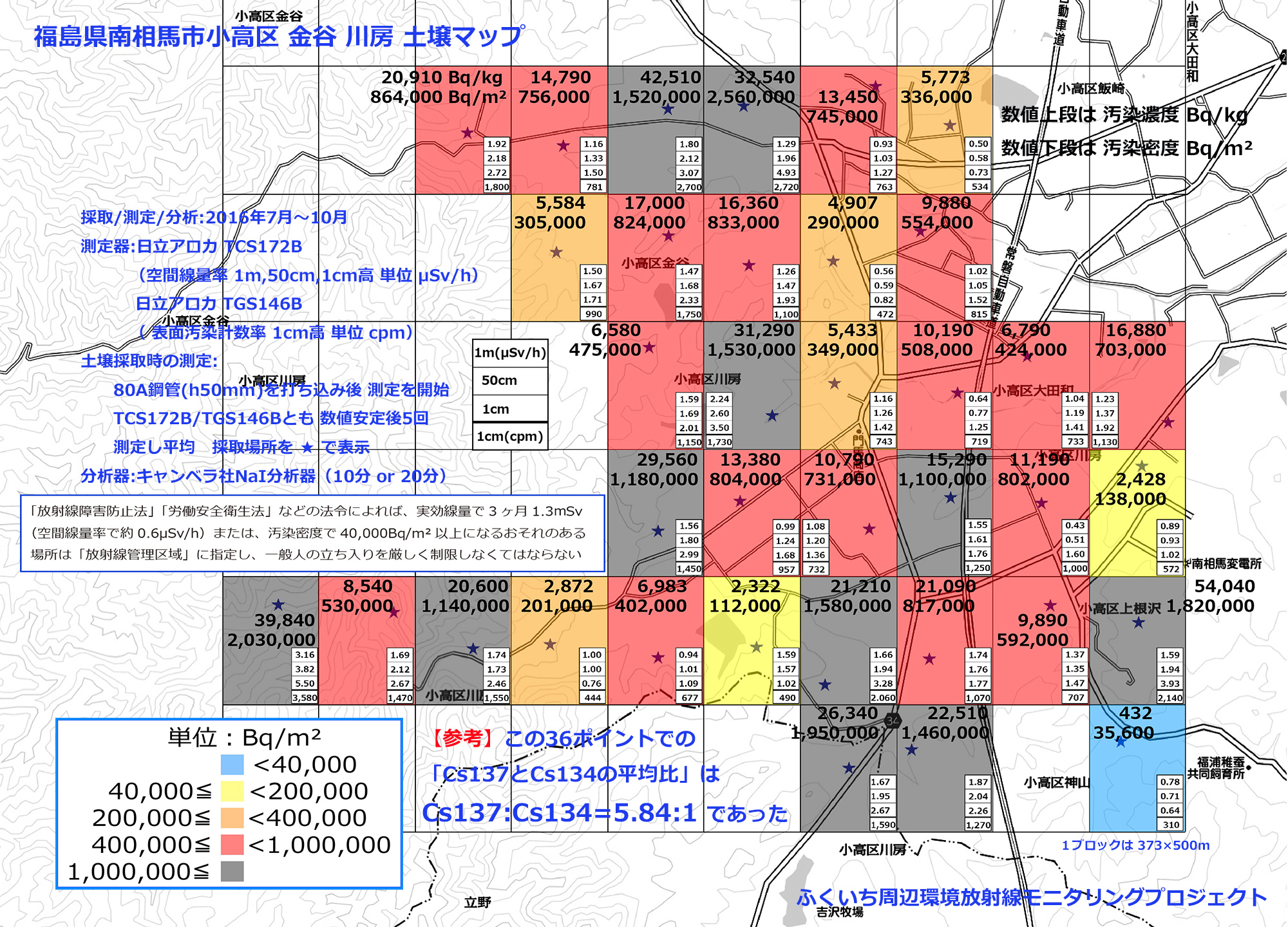
J’ai pris connaissance il y a quelques jours d’une carte qui m’a tout de suite interpellé. Elle affiche des mesures de la radioactivité à la fois précises et inquiétantes. Ne connaissant pas le japonais, j’ai demandé à Kurumi Sugita, présidente de l’association Nos voisins lointains 3.11, de me traduire le texte.


Elle a tout de suite accepté et m’a expliqué de quoi il s’agissait : « Le Projet de mesure de la radioactivité environnementale autour de la centrale nucléaire de Fukushima Daiichi (Fukuichi shûhen kankyôhôshasen monitoring project) est mené par une équipe de bénévoles relativement âgés (qui sont moins radiosensibles que les jeunes) pour réaliser des mesures de radioactivité avec un maillage serré de 75 x 100 m pour la radioactivité dans l’air et 375 x 500 m pour la contamination du sol. Les mesures de radioactivité ambiante et du sol sont réalisées principalement dans la ville de Minamisōma et aux alentours. Ils essaient de réaliser des mesures détaillées afin de montrer aux habitants les conditions réelles de leur vie, et également d’accumuler des données en vue de l’analyse des dommages sanitaires et environnementaux qui peuvent se montrer à long terme. »


Grâce à la traduction de Kurumi et avec l’accord de M. Ozawa, auteur du document, j’ai pu réaliser une version française de cette carte que vous trouverez ci-dessous.

Carte de l’équipe de M. Ozawa (traduction Kurumi Sugita)

Carte de l’équipe de M. Ozawa (traduction Kurumi Sugita)

Dans le cadre de la normalisation des territoires contaminés en zones habitables, l’ordre d’évacuation de l’arrondissement d’Odaka de la ville de Minamisōma a été levé le 12 juillet 2016, excepté la zone qui longe Namie (hameau d’Ohatake où habite un seul ménage) classée comme zone de “retour difficile”.

Situation de la zone étudiée

Situation de la zone étudiée

La carte de contamination examine les secteurs de Kanaya et Kawabusa de l’arrondissement d’Odaka, à une quinzaine de kilomètres de l’ex-centrale de Fukushima Daiichi. M. Ozawa, l’ingénieur qui a lancé cette enquête, a choisi la précision des mesures, c’est-à-dire qu’il s’emploie à mesurer la radioactivité avec des radiamètres à scintillation de laboratoire : Hitachi Aloka TCS172B, Hitachi Aloka TGS146B et Canberra NaI Scintillation Detector.


L’originalité de sa carte tient autant à la qualité de réalisation qu’à l’abondance de renseignements : on peut y lire, pour chacun des 36 prélèvements effectués, des mesures en Bq/m², en Bq/kg, en µSv/h à trois hauteurs différentes du sol (1 m, 50 cm, 1 cm) et en cpm (coups par minute) à la hauteur de 1 cm. Pour qui connaît un peu la radioactivité, ce sont des informations très précieuses. Habituellement, les mesures sont données en l’une ou l’autre unité, mais jamais simultanément avec 4 unités. Les organismes officiels devraient prendre exemple sur cette manière de travailler.


Les mesures que dévoile la carte sont très inquiétantes. Elles montrent que la terre a un niveau de contamination qui ferait d’elle un déchet radioactif dans n’importe quel pays non contaminé. Comme l’écrit M. Ozawa, ces terrains devraient être considérés comme une « zone contrôlée », c’est-à-dire un espace sécurisé, comme dans les centrales nucléaires, où l’on doit vérifier constamment les doses reçues. Dans les faits, c’est pire que dans une centrale car au Japon, on demande aux habitants évacués depuis 5 ans et demi de rentrer chez eux alors que l’on sait pertinemment qu’ils seront irradiés (jusqu’à 20 mSv/an) et contaminés (par inhalation et ingestion).

L'équipe de Fukushima Daiichi Monitoring Project lors d'une prise de mesure à Minamisoma cet été. On reconnaît sur les blousons le logo du laboratoire japonais indépendant Chikurin, partenaire de l’ACRO (Photo David Boilley).

L’équipe de Fukushima Daiichi Monitoring Project lors d’une prise de mesure à Minamisoma cet été. On reconnaît sur les blousons le logo du laboratoire japonais indépendant Chikurin, partenaire de l’ACRO (Photo David Boilley).

Cette recherche citoyenne est remarquable à plus d’un titre :


– Elle est indépendante de toute organisation. Aucun lobby n’intervient pour modifier ou atténuer telle ou telle mesure. Ce sont juste des données brutes, prises par des gens honnêtes, en recherche de vérité.


– Elle respecte un protocole scientifique, expliqué sur la carte. Il y aura toujours des gens pour critiquer tel ou tel aspect de la démarche, mais celle-ci est rigoureuse et objective.


– Elle prend des mesures à 1 m du sol mais aussi à 1 cm du sol. Cette démarche est plus logique car les hommes marchent sur le sol jusqu’à présent non ? Les cartes de contamination du Japon montrent souvent des mesures à 1 m du sol, ce qui ne reflète pas la réalité et semble être fait pour minimiser les faits. En effet, la mesure est souvent deux fois plus élevée à 1 cm du sol qu’à 1 m.


– Elle agit comme un révélateur. M. Ozawa et son équipe sont des lanceurs d’alerte. Leurs cartes disent : faites attention ! Des lois se contredisent au Japon. Ce que prétend le gouvernement, à savoir qu’une dose de 20 mSv/an ne produira pas d’effet sanitaire, n’est pas forcément la vérité. Si vous revenez, vous allez bel et bien être irradiés et contaminés. La France se prépare à la même forfaiture, à savoir qu’ « elle est en train de transposer en droit national les dispositions de la directive 2013/59/Euratom : les autorités françaises ont retenu la borne supérieure de l’intervalle : 100 mSv pour la phase d’urgence et 20 mSv pour les 12 mois suivants (et pour les années suivantes rien ne garantit que ce niveau de référence ne sera pas reconduit). Ces valeurs s’appliquent à tous, y compris les nourrissons, les enfants et les femmes enceintes ! » (source Criirad)


Le gouvernement japonais demande aux habitants de rentrer chez eux et supprime les indemnités aux évacués. Les JO approchent, la région de Fukushima doit être perçue comme « normale » pour que les sportifs et les supporters du monde entier n’aient pas peur, quitte à sacrifier la santé des populations locales. Il faut donc faire connaître la carte de M. Ozawa pour que les futures campagnes publicitaires n’étouffent pas la réalité des faits.


Pierre Fetet


____________________


Pour en savoir plus :


M. Ozawa dans un reportage de la RTBF

La poussière qui s’envole avec ses radionucléides à Minamisōma

Article sur le retour en zone contaminée du blog Nos voisins lointains 3.11

http://nosvoisins311.wixsite.com/voisins311-france/single-post/2016/08/22/Le-retour-aux-zones-contamin%C3%A9es


Les données concernant les mesures à Minamisōma

http://www.f1-monitoring-project.jp/open_deta.html


Site internet de l’équipe militante :

http://www.f1-monitoring-project.jp/index.html


Adresse de la carte d’origine (HD)

http://www.f1-monitoring-project.jp/dirtsfiles/20161104-Odaka-Kanaya-Kawabusa-s.jpg

Lanceurs d'alerte à Minamisōma

Cet article et sa carte ont été traduits en anglais par Hervé Courtois à cette adresse :

https://nuclear-news.net/2016/11/12/the-minamisoma-whistleblowers-fukushima/


Voici la traduction de la carte en anglais :

Lanceurs d'alerte à Minamisōma

http://www.fukushima-blog.com/2016/11/alerte-a-minamisoma.html

— Citizen scientists find high levels of radiation where government asks residents to re-settle — the Minamisoma whistleblowers, Fukushima

From the Fukushima 311 Watchdogs

November 12, 2016

A few days ago Pierre Fetet learned of a map which immediately called his attention.

That map displays at the same time precise and unsettling measurements. Not knowing Japanese, Pierre Fetet asked Kurumi Sugita, the president of Nos voisins lointains 3.11 association, to translate for him the text. She immediately accepted and explained to him what it was:

“The project to measure environmental radioactivity around the Fukushima Daiichi nuclear power plant (Fukuichi shuhen kankyôhôshasen monitoring project) is conducted by a team of relatively old volunteers (who are less radiosensitive than youth) to perform radioactivity measurements with a tight mesh size of 75 x 100 m for radioactivity in air and 375 x 500 m for soil contamination. Measurements of ambient radioactivity and soil radioactivity are carried out mainly in the city of Minamisōma and its surroundings. They try to make detailed measurements so as to show the inhabitants the real conditions of their lives, and also to accumulate data for the analysis of long-term health and environmental damages.”

Thanks to the Kurumi Sugita’s translation and with the agreement of Mr. Ozawa, author of the document, Pierre Fetet was able to make a French version of this map, which I translated into english here below:

Minamisoma contamination map oct 2016.jpg

Map of Mr. Ozawa’s team (translation first by Kurumi Sugita, then by Hervé Courtois)

In the context of the normalization of contaminated areas into habitable areas, the evacuation order of the Odaka district of the city of Minamisōma was lifted on 12 July 2016, except the area bordering Namie (Hamlet of Ohatake where a single household lives) classified as a “difficult return” area.

minamisoma-contamination-map-oct-2016-2

Situation of the study area

The contamination map examines the Kanaya and Kawabusa areas of the Odaka district, about fifteen kilometers from the former Fukushima Daiichi nuclear power plant. Mr. Ozawa, the engineer who launched this investigation, has chosen the precision of the measurements, that is to say laboratory scintillation radiometers are used to measure radioactivity: Hitachi Aloka TCS172B, Hitachi Aloka TGS146B and Canberra NaI Scintillation Detector.

The originality of this map is due as much to the quality of its realization as to the abundance of its informations: it can be read, for each of the 36 samples taken, measurements in Bq / m², in Bq / kg, in μSv / h at three different soil heights (1 m, 50 cm, 1 cm) And in cpm (counts per minute) at the height of 1 cm. For those who know a little about radioactivity, these informations are very valuable informations. Usually, measurements are given in either unit, but never simultaneously with 4 units. Official organizations should learn this way of working.

The measures revealed by the map are very disturbing. They show that the earth has a level of contamination that would make it a radioactive waste in any uncontaminated country. As Mr. Ozawa writes, these lands should be considered a “controlled zone”, that is to say a secure space, as in nuclear power plants, where the doses received must be constantly checked. In fact, it is worse than inside of a nuclear power plant because in Japan the inhabitants evacuated since five and a half years are now asked to return home, whereas it is known that they will be irradiated (Up to 20 mSv / year) and contaminated (by inhalation and ingestion).

This citizen research is remarkable in more ways than one:

  • It is independent of any organization. There is no lobby to alter or play down this or that measure. These are just raw data, taken by honest people, in search of truth.
  • It respects a scientific protocol, explained on the map. There will always be people to criticize this or that aspect of the process, But this one is rigorous and objective.
  • It takes measurements 1 m from the ground but also 1 cm from the ground. This approach is more logical because until now men are walking on the ground no? The contamination maps of Japan often show measurements at 1 m from the ground, Which does not reflect reality and seems to be done to minimize the facts. Indeed, the measurement is often twice as high at 1 cm from the ground as at 1 m.
  • It acts as a revealing map. Mr. Ozawa and his team are whistleblowers. Their maps say: Watch out ! Laws contradict each other in Japan. What the government claims, namely that a dose of 20 mSv / year will not produce any health effect, is not necessarily the truth. If you come back, you are going to be irradiated and contaminated.

France is preparing for the same forfeiture, namely that ‘it is transposing into national law the provisions of Directive 2013/59 / Euratom: the French authorities retained the upper limit of the interval: 100 mSv for the emergency phase and 20 mSv for the following 12 months (And for the following years there is no guarantee that this reference level will not be renewed). These values apply to all, including infants, children and pregnant women! ” (source Criirad)

The Japanese government is asking residents to return home and abolishing compensation for evacuees. The Olympics are coming, Fukushima must be perceived as “normal” so that the athletes and supporters of the whole world won’t be afraid, even if it means sacrificing the health of the local population. It is therefore necessary to make known the map of Mr. Ozawa so that future advertising campaigns do not stifle the reality of the facts.

Pierre Fetet

Data on measurements at Minamisōma

http://www.f1-monitoring-project.jp/open_deta.html

Website of the measuring team:

http://www.f1-monitoring-project.jp/index.html

Address of the original map (HD)

http://www.f1-monitoring-project.jp/dirtsfiles/20161104-Odaka-Kanaya-Kawabusa-s.jpg

3-ob_8977f5_20161104-odaka-kanaya-kawabusa-s.jpg

Source : Article of Pierre Fetet

http://www.fukushima-blog.com/2016/11/alerte-a-minamisoma.html

(Translation Hervé Courtois)

https://dunrenard.wordpress.com/2016/11/12/the-minamisoma-whistleblowers-fukushima/