— ‘Heartbreaking’: Over 300 whales die in biggest recent stranding in New Zealand

From RT
February 10, 2017

More photos and videos at RT

‘Heartbreaking’: Over 300 whales die in biggest recent stranding in New Zealand (PHOTOS)

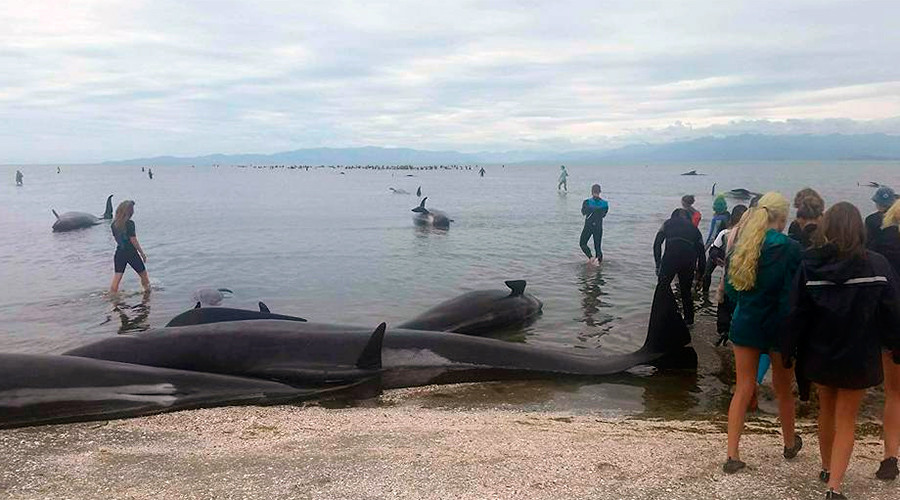
Most of the 415 whales that washed up on a narrow sand spit in Golden Bay, New Zealand died by Thursday night, while scores of volunteers armed with blankets struggled to keep the surviving animals wet to refloat them during a life-saving tide.

The mammals were scattered along the beach in Farewell Spit on the northwestern coast of New Zealand’s South Island, near the settlement on Puponga. Hundreds of volunteers joined the rescue operation, led by the New Zealand Department of Conservation.

Gruesome images showing piles of dead mammals lying mere meters from the water have emerged on social media.

About 30 medics have been dispatched to the site of the stranding to take care of the whales joining the efforts with volunteers in keeping them cool and comfortable and preventing the refloated whales from coming back ashore with impromptu “human chains.” The call for help, posted by Project Jonah of Facebook, has seen a tremendous response from locals, with a road leading to the beach being jammed with cars of helpers, the New Zealand Herald reports.

“This is quite emotional – it’s encouraging to see the number of people who have come out to help … We’re going to give these whales the best chance we can,” said Louisa Hawkes, of the Project Jonah environmental organization, as cited by 1 News, which is running live updates on the large-scale rescue operation.

Messages of sympathy and support have been pouring in on Twitter in response to the tragic scenes.

While the majority of nearly a hundred pilot whales were successfully refloated on Friday morning, there is a high chance that the same whales could get stuck again.

“What they’re doing is milling around so we won’t know until mid-afternoon whether we’re going to have a restranding or not,” Andrew Lamason, DOC Golden Bay operations manager, said as cited by Stuff.

As of Friday afternoon (local time), the whales have been spotted returning back to the beach, with some of them getting caught in the sands again.

The current stranding become the third largest in the recorded history of such events in New Zealand. The biggest stranding, which saw around a thousand sea creatures beached on the Chatham Islands, dates back to 1918. The second largest occurred in Auckland in 1985, when some 450 whales ran ashore.

READ MORE: Over 190 pilot whales stranded on NZ beach, dozens die   in 2015

The Farewell Spit has been known as a notorious trap for the mammals. Last February, about 200 pilot whales got stranded on the beach there.

https://www.rt.com/news/376895-whales-stranded-died-new-zealand/

— Pentagon panel urges Trump team to expand nuclear options; report suggests ‘tailored nuclear option for limited use’; Congress’ bills to give first strike authority also to itself

Dr. Helen Caldicott tweeted out this article with the comment: “These people are NUTS.”

President Obama already approved “modernizing” the U.S. nuclear arsenal. Hillary Clinton would have been fully on board with these recommendations, but would “liberals” have complained? Sen. Dianne Feinstein is a notorious hawk with flagrant conflicts of interest; her remarks in this article cannot be believed. 

From Roll Call

A blue-ribbon Pentagon panel has urged the Trump administration to make the U.S. arsenal more capable of “limited” atomic war.

The Defense Science Board, in an unpublished December report obtained by CQ Roll Call, urges the president to consider altering existing and planned U.S. armaments to achieve a greater number of lower-yield weapons that could provide a “tailored nuclear option for limited use.”

The recommendation is more evolutionary than revolutionary, but it foreshadows a raging debate just over the horizon.

Fully one-third of the nuclear arsenal is already considered low-yield, defense analysts say, and almost all the newest warheads are being built with less destructive options. But experts on the Pentagon panel and elsewhere say the board’s goal is to further increase the number of smaller-scale nuclear weapons — and the ways they can be delivered — in order to deter adversaries, primarily Russia, from using nuclear weapons first.

Critics of such an expansion say that even these less explosive nuclear weapons, which pack only a fraction of the punch of the bombs America dropped on Japan in 1945, can still kill scores of thousands of people and lead to lasting environmental damage. They worry that expanding the inventory of lower-yield warheads — and the means for delivering them — could make atomic war more thinkable and could trigger a cycle of response from adversaries, possibly making nuclear conflict more likely. And, they say, such an expansion would cost a lot of money without necessarily increasing security.

The issue will gain greater prominence in the next several years as an up-to-$1 trillion update of the U.S. nuclear arsenal becomes the biggest Pentagon budget issue. That update, as now planned, mostly involves building new versions of the same submarines, bombers, missiles, bombs and warheads. Support for the modernization effort is bipartisan.

But any effort to create new weapons, or even to modify existing ones, in order to expand the arsenal of potentially usable nuclear weapons is likely to trigger opposition.

There’s one role — and only one role — for nuclear weapons, and that’s deterrence. We cannot, must not, will not ever countenance their actual use,” said Democratic Sen. Dianne Feinstein of California. “There’s no such thing as limited nuclear war, and for the Pentagon’s advisory board to even suggest such a thing is deeply troubling.”

I have no doubt the proposal to research low-yield nuclear weapons is just the first step to actually building them,” she added. “I’ve fought against such reckless efforts in the past and will do so again, with every tool at my disposal.”

Conservatives on the congressional defense committees generally support exploring new nuclear options.

We know from testimony that Russia, among others, are fielding new nuclear weapons with new capabilities for new employment doctrines,” said Alabama Republican Rep. Mike D. Rogers, the chairman of the House Armed Services Strategic Forces Subcommittee. “We would be irresponsible not to evaluate what these developments mean for the U.S. and our modernization programs.”

Dustin Walker, a spokesman for Arizona Republican Sen. John McCain, chairman of Senate Armed Services, said, “It has been the policy of Republican and Democratic presidents since the end of the Cold War to retain a range of nuclear capabilities, both in terms of explosive yield and method of delivery. Such a range of capabilities strengthens deterrence by signaling to potential adversaries that we can respond to a wide range of scenarios.”

Worries about Trump

The Defense Science Board’s nuclear recommendation is buried inside a report titled “Seven Defense Priorities for the New Administration,” which also addresses homeland security, protecting information systems and more. The board has made similar nuclear recommendations before, but the new report adds volume to a growing chorus of hawkish experts calling for a nuclear arsenal they say is more “discriminate.”

The board’s latest statement comes at a pivotal time because Trump rattled many Americans with comments during the campaign about nuclear weapons. He suggested that atomic arms might be an appropriate response to an Islamic State attack and that it’s good for a president to be “unpredictable” about nuclear weapons. He also said, referring to nuclear weapons in general, that “the power, the destruction is very important to me.”

Thirty-four former nuclear launch control officers wrote an open letter during the campaign arguing that Trump “should not have his finger on the button.” And lawmakers are weighing legislation this year that, for the first time, would give Congress, not just the president, authority to launch a nuclear first strike, though those bills’ chances of passing either chamber are scant.

Continue reading

— Massachusetts: Seawater leak forces 72% power reduction at Pilgrim; NRC said plant has “poor maintenance, poor engineering practices, and equipment reliability problems”

By Michael P. Norton STATE HOUSE NEWS SERVICE
February 7, 2017

A seawater leak at Pilgrim Nuclear Power Station has prompted plant operators to sharply reduce energy output there.

Control room operators reduced power to about 50 percent on Monday afternoon, Feb. 6, after there was an indication of a leakage into the Plymouth plant’s condenser.

A power plant spokesman told the News Service on Tuesday morning that the plant is now operating at 28 percent while repair work is undertaken.

Entergy Pilgrim Station spokesman Patrick O’Brien did not have an estimate of how much seawater leaked into the plant’s condenser.

“There is no challenge to worker or public health or safety and no radiologial release occurred as a result of this brief leak,” he said in a statement. “The reduction in power enabled operators to isolate the leakage so workers can make repairs. Restoration of full power will follow the repair.”

Pilgrim experienced a similar seawater intrusion last year, O’Brien said.

After a final planned refueling the plant this year, Pilgrim owner Entergy plans to shut the plant down in 2019.

Critics of the plant point to repeated problems there that have necessitated shutdowns as proof that the plant should close now. Pilgrim officials say the plant is safe and have repeated over the years that the safety of the public and plant staff has not been put at risk.

The coastal power plant closed down for a week in December to repair a steam leak.

The plant was also in the news recently after media outlets obtained an internal Nuclear Regulatory Commission email documenting safety concerns found at the plant during an NRC inspection in December.

[See http://www.beyondnuclear.org/home/2016/12/8/misdirected-nrc-email-reveals-overwhelmed-safety-workforce-a.html  ]

The email detailed “poor maintenance, poor engineering practices, and equipment reliability problems” at the plant, which can produce 680 megawatts of power using its boiling water reactor.

http://pembroke.wickedlocal.com/news/20170207/seawater-leak-forces-reduced-power-at-pilgrim-nuclear-power-plant

— U.S. Army greenlights Dakota Access pipeline completion

From Lakota People’s Law Project

February 7, 2017

As you may have heard, today the Army Corps of Engineers notified Congress that it intends to override the environmental review process for the Dakota Access Pipeline, end the public comment period, and grant Energy Transfer Partners the easement they require to drill under Lake Oahe.

We expect everything to move ahead very quickly. They could try to resume drilling in as few as 48 hours. Fortunately, environmental organizations and the Standing Rock Sioux Tribe have both vowed to continue this fight in the courts.

Moving forward, the twin battle to safeguard Mother Earth and preserve Native sovereignty will be fought on two fronts: in the water protectors’ camps at Standing Rock and in the courtrooms.

Today, the Trump administration threw down the gauntlet. Today, our movement must hold together and strengthen itself in the face of the president’s onslaught. We will not be silenced!

Here are two actions you can take right now:

  1. If you have not already done so, email your representatives today! We have a form you can use at http://lakotalaw.org/dapl-action
  2. Invest in the movement by donating to Lakota People’s Law Project and sharing our prayerful message. Grow the movement to end DAPL.
    http://lakotalaw.org/donate

In Solidarity,

Chase Iron Eyes, Lakota People’s Law Project legal counsel

P.S. For those who haven’t heard, last Friday I was released from jail after spending two nights behind bars. Morton County is charging me with “inciting a riot,” a felony with a maximum sentence of five years in prison. This movement is not a riot. It is a historic stand. This was a clear attempt by the county government to intimidate and silence our brothers and sisters on the front lines. We will continue to prayerfully and peacefully resist this pipeline, and we will use every avenue at our disposal to prevent the passage of the Black Snake through our sacred lands.

Lakota People’s Law Project
A Project of the Romero Institute
740 Front St. Suite 265 Santa Cruz, Ca
info@lakotalaw.org – (831) 459-6135

— TV reporter: “Woah! Dead whales!” Record high number of dead whales in Hawaii; “Carcasses scattered throughout islands”; low numbers of calves and cows off Hawaii, Philippines, Japan; “Possible health effects” from Fukushima radiation (VIDEO)

“Swimming through that for eight hours a day for an entire year could have possible health effects,”
Dr. Ken Buesseler, Woods Hole Oceanographic Institution

What do whales do for the other 16 hours a day, Dr. Buesseler? Stop the smoke and mirrors! 

Educational comments posted with the article as well. 

From ENE News

February 5, 2017

KGMB, Jan 17, 2017 (emphasis added): Officials investigate record number of humpback whale deaths… Six humpback whale carcasses have washed up onto Hawaii shores since November. That’s double the number typically found in a season, which runs from November to May… The previous record [of five] whale carcasses found in Hawaii waters was in 2013… Biologists aren’t sure what’s behind the increase in deaths. “It is higher than usual. It’s almost double this early in the season for what we’d get in a whole season,” said [NOAA’s] David Schofield… Since November, whale carcasses have been scattered throughout the main Hawaiian islandsBiologists are investigating to see if the whales starved or if there’s a problem with the ocean’s healthofficials will be meeting with partners in Alaska and Washington D.C. to investigate further.

KGMB reporter Mahealani Richardson, Jan 17, 2017: Woah! Dead whales! Wildlife officials are investigating a mystery over a record number of humpback whale deaths

Other recent whale deaths in Hawaii

KHON, Nov 22, 2016: Beached melon-headed whale euthanized on Maui… “The body condition was significantly compromised…” said [NOAA’s] Aliza Milette-Winfree… a necropsy will be done to determine what made it sick.

KHON, Oct 23, 2016: A pregnant dwarf sperm whale found dead on Maui’s Makena shoreline… this is very unusual because these whales normally live in deep waters… samples have been sent to the mainland to see if the whale also had any diseases… [NOAA] reported that a witness saw two small whales stranded in Makena…

AP, Aug 26, 2016: Experts are reporting the sighting of a sickly humpback whale off Maui. [NOAA’s] Malia Chow said Friday the animal is emaciated and covered in whale lice… She says the animal’s poor condition is a mystery.

Hakai Magazine, May 25, 2016: No-Show Pacific Ocean Humpbacks Stump Scientists… Whale researchers from around the Pacific are reporting that far fewer whales showed up in their usual wintering grounds…  [NOAA’s Ed Lyman] says he started noticing changes in December 2015… [He] was getting calls from tour boat operators asking where the whales were. “Something happened this year,” agrees Jim Darling, a researcher with the nonprofit Whale Trust Maui. “It almost seemed as if the females didn’t bother to show up”… the density of cows and calves was especially low… Darling also reported hearing from colleagues in the Philippines and Japan of similarly low whale numbers… Also striking was the low number of calves… Puerto Vallarta, Mexico, also saw fewer whales than normal says Oscar Frey, an oceanographer… he observed “the least number of mothers with babies that I have ever seen.”

How about in 2017? — The Garden Island, Jan 30, 2017: Annual whale count… [Jean Souza, HINMS Kauai programs coordinator] said the Kauai sites… saw an average of four whale viewings within a 15-minute time count period… down from the six sightings of the 2016 count.

Dr. Ken Buesseler, Woods Hole Oceanographic Institution, Jan 7, 2017: “We know there can be health effects from exposure to any amount of radiation… the highest level we’ve seen north of Hawaii is 10 Becquerels per cubic meter. Swimming through that for eight hours a day for an entire year could have possible health effects, but that additional dose is one thousand times smaller than a single dental X-ray.”

Watch KGMB’s broadcast here

— 530 sieverts per hour at Fukushima reactor; officials find section under reactor is “unstable… about to collapse” — “Bad, bad news… Time to reconsider that trip to the east coast of Japan” (VIDEOS)

From ENE News

February 3, 2017

NHK World, Feb 3, 2017 (emphasis added): The operator of the crippled Fukushima Daiichi nuclear power plant is examining if it can go ahead with a plan to deploy a robot into one of the damaged reactors at the facility… An analysis of the images found that the radiation level inside the vessel was up to 530 sieverts per hour. Officials speculate that fuel debris–a mixture of nuclear fuel and melted parts of the reactor’s facility–may be emitting strong radiation inside the vessel… Last week’s probe found that part of a metal grating just beneath the reactor was missing. The robot was supposed to move around on the grating. The image analysis also found that an around one square-meter section near the missing segment is about to collapse.

NHK World transcript, Feb 3, 2017: “[Tepco] is facing more setbacks. Tepco has found unstable grating near a rector that will make it difficult to conduct further surveillance to help it decommission the plant… They found a section the size of a square meter is about to collapse. They had already found holes in other sections… A nuclear power expert suggests that will make it difficult for workers to locate the fuel.”

NHK World transcript, Feb 3, 2017 (at 1:30 in): “Engineers were able to get a glimpse inside Reactor No. 2… They found that a section one meter square is about to collapse. They had already found holes in other sections.”

Asahi, Feb 3, 2017: TEPCO said it will consider a different route for the robot… Fumiya Tanabe, an expert on nuclear safety… said the findings show that both the preparation for and the actual decommissioning process at the plant will likely prove much more difficult than expected. “We have few clues on the exact locations, the sizes and the shapes of the nuclear fuel debris,” he said. “The planned investigation by the robot needs a rethink. Work to decommission the plant will require even more time.”

CNET, Feb 3, 2017: High radiation levels at Fukushima reactor is bad, bad news — Time to reconsider that trip to the east coast of Japan. A containment vessel at the destroyed Fukushima No. 1 power plant has reached off-the-chart radiation levels, reported the Japan Times… Experts believe that escaped melted fuel can account for the spiked reading.

Watch NHKs’s broadcast here: #1 | #2

http://enenews.com/alert-collapse-imminent-at-fukushima-tv-officials-find-large-section-under-reactor-is-unstable-about-to-collapse-bad-bad-news-time-to-reconsider-that-trip-to-the-east-coast-of-jap

— Toshiba to withdraw from nuclear plant construction, chairman to quit

Comments from Beyond Nuclear below.

From Japan Times

January 28, 2017

Toshiba Corp. will cease taking orders related to the building of nuclear power stations, sources said Saturday, in a move that would effectively mark its withdrawal from the nuclear plant construction business.

The news comes amid reports Toshiba’s chairman may resign over the massive write-down that has doomed the company’s U.S. nuclear business.

The multinational conglomerate said Friday it will review its nuclear operations and spin off its chip business to raise funds in a bid to cover an expected asset impairment loss of up to ¥700 billion ($6.08 billion).

After Toshiba ceases taking new orders, it will focus on maintenance and decommissioning operations, according to the sources.

The company will continue work on four nuclear plants under construction in the United States that are expected to be completed by 2020.

The Japanese industrial conglomerate may announce company chairman Shigenori Shiga’s resignation as soon as Feb. 14, when it reports its April-December financial results, the sources also said.

Shiga once served as president of the U.S. nuclear unit, Westinghouse Electric Co., which Toshiba has said could face a multibillion-dollar loss due to cost overruns from delays in plant projects.

The post of Toshiba chairman is expected to remain vacant after Shiga’s resignation.

Westinghouse Chairman Danny Roderick is also set to step down, the sources said, but Toshiba President Satoshi Tsunakawa is likely to stay on.

Shiga, Roderick and Tsunakawa took their current posts last June as Toshiba reshuffled its management following an accounting scandal that surfaced in 2015.

Shiga was the vice president in charge of the power systems business when Westinghouse acquired CB&I Stone & Webster in late 2015. CB&I Stone & Webster is the U.S. nuclear plant construction firm at the heart of Toshiba’s massive write-down problem.

Comment on article:

Does this mean that Toshiba will scrap plans for the “biggest nuclear development in Europe” in Cumbria, UK.? TOshiba have already damaged 1500 acres of greenfield and floodplain in Cumbria. Toshiba are right now dumping radioactive wastes from 300 boreholes (which have brought up decades of deep contamination from Sellafield) into the river Ehen. What about Toshibas nuclear fuel manufacturing at Springfields in Preston …how reassuring (not) to have this financially broken company running a nuclear fuel manufacturing plant which dumps radioactive waste into landfill on the site and to nearby Clifton Marsh. Springfields also has a “discharge” pipeline direct to the river Ribble. There is no spotlight shone on Springfields Toshiba activities…despite the worlds first nuclear fuel manufacturing plant providing nuclear fuel for nuclear catastrophes such as the Windscale Fire. #StopMoorside

http://www.japantimes.co.jp/news/2017/01/28/business/corporate-business/toshiba-chairman-resign-struggling-u-s-nuclear-business#.WJPMslMrInS

Posted under Fair Use Rules.

From Beyond Nuclear:

…Toshiba will suffer an estimated $6 billion loss due to its uneconomic nuclear business and is looking to offload Westinghouse, its U.S. subsidiary. The company turmoil could throw a welcome wrench into the proposed new reactor at Moorside in the U.K., a nation whose nuclear problems are compounded by its exit of Euratom as part of the Brexit deal. Toshiba says its 4 Westinghouse AP-1000 reactor projects underway in Georgia and South Carolina will continue although the Vogtle project (pictured) is at least three years behind schedule and more than $3 billion over budget. And with the Trump administration threatening to weaken already inadequate federal regulations, Toshiba is seizing the opportunity to blame its financial woes on what it calls “stricter safety standards in the U.S.” Our mandate will now mean not only insisting on the enforcement of existing regulations, but likely a fight to block them from being gutted.

http://www.beyondnuclear.org

— Research: By 2013, Iodine 129 in Pacific near San Diego over 100 times normal concentration; higher amounts than near Fukushima plant after 3-11; what is the concentration now? Half life is 15.7 million years.

Yet another sharp contrast to the news reports that the plume is just reaching the American West Coast now.

From ENE News

January 23, 2017

Royal Society of Chemistry, National Institute for Physics & Nuclear Engineering, Romania, 2015 (emphasis added): AMS analyses of I-129 from the Fukushima Daiichi nuclear accident in the Pacific Ocean waters of the Coast La Jolla, San Diego, USA — This paper presents the results of an experimental study we performed by using the Accelerator Mass Spectrometry (AMS) method with iodine 129 (Halflife = 15.7 Million years], to determine the increase of the radionuclide content in the USA West Pacific Coast waters, two years after the March 2011 Fukushima Daiichi nuclear power plant accident… The results of the experiments showed a significant increase of the radionuclide concentration during the late spring of 2013. Compared to the isotopic ratio 129I/127I, measured at a 40 km distance, offshore of Fukushima and immediately after the accident, our results show an increase on the USA West Coast that was more than a 2.5 factor higher. Also, compared with the pre-Fukushima background values [in San Diego], our results show an isotopic ratio of about two orders of magnitude higher

The Fukushima Daiichi nuclear power plant… released an enormous amount of liquid waste of 129I and other fission isotopes directly into the Pacific Ocean that were subsequently dispersed eastwards. This paper reports on the determination of the nuclear plume impact on the West Coast of the USA that happened during April–July 2013… The determined maximum 129I concentration increase was in an amount of more than 2 times greater than the concentration of the isotope measured offshore of Fukushima at a 40 km distance immediately after the accident…

129I concentrations were measured… from the ocean water of the West Coast of the USA [at] La Jolla, San Diego… This work reports two sudden increases of the 129I/127I isotopic concentration in the ocean water, which were observed at the end of spring 2013…

Our exploratory measurements on the USA West Coast started on samples collected at the beginning of 2013. The lowest 129I concentrations that we measured had values between [6-20 million] atoms per L. Such values correspond to the equilibrium concentration of iodine… offshore of La Jolla, San Diego…

Our results… measured offshore of Cove La Jolla, San Diego, USA, during the spring of 2013, are presented in Fig. 5. Two high and distinct spike maxima are visible. They reveal the maximum concentration values of [1.2 billion] atoms per L measured on May 24, 2013 and [1.7 billion] atoms per L measured on June 18, 2013, with 24 days in between. Both peaks occurred in the measurement spectrum after a slow increase in concentration that started about 15-20 days before the main increase…

Samples collected [by Fukushima Daiichi, Jun 2011] at a distance of about 40 km away from the coast [had] a maximum concentration value of [620 million] atoms per L for 129I in the surface water of the ocean. Taking into account this value as a reference value, the maximum 129-iodine concentration reaching the USA West Coast was 2.5 times stronger than in the contaminated ocean water offshore of Fukushima after the accident. If we compare it to the equilibrium value of 129I concentration in the ocean water [near San Diego], then during the impact its concentration was about 100 times higher

AMS measurements of 129I were performed on ocean water… offshore of Cove La Jolla, San Diego, USA, and definitely have shown an increase of the radioactivity more than two orders of magnitude over the natural level of the Pacific Ocean before the accident

Read study for free here ($50 at Royal Society of Chemistry)

http://enenews.com/experts-us-hit-with-sudden-spikes-of-rare-radioactive-material-from-fukushima-has-15-7-million-year-half-life-orders-of-magnitude-rise-in-levels-on-west-coast-much-higher-amounts-than-de

— Huge crane collapses at Japan’s Takahama nuclear plant, damages spent fuel pool building; TV — “Workers checking building’s functions to prevent radioactive materials from leaking”

From ENE News

January 22, 2017

Kyodo News. Jan. 21, 2017 (emphasis added): Crane falls on building storing spent nuclear fuel at Takahama plant — A crane collapsed Friday night at the Takahama power station… damaging a building housing spent nuclear fuel, the plant operator said Saturday… An official apologized for the accident at a news conference at the plant, saying the utility would re-examine the risk of crane accidents amid strong winds and investigate the cause of the latest incident…

Asahi Shimbun, Jan 21, 2017: The mangled wreckage of the construction crane at the Takahama nuclear power plant… The 113-meter tall [nearly 400 foot] crane used for construction work collapsed around 9:50 p.m. … The plant’s operations have been suspended. The mangled wreckage lies on [a] building used to store spent nuclear fuel… Winds gusting at 50.4 to 54 kph [31 to 34 mph] were raging at the time, and a warning had been issued…

Jiji Press, Jan 21, 2017: Large Crane Falls Down at Takahama Nuclear Plant… A 113-meter crane toppled over two buildings… Friday night, the operator… [T]he 270-ton boom crane partially damaged steel frames of an auxiliary building and an adjoining spent fuel storage facility for the No. 2 reactor… The central control room for the reactor is located in the auxiliary building

Getty Images, Jan 21, 2017: Crane falls on Takahama plant building housing spent nuclear fuel… where a crane collapsed a day earlier, damaging a building housing spent nuclear fuel.

Manichi Daily News, Jan 21, 2017: After the incident, the framework of the collapsed crane was seen bent along the buildings on which it fell, and the metal rails on the edges of the roofs of the two affected buildings were damaged… [A] worker at the plant’s central control room heard a loud sound and checked to find one of the four cranes collapsed

NHK, Jan 20, 2017: A large crane has toppled onto a building storing nuclear fuel… Part of the building’s roof was damaged… Workers at the plant found… the crane had half-collapsed onto the building next to the containment vessel… They confirmed damage to a facility collecting rainwater on the roof, but say they have detected no change to radiation levels in the surrounding area… Nuclear Regulation Authority says its inspectors have confirmed the falling crane caused wall panels inside the building to move. Workers are checking the building’s functions to prevent radioactive materials from leaking… The Takahama plant’s operational chief… apologized for the accident…

Watch videos: Asahi | NHK

http://enenews.com/huge-crane-collapses-on-to-japan-nuclear-plant-damages-spent-fuel-pool-building-area-covered-in-mangled-wreckage-tv-workers-checking-buildings-functions-to-prevent-r