— Toujours 650Bq/kg d’Iode 131 dans une station d’épuration de Fukushima

Fukushima Diary

26-3-2016

650Bq/Kg of I-131 still measured from sewage sludge of Fukushima

(Photo) Boues d’épuration radioactives stockées à la station d’épuration. Publiée par la préfecture de Fukushima.

Le 26 février 2016 la préfecture de Fukushima avait déclaré qu’en janvier dernier, une forte radioactivité à l’iode 131 était relevée pendant 11 jours dans une station d’épuration.

Selon la préfecture de Fukushima, la station d’épuration est dans le district de Da-te de la préfecture.
Le record a été de 648,1 Bq/kg. Cette radioactivité a été relevée sans interruption du 21 au 31 janvier 2016. Les relevés de février ne sont pas encore publiés.
En même temps que l’Iode 131, la radioactivité en Cs 134/137 a aussi augmenté jusqu’à atteindre 111 Bq/kg le jour où l’I-131 atteignait son record.
Ces deux records ont été relevés environ une semaine après des pluies (57 mm), ce qui suggère fortement que les matières radioactives en cause ont été transportées par le vent puis soient retombées avec la pluie.

http://www.pref.fukushima.lg.jp/uploaded/attachment/153121.pdf

http://fukushima-diary.com/2016/03/650bqkg-of-i-131-still-measured-from-sewage-sludge-of-fukushima/

— 650Bq/Kg of Iodine-131 still measured from Fukushima sewage sludge

From Fukushima Diary

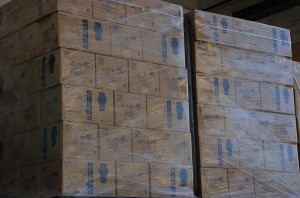
(Photo) Radioactive sewage sludge storaged at sewage plant. Posted by Fukushima prefectural government. 

High level of I-131 was measured for 11 days this January in dry sewage sludge, Fukushima prefectural government announced on 2/26/2016.

According to the prefectural government, the sewage plant is in Da-te District of Fukushima prefecture.

The highest density was 648.1 Bq/Kg. It was continuously detected from 1/21 to 1/31/2016. The data of February has not been published yet.

Along with I-131, Cs-134/137 density also increase and became the highest, which was 111 Bq/Kg on the same day when I-131 density became the highest.

Both of the highest densities were detected about 1 week after the rain (57.0 mm) to strongly implies the possibility that the discharged radioactive material is carried by the wind and fall with rain.

http://www.pref.fukushima.lg.jp/uploaded/attachment/153121.pdf

http://fukushima-diary.com/2016/03/650bqkg-of-i-131-still-measured-from-sewage-sludge-of-fukushima/

— Fukushima water receives international Monde gold award in 2015 and 2016 for its taste

International collusion at every level.

Reported on Fukushima Diary

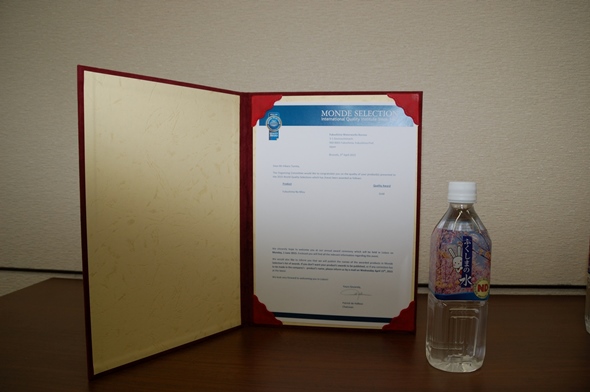
Fukushima tap water is named “Fukushima water” by the city government and obtained “Monde Selection” in 2015 and 2016 for its taste.

From Fukushima Waterworks Bureau:

モンドロゴ(ブルー)2015

056

https://www.city.fukushima.fukushima.jp/suidou/?p=7982

From

Monde Selection — International Institute for Quality Selection

Our Mission:

Founded in 1961, Monde Selection’s mission is to test consumer products and grant them a bronze, silver, gold or grand gold quality award.

This quality label, awarded by a totally independent professional jury, offers the consumer and the producer numerous advantages.

Your Benefits:

A Monde Selection quality label offers undeniable advantages:

  • It BOOSTS SALES as consumers undeniably prefer a labelled product
  • It offers FREQUENT EXTERNAL CONTROL of the quality of your products and rewards your production team
  • It helps to POSITION YOUR PRODUCT and measure the national and international level of your competitors
  • It helps your company TO PROMOTE YOUR PRODUCT on national and international markets

http://www.monde-selection.com/


— La municipalité de Fukushima fait don de 10 000 bouteilles d’eau du robinet à celle de Kumamoto

Fukushima Diary
21-4-2016

Le 18 avril 2016, le Bureau des stations hydroliques de la municipalité de Fukushima a donné 10 000 bouteilles d’eau de leurs robinet à la municipalité de Kumamoto.

La ville de Kumamoto est une des principales zones sinistrées des séismes de 2016 de Kumamoto.
L’eau du robinet de Fukushima est baptisée “Eau de Fukushima” par sa municipalité et a obtenu, en 2015 et 2016 et pour son goût, le label “Sélection Mondiale”.

2 Fukushima city government donated 10,000 bottles of tap water to Kumamoto city

056

https://www.city.fukushima.fukushima.jp/suidou/?p=15191
https://www.city.fukushima.fukushima.jp/suidou/?p=7982

http://fukushima-diary.com/2016/04/fukushima-city-government-donated-10000-bottles-of-tap-water-to-kumamoto-city/

— Fukushima city government donated 10,000 bottles of their tap water to Kumamoto city

From Fukushima Diary

On 4/18/2016, Fukushima city Waterworks Bureau donated 10,000 bottles of their tap water to Kumamoto city.

Kumamoto city is one of the main disaster areas of 2016 Kumamoto earthquakes.

Fukushima tap water is named “Fukushima water” by the city government and obtained “Monde Selection” in 2015 and 2016 for its taste.

056

https://www.city.fukushima.fukushima.jp/suidou/?p=15191

https://www.city.fukushima.fukushima.jp/suidou/?p=7982

http://fukushima-diary.com/2016/04/fukushima-city-government-donated-10000-bottles-of-tap-water-to-kumamoto-city/

— Researcher asks for investigative help to verify major nuclear accident(s) in 2016 and cover-up

From Allegedly Apparent
May 1, 2016

Request for Investigative Assistance! WANTED: Verification of MAJOR Nuclear Accident(s) in 2016: WHEN, WHERE, HOW BAD, and WHO is covering it up?

https://goo.gl/ZYEdai — short link

Excerpt on detections:

Ruthenium-103, mid-January 2016, Southern Norway
Cesium-137, early/mid-March 2016, Far-Northern Finland
Tellurium-103, late April 2016, Northern Germany

https://allegedlyapparent.wordpress.com/2016/05/01/request-for-investigative-assistance-wanted-verification-of-major-nuclear-accident-in-2016-when-where-how-bad-and-who-is-covering-it-up/

— Tellurium-132 detected in Northern Germany

Where is this coming from?

From Allegedly Apparent

April 26, 2016

Shortlink:   http://wp.me/puwO9-7M9  Please share widely.

Excerpts:

The sampling location, Seehausen, Deutschland (see map, below) is over 100 km from the nearest nuclear plant…

Tellurium-132’s  is a major short-lived FISSION PRODUCT, with a half-life of only 3.2 days, making it a tell-tale sign of a leaking ACTIVE reactor...

Magnitude of detection over 100x larger than after Fukushima

See this article and charts at 

https://allegedlyapparent.wordpress.com/2016/04/26/tellurium-132-detected-in-northern-germany/

— Nuclear power plant near Munich attacked by two viruses

From La-Kabylie

May 1, 2016
Author: Djeferson Maurice

The company says it’s stepping up security after the incident.

Gundremmingen is around 120km (75m) northwest of Munich and the plant is Gemany’s most elevated yield power station.

W32.Ramnit allows hackers access to files and, potentially, physical control over systems; terrorists could access the information and use it to build a radioactive “dirty” bomb. It included Conflicker, a worm first detected in 2008 created to steal user credentials, personal financial data, and turn infected computers into “bots” to carry out distributed denial of service (DDoS) attacks. It is able to spread through networks and by copying itself onto removable data drives, Symantec said.

In a statement, the power plant Kernakraftwerk Gundremmingen GmbH (KGG) noted that the technical components used for system controls are detached from the Internet. “We saw the example of the blast furnace being destroyed by a malware attack (disclosed by Germany’s Federal Office for Information Security); there was Stuxnet – malware allegedly created to physically destroy nuclear enrichment facilities in Iran”.

The BSI was not immediately available for comment.

According to Mikko Hypponen, chief research officer for Finland-based F-Secure, various types of computer viruses can be found in industrial computer networks quite frequently, but are usually harmless.

“Operators and regulators have to understand that in an age when we see more than 310,000 new samples of malware a day, some of those samples might damage systems they were never meant to be aimed at”.

Because the plane runs a different operating system, nothing would befall it. But it would pass the virus on to other devices that plugged into the charger. The viruses were discovered in the B unit of Gundremmingen in a computer system retrofitted in 2008 with data visualisation software used with equipment for moving nuclear fuel rods.

After Japan’s Fukushima nuclear disaster five years ago, concern in Germany over the safety of nuclear power triggered a decision by the government to speed up the shutdown of nuclearplants.

Computer systems of a German nuclear power plant have been found to be infected with viruses, although no harm has been done as the systems were isolated from the internet.

http://la-kabylie.com/2016/05/01/nuclear-power-plant-near-munich-attacked-by-two-viruses/

Posted under Fair Use Rules.

— California Senate Bill 968 supporting PG&E’s Diablo Canyon faces sharp opposition

Diablo Canyon nuclear power plant faces increasing calls for closure. It is the only power generating nuclear plant currently operating in California. Its problems have been ongoing from the beginning. It is at daily risk from the four earthquake faults in the vicinity. The many frightening safety violations there by Pacific Gas and Electric and the NRC whistleblower exposé that the plant is out of compliance have caused alarm bells. Recent comments by Lieutenant Governor Gavin Newsom on the California Lands Commission mean Diablo Canyon’s future is being questioned in Sacramento.

But in February, Sen. Bill Monning introduced Senate Bill 968, co-written by Sen. Katcho Achadjian (San Luis Obispo) and Assemblywoman Hannah-Beth Jackson (Santa Barbara-Ventura), calling for a study of the adverse economic effects of closing Diablo Canyon. Many profit by its continued operation. The study would be funded by the public. The bill and its unbalanced study has encountered strong opposition from environmental and health organizations. Though Monning has now amended the bill to add ‘beneficial’ economic effects from a closure to the investigation, this seems merely a cosmetic change. The intent of the authors and this bill is clear.

Sen. Monning and co-authors state they want an independent evaluation, but the California Public Utilities Commission – an agency notorious for biasing results and ignoring unwanted conclusions – will oversee the selection. Furthermore in 2011, Monning as Assemblyman helped choose, and then affirmed findings of, the California Council on Science and Technology on Smart Meters. CCST was a supposedly independent group, but flaws in the review panel, the data, and the report were exposed by state health officials, scientists, and medical experts. However, Monning stood firm, despite what was widely known about Smart Meter problems, despite formal comments to the CPUC on overbilling and health issues, and despite public testimony to the Commission and Monning’s own office of the harm being inflicted by Smart Meters. CCST’s pro-industry report gave cover to PG&E and other utility companies for the continued roll-out of the very dangerous and controversial meters.

Bill Monning has proven a reliable supporter for utility company initiatives and Democratic Party positions and backers, despite his former position as Executive Director for the International Physicians for Social Responsibility. The San Francisco Bay and Los Angeles Chapters of Physicians for Social Responsibility called their decision to oppose this bill and its author “painful” because of Monning’s previous affiliation with their group, but they felt they had no choice.

PSR reluctantly has concluded that this bill would be at variance with the fundamental principle “do no harm”. By calling on PG&E to submit an analysis of the supposedly adverse economic impacts of closing the plant at the end of its designed life with no discussion of impacts of a Fukushima-type disaster were the plant to keep running, the study would amount to a piece of advocacy for continued operation of this dangerous facility.

Each Diablo unit contains 1000 times a long-lived radioactivity of the Hiroshima bomb. Each year Diablo produces enough plutonium for hundreds of nuclear weapons as well as waste toxic for half a million years.

The plant was built based on the assumption there were no active earthquake faults within 30 kilometers. Now we know there are 4. It is a catastrophe waiting to happen.

The public should not be forced to pay as taxpayers or ratepayers for a wasteful, unbalanced, and unnecessary report that may have the effect of implicitly pushing for the continuation of these risks. Thank you.

Monning: “One slight correction on the opposition testimony. We do remain open to working with them. This would not be a study conducted by PG&E. It would be supported by an independent study.”

The economic and environmental damage that Diablo Canyon inflicts on San Luis Obispo County now and on the ocean now is not considered by Sen. Monning and Co.. And “a catastrophe waiting to happen” decimating all industry and population centers within many miles is simply not a part of their equation, economic or otherwise – a startling realization. It is especially surprising that Senator Jackson co-authored this bill, since her district does not have the economic gain that SLO County enjoys, and both of the counties she represents — Santa Barbara and Ventura — would suffer terrible impacts if Diablo Canyon underwent an accident. Ventura County was impacted by the Santa Susanna Field Laboratory’s multiple nuclear accidents starting in the 1950s. Why would Sen. Jackson risk more nuclear danger?

Given Sen. Monning and co-authors’ intent for his bill, it is doubtful that an evaluative group would do anything other than rubberstamp the original goal — to show that closing Diablo Canyon would cause adverse economic impacts to San Luis Obispo County (and also, to PG&E investors) – and thereby slow any process to close the plant.

When Monning states that the bill’s authors remain open to working with the groups in opposition, one thing is clear: for the authors, these environmental and health groups are the opposition. The authors are against reason, against the science, and against public safety.

Below is an unofficial transcript of the May 2 Senate Appropriations Committee hearing. The links to the video are here:http://senate.ca.gov/media-archive – Videos, May 2, 2016 Appropriations Comm hearing

http://vod.senate.ca.gov/videos/2016/20160502_Appropriations_high.mp4

Appropriations Committee hearing, May 2, 2016

SB 968 goes from 10:20 – 17:28 on the video.

SB 968 – Diablo Canyon

Sen. Monning: Good morning, Chair, members.

Senate Bill 968 requires an economic assessment of the adverse and beneficial impacts that could occur in the event that the Diablo nuclear power plant shuts down. The economic assessment is an appropriate use of ratepayer funds, because allr atepayers have benefited from the energy generated from Diablo Canyon. There are past examples of ratepayers-funded studies only benefiting a single region.

Even if there is disagreement on this point, the actual impact to ratepayers will be de minimis.

San Luis Obispo’s economy is heavily reliant on Diablo Canyon which is why an independent accurate assessment to help identify ways to mitigate the impacts is indeed prudent.

I along with Asm. Achadjian have a duty to protect the region that we represent from economic harm, and SB 968 is a means for the San Luis Obispo community to plan and discuss in the event of the plant’s closure. I recognize this is a candidate for suspense and would urge an aye vote at the appropriate time. And we have a couple of witnesses in support. Thank you.

In support:

1 — Derek ? on behalf of the San Luis Coastal Unified School District. This is a school district that encompasses the power plant and surrounding region and so it’s really impacted by the local economy that’s brought to the area by PG&E and the power plants.

This nexus we think with state funding here is the fact that when the local economy becomes depressed because of a sudden instance like the closure of a power plant, we’d see an augmentation in state funding required under the local control funding formula and our unique funding system here in California. So we think that some point, there could bee a big augmentation devoted to this very school district and surrounding area, given its $80 million dollar annual operating budget and the fact that it might fall out of basic aid status. And so we urge you to support the bill.

2 — Good morning, Chair, members. Karen Lang (?) of the San Luis Obispo County Board of Supervisors. This county collects almost $26 million dollars in property taxes from the existence of the plant. Obviously that goes to all the tax entities including the school district. With concerns about any sudden or over time closure of the plant, and so a third party analysis would be really helpful we think and we urge your aye vote when the time comes.

Witness in support:

In opposition:

1 — I am Molly Johnson. I am here to present the opposition of more than 30 environmental and other health organizations including Public Citizen, Greenpeace, LA and San Francisco Chapter of Physicians for Social Responsibility, San Luis Obispo Mothers for Peace, Northern Band Chumash Council

We remain troubled by the bill’s one-sided nature although it is getting better, and we are working with to continue that, Uit still focuses on adverse economic rather than a balanced, and we would like to it more balanced.

We do see that there has been an amount put to the bill which we did not see until just a little bit ago. So even though these matters are now touched upon by the staff report, we feel that this still is a wasteful expense unless it is a balanced bill. Thank you.

2 — Good morning. I am Tabez Zadi (sp?) and am appearing on behalf of the San Francisco Bay and Los Angeles Chapters of Physicians for Social Responsibility which has long worked to address nuclear risks. And Sen. Monning once served as Executive Director of PSR’s parent international physician’s organization.

And PSR’s opposition to his bill on Diablo Canyon is thus painful and hasn’t been entered into lightly. PSR reluctantly has concluded that this bill would be at variance with the fundamental principle “do no harm”. By calling on PG&E to submit an analysis of the supposedly adverse economic impacts of closing the plant at the end of its designed life with no discussion of impacts of a Fukushima-type disaster were the plant to keep running, the study would amount to a piece of advocacy for continued operation of this dangerous facility.

Each Diablo unit contains 1000 times a long-lived radioactivity of the Hiroshima bomb. Each year Diablo produces enough plutonium for hundreds of nuclear weapons as well as waste toxic for half a million years.

The plant was built based on the assumption there were no active earthquake faults within 30 kilometers. Now we know there are four. It is a catastrophe waiting to happen.

The public should not be forced to pay as taxpayers or ratepayers for a wasteful, unbalanced, and unnecessary report that may have the effect of implicitly pushing for the continuation of these risks. Thank you.

Monning: One slight correction on the opposition testimony. We do remain open to working with them. This would not be a study conducted by PGE&. It would be supported by an independent study. With that again, I would request at the appropriate time an aye vote.

——————-

More information:

http://mothersforpeace.org/blog/29-gaps-in-excellence-in-2014

http://nonukesca.net/?p=539

http://www.foe.org/news/news-releases/2015-03-diablo-pge-secretly-used-wrong-data-for-safety-equipment#sthash.8DQl1ReI.dpuf

https://healfukushima.org/2016/02/29/take-action-on-diablo-canyon-npp-tell-california-state-lands-commission-to-do-full-ceqa-review/

http://mothersforpeace.org/blog/topics-to-address-at-august-5-2015-nrc-meeting-in-slo

http://www.ktvu.com/news/news/ap-exclusive-expert-calls-diablo-canyon-shutdown/ng8Tj/

http://lompocrecord.com/news/opinion/mailbag/hartmann-nuke-risks-oil-trains/article_9f1703e4-4a34-5f16-997c-6be468a26bc9.html