From the Santa Susanna Field Laboratory Work Group

|
|
|
||
|
From the Santa Susanna Field Laboratory Work Group
|
|
|
||
|
From ENE News
February 21, 2017
Arnie Gundersen, former nuclear engineer (emphasis added), Feb 2, 2017: “When I went to school, the saying was ‘dilution is the solution to pollution,’ and that’s what the Japanese believe. If they dump [radioactive water from Fukushima Daiichi] on their side and it floats over to the West Coast of the U.S. — the Pacific’s a big place — it’ll dilute out. I don’t think that’s appropriate… people are going to die. Regardless of how low the radiation is, it does cause cellular damage and cancer. So if you spread it out in a big body of water, the concentration goes down, but on the other hand, you’ve got a couple billion people exposed to it because they’re on the edge of that big body of water. So the concentration is down but the population is up and you’re still going to get cancer; it’s inevitable.”
Dr. Helen Caldicott, Feb 13, 2017: As the water flows beneath the damaged reactors, it immerses the three molten cores and becomes extremely radioactive as it continues its journey into the adjacent Pacific Ocean. Every day since the accident began, 300 to 400 tons of water has poured into the Pacific where numerous isotopes including cesium 137, 134, strontium 90, tritium, plutonium, americium and up to 100 more, enter the ocean and bio-concentrate by orders of magnitude at each step of the food chain… tuna, salmon and other species found on the American west coast now contain some of these radioactive elements… [Fukushima Daiichi] will continue to pour water into the Pacific for the rest of time…
Fox News, Feb 8, 2017: Adam Housley, who reported from the area in 2011 following the catastrophic triple-meltdown, said… small levels of radiation are still being detected off the coasts of California and Oregon and scientists fear it could get worse. “The worry is with 300 tons of radioactive water going into the Pacific every day, what is that doing to the Pacific Ocean?” said Housley…
Fox News video transcript excerpts, Feb 8, 2017: Nearly 300 tons of radioactive water is dumped into the Pacific Ocean each and every day… There is still radiation being detected off the west coast of California and Oregon… The worry is with 300 tons of radioactive water going in every day to the Pacific — what is that doing to the Pacific Ocean?… We really don’t know what this radioactive water is doing to the Pacific I think a lot of people are very concerned about that…. As we know that water moves toward the west coast of the US.”
Watch the FOX News broadcast here
There are various inaccuracies in the Fox report:
What’s important is that mainstream news is covering this and the ocean contamination as a very important and ongoing event that can also impact the West Coast of America. That is a change.
From ENE News
February 20, 2017
The Aviationist, Feb 19 2017 (emphasis added): U.S. Air Force deploys WC-135 nuclear sniffer aircraft to UK as spike of radioactive Iodine levels is detected in Europe… Along with monitoring nuke testing, the WC-135 is used to track radioactive activity as happened after the Chernobyl nuclear plant disaster in the Soviet Union in 1986 and Fukushima incident back in 2011… As of yet, there has been no official statement from the U.S. military about the reasons why such nuclear research aircraft was deployed there. However, many sources suggest the aircraft was tasked with investigating the spike in Iodine levels detected in northern Europe since the beginning of January… no one seems to know the reason behind the released Iodine-131…
Barents Observer, Feb 19, 2017: … radioactive Iodine-131 of unknown origin was in January detected over large areas in Europe. Since the isotope has a half-life of only eight days, the detection is a proof of a rather recent release. Where the radioactivity is coming from is still a mystery… Iodine-131 in the air could come from an incident with a nuclear reactor… Someone out there knows why the radioactivity was spread over larger areas of Europe… Nuclear installations [where] radioactivity was first discovered, includes nuclear power plants in Finland, Sweden and Russia… The source could as well come from even further away installations.
IRSN (France’s Radioprotection and Nuclear Safety Institute), Feb 13, 2017: Iodine-131 (131I), a radionuclide of anthropogenic origin, has recently been detected in tiny amounts in the ground-level atmosphere in Europe. The preliminary report states it was first found during week 2 of January 2017 in northern Norway. Iodine-131 was also detected in Finland, Poland, Czech Republic, Germany, France and Spain, until the end of January. Iodine-131 is a radionuclide with a short half-life (T1/2 = 8.04 day). The detection of this radionuclide is proof of a rather recent release… the origin of which is still unknown… Lead-210 [concentration detected by IRSN peaked at 1600 µBq/m3 in January, four times higher than the usual mean value]… It must be pointed out that only particulate iodine was reported. When detectable, gaseous iodine is usually dominant and can be estimated to be 3 to 5 times higher than the fraction of particulate iodine. In France, particulate 131I reached 0.31 µBq/m3 and thus the total (gaseous + particulate fractions) can be estimated at about 1.5 µBq/m3.
From RT
February 23, 2017

Unveiled on Wednesday by the Nuclear Information Service (NIS), an independent nuclear watchdog, the report sheds light onto dozens of mishaps involving British nuclear weapons, featuring previously unreported accidents with potentially disastrous consequences. The in-depth study, which traces back all 65 years of the British nuclear program, arranges accidents into seven sections in accordance with their place of origin.
The report is based on the official findings, including the report on nuclear weapons safety written by Professor Sir Ronald Oxburgh, information revealed during parliamentary questions, obtained under the Freedom of Information Act as well as from whistleblowers, witnesses and other researchers.
The biggest group of all lists accidents that took place on nuclear-capable submarines, ships and aircraft. The causes for a total of 45 mishaps, including 24 that occurred with nuclear-armed submarines, range from collision and fires to the effects of lightning.
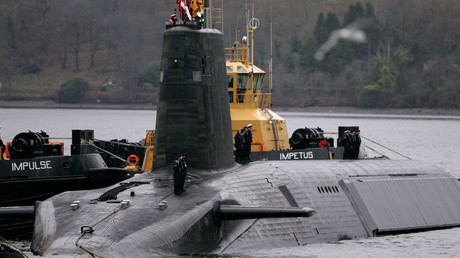
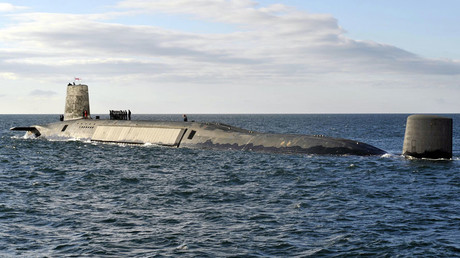
In one of the most notable accidents of that kind, Royal Navy submarine HMS Vanguard, which is capable of carrying up to 48 Trident nuclear warheads, collided with a French Le Triomphant submarine, which could be armed with about the same amount of TN75 nuclear warheads. The circumstances of the accident, which happened early February 2009 in the Atlantic Ocean, were hushed up at the time and still not known to the full.
Although the official investigation report into the collision came to the reassuring conclusion that “at no time was nuclear safety compromised and the Strategic Weapon System remained inside tolerable limits at all times”, whistleblowers’ accounts are far more daunting. An officer who was on board the UK submarine reportedly said “We thought, this it we’re all going to die,” while recalling the incident in the conversation with Royal Navy whistleblower William McNeilly.
Other case studies include a nuclear warhead carrier sliding off the rode into the ditch on January 10, 1987 in Wiltshire. The misfortune is described by the authors as “most visible” and “embarrassing” incident to date. Overall, 22 road transportation incidents, among them overturning of vehicles carrying nukes, have been cited in the report.
While only 14 accidents, linked to the faults in manufacturing and production process, are listed in the report, the most severe nuclear accident in UK history also falls into this category. The fire at the Windscale plant in 1957 led to massive release of radiation from graphite-moderated reactor that triggered “around 100 fatal cancers and around 90 non-fatal cancers.”
The report also lists 21 “security-related” incidents and eight incidents blamed onto the improper storage and handling of the nukes.
The comprehensive study, spanning over 100 pages under an awe-inspiring title “Playing with Fire,” blames the defense ministry for attempting to sweep the issue of nuclear safety under the carpet by concealing essential details of the incidents and downplaying their impact.
READ MORE: Trident whistleblower calls out MoD’s ‘lame attempt’ to excuse nuke malfunctions
The report argues that the official data released by the British Defense Ministry in 2003 which put the number of incidents at 27, is “far from a full list of all the accidents.”
It is not the first time the British military has been accused of covering up major issues with its nuclear deterrent. News on a failed Trident missile test, carried out off Florida coast in June 2016, sparked a new round of heated debates on the British nuclear program. The routine test performed by the HMS Vengeance in June 2016 from Port Canaveral went horribly wrong with the missile heading back to the US mainland. However, the UK authorities did not issue any statement on the failed test, reportedly, advised to refrain from sharing unfavorable data by US colleagues.
READ MORE: Trident nukes useless against today’s actual security problems – CND report
The Trident missile malfunction came just weeks before the UK parliament voted in favor of renewing controversial Britain’s Trident deterrent, estimated to cost some £40 billion.
In January, McNeilly, who was first to leak the details about the serious fire issues aboard Trident submarine, told RT that he has witnessed Trident “fail 3 out of 3 WP 186 Missile Compensating Tests.”
https://www.rt.com/uk/378340-nuclear-accidents-report-defense/
Posted under Fair Use Rules.
From Mothers for Peace
January 31, 2017
On Friday, January 27, Mothers for Peace through Ojai-based attorney Sabrina Venskus, submitted expert testimony to the California Public Utilities Commission showing that Diablo Canyon should be closed in 2019, not 2024. news release
One of Mothers for Peace’s expert witness, nuclear engineer Arnie Gundersen, chief engineer for Fairewinds Associates, Inc, provided testimony demonstrating unsafe and unreliable conditions at the plant. Arnie Gundersen testimony
Another expert witness is David D. Jackson who works with the Department of Earth, Planetary, and Space Sciences at UCLA. In his testimony, Dr. Jackson explains the many types of seismic damage to the plant in case of an earthquake. Among his assertions is that the substantial risk of earthquakes at Diablo Canyon nuclear plant has been underestimated, and that the seismic studies relied upon evaluate only a part of the risk which affects any decision of how long to continue operation of the two Diablo Canyon reactors. David D. Jackson testimony
————————————–
NEWS RELEASE
For Immediate Release
January 31, 2017
Contacts: Jane Swanson, spokesperson
(805) 440-1359
Linda Seeley, spokesperson
(805) 234-1769
On Friday January 27, San Luis Obispo Mothers for Peace (SLOMFP) through Ojai-based attorney Sabrina Venskus submitted expert testimony to the California Public Utilities Commission (CPUC) showing that Diablo Canyon should be closed in 2019, not 2024, because it is becoming unsafe and unreliable. SLOMFP’s expert witness is nuclear engineer Arnie Gundersen, chief engineer for Fairewinds Associates, Inc.
“Diablo Canyon was designed in the mid-1960s. Some of its parts are as dated as rabbit ears on a black and white TV. This atomic power reactor is old and tired, and it is not reliable or safe. The faster Diablo Canyon closes, the safer Californians will be,” stated Mr. Gundersen. Replacement costs for these outmoded parts at Diablo Canyon during the next 7 to 8 years are well in excess of a reasonable investment for a plant that is scheduled to shut down in 2024. Mr. Gundersen’s testimony also illuminates the degraded condition of tens of thousands of often neglected switches, plates, springs, shock absorbers, pipes, and other components of this aged atomic power reactor that are in danger of failing well before 2024.
The companies that own nuclear reactors have a tendency to defer needed maintenance and replacement of worn parts when permanent closure is imminent. Called “running to failure,” the operator tends to take a chance that the part won’t fail before the plant closes down. In an old car that is ready for the junkyard the owner won’t replace worn tires with ones that are guaranteed for 50,000 miles. Instead, he will take a chance that the tires won’t blow out before the old car is junked. If there’s a blowout in a tire, it can be hazardous. If there’s a failure of an essential component of a nuclear power plant, the costs of of replacement or of repair of damage can be huge.
Mr. Gundersen’s testimony, attached below, cites numerous parts and components at Diablo Canyon that have been listed in the 2017 Rate Case by Pacific Gas and Electric as in need of replacement. In Mr. Gundersen’s opinion, shutting the doors of the two reactors makes sense in 2019, before parts and components are forced to run to failure.
SLOMFP is commenting as a party to the California Public Utilities Commission’s proceedings on the Joint Proposal reached in June of 2016 between PG&E and several environmental groups and unions. SLOMFP has also submitted expert testimony to the CPUC by David Jackson, Ph.D. regarding seismic damage to the plant in case of an earthquake. SLOMFP has joined with Women’s Energy Matters of Marin County regarding timing and costs of replacing the needed power at Diablo Canyon with renewable energy, using the testimony of energy analyst Robert Freehling. SLOMFP compiled documents regarding the environmental effects of Once-Through Cooling on aquatic life around the facility. By co-sponsoring a portion of the testimony by the Alliance for Nuclear Responsibility’s attorney Al Pak, SLOMFP is objecting to PG&E’s request to recover the costs of its relicensing application filed with the Nuclear Regulatory Commission in 2009, but later withdrawn.

Sputnik
16.02.2017
Face à la perspective des coupures d’électricité tournantes en Ukraine, l’Union européenne s’est enfin aperçue du blocus commercial du Donbass, Kiev n’en recevant plus la houille anthracite absolument nécessaire pour les centrales ukrainiennes.
Le blocus commercial du Donbass viole les droits des Ukrainiens habitant sur les territoires qui échappent actuellement au contrôle de Kiev et risque de déclencher une crise énergétique dans le pays, prévient, dans un communiqué, la représentation de l’Union européenne en Ukraine, ajoutant que les organisateurs du blocus doivent le lever immédiatement.
« Le blocus du Donbass par l’Ukraine contredit l’approche inclusive envers les Ukrainiens habitant sur les territoires où les organes du pouvoir n’exercent pas provisoirement leurs fonctions. Les responsables du lancement du blocus doivent le lever immédiatement. Quant aux autorités, elles doivent régler ce problème au plus vite », lit-on dans le communiqué, cité par Sputnik.
Il s’agit en l’occurrence du blocus de la communication ferroviaire avec le Donbass qui se poursuit depuis fin janvier, quand un groupe d’anciens combattants des bataillons de volontaires, qui avaient participé aux hostilités dans le sud-est de l’Ukraine, et de députés de la Rada suprême (parlement ukrainien), a barré le trafic sur la ligne de chemin de fer. Les organisateurs du blocus ont affirmé que tout commerce avec les Républiques populaires autoproclamées de Donetsk (DNR) et de Lougansk (LNR) était illégal, et que toutes les marchandises transportées relevaient par conséquent de la contrebande.
Le blocus ferroviaire a débouché sur des problèmes de livraison de houille anthracite depuis le Donbass, engendrant des difficultés dans le secteur énergétique de l’Ukraine. Comme résultat, Kiev envisage d’ores et déjà des coupures d’électricité tournantes dans la plupart des régions du pays.
https://fr.sputniknews.com/international/201702161030122172-ue-blocus-donbass-levee-commerce-kiev/
To understand the situation in Ukraine —
http://www.globalresearch.ca/a-documentary-youll-likely-never-see-ukraine-on-fire-by-oliver-stone/5574843
http://www.globalresearch.ca/indepthreport/ukraine-report
From Fort Russ
|
February 16, 2017 – Fort Russ News –
– Sputnik France, translated by Tom Winter –
|
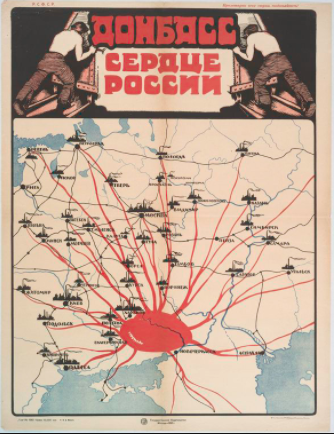
| “Donbass, the Heart of Russia.” 1921 poster has two coal miners at top, and the map serves well today to show how suicidal blocking the coal trains was. |
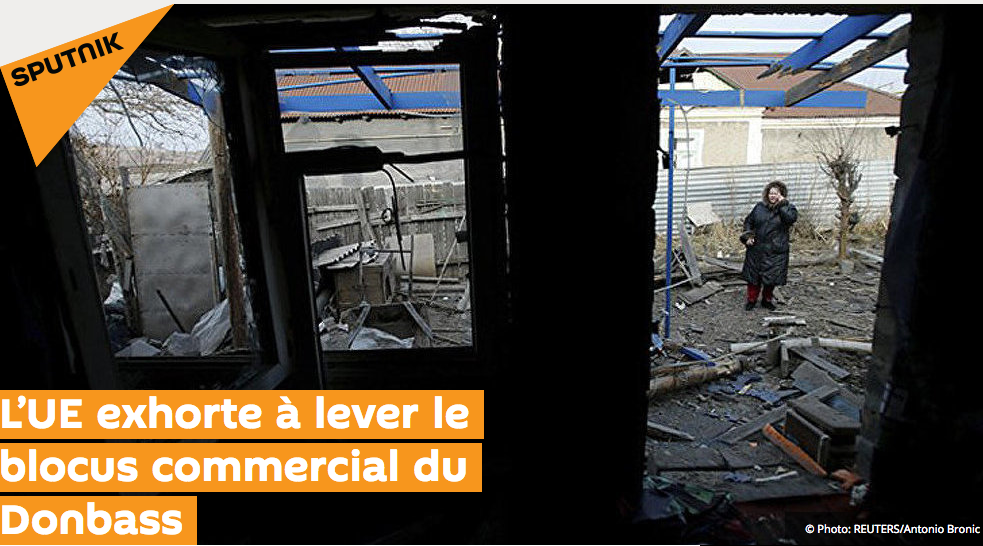 |
| This is Sputnik France’s illustration for this report. “The EU urges lifting the Commercial blockade of Donbass.” And the picture’s hidden label reads “Instead of aid, blockade.” |
Faced with the prospect of revolving power outages in Ukraine, the European Union has at last taken note of the commercial blockade of the Donbass, with Kiev no longer receiving the anthracite coal absolutely necessary for the Ukrainian power stations.
The commercial blockade of the Donbass
a) violates the rights of Ukrainians living in the territories that are currently beyond the control of Kiev, and
b) is likely to trigger an energy crisis in the country, warns the representation of the European Union in Ukraine, adding that the organizers of the blockade must immediately lift it.
The blockade of the railway connections with Donbass started at end of January, when a group of veterans of the volunteer battalions participating in the hostilities [on the side of the Kiev regime], with deputies of the Supreme Rada (Ukrainian parliament), blocked traffic on the railway line.
The organizers of the blockade claimed that any trade with the self-proclaimed People’s Republics of Donetsk (DNR) and Lugansk (LNR) was illegal, and that all goods transported were therefore contraband.
The railway blockade has led to problems in getting anthracite coal from the Donbass, causing difficulties in Ukraine’s energy sector. As a result, Kiev is already considering revolving power cuts in most parts of the country.
http://www.fort-russ.com/2017/02/eu-urges-lifting-rail-blockade-of.html
From Beyond Nuclear
February 9, 2017

Waste Control Specialists (WCS) in West Texas has applied to the U.S. Nuclear Regulatory Commission (NRC) for a license to construct and operate a “centralized interim storage facility” for 40,000 metric tons of commercial irradiated nuclear fuel, more than half of what exists in the U.S.
The “host” county, Andrews, has a large Latin American population, as well as many low income residents; so too does Eunice, New Mexico, just four miles from WCS across the state border.
This de facto permanent parking lot dump would launch 4,000 high-risk Mobile Chernobyl train car shipments, traveling through most states (see map, right; click here for a larger version).
A significant number would initially travel by barge on surface waters — Floating Fukushimas on lakes, rivers, and seacoasts — just to reach the nearest rail head. Dirty Bomb on Wheels security risks would abound.
NRC’s Webinar link will go live in real time. The toll free call-in/teleconference number is (800) 619-9084; Passcode 3009542.
Beyond Nuclear has assembled sample comments you can use to prepare your own, for oral submission at next week’s meeting, whether in-person or via Webcast/call-in, and/or for written submission by the March 13th deadline, via email, online Web form, or snail mail. Please take part, make comments, and spread the word! More
Public comments are needed in opposition to Waste Control Specialists (WCS) in West Texas, which seeks to open a de facto permanent parking lot dump for up to half the commercial high-level radioactive waste in the U.S., upstream of the Ogallala Aquifer, vital drinking and irrigation water supply for numerous High Plains states, from Texas to South Dakota.
The region around WCS has a high proportion of low income, Latin American residents, and is already heavily burdened with nuclear activities and dirty fossil fuel industries. WCS would launch unprecedented numbers of irradiated nuclear fuel train and barge shipments through many states.
Sample comments you can use to write your own:
Beyond Nuclear sample comments on a variety of subject matter:
Risks of De Facto Permanent Parking Lot Dump at WCS;
Risks of Loss of Institutional Control if De Facto Permanent Parking Lot Dumps are Abandoned, Containers Fail, and Release Catastrophic Amounts of Hazardous Radioactivity into the Environment;
Public comments previously submitted to the U.S. Department of Energy (DOE) for a proceeding re: Private Initiatives to carry out centralized interim storage can now also be used — “recycled,” so to speak! — to prepare comments to NRC re: WCS’s scheme (the comments to DOE were due Jan. 27, 2017);
Please see entries below on Beyond Nuclear’s Centralized Interim Storage website section, for more information.
From Beyond Nuclear
February 8, 2017
The U.S. Nuclear Regulatory Commission (NRC) has, at long last, published the announcement for its quickly approaching HQ meeting, at its Rockville, MD HQ, re: WCS, TX’s environmental scoping public comment opportunity, to be held on Thursday, February 23, 2017. Please attend in person if you can, or by Webcast/Teleconference Call-In. Please pre-register in advance to make oral public comments for the official record, raising various concerns in opposition to WCS’s application.
NRC’s announcement is posted at: https://www.nrc.gov/pmns/mtg?do=search.results&pageno=1&StartDate=2/23/2017&EndDate=2/23/2017
Here are those details and additional links:
Date/Time: 02/23/17, 1:00PM – 4:00PM
Purpose:
To conduct a public scoping meeting for the NRC’s Environmental Impact Statement (EIS) for Waste Control Specialist LLC (WCS) license application to construct and operate a consolidated interim storage facility (CISF) for spent nuclear fuel at the WCS site in Andrews County, Texas. At the meeting, the NRC will receive comments from the public on the appropriate scope of issues to be considered in, and the content of the EIS. [more…]
Participation: Category 3
Teleconference/Webcast
[Here is the Webinar info.:
Webinar
Webinar Link:https://video.nrc.gov/
Webinar Meeting Number:None
Webinar Password:None
Here is the teleconference/call-in info.:
Teleconference
Bridge Number: 8006199084
Passcode: 3009542]
[Yes, comments can be submitted orally via the Webcast/Call-in options. Please sign up in advance — see below — and do make comments!]
Location [yes, in person attendance is an option, and oral comments can be made there]:
NRC One White Flint North
11545 Rockville Pike
Commission Hearing Room
Rockville MD
NRC Contacts:
James Park
301-415-6954
Debbie Miller
301-415-7359
From NRC’s Public Meeting Schedule: Meeting Details link: https://www.nrc.gov/pmns/mtg?do=details&Code=20170198
Members of the public who will attend the meeting in person, and those wishing to present oral comments [via Webcast and/or teleconference/call-in] may register in advance by contacting Mrs. Debra Miller at (301) 415-7359, or by email to Debra.Miller@nrc.gov, no later than February 21, 2017. Those comments may be limited by the time available, depending on the number of persons who wish to speak. Please provide name and company or organization for each attendee. Arrive 30 minutes early to allow time for security registration.
[Please see entries below, for more background details and links to additional information. Please attend by watching the webcast and/or calling in. Please sign up to make comments at the meeting. Additional written comments can be made until March 13th. Legal intervention deadline is March 31st (or forever hold your peace). See entries below for links to more info.
See http://www.beyondnuclear.org/centralized-storage/
Articles are in Russian. As they are translated, they will be posted.
From Fort Russ:
Ukrainian energy crisis: state of emergency declared
February 15, 2017 –
– Rusvesna – Translated by James Harmon
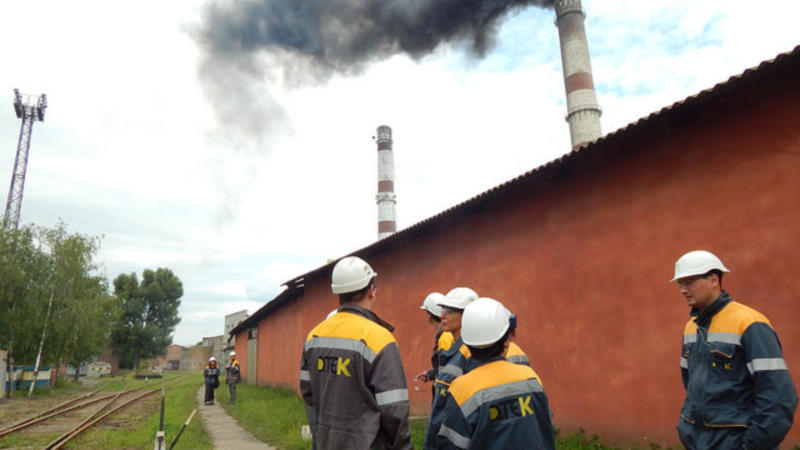
The Cabinet of Ministers declared a state of emergency today within the Ukrainian energy system.

 Heal Fukushima