— Dans le Pacifique, la radioactivité de la centrale de Fukushima revient sur le Japon

Fukushima Diary
3-5-2016

Le Pr. Aoyama de l’Institut de Radioactivité Environnementale de l’Université de  Fukushima déclare que la radioactivité déversée par la centrale de Fukushima dans le Pacifique en a fait le tour pour revenir au large du Japon.

Il a procédé à des analyses de l’eau de mer en 71 points entre novembre 2015 et février 2016. Ces analyses sont partiellement terminées et montrent que la radioactivité s’est répandue au large du Sud-Ouest du Japon. Ils ont relevé 2 Bq/m³ de Cs-137 dans l’eau de mer au Sud-ouest de Kyushu. Ils ont même eu 1,83 Bq/m³ au large de la côte Ouest du Japon.
0,38 Bq/m³ de Cs-134 ont aussi été isolés prouvant qu’il s’agit bien de la catastrophe de Fukushima.
On pense que les Cs-134/137 déversés ont voyagé vers l’Est dans le Pacifique Nord. Ils ont ensuite, pendant 2 à 3 ans, été transportés vers le Sud puis l’Ouest pour revenir au Japon.

Il déclare possible que la radioactivité se mette à augmenter à partir de maintenant.

http://www.asyura2.com/16/genpatu45/msg/611.html

http://fukushima-diary.com/2016/05/radioactive-material-from-fukushima-plant-coming-back-to-japan-in-the-pacific/

— Radioactive material from Fukushima plant coming back to Japan in the Pacific

Fukushima Diary

, May 3, 2016

Prof. Aoyama from Institute of Environmental Radioactivity of Fukushima University reported that the radioactive material discharged from Fukushima plant circulated in the Pacific to come back to Japan offshore.

He implemented seawater analysis at 71 points from 11. 2015 to 2. 2016. The analysis is partially completed to show radioactive material has spread to the South West offshore of Japan. 2 Bq/m3 of Cs-137 was detected in seawater from South West offshore of Kyushu. 1.83 Bq/m3 was detected even offshore of the west coast of Japan.

0.38 Bq/m3 of Cs-134 was also measured to prove this is from Fukushima accident.

It is assumed that the discharged Cs-134/137 travelled to the east in the Northern Pacific. It was carried to the South and West to come back to Japan by taking 2 ~ 3 years.

He comments it is possible that the density of radioactive material increases from now.


http://www.asyura2.com/16/genpatu45/msg/611.html

http://fukushima-diary.com/2016/05/radioactive-material-from-fukushima-plant-coming-back-to-japan-in-the-pacific/

— Toujours 650Bq/kg d’Iode 131 dans une station d’épuration de Fukushima

Fukushima Diary

26-3-2016

650Bq/Kg of I-131 still measured from sewage sludge of Fukushima

(Photo) Boues d’épuration radioactives stockées à la station d’épuration. Publiée par la préfecture de Fukushima.

Le 26 février 2016 la préfecture de Fukushima avait déclaré qu’en janvier dernier, une forte radioactivité à l’iode 131 était relevée pendant 11 jours dans une station d’épuration.

Selon la préfecture de Fukushima, la station d’épuration est dans le district de Da-te de la préfecture.
Le record a été de 648,1 Bq/kg. Cette radioactivité a été relevée sans interruption du 21 au 31 janvier 2016. Les relevés de février ne sont pas encore publiés.
En même temps que l’Iode 131, la radioactivité en Cs 134/137 a aussi augmenté jusqu’à atteindre 111 Bq/kg le jour où l’I-131 atteignait son record.
Ces deux records ont été relevés environ une semaine après des pluies (57 mm), ce qui suggère fortement que les matières radioactives en cause ont été transportées par le vent puis soient retombées avec la pluie.

http://www.pref.fukushima.lg.jp/uploaded/attachment/153121.pdf

http://fukushima-diary.com/2016/03/650bqkg-of-i-131-still-measured-from-sewage-sludge-of-fukushima/

— 650Bq/Kg of Iodine-131 still measured from Fukushima sewage sludge

From Fukushima Diary

(Photo) Radioactive sewage sludge storaged at sewage plant. Posted by Fukushima prefectural government. 

High level of I-131 was measured for 11 days this January in dry sewage sludge, Fukushima prefectural government announced on 2/26/2016.

According to the prefectural government, the sewage plant is in Da-te District of Fukushima prefecture.

The highest density was 648.1 Bq/Kg. It was continuously detected from 1/21 to 1/31/2016. The data of February has not been published yet.

Along with I-131, Cs-134/137 density also increase and became the highest, which was 111 Bq/Kg on the same day when I-131 density became the highest.

Both of the highest densities were detected about 1 week after the rain (57.0 mm) to strongly implies the possibility that the discharged radioactive material is carried by the wind and fall with rain.

http://www.pref.fukushima.lg.jp/uploaded/attachment/153121.pdf

http://fukushima-diary.com/2016/03/650bqkg-of-i-131-still-measured-from-sewage-sludge-of-fukushima/

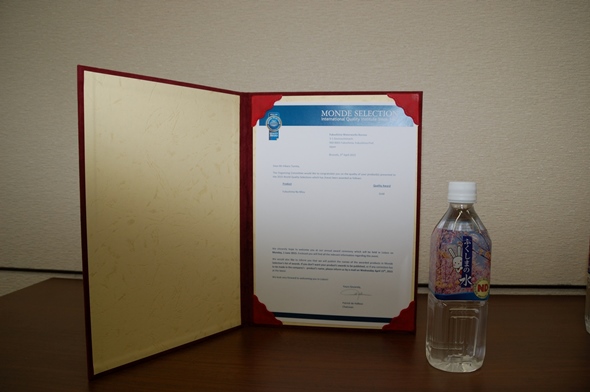
— Fukushima water receives international Monde gold award in 2015 and 2016 for its taste

International collusion at every level.

Reported on Fukushima Diary

Fukushima tap water is named “Fukushima water” by the city government and obtained “Monde Selection” in 2015 and 2016 for its taste.

From Fukushima Waterworks Bureau:

モンドロゴ(ブルー)2015

056

https://www.city.fukushima.fukushima.jp/suidou/?p=7982

From

Monde Selection — International Institute for Quality Selection

Our Mission:

Founded in 1961, Monde Selection’s mission is to test consumer products and grant them a bronze, silver, gold or grand gold quality award.

This quality label, awarded by a totally independent professional jury, offers the consumer and the producer numerous advantages.

Your Benefits:

A Monde Selection quality label offers undeniable advantages:

  • It BOOSTS SALES as consumers undeniably prefer a labelled product
  • It offers FREQUENT EXTERNAL CONTROL of the quality of your products and rewards your production team
  • It helps to POSITION YOUR PRODUCT and measure the national and international level of your competitors
  • It helps your company TO PROMOTE YOUR PRODUCT on national and international markets

http://www.monde-selection.com/


— La municipalité de Fukushima fait don de 10 000 bouteilles d’eau du robinet à celle de Kumamoto

Fukushima Diary
21-4-2016

Le 18 avril 2016, le Bureau des stations hydroliques de la municipalité de Fukushima a donné 10 000 bouteilles d’eau de leurs robinet à la municipalité de Kumamoto.

La ville de Kumamoto est une des principales zones sinistrées des séismes de 2016 de Kumamoto.
L’eau du robinet de Fukushima est baptisée “Eau de Fukushima” par sa municipalité et a obtenu, en 2015 et 2016 et pour son goût, le label “Sélection Mondiale”.

2 Fukushima city government donated 10,000 bottles of tap water to Kumamoto city

056

https://www.city.fukushima.fukushima.jp/suidou/?p=15191
https://www.city.fukushima.fukushima.jp/suidou/?p=7982

http://fukushima-diary.com/2016/04/fukushima-city-government-donated-10000-bottles-of-tap-water-to-kumamoto-city/

— Fukushima city government donated 10,000 bottles of their tap water to Kumamoto city

From Fukushima Diary

On 4/18/2016, Fukushima city Waterworks Bureau donated 10,000 bottles of their tap water to Kumamoto city.

Kumamoto city is one of the main disaster areas of 2016 Kumamoto earthquakes.

Fukushima tap water is named “Fukushima water” by the city government and obtained “Monde Selection” in 2015 and 2016 for its taste.

056

https://www.city.fukushima.fukushima.jp/suidou/?p=15191

https://www.city.fukushima.fukushima.jp/suidou/?p=7982

http://fukushima-diary.com/2016/04/fukushima-city-government-donated-10000-bottles-of-tap-water-to-kumamoto-city/

— Researcher asks for investigative help to verify major nuclear accident(s) in 2016 and cover-up

From Allegedly Apparent
May 1, 2016

Request for Investigative Assistance! WANTED: Verification of MAJOR Nuclear Accident(s) in 2016: WHEN, WHERE, HOW BAD, and WHO is covering it up?

https://goo.gl/ZYEdai — short link

Excerpt on detections:

Ruthenium-103, mid-January 2016, Southern Norway
Cesium-137, early/mid-March 2016, Far-Northern Finland
Tellurium-103, late April 2016, Northern Germany

https://allegedlyapparent.wordpress.com/2016/05/01/request-for-investigative-assistance-wanted-verification-of-major-nuclear-accident-in-2016-when-where-how-bad-and-who-is-covering-it-up/

— Tellurium-132 detected in Northern Germany

Where is this coming from?

From Allegedly Apparent

April 26, 2016

Shortlink:   http://wp.me/puwO9-7M9  Please share widely.

Excerpts:

The sampling location, Seehausen, Deutschland (see map, below) is over 100 km from the nearest nuclear plant…

Tellurium-132’s  is a major short-lived FISSION PRODUCT, with a half-life of only 3.2 days, making it a tell-tale sign of a leaking ACTIVE reactor...

Magnitude of detection over 100x larger than after Fukushima

See this article and charts at 

https://allegedlyapparent.wordpress.com/2016/04/26/tellurium-132-detected-in-northern-germany/