• Comments to the NRC on Diablo Canyon relicensing

Comments submitted to the Nuclear Regulatory Commission
On Diablo Canyon Nuclear Power Plant re-licensing
Docket Nos. 50-275 and 50-323NRC-2009-0552

Given the earthquake faults, the ongoing radioactive emissions from the plant, and the hacking risk to the plant, as well as PG&E’s deplorable safety record and culture, Diablo Canyon must be immediately shut down and decommissioned. The danger to the ocean, to the West Coast, and the world from nuclear energy has been amply demonstrated with the ongoing disaster at Fukushima.

The NRC allows Diablo Canyon to continue operating despite holding other NPPs to much higher and stricter standards. The Union of Concerned Scientists reported last year that Diablo Canyon does not comply with federal safety standards.[i]

Despite the disclosure this year that PG&E used the wrong accident and earthquake data when building safety equipment, and has failed since 1984 to use updated data, the NRC allows Diablo Canyon to remain open.[ii]

Also disclosed was that PG&E and the NRC altered Diablo Canyon’s operating license so it would conform.

Diablo Canyon discharges huge amounts of tritium, strontium and cesium into the ocean continually. PG&E stated in 2014 that Diablo Canyon regularly discharges more tritium than Fukushima NPP in its melted down state is pouring into the ocean.

That water [in 2012] contained 3,670 curies of tritium, or 136 trillion becquerels, according to the company, almost three-and- a-half times the amount released from the Fukushima plant into the ocean in the period starting May 2011. The plant also discharged cesium-137 and strontium-90, though at lower levels than Fukushima.[iii]

Since it was estimated in June 2014 that 60 PBq of cesium-137 had been released into the ocean from Fukushima[iv], and TEPCO announced that 5 billion Bq of Strontium-90 are released daily into the ocean from Fukushima[v], the questions have to be asked:

  • How much less?
  • Does it really matter how much less when we are dealing with such virulent poisons, poisons that bioaccumulate up the food chain?

Strontium mimics calcium and is known as the bone seeker.

There are unknown normal airborne releases, as well as periodic high releases when the reactors are re-fueled. These releases are averaged over 365 days, rather than given as the figures per release[vi]. The rain-out amounts from Diablo Canyon emissions combined with Fukushima fallout can only be imagined.

This is very serious and ongoing radioactive contamination of the environment.

In addition, there is the hazard from the power plant’s reliance on grid power.

Arne Gundersen:

…the most likely type of a nuclear accident is caused by a loss of offsite power.  That is what happened at Fukushima:  the power system AROUND the plant broke down.  If that happens, not only will the plant not have power, but the street lights won’t work.  According to the NRC, the street lights DO work.  Not only that, but your home lighting won’t work and your radio and TV won’t work.  But according to the NRC, you will be able to contact the outside world by phones or by radio or by television.   But remember the most likely cause of a nuclear accident is loss of offsite power and that has NEVER been part of an emergency plan, assuming that all of that does not work.[vii]

There are increasing attacks to the power grid. PG&E has played a pivotal role in creating the so-called “Smart Grid”, which former CIA director James Woolsey calls a stupid grid because of its vulnerability[viii]. PG&E has also aggressively Installed wireless Smart Meters and encouraged network-connected Smart appliances, creating millions of vectors to the power grid and increasing exponentially the possibilities for hacking[ix].

These factors put the residents of the region in increased jeopardy. A hacked power grid disconnects essential power for keeping reactor cores and fuel pools cool. Without power, the power plant must rely on generators to turn on instantly at full power and sustain operation for as long as needed.

Fukushima’s troubles started before the tsunami. The earthquake cut off electrical power to the plant, and at least some of the generators failed when they were turned on. Journalist Greg Palast in Vulture’s Picnic has a long and detailed section on the vulnerability of generators as backup power.

A page from the notebook of an Emergency Diesel Generator expert, R.D. Jacobs, hired to monitor a test for a nuclear reactor’s back-up cooling system.

This is to record that on my last visit,….I pressed [a company executive] saying that we just did not know what the axial vibration of the crankshaft was doing to the [diesel] units. I was unable to impress him sufficiently.

The diesels were “tested” by turning them on for a few minutes at low power. They worked find. But R.D., a straight shooter, suspected problems. He wanted the motors opened and inspected. He was told by power company management to go to hell.

When we forced the plant builder [in Suffolk County, New York] to test the three Emergency Diesel Generators in emergency conditions, one failed almost immediately (the crankshaft snapped, as R.D.[Jacobs} predicted), then the second, then the third. We named the three diesels “Snap, Crackle, and Pop.”

…I knew that all these diesels were basically designed, or even taken from, cruise ship engine rooms or old locomotives. . I’m not an engineer, but I suspect a motor designed for a leisurely float n Bermuda is not fit for a life-and-death scramble. So, I asked [an industry insider], “They really can’t work at all, the diesels, can they?”

That’s when he introduced me to the phrase “crash start.”

On a ship, he explained, you would take half an hour to warm up the bearings, and then slowly build up to “critical” crankshaft speed, and only then add the “load.” the propeller…

That’s for sailing. But in a nuclear emergency, “the diesels have to go from stationary to taking a full load in less than ten seconds.”

Worse, to avoid having to buy additional diesels, the nuclear operators turbo-charge them, revving them to 4,000 horsepower in ten seconds when they are designed for half that output.

The result: snap, crackle, pop.

I learned that, at Fukushima, at least two of the diesels failed before the tsunami hit. What destroyed those diesels was turning them on. In other words, the diesels are junk, are crap, are not capable of getting up to full power in seconds, then run continuously for days….

”So, you saying emergency diesels can’t work in an emergency?”

“Actually, they’re just not designed for it.”

Vulture’s Picnic, p. 294-297

Scientific American had a very telling graphic with a computer keyboard, a time bomb, and a power plant[x].

I would not visit San Luis Obispo County nor would I live there because of this resident hazard.

The U.S. government is ultimately at fault for promoting these hazardous power plants in the first place. But even with safety regulations in place, the NRC clearly cannot police itself, and it certainly cannot provide even a bare minimum of safety for the nuclear power plants under its jurisdiction and the people who live in the vicinity.

It is lunacy to continue this extremely toxic method for generating electricity, when the current costs to society and the environment from its continuance are so high and go on permanently into the future. Solar is coming online in increasing levels, and Californians’ energy use has been dropping. The cost is too great to allow its continuance one more day.

Shut down Diablo Canyon now.


[i] http://www.ucsusa.org/news/press_release/diablo-canyon-report-0381.html

[ii] http://www.foe.org/news/news-releases/2015-03-diablo-pge-secretly-used-wrong-data-for-safety-equipment#sthash.8DQl1ReI.dpuf

[iii] http://www.telegram.com/article/20140203/NEWS/302039780/1052

[iv] http://www.nature.com/srep/2014/140304/srep04276/full/srep04276.html

[v] At press conference 8/25/14 http://www.tepco.co.jp/tepconews/library/archive-j.html

[vi] https://www.youtube.com/watch?v=Tk7xzg1T0kk&feature=player_detailpage#t=1574

[vii] http://fairewinds.com/content/white-house-nrc-recommend-50-mile-fukushima-evacuation-yet-insist-us-safe-only-10

[viii] http://www.youtube.com/watch?v=1lF3eywqD-I

[ix] http://www.smartgridnews.com/artman/publish/End_Use_Smart_Homes/Are-smart-homes-a-security-threat-to-electric-power-utilities-5914.html

http://www.forbes.com/sites/kashmirhill/2013/07/26/smart-homes-hack/

http://www.sfgate.com/technology/article/Security-lags-in-protecting-Internet-connected-5153837.php#photo-5734988

http://www.bloomberg.com/news/articles/2015-04-01/turkish-blackout-shows-world-power-grids-under-threat

“More and more attacks are targeting the industrial control systems that run the production networks of critical infrastructure, stealing data and causing damage,” said David Emm, a principal researcher at Moscow-based security company Kaspersky Lab Inc., which advises governments and businesses.

All power use was previously measured by mechanical meters, which were inspected and read by a utility worker. Now, utilities are turning to smart meters, which communicate live data to customers and the utility company. This opens up the systems to hackers…

“Introducing smart meters means you install access points to the electricity grid in private homes,” said Reinhard Gruenwald, an energy expert at the Office of Technology Assessment at the German Bundestag, a scientific institution advising German lawmakers. “You can’t physically protect those. If criminals are smart enough, they may be able to manipulate them.”

http://www.abs-cbnnews.com/business/tech-biz/07/16/14/smart-technology-could-make-utilities-more-vulnerable-hackers

http://www.csmonitor.com/USA/2011/1206/Cyber-security-Power-grid-grows-more-vulnerable-to-attack-report-finds

Massachusetts Institute for Technology — “Millions of new communicating electronic devices … will introduce attack vectors — paths that attackers can use to gain access to computer systems or other communicating equipment. That increase[s] the risk of intentional and accidental communications disruptions,” including “loss of control over grid devices, loss of communications between grid entities or control centers, or blackouts.”

[x] http://www.scientificamerican.com/article/power-hackers/
• Diablo Canyon scoping memo comments — due Aug. 31

Excerpts from the Federal Register, July 1, 2015

https://www.federalregister.gov/articles/2015/07/01/2015-15921/diablo-canyon-power-plant-units-1-and-2

Summary

On January 27, 2010, the U.S. Nuclear Regulatory Commission (NRC) notified the public of its opportunity to participate in the scoping process associated with the preparation of an environmental impact statement (EIS) related to the review of the license renewal application submitted by Pacific Gas and Electric Company (PG&E) for the renewal of Facility Operating Licenses DPR-80 and DPR-82 for an additional 20 years of operation at Diablo Canyon Power Plant (DCPP), Units 1 and 2. The current operating licenses for DCPP, Units 1 and 2 expire on November 2, 2024, and August 26, 2025, respectively. The scoping period closed on April 12, 2010. The NRC has decided to reopen the scoping process and allow members of the public an additional opportunity to participate.

DATES:

The comment period for the environmental scoping process published on January 27, 2010 (75 FR 4427) has been reopened. Comments should be filed no later than August 31, 2015.

II. Discussion

On December 22, 2014 (ADAMS Package No. ML14364A259), and February 25, 2015 (ADAMS Package No. ML15057A102), PG&E amended its ER to provide additional information identified by NRC staff as necessary to complete the review of the DCPP license renewal application. By letter dated April 28, 2015 (ADAMS Accession No. ML15104A509), the NRC staff issued a schedule for the remainder of the DCPP license renewal review. The purpose of this notice is to (1) inform the public that the NRC has decided to reopen the scoping process, as defined in 10 CFR 51.29, “Scoping-environmental impact statement and supplement to environmental impact statement,” and (2) allow members of the public an additional opportunity to participate. The comments already received by the NRC will be considered; reopening of the scoping process provides additional opportunity for the public to comment on issues that may have emerged since completion of the last scoping period.

The NRC will first conduct a scoping process for the supplement to the GEIS and, as soon as practicable thereafter, will prepare a draft supplement to the GEIS for public comment. Participation in the scoping process by members of the public and local, State, Tribal, and Federal government agencies is encouraged. The scoping process for the supplement to the GEIS will be used to accomplish the following:

  1. Define the proposed action, which is to be the subject of the supplement to the GEIS;
  2. Determine the scope of the supplement to the GEIS and identify the significant issues to be analyzed in depth;
  3. Identify and eliminate from detailed study those issues that are peripheral or that are not significant;
  4. Identify any environmental assessments and other ElSs that are being or will be prepared that are related to, but are not part of, the scope of the supplement to the GEIS being considered;
  5. Identify other environmental review and consultation requirements related to the proposed action;
  6. Indicate the relationship between the timing of the preparation of the environmental analyses and the Commission’s tentative planning and decision-making schedule;
  7. Identify any cooperating agencies and, as appropriate, allocate assignments for preparation and schedules for completing the supplement to the GEIS to the NRC and any cooperating agencies; andShow citation box
  8. Describe how the supplement to the GEIS will be prepared and include any contractor assistance to be used.

More information and links to documents at https://www.federalregister.gov/articles/2015/07/01/2015-15921/diablo-canyon-power-plant-units-1-and-2


• Jimmy Carter’s cancer risk history censored by news media

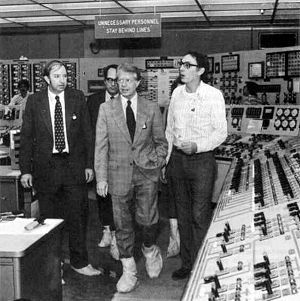
Jimmy Carter touring Three Mile Island,  April 1, 1979
Jimmy Carter touring Three Mile Island,
April 1, 1979
Courtesy of Wikipedia.org. Public domain.

Former President Jimmy Carter recently had cancer on his liver removed, and is now being treated for cancer on his brain.

Jimmy Carter helped cleanup a nuclear accident in Canada during the 1950s. As President, he toured Three Mile Island on the fourth day after the partial meltdown, while the accident was still ongoing. And he was part of then-Captain Hyman G. Rickover’s fledgling nuclear submarine program when he served in the Navy. These substantial radiation exposures are risk factors for cancer, but they aren’t mentioned in the (virtually identical) media reports dated August 20. One AP article stated his cancer is probably due to too much sun.

Experts say his lifelong activities may have increased his risk for skin cancer. He lives in the South, is fair-skinned and freckled, and through Habitat for Humanity and travel, has spent a lot of time outdoors, noted Anna Pavlick, co-director of the melanoma program at NYU’s Laura & Isaac Perlmutter Cancer Center.”            http://www.baynews9.com/content/news/baynews9/news/article.html/content/news/articles/cfn/2015/8/20/jimmy_carter_to_disc.html

Many think Jimmy Carter was just a peanut farmer who became President for one term, and then got involved with Habitat for Humanity. His career is much more extensive.

Carter graduated from the U.S. Naval Academy, served on submarines as a Navy officer, did graduate work at Union College (NY) in reactor technology and nuclear physics, and was senior officer of the pre-commissioning crew of the Seawolf, the second US nuclear submarine. He helped shut down and disassemble the Ontario Chalk River Experimental Reactor after it suffered a partial meltdown in 1952. This, plus his exposure at TMI in 1979, together with his exposures in Rickover’s program and in graduate school, are risk factors for his present cancers.

Carter himself seems unwilling to bring up this issue.

Cancers often have long latency periods and can take decades to develop.

Especially now that the Nuclear Regulatory Commission wants to declare “low-level” radiation exposure as beneficial, the lack of information on Jimmy Carter’s background and exposure is suspicious. With no information, there is no bad press for the nuclear industry, no derailing an industry-friendly NRC decision, and no reminders about Fukushima.

———————————-

Remember: NRC comments due September 8.

https://www.federalregister.gov/articles/2015/06/23/2015-15441/linear-no-threshold-model-and-standards-for-protection-against-radiation

Sources:

http://www.cartercenter.org/news/experts/jimmy_carter.html

https://en.wikipedia.org/wiki/Jimmy_Carter

https://en.wikipedia.org/wiki/Three_Mile_Island_accident

https://en.wikipedia.org/wiki/List_of_civilian_nuclear_accidents#1960s

Note: A 2007 New York Times article on the Carter family also sidestepped malathion and pesticide exposure as a reason for his family’s high death rate from pancreatic cancer.

http://www.nytimes.com/2007/08/07/health/07jimm.html?_r=1&


• Be afraid: Japan is about to do something that’s never been done before

From Zero Hedge, 8-8-15

By Tyler Durden

When the words “mothballed”, “nuclear”, and “never been done before” are seen together with Japan in a sentence, the world should be paying attention…

As TEPCO officials face criminal charges over the lack of preparedness with regard Fukushima, and The IAEA Report assigns considerable blame to the Japanese culture of “over-confidence & complacency,” Bloomberg reports,

Japan is about to do something that’s never been done before: Restart a fleet of mothballed nuclear reactors. 

The first reactor to meet new safety standards could come online as early as next week. Japan is reviving its nuclear industry four years after all its plants were shut for safety checks following the earthquake and tsunami that wrecked the Fukushima Dai-Ichi station north of Tokyo, causing radiation leaks that forced the evacuation of 160,000 people. 

Mothballed reactors have been turned back on in other parts of the world, though not on this scale — 25 of Japan’s 43 reactors have applied for restart permits. One lesson learned elsewhere is that the process rarely goes smoothly. Of 14 reactors that resumed operations after four years offline, all had emergency shutdowns and technical failures, according to data from the World Nuclear Association, an industry group. 

“If reactors have been offline for a long time, there can be issues with long-dormant equipment and with ‘rusty’ operators,” Allison Macfarlane, a former chairman of the U.S. Nuclear Regulatory Commission, said by e-mail.

In case you are not worried enough yet…

As problems can arise with long-dormant reactors, the NRA “should be testing all the equipment as well as the operator beforehand in preparation,” Macfarlane of the U.S. said by e-mail. Although the NRA “is a new agency, many of the staff there have long experience in nuclear issues,” she said. 

Kyushu Electric has performed regular checks since the reactor was shut to ensure it restarts and operates safely, said a company spokesman, who asked not to be identified because of company policy. 

“If a car isn’t used for a while, and you suddenly use it, then there is usually a problem. There is definitely this type of worry with Sendai,” said Ken Nakajima, a professor at Kyoto University Research Reactor Institute. “Kyushu Electric is probably thinking about this as well and preparing for it.”

It’s not the first time a nation has tried this..

In Sweden, E.ON Sverige AB closed the No. 1 unit at its Oskarshamn plant in 1992 and restarted it in 1996. 

It had six emergency shutdowns in the following year and a refueling that should have taken 38 days lasted more than four months after cracks were found in equipment.

*  *  *

Good luck Japan

http://www.zerohedge.com/news/2015-08-08/be-afraid-japan-about-do-something-thats-never-been-done

• Russia declassifies report on the aftermath of the US nuclear bombings of Hiroshima and Nagasaki; U.S. denied contamination of cities and said Japanese were exaggerating bombs’ effects [audio]

The U.S. official story on atomic radiation hasn’t changed — nothing to worry about, no hazard, no long-term effects. The current NRC proceeding to declare radiation exposure as healthful is just more of the same.
The U.S. government continues to justify its actions against Japan despite all the evidence showing it entrapped Japan into war in the first place and knew that the Japanese government was surrendering before the decision was made to drop the bombs.
Posted on Fort Russ
August 5, 2015
Kristina Rus 

Russian Historical Society has published a report of the Soviet ambassador to Japan on the aftermath of the bombings of Hiroshima and Nagasaki from the Archive of Foreign Policy of Russia in time for the 70-th anniversary of the attacks. The report was recorded a month after the attacks.

The following is an audio reading of highlights of the report, read by journalist Maurice Herman:

The following are the highlights of the report:

The train terminal and the city of Hiroshima were destroyed so much that there was no shelter to hide from the rain.
The city was a scorched plain with 15-20 cement buildings left standing.
Several dozen thousand people huddled in the dugouts on the outskirts of the city.
People who came to help the victims during the first 5-10 days died.
A month after the bombing grass began to grow and new leaves appeared on the burned trees.
Glass windows in the cement building of police department, which was left standing, blew out inward. The ceiling was bulging upwards.
The zone of impact was 6-8 kilometers, where all the buildings were damaged.
At 5-6 kilometers mostly roofs were damaged.

Some areas were not affected by the rays, suggesting that the energy was expelled unequally by bursts. Some people who where close to the injured did not receive any burns. This pertains to sections significantly removed from the impact.

Everything alive was destroyed in the radius of one kilometer.

The sound and the flash were heard and seen 50 kilometers away.

On person reported seeing a flash and feeling a touch of a warm stream on his cheek and a needle pinch.

Many people only had injuries from shattered glass.

Burns were mainly on the face, arms and legs.

A doctor reported seeing three bombs dropped on parachutes, two of which did not explode and were collected by the military. The doctor experienced diarrhea after drinking the water. Other rescuers got sick after 36 hours. The doctor said that in those affected the white blood cell count reduced from 8000 per cubic centimeter to 3,000, 1,000 and even 300, which causes bleeding from nose, throat, eyes, and from the uterus in females. The injured die after 3-4 days.

The injured, who are evacuated heal faster. Those who drank or rinsed with water in the impact area died thereafter.

After a month it was considered safe to stay in the impact zone, however it was still not conclusive.

According to the doctor, rubber clothing offered protection against uranium, as well as any material which is a conductor of electricity.

A girl who visited the area a few days after the blast got sick in 1-2 weeks and died 3 days after.

Nagasaki is divided into two sections by a mountain. The section sheltered from the blast by a mountain had much less destruction.

Japanese driver in Nagasaki said no rescue work was done on the day of the bombing, because the city was engulfed in fire.

Nagasaki bomb was dropped over a university hospital in Urakami district (near a Mitsubishi plant), all the patients and the staff of the hospital died.

The driver said, some children who were up on the trees [playing?] survived, but those on the ground died.

Most people in Hiroshima said the bomb was dropped on a parachute and detonated 500-600 feet above the ground.

The head of the sanitary service of the 5th American fleet, commander Willkatts said that no parachutes were used in the dropping of the bombs. He also said no bomb could fall without detonating.

He said after the bombing the zone of impact is safe and the Japanese are exaggerating the effects of a nuclear bomb.

(The pictures above are from the online sources, and not from the report)

• TEPCO prepares to carefully lift 20-ton debris from spent fuel pool

From Wall St. Journal/Japan Real Time
By Jun Hongo
July 27, 2015

The latest challenge at the Fukushima Daiichi nuclear power plant is to remove a 20-ton piece of debris from a pool holding over 500 spent fuel rods.

More than four years after the plant was hit by a massive earthquake and tsunami, Fukushima Daiichi’s operator Tokyo Electric Power Co. said it would start work on the critical task this week using a specially designed crane.

“The debris will be pulled out using two cranes, but we had to create a specially designed hook with a unique shape for it to securely hold on to the object,” a Tepco spokesman told Japan Real Time on Monday.

The object is what remains of a fuel handling machine originally located above the surface of the water. The debris is preventing Tepco from removing the spent fuel rods to a safer location. It is the largest object requiring removal inside the power plant’s reactor No. 3, according to the company.

The removal will be conducted at the slowest possible speed to ensure safety. The pool’s water level, as well as any signs of a jump in radiation levels, will be monitored closely with multiple cameras during the procedure. The debris must be lifted so that it won’t swing or cause damage to the spent fuel pool’s gates.

While it is unlikely that any water from the pool will leak even if the object comes into contact with the gate, Tepco said it will be ready to add water in case of a drawdown. Reduced water levels or exposure to air could cause the radioactive fuel rods to heat up.

All other procedures at Fukushima Daiichi will be halted while the debris is being removed, according to the company.

http://blogs.wsj.com/japanrealtime/2015/07/27/fukushima-operator-prepares-to-lift-20-ton-debris-from-fuel-pool/?mod=yahoo_hs
Fukushima Operator Prepares to Lift 20-Ton Debris From Fuel Pool

• ALERT: NRC may rule radiation exposure is healthful; new deadline Nov. 19

The Nuclear Regulatory Commission may decide that exposure to ionizing radiation is beneficial – the radiation from nuclear bombs, nuclear power plants, depleted uranium, x-rays, and Fukushima. It has opened a proceeding to consider adopting this “radiation is good for you” model.

The U.S. Nuclear Regulatory Commission (NRC) has received three petitions for rulemaking (PRM) requesting that the NRC amend its “Standards for Protection Against Radiation” regulations and change the basis of those regulations from the Linear No-Threshold (LNT) model of radiation protection to the radiation hormesis model. The radiation hormesis model provides that exposure of the human body to low levels of ionizing radiation is beneficial and protects the human body against deleterious effects of high levels of radiation. Whereas, the LNT model provides that radiation is always considered harmful, there is no safety threshold, and biological damage caused by ionizing radiation (essentially the cancer risk) is directly proportional to the amount of radiation exposure to the human body (response linearity).

Is this a joke? No.This would be the most significant and alarming change to U.S. federal policy on nuclear radiation.

Here is the Federal Register notice —
https://www.federalregister.gov/articles/2015/06/23/2015-15441/linear-no-threshold-model-and-standards-for-protection-against-radiation

Comments are due by September 8, 2015  have been extended to November 19, 2015.

If adopted, this would permit all current radioactive releases, leaks, and ongoing emissions from nuclear power plants, and decrease evacuation zones, as well as allow Fukushima, Chernobyl, WIPP (New Mexico nuclear waste disposal site), Hanford, Oak Ridge, Nevada and Alaska test sites, Santa Susanna, Farallons nuclear waste dump, depleted uranium, nuclear weapons, and other international emissions, as long as the government deems them to be “low level”, to impact Americans under the fantasy of a hormesis effect.

No protective measures or public safety warnings would be considered necessary. Clean-up measures could be sharply reduced. Protection for medical and screening personnel working around radiation-emitting equipment could be reduced.

In a sense, this would legalize what the government is already doing – failing to protect the public and promoting nuclear radiation.

From commenters on ENE News:

If a pro-hormesis model is allowed to take hold, it will change things forever…

It could give the nuclear industry an excuse to release more radiation from nuclear power plants; an excuse for gov’t agencies to allow even more radiation in food and water; allow doctors to give you more radiation…

It allows you to be exposed to low-level radiation because “it’s good for you.”

As we all know, zero radiation is good for you.

And who will define what low-level radiation is? The same agencies that keep raising the amounts of allowable radiation?

This is a nightmare for human DNA and human health, imo.

Don’t be shy about commenting, everyone. Just do it.…

Tell the NRC. THIS MATTERS.

The NRC standard needs revised to be more protective. Just like non-ionizing wireless radiation exposure, impact is not necessarily linear. Chronic low dose can be much worse than a one-time high dose.

Public opposition is urgently needed now as well as exposing radiation hazards, including the devastating impact to DNA. Another example:
http://sgtreport.com/2015/06/breast-cancer-rates-skyrocket-near-nuclear-power-plants/

Here is the Federal Register notice —
https://www.federalregister.gov/articles/2015/06/23/2015-15441/linear-no-threshold-model-and-standards-for-protection-against-radiation

Comments are due by September 8, 2015 have been extended  until November 19, 2015 .

There is a 5000 character limit in the open comment box. You can put a summary comment in the open comment box, and attach a comment letter.

This proceeding was opened at the request of just three individuals, in stark contrast to the thousands of requests for hearings and action by healthcare professionals, scientists, and regular Americans to the FCC, EPA, FDA, NRC, and Congress which have not resulted in proceedings being opened on public health issues.


• Par heure, on a toujours 960 000 Bq de Cs 134/137 et 2,336 millions Bq de gaz rares émis dans l’atmosphère

Fukushima Diary

Le 25 mai 2015, Tepco a rapporté que pour avril dernier ils estiment que 960 000 Bq/heure de césium 134 et 137 s’échappent toujours des réacteurs 1 à 4 dans l’atmosphère.
C’est 2,7 fois plus que leur estimation préliminaire publiée fin avril.

Tepco affirme que la différence s’explique par leur changement de méthode de calcul. Ça laisse fortement penser que la totalité du volume de Cs 134-137 dispersé depuis le début est sous-estimée depuis le 11-3. Ils n’ont pas publié le re-calcul de ce volume pour avant avril 2014.
Comparé à mai 2014, le volume de Cs 134/137 dispersé a augmenté de 180 % en avril dernier. Tepco affirme cependant que ça reste 10 % en dessous du niveau de “contrôle de dispersion” et ils ne donne aucune explication à cette augmentation.
Pour le réacteur 3 en particulier, le volume dispersé est 78 fois celui de mai 2014. En outre, 95 000 Bq / heure de Cs 134/137 se répand depuis le bâtiment du réacteur 4 bien qu’il ne contienne aucun combustible nucléaire.

Concernant les gaz rares (comme le Kr 85), le système de contrôle des gaz de la PCV (Primary Containment Vessel = enceinte de confinement primaire) a relevé 2 336 000 000 Bq de gaz dispersés à l’heure depuis avril à partir des réacteurs 1 à 3. Tepco affirment que les gaz rares s’échappent en nuages radioactifs qui ne provoquent que des expositions externes, donc que la dose d’exposition due à ces gaz rares libérés devrait être vraiment faible.

http://www.tepco.co.jp/nu/fukushima-np/f1/smp/2015/images/additional_amount_150525-j.pdf
http://www.tepco.co.jp/life/custom/faq/images/d150430_08-j.pdf

http://fukushima-diary.com/2015/06/still-960000bq-of-cs-134137-and-2336000000bq-of-noble-gas-discharged-from-reactors-to-the-air-every-single-hour/