— NASA’s system failure case study of Fukushima

From Mining Awareness

July 16, 2016

the NAIIC concluded that “the disaster was man-made and the result of collusion between government, the regulators and TEPCO, and a lack of governance by said parties,” citing that the organizational and regulatory systems supported faulty rationales for decisions and actions. Regulators served TEPCO’s business interests through tailored regulation and weak enforcement.“(NASA)
Nasa Fukushima failure

NASA Failure Studies [Comments added in brackets]:
October 2015 Volume 8 Issue 7

PROXIMATE CAUSE

• Loss of electricity and backup power left the Fukushima complex crippled and unable to adequately cool the reactors

UNDERLYING ISSUES

• Disregard of Regulations

• Poor Safety History

• Lack of Response to Natural Disaster Concerns

AFTERMATH

• Recommendation pertaining to the creation of a permanent committee to deal with issues regarding nuclear power in order to supervise regulators and provide security to the public.

The Great Wave of Reform The Prophetic Fallacy of the Fukushima Daiichi Meltdown

March 11, 2011, off the Pacific coast of Tohoku, Japan: At 14:46 (2:46 p.m.) Japan Standard Time (JST) a magnitude 9.0 earthquake occurred 43 miles east of the Oshika Peninsula. The undersea megathrust earthquake shifted the mainland of Japan an estimated 8 feet east and deviated Earth’s axis by estimates between 4 to 10 inches. The Great East Japan Earthquake generated massive tsunami waves that peaked at heights of 133 feet and travelled up to 6 miles into areas of mainland Japan… The disaster also triggered the second Level 7 International Nuclear Event (after Chernobyl) in history — the Fukushima Daiichi nuclear disaster.

Background

The Fukushima Daiichi Catastrophe

Analysis of the safety history of the Fukushima Daiichi nuclear power complex reveals a catastrophic failure of prediction on behalf of the plant’s Tokyo Electric Power Company (TEPCO) management. How could planners overlook the tsunami?

Hazards of Predicting the Future

In 1958, Arthur C. Clarke, already recognized for major contributions to the fields of rocketry and space flight, began writing a series of magazine essays that were later combined and published in 1962 as Profiles of the Future; a lexicon of universal scientific possibilities.

The book’s introductory essay, “Hazards of Prophecy, ” concerned itself with the two traps of assumptions: “failures of nerve” and “failures of imagination. ”

Failure of the imagination manifests when presently known facts are respected but vital truths are still unknown, and the possibility of the unknown (the unknown unknowns) is not confessed.

Failure of nerve, the more common fallacy (noted by Clarke), “occurs when given all the relevant facts the would-be prophet cannot see that they point to an inescapable conclusion. ”
Figure 1. Debris from the upper levels of Unit 4 lies beside the building. Source: IAEA via NASA

What happened

The seismic activity of the Great East Japan Earthquake forced the emergency shut-down feature on reactors 1, 2 and 3. Off-site electricity to the power plant was also disrupted by the tremors and backup power was tapped from a 66kV transmission line from the Tohoku Electric Power Company Network. However, the back-up line failed to power reactor 1 due to a mismatched circuit connection.

Beginning at 15:37 (3:17 p.m.) JST, the peak tsunami waves broke upon Japan and flooded and destroyed the emergency diesel generators at the Fukushima complex. Seawater cooling pumps and electric wiring system for the DC power supply for reactors 1, 2 and 4 failed shortly after. All power was effectively lost except for emergency diesel generator power to reactor 6. The tsunami also destroyed vehicles, heavy equipment and many installations.

Without power, the operators at the complex worked tirelessly to monitor and cool the overheating reactors, at one point salvaging car batteries from destroyed vehicles to power necessary equipment. Hydrogen explosions from emptying coolant reservoirs led to interruptions in the recovery operations, which failed when the Unit 2 reactor suppression chamber failed and discharged radioactive material.

Proximate cause

The loss of electric power after flooding made it difficult to effectively cool down the reactors in a timely manner. Cooling operations and observing reactor temperatures were heavily dependent on electricity for coolant injection and depressurization of the reactor and reactor containers, and removal of decay heat at the final heat sink. Lack of access due to the disaster obstructed the delivery of necessities like alternative seawater injection via fire trucks“.
[Note: Loss of cooling made it impossible to cool the reactors, not difficult.]

Underlying issues

The Nuclear Accident Independent Investigation Commission (NAIIC), formed on Oct. 30, 2011 to investigate the direct and indirect causes of the Fukushima accident, was the first independent commission created in the history of Japan’s constitutional government. In its legal investigation, the NAIIC concluded that “the disaster was man-made and the result of collusion between government, the regulators and TEPCO, and a lack of governance by said parties,” citing that the organizational and regulatory systems supported faulty rationales for decisions and actions. Regulators served TEPCO’s business interests through tailored regulation and weak enforcement.
Continue reading

— Idaho: Ready to give “consent” to allow more commercial nuclear waste?

From Idaho Statesman

Guest Editorial
by BreBrent Marchbanksnt Marchbanks
July 12, 2016

Longtime Idahoans remember being shocked some 40 years ago when it was revealed the INL was dumping radioactive waste water directly into the volcanic, porous ground above the Snake River Aquifer; the source of our agricultural irrigation and the water supply for thousands.

Many have seen the pictures from the ’70s of trucks dumping blue barrels full of transuranic waste into ditches at the site.

Public outcry stopped those specific practices. But that waste is still there. Radioactive isotopes have leached into the aquifer. Tons and tons of other people’s nuclear waste kept arriving.

In 1995 Gov. Phil Batt worked a deal with the U.S. Department of Energy: In exchange for a limited amount of new military waste shipments (the “nuclear Navy,” Three Mile Island, etc.) the DOE would: 1) Build a permanent site for those (and previous) shipments, and 2) Clean up the mess that was already there.

The agreed-to shipments began to arrive. Neither the permanent storage nor the cleanup has happened.

The military waste shipments that were allowed into Idaho continue to this day; I saw new shipments in rail cars at the Pocatello yard two weeks ago.

Many of us anti-nuclear types, including the Snake River Alliance, opposed the Batt 1995 Agreement at the time, believing it was too weak; it allowed for too much waste and caved in to the Feds.

But, even if too weak, it was at least some kind of a brake on the seemingly endless shipments to our state. Idaho voters approved the Batt Agreement. Even the campaign slogan of the pro-Batt Agreement forces, including INL itself, was ”Keep the Waste Out.”

Now, those same forces want to get rid of the Batt Agreement altogether; not because it’s too weak, but because it’s too strong. It doesn’t allow enough waste in. It commits the feds and our state to clean-up. Apparently, they want more waste, with no permanent repository in sight, and they want it without a commitment for cleanup. They want to throw out the people’s referendum vote. The governor has used state dollars to support this campaign by creating the Leaders In Nuclear Energy (LINE) Commission. One of the appointed members is Larry Craig.

The DOE is coming to Boise on Thursday [July 14] for a discussion of whether Idaho is willing to throw out the Batt Agreement. The federal jargon being used is whether Idaho is now willing to become a become a “Consent State;” volunteering to allow tons and tons of new shipments of commercial waste generated by the dying nuclear power plant industry (in our own country and overseas.)

The meeting is being held 5 to 9:30 p.m., at the Boise Centre on the Grove.

The public is invited to listen, ask questions and comment.

Brent Marchbanks is a retired lawyer and longtime Boise resident. He remains active in social issues.

— University of Hawaii research shows radiation in Hawaii soil 2016 as bad as 7 prefectures in Japan 2 weeks after Fukushima

From Nuke Professional
July 18, 2016

Stock here

Breaking! University of Hawaii Research Shows Radiation in Hawaii Soil 2016 as Bad as 7 Prefectures in Japan 2 weeks After Fukushima

Story here
http://www.hawaii.edu/news/2016/06/03/geology-graduates-investigate-fukushima-derived-radioactivity-in-hawaii/

1200 Bq/M2 in Hawaii, most from potassium, about 400 Bq/M2 from Radioactive Cesium 137

Most wild mushrooms in Hawaii around 50 Bq/kG, but some as high as 100 Bq/kG

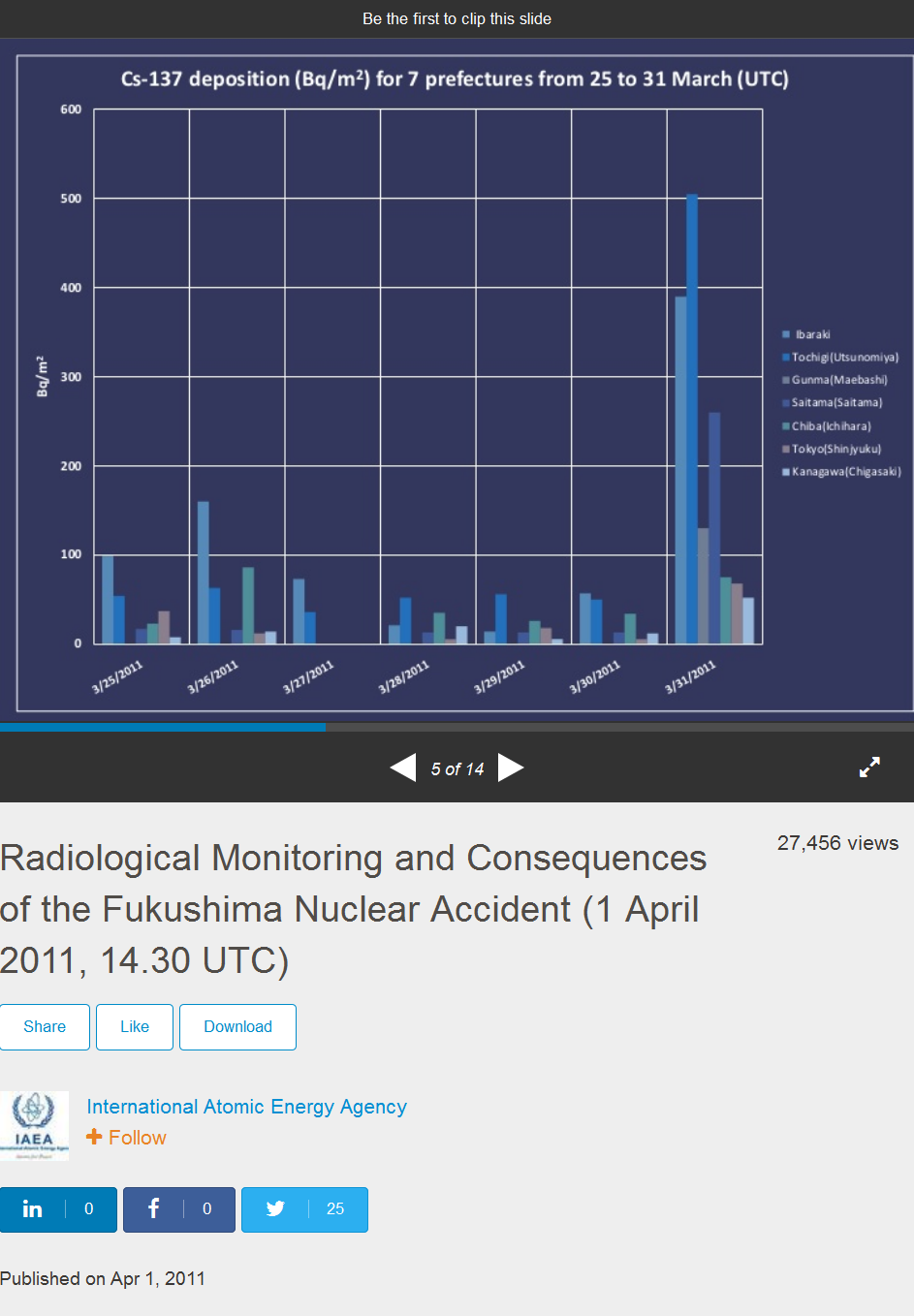
2 weeks after Fukushima the IAEA published findings of ground contamination in 7 prefectures around Fukushima.   These are shown below.

Only 1 Prefecture in Japan exceeded 400 Bq/M2 after Fukushima — Most of Hawaii now exceeds 400 Bq/M2 of Radioactive Cesium 137.

In the news report covering the release of this University study, a paid industry troll shows up and asks the authors to try to minimize the perception of danger by comparing the radiation level to “bananas”.

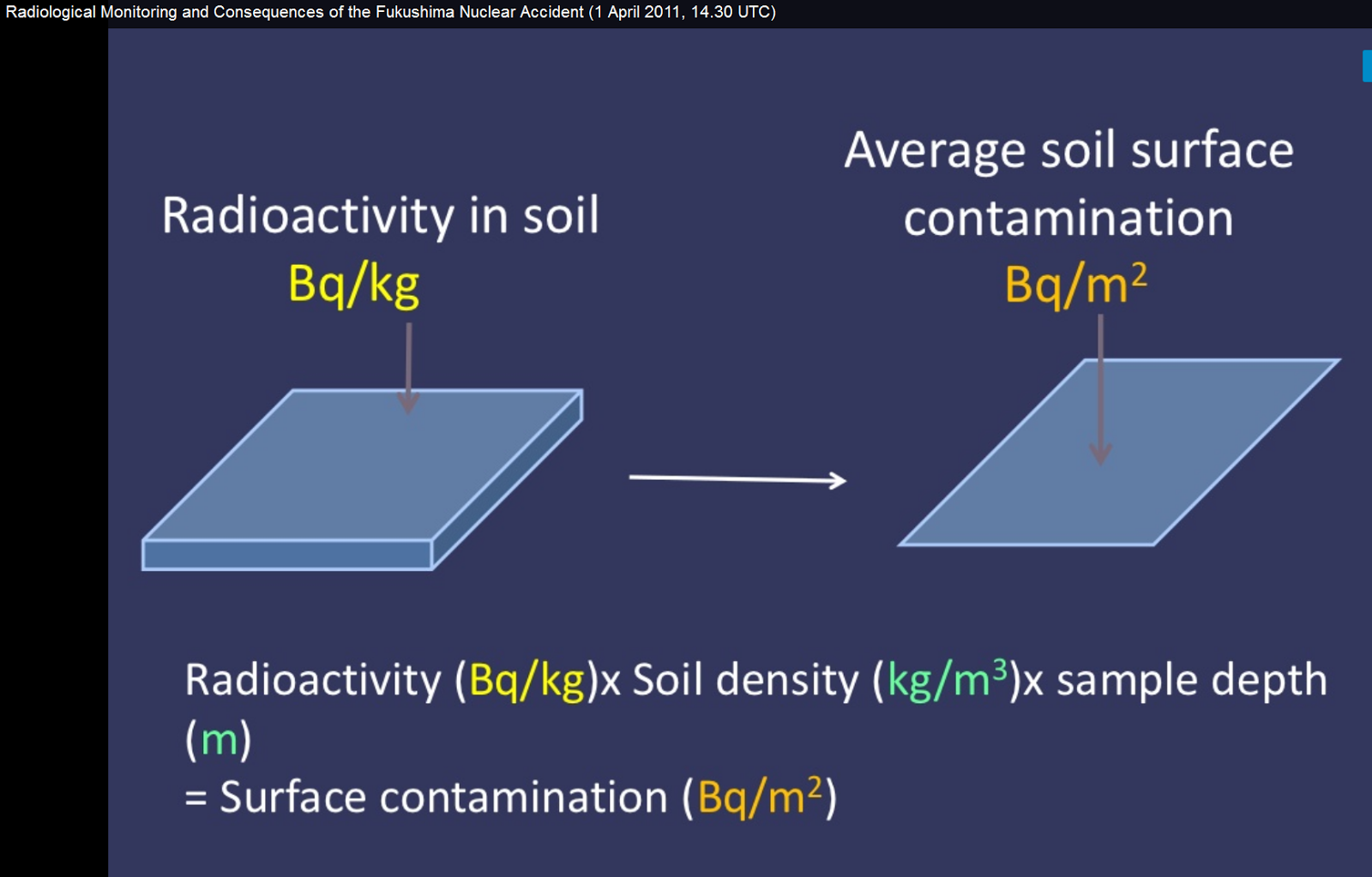
Also this paid troll, pretending to be a life long expert, doesn’t even know basics of measuring and presenting information on radiation.    Bq/M2 is simplistic as shown in this IAEA slide presentation


Then the troll gets schooled by a U of Hawaii Associate Professor……

Cesium concentrations measured in soil in Bq/kg were converted to Bq/m2 using soil bulk densities measured for each soil sample. This way it is possible to estimate the total inventory of deposited cesium per area. It is common to express these quantities in units of Bq/m2 in the scientific literature. For reference these soils samples had 2 to 3 times as much naturally occurring radioactive potassium than cesium.
Bioaccumulation was addressed by looking at mushroom cesium concentrations – you can read about it more in Trista’s thesis:http://www.soest.hawaii.edu/GG/resources/theses/McKenzie_Trista_Senior_Thesis.pdf
and details about the fish study can be found here:
http://www.soest.hawaii.edu/GG/resources/theses/Azouz_Senior_Thesis.pdf
There are no limits for soil Cs content, only for fish, so the 300 Bq/kg limit relates to fish consumption.

http://nukeprofessional.blogspot.com/2016/07/breaking-university-of-hawaii-research.html

— Nigerians, contact the Navajo Nation about uranium mining safety claims — $$millions spent for cleanup and no end in sight

From Albuquerque Journal

Feds reach settlement with Navajos over uranium mine cleanup

By Susan Montoya Bryan / Associated Press
Tuesday, July 19th, 2016

ALBUQUERQUE, N.M. — The federal government has reached another settlement with the Navajo Nation that will clear the way for cleanup work to continue at abandoned uranium mines across the largest American Indian reservation in the U.S.

The target includes 46 sites that have been identified as priorities due to radiation levels, their proximity to people and the threat of contamination spreading. Cleanup is supposed to be done at 16 abandoned mines while evaluations are planned for another 30 sites and studies will be done at two more to see if water supplies have been compromised.

The agreement announced by the U.S. Justice Department settles the tribe’s claims over the costs of engineering evaluations and cleanups at the mines.

The federal government has already spent $100 million to address abandoned mines on Navajo lands and a separate settlement reached with DOJ last year was worth more than $13 million. However, estimates for the future costs for cleanup at priority sites stretch into the hundreds of millions of dollars.

Officials with the U.S. Environmental Protection Agency could not immediately pinpoint the worth of the latest settlement.

Assistant Attorney General John C. Cruden, who is with the DOJ’s Environment and Natural Resources Division, said the latest settlement marks the second phase of ensuring cleanup of mines that pose the most significant public health risks.

“Addressing the legacy of uranium mining on Navajo lands reflects the commitment of the Justice Department and the Obama administration to fairly and honorably resolve the historic grievances of American Indian tribes and build a healthier future for their people,” Cruden said in a statement.

Navajo leaders have been pushing for cleanup for decades, specifically for the removal of contaminated soils and other materials rather than burying and capping the waste on tribal land. Since 2005, they’ve had a ban on uranium mining.

Over four decades, some 4 million tons of uranium ore were extracted from mines on Navajo lands with the federal government being the sole purchaser from the 1940s through the 1960s, when commercial sales began. The mining operations stretched from western New Mexico into Arizona and southern Utah.

Decades of uranium mining have left behind a legacy of contamination that includes one of the nation’s worst disasters involving radioactive waste: a spill in the Church Rock area that sent more than 1,100 tons of mining waste and millions of gallons of toxic water into an arroyo and downstream to the Rio Puerco. The result was a Superfund declaration.

Advocates have called for more studies on the health effects of continued exposure to the contamination resulting from the mining sites, and some have criticized the slow pace of cleanup and the lack of adequate funding for the work that needs to be done.

In a report submitted to New Mexico lawmakers last year, a team of consultants estimated it would take EPA more than a century to fund the removal of contamination at just 21 of the highest priority sites.

In a letter sent last month to President Barack Obama and EPA leadership, Navajo President Russell Begaye said the abandoned uranium mines project continues to struggle with outreach, coordination and trust issues.

EPA officials say in the last decade, the agency has remediated nearly four dozen homes, conducted field studies at all 523 mines on Navajo lands and provided safe drinking water to more than 3,000 families. Stabilization and cleanup work also has been done at nine abandoned mines.

Feds reach settlement with Navajos over uranium mine cleanup

— IAEA colludes with Nigerian government to exploit uranium deposits, says no health risk

IAEA backs Nigeria’s use of Uranium for power generation, says it poses no threat

ON JULY 19, 2016

… The Federal Government brought in top experts from the International Atomic Energy Agency to conduct a week-long training for nuclear practitioners and security officers in the country on the extraction, exploitation and utilisation of the substance. …

The Director-General/Chief Executive Officer, NNRA, Prof. Lawrence Dim, explained that the latest training would expose participants to the technicalities in Uranium use for power generation since Nigeria does not have the relevant technology to do so at the moment.

He was quick to say that the use of uranium does not pose any threat to the country, adding, “Uranium exploration in Nigeria is quite safe. We have not had any cause to find out that there is any high level of radiation or exposure relating to that.

“The issue is that the uranium we get in our soil is the natural uranium; although it has radioactive material, the concentration is low. So we don’t have any situation where the level of radiation coming out from it is detected to be harmful.”

Read more at: http://www.vanguardngr.com/2016/07/iaea-backs-nigerias-use-uranium-power-generation-says-poses-no-threat/

— Nuclear info sessions across South Australia

From Great Lakes Advocate
July 19, 2016

CONSULTATION: Nuclear consultation sessions will be held around EP.

LOCALS are urged to have their say on nuclear as part of the state’s largest community engagement program.

Teams from the state government’s Nuclear Consultation and Response Agency will run sessions at more than 100 sites including 10 on the Eyre Peninsula.

The key themes discussed will be community consent and the importance of an informed opinion, economics including the benefits and risks to the state, safety including key issues around storage, health and transport, and trust.

Eyre Peninsula consultation sessions will run from 11am to 7pm at Streaky Bay on August 2, Ceduna on August 3, Elliston on August 4, Port Lincoln on August 5, Kimba on August 16, Cummins on August 17, Cowell on August 18, with separate Aboriginal community consultation at Port Lincoln and Ceduna.

There will also be a booth at the EP Field Days at Cleve on August 9 and 10.

For more information about the sessions visit the YourSAy nuclear website. http://yoursay.sa.gov.au/

http://www.greatlakesadvocate.com.au/story/4039198/nuclear-info-sessions-across-sa/?cs=2452

— 22 security guards at Palisades placed on leave for falsifying fire inspection records

Posted on Enformable

July 19, 2016

Officials from the Palisades nuclear power plant in Michigan operated by Entergy have confirmed that 22 workers have been placed on paid leave after it was found that fire inspection records had been falsified.

One of the duties of security officers at some nuclear power plants is to conduct routine checks to ensure that there are no indications of fires.  These fire inspections are part of a commitment made by licensees instead of upgrading or modifying nuclear power plants to remove the threat of fires affecting the performance of critical safety systems.

Val Gent, spokeswoman for the nuclear power plant said, “we cannot tolerate employees stating they completed a task when they didn’t, and we are obligated to fully investigate any such instances.”

Several of the security officers placed on leave have told reporters that they are being treated as scapegoats by plant management, and claim they were never trained to perform the fire inspections.

“Now the company [Entergy] lawyer is asking us questions, saying the NRC will be speaking with us…and that we could be criminally liable,” a suspended security officer told a reporter from WWMT News Channel 3.

The falsification of fire reports was discovered in June when physical documents indicating fire inspections had been performed were found to not match the digital records from security key cards tracking employee movements in the plant.   Entergy began an internal investigation after finding the discrepancy.

In 2013 and 2014, employees at the Entergy-owned Waterford nuclear power plant in Louisiana were also found to have falsified nearly a year’s worth of fire watch logs.w

Source: Detroit Free Press

Source: WWMT

22 security guards at Palisades placed on leave for falsifying fire inspection records

— Please don’t shoot our civilians, UK begged US during height of 1980s nuclear cruise missile protests

From Sputnik

Nikolai Gorshkov
July 20, 2016

Secret UK Cabinet files released by the National Archives in Kew, west London on Thursday reveal that at the height of protests against the deployment of US nuclear cruise missiles in 1983-1985 the government of Margaret Thatcher was horrified by a prospect of US military shooting British peace activists.

Throughout the 1980-s Britain was in a grip of mass peace protests against the deployment of American cruise missiles tipped with nuclear warheads.

While publicly dismissing the Campaign for Nuclear Disarmament (CND) and other peace groups as “unrepresentative” of the British people, privately Thatcher and her Ministers were agonizing over the ways of “combatting” them, as the declassified files show. The Defense Secretary Michael Heseltine established a pro-government “peace” group to challenge CND’s “unilateralism”, while the Secret Service was charged with “exposing” the CND’s foreign backers. They failed to find any. Apparently, they hadn’t yet mastered the art of creating “dodgy dossiers” at the time.

Top secret documents

A handwritten note informed the Prime Minister of the failure: “you will remember asking me to find out whether Sir Robert Armstrong knew who was financing CND’s activities at Molesworth. The attached is his answer, though it does not answer the question where CND get their money from.”

A MAJOR ELECTION PROBLEM

The CND was considered by the government to be a fairly responsible organization, but the famous peace women of Greenham Common (the US cruise missile site to the west of London) were branded “extremist”.

Handwritten note to Thatcher regarding CND

The repeated attempts by peace activists to breach security at bases housing nuclear weapons, like RAF Upper Heyford, ran the risk of a confrontation with armed US guards, and the Ministers were horrified by a prospect of the US military shooting British civilians on their home turf.

“The Home Secretary believes that an incident involving US firearms could be a major election problem”, a handwritten note of 17 May 1983 advised Thatcher who was in the middle of her reelection bid.

Even warning the demonstrators of this mortal danger was deemed to be politically too sensitive.

“…it would be a mistake to make any public reference to the presence of armed guards in the next few weeks”, wrote Home Secretary William Whitelaw on 17 May 1983. “The arming of security personnel in any circumstances is a potentially controversial issue. In this case there is the added complication that they are US personnel outside our control.”

A flurry of minutes between the Home, Defense, Foreign Secretaries and the PM explored how to “tactfully” impress on the Americans that shooting a British civilian during the UK election campaign would be a very bad idea.

The Home Secretary cautioned: “I see the difficulty of signaling tactfully to the US authorities our expectation that firearms will not be used without good cause during the proposed blockade [of RAF Upper Heyford – NG] from 31 May to 3 June [1983]. But the timing, which could hardly be more sensitive [UK general election – NG], and the traditionally different approach to the use of firearms in law enforcement in the United States make me think that the possibility should, at least, be explored.”

It appears from these discussions that the British Government did not feel to be in a position to take up the issue directly with the US military commanders stationed in the UK!

The Home Secretary suggested “a high level approach to the US Embassy who might [NG] be persuaded to emphasize the risks to the military commanders responsible for the base… The Foreign and Commonwealth Secretary would, no doubt, advise on whether [NG] some message might be sent and how it could best be delivered.”

Reply from Secret Service

Not entirely sure that the Americans would heed the plea, the Ministers planned to insert a thousand or more UK personnel between the demonstrators and the US armed guards. On quite a few occasions there were two guards for every protester! The Ministers were also crunching numbers as to how many millions of pounds they would need to install electronic security systems around the bases. Security at UK military installations, even at those housing nuclear weapons, Ministers agreed, was inadequate.

TRAVELLERS, GYPSIES AND PEACE CAMPS

The best solution to the government’s worries would of course be the eviction of protesters from peace camps around the USAF/RAF bases. But there was a legal conundrum, as explained by the then Secretary of State for Transport Nicholas Ridley:

“First, there is our policy towards travellers [e.g. gypsies — NG]. The situation of these people and the Greenham Common protestors is, I believe, in law much the same. They both trespass on the highway. Yet in the case of travellers, we condone it.”

This advice was not something Margaret Thatcher and other Ministers apparently wanted to hear, just like Tony Blair after them didn’t like the legal warnings about the Iraq invasion. In both cases the voices of reason were eventually silenced. As the declassified files show, Nicholas Ridley was put under serious pressure, not least by the Defense Secretary Michael Heseltine, to reconsider his position.

“ONLY MAJOR TRAGEDY CAN COMPETE WITH CND PICTURES”

Heseltine also took the lead in the “presentational” aspect of “combatting” the peace activists.

Request to Secret Service

To counter the publicity of a series of mass protests across the UK planned by the CND for Easter 1983 he volunteered to make a speech at the Berlin Wall accusing the CND of working for the “forces of oppression” on the other side.

Heseltine’s visit to West Berlin was welcomed by his West German counterpart Dr. Woerner but he warned that it could provoke demonstrations in Berlin itself!

Foreign Office ministers and Thatcher’s own chief press secretary Bernard Ingham were equally in two minds about the validity of Heseltine’s counter-offensive:

“What we have to avoid is the charge that the CND’s Easter activities have the government rattled.”

The CND’s Easter “peace offensive” will only “secure less airtime and have less impact if something more newsworthy in television terms occurs – e.g. (to be brutal) a North Sea blowout; an assassination attempt on the Pope, etc.”, Bernard Ingham wrote in confidence on 17 March 1983.

“… If we accept that only a major tragedy can compete with CND pictures, Mr. Heseltine’s visit to the Berlin Wall should be seen more as a preemptive strike than a competitive event. In any case, I have serious doubts about Ministers being seen to be competing with CND on Good Friday, the day of Christ’s crucifixion.”

“…It is also a day when there is not much sport,” Thatcher’s chief press secretary lamented.

LET THE ROYALS DO THE BIDDING

To win the “battle of ideas” against the CND Ingham suggested to “feed into the BBC and ITN at an appropriate level the idea of getting cameras to film the various pursuits” like “pigeon, or whippet or tortoise racing (or whatever respectable minority sport we can confidently prove attracts more participants than CND demonstrating).”

Upper Heyford US Armed Guards

But what would really “do the trick would be press and TV pictures, for TV release on the evening of Good Friday and/or Saturday newspapers of Prince William in Australia.”

Eventually, the UK government succeeded in reclaiming parts of the land occupied by the peace camps under the pretext of road improvements, and the Soviet-American arms reductions deals made US cruise missiles in Europe redundant.

In his notes of March 1983 Bernard Ingham wrote that “CND, if successful, contains not the seeds but the certainty of its annihilation”. CND, in its own way, did contribute to the success of arms talks in late 1980-s, but this did not lead to its annihilation. To the contrary, with the relapses of Cold War mentality in the British Establishment the peace movement appears to go through a revival.

http://sputniknews.com/military/20160721/1043372433/please-dont-shoot-civilians-gorshkov.html

— UK Prime Minister Theresa May says “Yes,” she’s prepared to kill hundreds of thousands in nuke attack

Global Research, July 19, 2016
Common Dreams 18 July 2016

Newly installed U.K. Prime Minister Theresa May is prepared to authorize a nuclear strike that could kill hundreds of thousands of innocent people.

So she said before Parliament on Monday, as the body debated whether to renew Trident, Britain’s aging nuclear weapons system.

According to the Independent, May was challenged on her support for the program by the SNP’s George Kerevan, who asked: “Are you prepared to authorize a nuclear strike that could kill hundreds of thousands of men, women and children?”

May replied with one word: “Yes.”

Later, when it was his turn to speak, Labour party leader Jeremy Corbyn countered that he “would not take a decision that kills millions of innocent people,” saying: ”

I do not believe the threat of mass murder is a legitimate way to go about international relations.”

Corbyn’s stance puts him at odds with the official stance of his party, a fact that was not lost during the debate, which comes amid intense Labour infighting.

Meanwhile, the Telegraph reported on another tense exchange in the chamber, this one between May and Green MP Caroline Lucas:

Caroline Lucas, the Green MP:

“If keeping and renewing our nuclear weapons is so vital to our national security and our safety, then does she accept the logic of that position must be that every other single country must seek to acquire nuclear weapons?

“Does she really think the world would be a safer place if it did? Our nuclear weapons are driving proliferation, not the opposite.”

Theresa May, the Prime Minister

“No, I don’t accept that at all and I have say to the honorable lady that sadly she and some members of the Labour Party seem to be the first to defend the country’s enemies and the last to actually accept the capabilities that we need.”

Lucas hit back on Twitter:

According to the Campaign for Nuclear Disarmament (CND), which favors scrapping Trident and was holding a #StopTrident rally outside the House of Commons on Monday evening, the weapons system serves ”no legitimate purpose” and is hugely wasteful.

Of the Trident vote, CND’s general secretary Kate Hudson said:

“This is a once in a generation opportunity to break with this massively expensive yet redundant old technology and instead spend Britain’s valuable resources on meeting the security challenges we face today, like terrorism and climate change.”

Meanwhile, wrote Andrew Smith of the Campaign Against Arms Trade on Monday, “even if we put the financial implications to one side, the potential impact of the weapons is far too deadly to contemplate. One Trident submarine has the power to kill 5.4 million people, and it would do so indiscriminately. The impact could be on an even greater scale than Hiroshima.”

Opposition to Trident is widespread in Scotland, where the issue was among several fueling2014′s independence campaign. Anti-Trident protests were held in more than 30 Scottish cities, towns, and villages on Saturday, according to The Herald.

On Monday, SNP’s Westminster leader Angus Robertson described Trident as an “immoral, obscene, and redundant weapons system” and said renewing the program would speed up Scottish independence.

“The people of Scotland have shown repeatedly, clearly and consistently that we are opposed to the renewal of nuclear weapons,” he said.

— “They told us it was safe”: 1966 US Air Force nuclear accident in Palomares, Spain — plutonium contamination

From the New York Times

Decades Later, Sickness Among Airmen After a Hydrogen Bomb Accident

By DAVE PHILIPPS
JUNE 19, 2016

Second article in series:
http://www.nytimes.com/2016/06/21/world/europe/spain-palomares-hydrogen-bombs.html

Even Without Blast, 4 Hydrogen Bombs From ’66 Scar Spanish Village, June 20, 2016

Alarms sounded on United States Air Force bases in Spain and officers began packing all the low-ranking troops they could grab onto buses for a secret mission. There were cooks, grocery clerks and even musicians from the Air Force band.

It was a late winter night in 1966 and a fully loaded B-52 bomber on a Cold War nuclear patrol had collided with a refueling jet high over the Spanish coast, freeing four hydrogen bombs that went tumbling toward a farming village called Palomares, a patchwork of small fields and tile-roofed white houses in an out-of-the-way corner of Spain’s rugged southern coast that had changed little since Roman times.

It was one of the biggest nuclear accidents in history, and the United States wanted it cleaned up quickly and quietly. But if the men getting onto buses were told anything about the Air Force’s plan for them to clean up spilled radioactive material, it was usually, “Don’t worry.”

“There was no talk about radiation or plutonium or anything else,” said Frank B. Thompson, a then 22-year-old trombone player who spent days searching contaminated fields without protective equipment or even a change of clothes. “They told us it was safe, and we were dumb enough, I guess, to believe them.”

Mr. Thompson, 72, now has cancer in his liver, a lung and a kidney. He pays $2,200 a month for treatment that would be free at a Veterans Affairs hospital if the Air Force recognized him as a victim of radiation. But for 50 years, the Air Force has maintained that there was no harmful radiation at the crash site. It says the danger of contamination was minimal and strict safety measures ensured that all of the 1,600 troops who cleaned it up were protected.

Interviews with dozens of men like Mr. Thompson and details from never before published declassified documents tell a different story. Radiation near the bombs was so high it sent the military’s monitoring equipment off the scales. Troops spent months shoveling toxic dust, wearing little more protection than cotton fatigues. And when tests taken during the cleanup suggested men had alarmingly high plutonium contamination, the Air Force threw out the results, calling them “clearly unrealistic.”

In the decades since, the Air Force has purposefully kept radiation test results out of the men’s medical files and resisted calls to retest them, even when the calls came from one of the Air Force’s own studies.

Many men say they are suffering with the crippling effects of plutonium poisoning. Of 40 veterans who helped with the cleanup who The New York Times identified, 21 had cancer. Nine had died from it. It is impossible to connect individual cancers to a single exposure to radiation. And no formal mortality study has ever been done to determine whether there is an elevated incidence of disease. The only evidence the men have to rely on are anecdotes of friends they watched wither away.

“John Young, dead of cancer … Dudley Easton, cancer … Furmanksi, cancer,” said Larry L. Slone, 76, in an interview, laboring through tremors caused by a neurological disorder.

At the crash site, Mr. Slone, a military police officer at the time, said he was given a plastic bag and told to pick up radioactive fragments with his bare hands.

“A couple times they checked me with a Geiger counter and it went clear off the scale,” he said. “But they never took my name, never followed up with me.”

Monitoring of the village in Spain has also been haphazard, declassified documents show. The United States promised to pay for a public health program to monitor the long-term effects of radiation there, but for decades provided little funding. Until the 1980s, Spanish scientists often relied on broken and outdated equipment, and lacked the resources to follow up on potential ramifications, including leukemia deaths in children. Today, several fenced-off areas are still contaminated, and the long-term health effect on villagers is poorly understood.

Continue reading