From Tri-Valley CAREs
Tuesday, August 9, 2016 8 AM
Disarm Now! Nagasaki Day Action at Livermore Lab Gates

From Tri-Valley CAREs
Tuesday, August 9, 2016 8 AM
Disarm Now! Nagasaki Day Action at Livermore Lab Gates
From Tri-Valley CAREs
Wednesday August 3, 2016 7 pm
“Nuclear Weapons and Climate Change: Twin Existential Threats”
Join us in Oakland for a showing of “Nuclear Savage” documentary film (one-hour version). Followed by Tony de Brum from the Marshall Islands as keynote speaker. Wine and light refreshments. Donation requested: $5 – $20 (no one turned away).Sponsored by American Friends Service Committee, Asian-Americans for Peace & Justice, Livermore Conversion Project, No Nukes Action, Northern California Climate Mobilization (Steering Committee), Pax Christi-NorCal, Peace Action, Physicians for Social Responsibility-SF Bay Area, Tri-Valley CAREs and Western States Legal Foundation.
Location: Humanist Hall, 390 27th St, Oakland
More Info: (925) 443-7148
————————-
Thursday August 4, 2016 6 – 9 pm
Hon. Tony deBrum Roundtable & Potluck Dinner with Pacific Islanders & Indigenous Communities
An Intimate evening with Hon Tony deBrum, current Republic of the Marshall Islands’ (RMI) Ambassador for Climate. The Hon. deBrum will be offering a Keynote presentation and participating in a Roundtable Discussion with leading Indigenous Leaders, Corrina Gould (Ohlone, California) and others (will be shortly announced) to discuss Climate Change and pathways for self-determination for Pacific Islander communities and for Indigenous communities here in California. The Roundtable discussion will be facilitated by Fuifuilupe Niumeitolu (Tongan, Pacific Islander). & Marshallese Community Leader, Yoshitaga Kaneho and the Marshallese Community of Sacramento will be conducting Opening and Closing ceremonies. Potluck dinner. Please bring food to share.
Location: East Bay Media Center, 1939 Addison Street, Berkeley
Click here for more info
——————-
Friday August 5, 2016 7 pm
“Tony deBrum – Nuclear Zero”
Activist and Former Foreign Minister of the Marshall Islands speaking on Nuclear Weapons Elimination and Climate Change. Free: donation requested. Sponsored by Mt. Diablo Peace & Justice Center and the Green Group of the Mt. Diablo Peace & Justice Center.
Location: Bortin Hall, Mt. Diablo Unitarian Universalist Church, 55 Eckley Lane, Walnut Creek.
Click here for more info.
————————-
Sunday, August 7, 2016 3:00 PM – 4:30 PM
Sacramento August Peace Event: Challenging the Nuclear Giants to Disarm
Nobel Peace nominee Tony deBrum will address the Marshall Islands’ landmark suit to force nuclear disarmament. Free, donations welcome.
Location: Social hall, St John’s Lutheran Church, 1701 L St, Sacramento
Click here for more info or call (916) 485-5451
———————
Tuesday, August 9, 2016 8 AM
Disarm Now! Nagasaki Day Action at Livermore Lab Gates
Great venue to hold protests and inform the public.
Press release from PG&E, July 10, 2016
…There will be four meetings, two in each location. The content of the meetings will be identical. This is to provide more chances for the public to participate. At these meetings, PG&E staff will present information about the joint proposal, address questions, and provide attendees an opportunity to provide feedback and commentary on the joint proposal.
In late June, the State Lands Commission voted to approve a lease extension necessary to run Diablo Canyon Power Plant (DCPP) to 2025, a critical first step toward realizing the goals outlined in the joint proposal. Consideration of the joint proposal moves next to the California Public Utilities Commission (CPUC). PG&E will file the proposal with the CPUC on July 28.
Following these meetings, a public report will be made available that summarizes public questions and commentary gathered at these public information meetings and will be submitted with PG&E’s filing with the CPUC.
San Francisco
July 22, 2016
Meeting 1: 12:00- 3:45pm
Meeting 2: 4:15-8:00pm
South San Francisco Conference Center
255 S. Airport Boulevard
South San Francisco, CA 94080
San Luis Obispo
July 20, 2016
Meeting 1: 12:00- 3:45pm
Meeting 2: 4:15-8:00pm
Embassy Suites
333 Madonna Road
San Luis Obispo, CA 93405
Meetings are open to the public. Each meeting will cover the same information and follow the same format.
For parties unable to attend public information meetings, comments can be submitted to diablocanyon@pge.com prior to July 26, 2016.
Joint Proposal
Reflecting California’s changing energy landscape, PG&E announced a joint proposal with labor and leading environmental organizations on June 21, 2016, that would increase investment in energy efficiency, renewables and storage beyond current state mandates while phasing out PG&E’s production of nuclear power in California by 2025.
The joint proposal would replace power produced by two nuclear reactors at the Diablo Canyon Power Plant (DCPP) with a cost-effective, greenhouse gas free portfolio of energy efficiency, renewables and energy storage. It includes a PG&E commitment to a 55 percent renewable energy target in 2031, an unprecedented voluntary commitment by a major U.S. energy company.
The Parties to the joint proposal are PG&E, International Brotherhood of Electrical Workers Local 1245, Coalition of California Utility Employees, Friends of the Earth, Natural Resources Defense Council, Environment California and Alliance for Nuclear Responsibility.
The announcement of the Joint Proposal can be found here.
The Joint Proposal can be read in its entirety here.
Additional Information
Information on the State Lands Commission approval of necessary lease extensions can be read here.
Additional information prepared by M.J. Bradley & Associates, a strategic environmental consulting firm, can be accessed here.
Media contact:
PG&E 24-Hour Media Line
(415) 973-5930
From Mining Awareness
July 16, 2016
“the NAIIC concluded that “the disaster was man-made and the result of collusion between government, the regulators and TEPCO, and a lack of governance by said parties,” citing that the organizational and regulatory systems supported faulty rationales for decisions and actions. Regulators served TEPCO’s business interests through tailored regulation and weak enforcement.“(NASA)

NASA Failure Studies [Comments added in brackets]:
“October 2015 Volume 8 Issue 7
PROXIMATE CAUSE
• Loss of electricity and backup power left the Fukushima complex crippled and unable to adequately cool the reactors
UNDERLYING ISSUES
• Disregard of Regulations
• Poor Safety History
• Lack of Response to Natural Disaster Concerns
AFTERMATH
• Recommendation pertaining to the creation of a permanent committee to deal with issues regarding nuclear power in order to supervise regulators and provide security to the public.
The Great Wave of Reform The Prophetic Fallacy of the Fukushima Daiichi Meltdown
March 11, 2011, off the Pacific coast of Tohoku, Japan: At 14:46 (2:46 p.m.) Japan Standard Time (JST) a magnitude 9.0 earthquake occurred 43 miles east of the Oshika Peninsula. The undersea megathrust earthquake shifted the mainland of Japan an estimated 8 feet east and deviated Earth’s axis by estimates between 4 to 10 inches. The Great East Japan Earthquake generated massive tsunami waves that peaked at heights of 133 feet and travelled up to 6 miles into areas of mainland Japan… The disaster also triggered the second Level 7 International Nuclear Event (after Chernobyl) in history — the Fukushima Daiichi nuclear disaster.
Background
The Fukushima Daiichi Catastrophe
Analysis of the safety history of the Fukushima Daiichi nuclear power complex reveals a catastrophic failure of prediction on behalf of the plant’s Tokyo Electric Power Company (TEPCO) management. How could planners overlook the tsunami?
Hazards of Predicting the Future
In 1958, Arthur C. Clarke, already recognized for major contributions to the fields of rocketry and space flight, began writing a series of magazine essays that were later combined and published in 1962 as Profiles of the Future; a lexicon of universal scientific possibilities.
The book’s introductory essay, “Hazards of Prophecy, ” concerned itself with the two traps of assumptions: “failures of nerve” and “failures of imagination. ”
Failure of the imagination manifests when presently known facts are respected but vital truths are still unknown, and the possibility of the unknown (the unknown unknowns) is not confessed.
Failure of nerve, the more common fallacy (noted by Clarke), “occurs when given all the relevant facts the would-be prophet cannot see that they point to an inescapable conclusion. ”

What happened
The seismic activity of the Great East Japan Earthquake forced the emergency shut-down feature on reactors 1, 2 and 3. Off-site electricity to the power plant was also disrupted by the tremors and backup power was tapped from a 66kV transmission line from the Tohoku Electric Power Company Network. However, the back-up line failed to power reactor 1 due to a mismatched circuit connection.
Beginning at 15:37 (3:17 p.m.) JST, the peak tsunami waves broke upon Japan and flooded and destroyed the emergency diesel generators at the Fukushima complex. Seawater cooling pumps and electric wiring system for the DC power supply for reactors 1, 2 and 4 failed shortly after. All power was effectively lost except for emergency diesel generator power to reactor 6. The tsunami also destroyed vehicles, heavy equipment and many installations.
Without power, the operators at the complex worked tirelessly to monitor and cool the overheating reactors, at one point salvaging car batteries from destroyed vehicles to power necessary equipment. Hydrogen explosions from emptying coolant reservoirs led to interruptions in the recovery operations, which failed when the Unit 2 reactor suppression chamber failed and discharged radioactive material.
Proximate cause
The loss of electric power after flooding made it difficult to effectively cool down the reactors in a timely manner. Cooling operations and observing reactor temperatures were heavily dependent on electricity for coolant injection and depressurization of the reactor and reactor containers, and removal of decay heat at the final heat sink. Lack of access due to the disaster obstructed the delivery of necessities like alternative seawater injection via fire trucks“.
[Note: Loss of cooling made it impossible to cool the reactors, not difficult.]
“Underlying issues
The Nuclear Accident Independent Investigation Commission (NAIIC), formed on Oct. 30, 2011 to investigate the direct and indirect causes of the Fukushima accident, was the first independent commission created in the history of Japan’s constitutional government. In its legal investigation, the NAIIC concluded that “the disaster was man-made and the result of collusion between government, the regulators and TEPCO, and a lack of governance by said parties,” citing that the organizational and regulatory systems supported faulty rationales for decisions and actions. Regulators served TEPCO’s business interests through tailored regulation and weak enforcement.
From Idaho Statesman
Guest Editorial
by Brent Marchbanks
July 12, 2016
Longtime Idahoans remember being shocked some 40 years ago when it was revealed the INL was dumping radioactive waste water directly into the volcanic, porous ground above the Snake River Aquifer; the source of our agricultural irrigation and the water supply for thousands.
Many have seen the pictures from the ’70s of trucks dumping blue barrels full of transuranic waste into ditches at the site.
Public outcry stopped those specific practices. But that waste is still there. Radioactive isotopes have leached into the aquifer. Tons and tons of other people’s nuclear waste kept arriving.
In 1995 Gov. Phil Batt worked a deal with the U.S. Department of Energy: In exchange for a limited amount of new military waste shipments (the “nuclear Navy,” Three Mile Island, etc.) the DOE would: 1) Build a permanent site for those (and previous) shipments, and 2) Clean up the mess that was already there.
The agreed-to shipments began to arrive. Neither the permanent storage nor the cleanup has happened.
The military waste shipments that were allowed into Idaho continue to this day; I saw new shipments in rail cars at the Pocatello yard two weeks ago.
Many of us anti-nuclear types, including the Snake River Alliance, opposed the Batt 1995 Agreement at the time, believing it was too weak; it allowed for too much waste and caved in to the Feds.
But, even if too weak, it was at least some kind of a brake on the seemingly endless shipments to our state. Idaho voters approved the Batt Agreement. Even the campaign slogan of the pro-Batt Agreement forces, including INL itself, was ”Keep the Waste Out.”
Now, those same forces want to get rid of the Batt Agreement altogether; not because it’s too weak, but because it’s too strong. It doesn’t allow enough waste in. It commits the feds and our state to clean-up. Apparently, they want more waste, with no permanent repository in sight, and they want it without a commitment for cleanup. They want to throw out the people’s referendum vote. The governor has used state dollars to support this campaign by creating the Leaders In Nuclear Energy (LINE) Commission. One of the appointed members is Larry Craig.
The DOE is coming to Boise on Thursday [July 14] for a discussion of whether Idaho is willing to throw out the Batt Agreement. The federal jargon being used is whether Idaho is now willing to become a become a “Consent State;” volunteering to allow tons and tons of new shipments of commercial waste generated by the dying nuclear power plant industry (in our own country and overseas.)
The meeting is being held 5 to 9:30 p.m., at the Boise Centre on the Grove.
The public is invited to listen, ask questions and comment.
Brent Marchbanks is a retired lawyer and longtime Boise resident. He remains active in social issues.
From Nuke Professional
July 18, 2016
Stock here
Breaking! University of Hawaii Research Shows Radiation in Hawaii Soil 2016 as Bad as 7 Prefectures in Japan 2 weeks After Fukushima
1200 Bq/M2 in Hawaii, most from potassium, about 400 Bq/M2 from Radioactive Cesium 137
Most wild mushrooms in Hawaii around 50 Bq/kG, but some as high as 100 Bq/kG
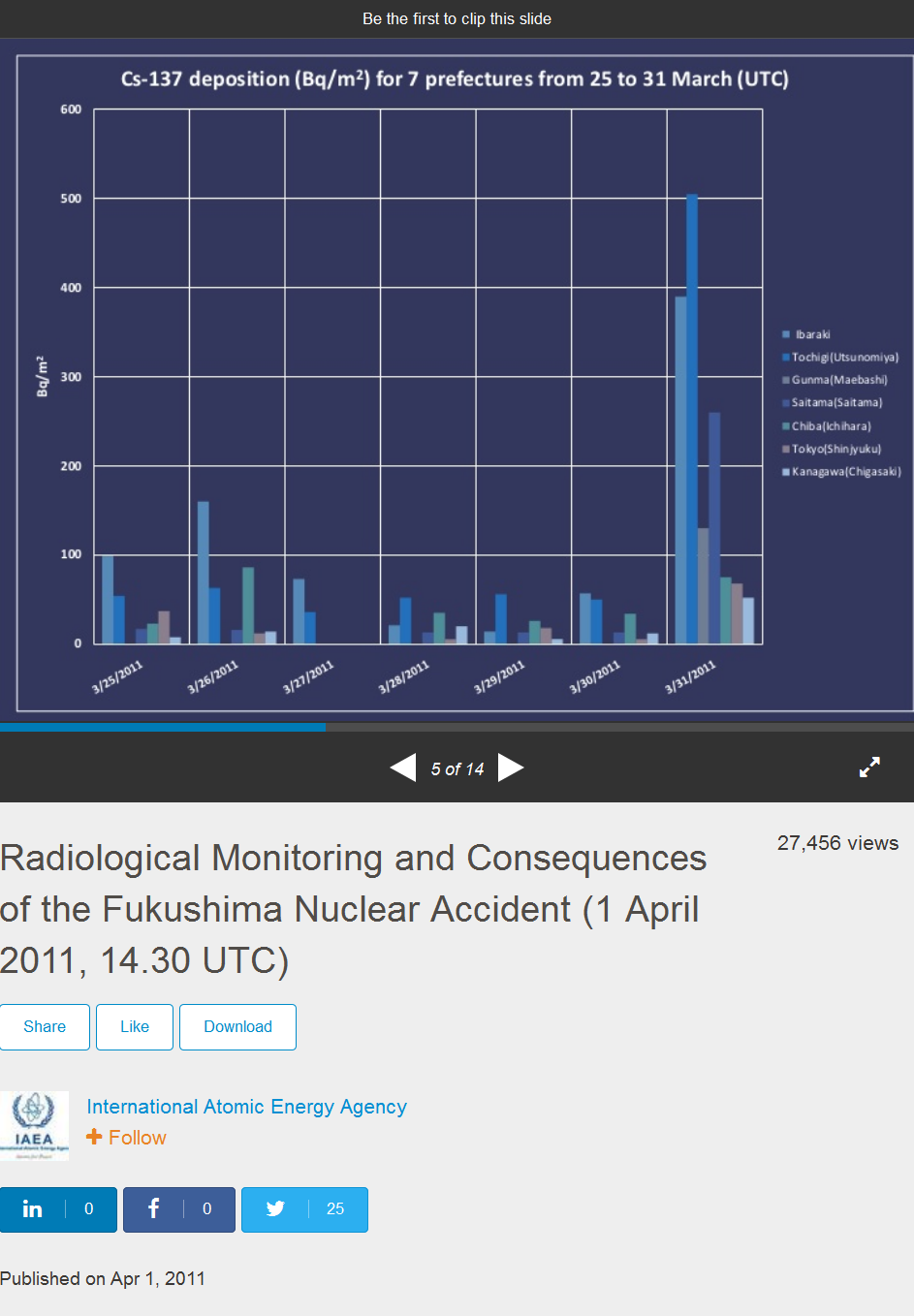
2 weeks after Fukushima the IAEA published findings of ground contamination in 7 prefectures around Fukushima. These are shown below.
Only 1 Prefecture in Japan exceeded 400 Bq/M2 after Fukushima — Most of Hawaii now exceeds 400 Bq/M2 of Radioactive Cesium 137.

In the news report covering the release of this University study, a paid industry troll shows up and asks the authors to try to minimize the perception of danger by comparing the radiation level to “bananas”.
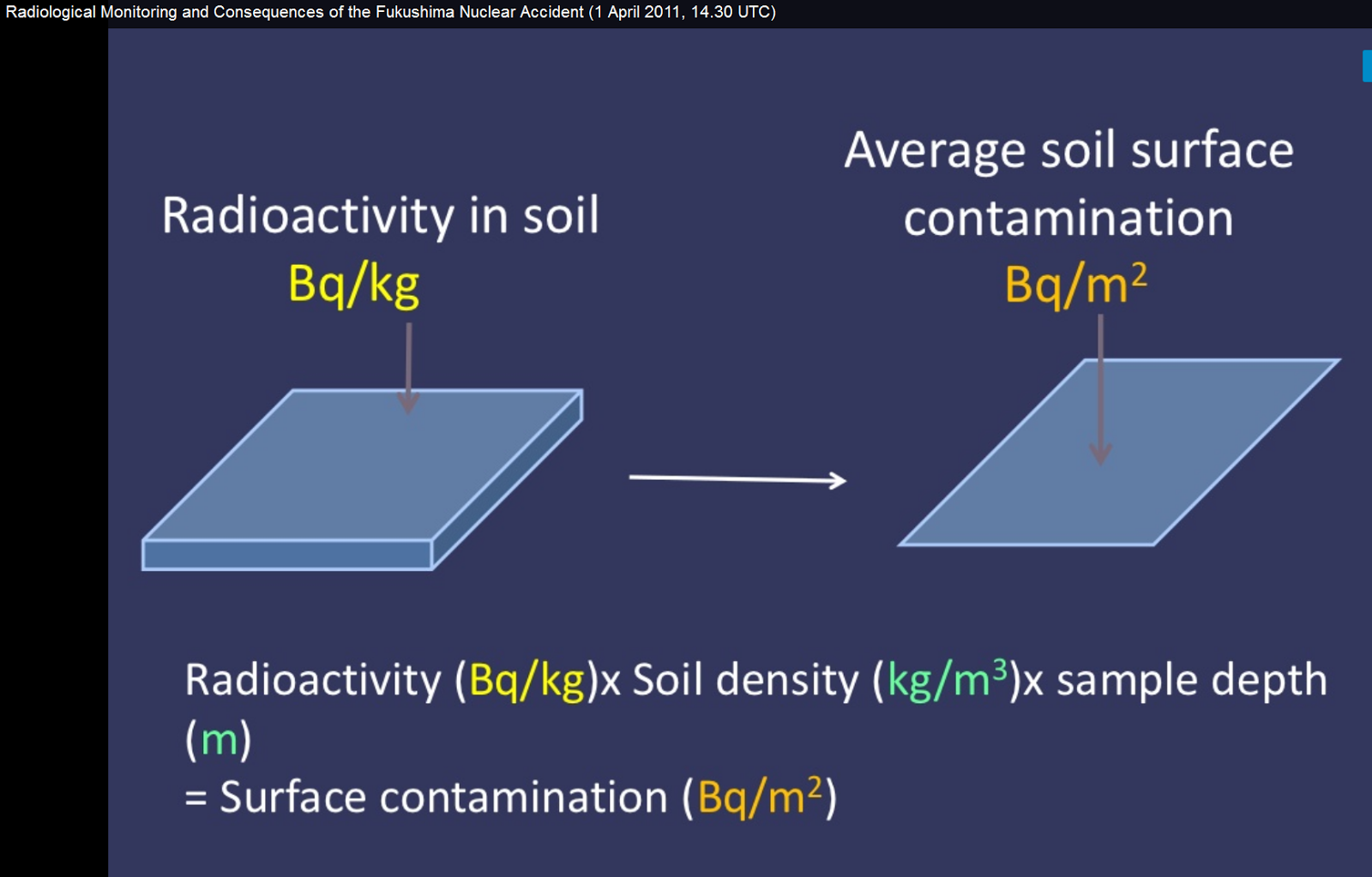
Also this paid troll, pretending to be a life long expert, doesn’t even know basics of measuring and presenting information on radiation. Bq/M2 is simplistic as shown in this IAEA slide presentation

Then the troll gets schooled by a U of Hawaii Associate Professor……

Cesium concentrations measured in soil in Bq/kg were converted to Bq/m2 using soil bulk densities measured for each soil sample. This way it is possible to estimate the total inventory of deposited cesium per area. It is common to express these quantities in units of Bq/m2 in the scientific literature. For reference these soils samples had 2 to 3 times as much naturally occurring radioactive potassium than cesium.
Bioaccumulation was addressed by looking at mushroom cesium concentrations – you can read about it more in Trista’s thesis:http://www.soest.hawaii.edu/GG/resources/theses/McKenzie_Trista_Senior_Thesis.pdf
and details about the fish study can be found here:
http://www.soest.hawaii.edu/GG/resources/theses/Azouz_Senior_Thesis.pdf
There are no limits for soil Cs content, only for fish, so the 300 Bq/kg limit relates to fish consumption.
http://nukeprofessional.blogspot.com/2016/07/breaking-university-of-hawaii-research.html
IAEA backs Nigeria’s use of Uranium for power generation, says it poses no threat
ON JULY 19, 2016
… The Federal Government brought in top experts from the International Atomic Energy Agency to conduct a week-long training for nuclear practitioners and security officers in the country on the extraction, exploitation and utilisation of the substance. …
The Director-General/Chief Executive Officer, NNRA, Prof. Lawrence Dim, explained that the latest training would expose participants to the technicalities in Uranium use for power generation since Nigeria does not have the relevant technology to do so at the moment.
He was quick to say that the use of uranium does not pose any threat to the country, adding, “Uranium exploration in Nigeria is quite safe. We have not had any cause to find out that there is any high level of radiation or exposure relating to that.
“The issue is that the uranium we get in our soil is the natural uranium; although it has radioactive material, the concentration is low. So we don’t have any situation where the level of radiation coming out from it is detected to be harmful.”
Read more at: http://www.vanguardngr.com/2016/07/iaea-backs-nigerias-use-uranium-power-generation-says-poses-no-threat/
From Great Lakes Advocate
July 19, 2016
CONSULTATION: Nuclear consultation sessions will be held around EP.
LOCALS are urged to have their say on nuclear as part of the state’s largest community engagement program.
Teams from the state government’s Nuclear Consultation and Response Agency will run sessions at more than 100 sites including 10 on the Eyre Peninsula.
The key themes discussed will be community consent and the importance of an informed opinion, economics including the benefits and risks to the state, safety including key issues around storage, health and transport, and trust.
Eyre Peninsula consultation sessions will run from 11am to 7pm at Streaky Bay on August 2, Ceduna on August 3, Elliston on August 4, Port Lincoln on August 5, Kimba on August 16, Cummins on August 17, Cowell on August 18, with separate Aboriginal community consultation at Port Lincoln and Ceduna.
There will also be a booth at the EP Field Days at Cleve on August 9 and 10.
For more information about the sessions visit the YourSAy nuclear website. http://yoursay.sa.gov.au/
http://www.greatlakesadvocate.com.au/story/4039198/nuclear-info-sessions-across-sa/?cs=2452
Posted on Enformable
July 19, 2016
Officials from the Palisades nuclear power plant in Michigan operated by Entergy have confirmed that 22 workers have been placed on paid leave after it was found that fire inspection records had been falsified.
One of the duties of security officers at some nuclear power plants is to conduct routine checks to ensure that there are no indications of fires. These fire inspections are part of a commitment made by licensees instead of upgrading or modifying nuclear power plants to remove the threat of fires affecting the performance of critical safety systems.
Val Gent, spokeswoman for the nuclear power plant said, “we cannot tolerate employees stating they completed a task when they didn’t, and we are obligated to fully investigate any such instances.”
Several of the security officers placed on leave have told reporters that they are being treated as scapegoats by plant management, and claim they were never trained to perform the fire inspections.
“Now the company [Entergy] lawyer is asking us questions, saying the NRC will be speaking with us…and that we could be criminally liable,” a suspended security officer told a reporter from WWMT News Channel 3.
The falsification of fire reports was discovered in June when physical documents indicating fire inspections had been performed were found to not match the digital records from security key cards tracking employee movements in the plant. Entergy began an internal investigation after finding the discrepancy.
In 2013 and 2014, employees at the Entergy-owned Waterford nuclear power plant in Louisiana were also found to have falsified nearly a year’s worth of fire watch logs.w
Source: Detroit Free Press
Source: WWMT
 Heal Fukushima
From Albuquerque Journal
Feds reach settlement with Navajos over uranium mine cleanup
By Susan Montoya Bryan / Associated Press
Tuesday, July 19th, 2016
ALBUQUERQUE, N.M. — The federal government has reached another settlement with the Navajo Nation that will clear the way for cleanup work to continue at abandoned uranium mines across the largest American Indian reservation in the U.S.
The target includes 46 sites that have been identified as priorities due to radiation levels, their proximity to people and the threat of contamination spreading. Cleanup is supposed to be done at 16 abandoned mines while evaluations are planned for another 30 sites and studies will be done at two more to see if water supplies have been compromised.
The agreement announced by the U.S. Justice Department settles the tribe’s claims over the costs of engineering evaluations and cleanups at the mines.
The federal government has already spent $100 million to address abandoned mines on Navajo lands and a separate settlement reached with DOJ last year was worth more than $13 million. However, estimates for the future costs for cleanup at priority sites stretch into the hundreds of millions of dollars.
Officials with the U.S. Environmental Protection Agency could not immediately pinpoint the worth of the latest settlement.
Assistant Attorney General John C. Cruden, who is with the DOJ’s Environment and Natural Resources Division, said the latest settlement marks the second phase of ensuring cleanup of mines that pose the most significant public health risks.
“Addressing the legacy of uranium mining on Navajo lands reflects the commitment of the Justice Department and the Obama administration to fairly and honorably resolve the historic grievances of American Indian tribes and build a healthier future for their people,” Cruden said in a statement.
Navajo leaders have been pushing for cleanup for decades, specifically for the removal of contaminated soils and other materials rather than burying and capping the waste on tribal land. Since 2005, they’ve had a ban on uranium mining.
Over four decades, some 4 million tons of uranium ore were extracted from mines on Navajo lands with the federal government being the sole purchaser from the 1940s through the 1960s, when commercial sales began. The mining operations stretched from western New Mexico into Arizona and southern Utah.
Decades of uranium mining have left behind a legacy of contamination that includes one of the nation’s worst disasters involving radioactive waste: a spill in the Church Rock area that sent more than 1,100 tons of mining waste and millions of gallons of toxic water into an arroyo and downstream to the Rio Puerco. The result was a Superfund declaration.
Advocates have called for more studies on the health effects of continued exposure to the contamination resulting from the mining sites, and some have criticized the slow pace of cleanup and the lack of adequate funding for the work that needs to be done.
In a report submitted to New Mexico lawmakers last year, a team of consultants estimated it would take EPA more than a century to fund the removal of contamination at just 21 of the highest priority sites.
In a letter sent last month to President Barack Obama and EPA leadership, Navajo President Russell Begaye said the abandoned uranium mines project continues to struggle with outreach, coordination and trust issues.
EPA officials say in the last decade, the agency has remediated nearly four dozen homes, conducted field studies at all 523 mines on Navajo lands and provided safe drinking water to more than 3,000 families. Stabilization and cleanup work also has been done at nine abandoned mines.