— France’s nuclear giant Areva admits to ‘400 irregularities’ in power plant parts; will the UK govt finalize HInkley Point contract with Areva?

Areva is partner in the Hanford nuclear site.

Documents on 400 Areva nuclear reactor parts were “modified’ — falsified — to rubberstamp their quality because those 400 parts failed the tests.


From the Telegraph

The British government is poised to finalise a multi-billion pound contract to build reactors at Hinkley Point designed by Areva CREDIT:  EDF ENERGY/PA

France’s ailing nuclear giant, Areva, faced a major scandal on Tuesday after the country’s nuclear watchdog confirmed there have been “irregularities” in 400 parts produced in its reactors since 1965, and that “around 50 are currently in service in France’s nuclear power plant fleet”.

France’s independent Nuclear Safety Authority, ASN, said the “irregularities” were listed in an audit it had ordered from Areva after it detected a “very serious anomaly” in a reactor vessel in the country’s Flamanville EPR nuclear plant, the same model Britain plans to use for two new plants at Hinkley Point. 

The fault in the vessel destined to house the plant’s nuclear fuel and confine its radioactivity was detected last year.

“These irregularities consist in incoherencies, modifications or omissions in manufacturing dossiers,” ASN said in a statement.

The revelation came hours after Areva’s director general admitted that 400 documents assessing whether parts of nuclear plants met required standards may have been “falsified”.

The doubts over documents supposed to rubber-stamp the quality of parts destined for new-generation nuclear power reactors will be a cause for serious concern for the British government as it is poised to finalise a controversial, multi-billion pound contract to build reactors at Hinkley Point designed by Areva.

Areva launched an audit late 2015 into anomalies at the Le Creusot Forge site, which  specialises in highly complex moulded parts for new-generation nuclear reactors.

According to Les Echos, an operator conducted tests on metal parts then wrote down his findings on a host of parameters.

“When a value was obtained at the upper end of the required norm, the written reports of certain manufacturing reports were allegedly modified,” it wrote.

This was the case for around 400 parts, it wrote.

ASN said it has asked Areva to transmit as soon as possible the list of parts concerned and its analysis of the consequences on the safety of installations”.

The explosive revelations came just hours after Emmanuel Macron, the French economy minister, visited the site.

During the visit, Mr Macron reiterated the French government’s support for the Hinkley Point project, which unions at EDF have argued is too expensive for the cash-strapped French electricity utility due to manage it.

“Hinkley Point is an essential project for this factory and I have come to restate the government’s commitment to the project without which there would be hundreds of job losses at the Le Creusot site,” he told unions.

“I believe in the need to undertake big export projects for the French nuclear industry and in particular Hinkley Point,” he went on.

“It will enable us to continue to strengthen our skills, to make us even stronger and to conquer new markets.”

His words came days after Mr Macron confirmed that the final decision on whether to go ahead with the project would be delayed until at least September, casting fresh doubt over the likelihood of the plant starting up in 2025 as planned.

Mr Macron issued the latest delayed timescale after announcing thata financial bailout for developer EDF had been agreed with the French state, its majority shareholder, but that the company would embark on a 60-day consultation with unions hostile to the project.

Hinkley Point:

£18 billionEDF estimate of construction cost
3.2 GWCapacity of plant
5.8 millionNumber of homes it could power
5,600People to be employed on site at peak construction
25,000Total number of jobs that could be created
£92.50Price to be paid (in 2012 money) for each MWh unit of electricity – more than double the current market price of power
35 yearsDuration of subsidy contract agreed by ministers
2025Earliest expected date for first power to be generated

http://www.telegraph.co.uk/news/2016/05/03/frances-nuclear-giant-areva-admits-to-400-irregularities-in-nucl/

FINAL NOTE:

“Jobs” is the banner waved by the French government to promote their nuclear maladventures.

If France would quit bombing Syria and Libya and other countries and quit subsidizing NATO, there would be plenty of money in the federal budget for creating a strong living economy.

— Americans distracted by transgender bathrooms while (at least) 3 nuclear disasters unfold

and Fukushima, and Hanford, and WIPP (New Mexico), and Farallon Islands Waste Dump and …

From Natural Blaze
May 3, 2016

nuc1

The American people have been distracted to keep them from hearing about the 3 nuclear disasters occurring on the East Coast.

The debate over which bathroom transgender people can use has been taking over the Internet and our social conversations for weeks now, and it’s getting a bit ridiculous. Transgender people have always used the bathroom that they feel comfortable with, whether it’s the bathroom that belongs to the sex they were born with or not, and there have been no problems.

In the heat of this debate, Americans are not only divided on the issue but collectively distracted from bigger, more important issues, such as the fact that there are three nuclear disasters occurring throughout the nation that have been getting no media attention.

One major disaster that will soon come to head all started with a fire at the Bridgeton Landfill in Missouri that has been burning for five years. Despite this extremely long length of time, authorities say that this fire is nowhere close to being contained. What’s more is that St. Louis County officials have reported that they have an emergency plan in place because the fire is closing in on nuclear waste dump.

It’s been an entire year since the county first became concerned that the fire would reach the West Lake Landfill, which is home to piles of leftover nuclear waste from the Manhattan Project and the Cold War. Although the EPA has had control over the site since 1990, no significant effort has been made to clear the harmful waste.

The EPA announced last December that it planned on building a wall to prevent the fire from ever reaching the hazardous materials, but the project was supposed to take a year to complete and residents are furious at this slow-moving “effort” to stop a natural disaster. The project has not yet begun and was just barely finalized last week.

Credit: St. Louis Rad Waste Legacy

Additionally, there are two nuclear reactors in the U.S. that have reportedly been leaking for months.

One of the nuclear power plants in Turkey Point, which is in Florida, was found to have been leaking polluted water into Miami-Dade County’s Biscayne Bay. The pollution is affecting the bay’s surface waters and will likely have a damaging effect on the already-fragile ecosystem.

This pollution is also said to be affecting the drinking water, as huge saltwater plumes coming from the power plants have invaded the groundwater.

Laura Reynolds, an environmental consultant that is working towards filing a lawsuit against the Turkey Point power plants said,

“We now know exactly where the pollution is coming from, and we have a tracer that shows it’s in the national park. We are worried about the marine life there and the future of Biscayne Bay.”

Meanwhile, another nuclear reactor in New York has been leaking ever since Americans greeted the new year, when workers accidentally spilled contaminated water that contained the radioactive hydrogen isotope tritium. The spill caused a massive spike in radiation in the groundwater wells, and one well even saw an increase in radioactivity of about 65,000%.

Credit: Awareness Act

Credit: Awareness Act

This is extremely concerning, but when you consider that this is the ninth reported spill in the last year, four of which were so severe that the plant had to be closed, it becomes clear that something needs to change. The residents living close to these leaks and fires are alarmed to say the least, but utility companies and government agencies (whose hands are in the pockets of the utility companies) have continued to downplay the damaging effects of exposure to radiation.

Some Americans have suspected that the passing of North Carolina’s “bathroom bill,” which prohibits transgender people from using the bathroom associated with the gender they identify with, has been a ploy to distract Americans from real issues and they may be right. While there are other important matters occurring daily throughout the world, these three nuclear disasters are being underreported on in an effort to keep the public from turning their attention to these dangerous problems.

Top image credit: Fukushima Watch
This article (Americans Distracted By The Transgender Bathroom Argument While 3 Nuclear Disasters Unfold) is free and open source. You have permission to republish this article under a Creative Commons license with attribution to the author and TrueActivist.com

— Monterey Bay: Another dead whale found at Santa Cruz, California

From the Santa Cruz Sentinel and Monterey Herald,
May 4, 2015

NOTE: The Herald article is not on the home page and is difficult to find unless you have the link. It has been changed a lot from the print edition and it is missing these paragraphs about cause of death and investigation –

Milbury said it’s not clear what caused the whale’s death.

There is nothing external on the whale, like entanglement or ship strike marks, that indicate the cause of death,” Milbury said.

Karen Grimmer, NOAA’s resource protection coordinator in the Monterey Bay National Marine Sanctuary, said two NOAA officials took tissue samples from the whale to help determine its cause of death.

The Sentinel is missing this paragraph published in the Herald.

Karen Grimmer, NOAA’s resource protection coordinator in the Monterey Bay National Marine Sanctuary, said two NOAA officials took tissue samples from the whale to help determine its cause of death.

The article notes that a dead grey whale calf was found in April. Killer whales are in the bay. However, if they killed this calf, why wasn’t it eaten?

More photos online
—————————————–

By Stephen Baxter

A kayaker investigates the carcass of a humpback whale caught in the kelp off of West Cliff in Santa Cruz Tuesday morning. (Shmuel Thaler — Santa Cruz Sentinel)

SANTA CRUZ >> A dead 40-foot humpback whale caught the attention of residents and authorities off West Cliff Drive in Santa Cruz late Monday and early Tuesday.

Leaders from Long Marine Lab launched a kayak on Tuesday to get a closer look at the whale, which was about a quarter mile off Woodrow Avenue and Columbia Street in a kelp bed.

Jim Milbury, a spokesman for National Oceanic and Atmospheric Administration, said Tuesday afternoon that a decision had not yet been made whether to move the animal further offshore or to another location. Dead whales often attract sharks, and some residents expressed concern that sharks could endanger surfers at nearby Steamer Lane.

Don Kinnamon, senior deputy harbormaster of the Santa Cruz Small Craft Harbor, said authorities typically don’t intervene with dead whales off beaches.

Any time there’s a dead marine mammal, they let it take it’s natural course. The regular chain of predators will feed off it,” Kinnamon said Tuesday. “We’re not doing anything with it at this stage.”

Milbury said it’s not clear what caused the whale’s death.

There is nothing external on the whale, like entanglement or ship strike marks, that indicate the cause of death,” Milbury said.

Karen Grimmer, NOAA’s resource protection coordinator in the Monterey Bay National Marine Sanctuary, said two NOAA officials took tissue samples from the whale to help determine its cause of death.

The Coast Guard first received reports of the whale on Monday. It appeared to be drifting slowly toward Its Beach and Lighthouse Point.

The dead cetacean is at least the second whale to wash up on Santa Cruz County shores this year.

A dead gray whale calf beached itself at Hidden Beach in April. Its carcass then drifted to the Cement Ship off Seacliff State Beach, said photographer and boat captain Giancarlo Thomae.

White sharks are feeding on it,” Thomae said April 24. “Although it’s extremely rare for sharks to attack live whales, it’s very common for them to feed on the carcass.”

A dead 30-foot gray whale also washed up at Lower Trestles, a surfing beach south of San Clemente, last week. It was chopped up and taken to a landfill, according to the Los Angeles Times. Thousands of gray whales are migrating north this time of year, authorities said.

http://www.santacruzsentinel.com/environment-and-nature/20160503/dead-whale-examined-by-authorities-in-santa-cruz

http://www.montereyherald.com/general-news/20160504/dead-40-foot-humpback-whale-examined-by-authorities-in-santa-cruz/1 downloaded at 2:55 pm PT

Also, http://www.kionrightnow.com/news/local-news/dead-whale-of-west-cliff-may-be-the-result-of-more-orcas-in-the-monterey-bay/39366164

— Dans le Pacifique, la radioactivité de la centrale de Fukushima revient sur le Japon

Fukushima Diary
3-5-2016

Le Pr. Aoyama de l’Institut de Radioactivité Environnementale de l’Université de  Fukushima déclare que la radioactivité déversée par la centrale de Fukushima dans le Pacifique en a fait le tour pour revenir au large du Japon.

Il a procédé à des analyses de l’eau de mer en 71 points entre novembre 2015 et février 2016. Ces analyses sont partiellement terminées et montrent que la radioactivité s’est répandue au large du Sud-Ouest du Japon. Ils ont relevé 2 Bq/m³ de Cs-137 dans l’eau de mer au Sud-ouest de Kyushu. Ils ont même eu 1,83 Bq/m³ au large de la côte Ouest du Japon.
0,38 Bq/m³ de Cs-134 ont aussi été isolés prouvant qu’il s’agit bien de la catastrophe de Fukushima.
On pense que les Cs-134/137 déversés ont voyagé vers l’Est dans le Pacifique Nord. Ils ont ensuite, pendant 2 à 3 ans, été transportés vers le Sud puis l’Ouest pour revenir au Japon.

Il déclare possible que la radioactivité se mette à augmenter à partir de maintenant.

http://www.asyura2.com/16/genpatu45/msg/611.html

http://fukushima-diary.com/2016/05/radioactive-material-from-fukushima-plant-coming-back-to-japan-in-the-pacific/

— Radioactive material from Fukushima plant coming back to Japan in the Pacific

Fukushima Diary

, May 3, 2016

Prof. Aoyama from Institute of Environmental Radioactivity of Fukushima University reported that the radioactive material discharged from Fukushima plant circulated in the Pacific to come back to Japan offshore.

He implemented seawater analysis at 71 points from 11. 2015 to 2. 2016. The analysis is partially completed to show radioactive material has spread to the South West offshore of Japan. 2 Bq/m3 of Cs-137 was detected in seawater from South West offshore of Kyushu. 1.83 Bq/m3 was detected even offshore of the west coast of Japan.

0.38 Bq/m3 of Cs-134 was also measured to prove this is from Fukushima accident.

It is assumed that the discharged Cs-134/137 travelled to the east in the Northern Pacific. It was carried to the South and West to come back to Japan by taking 2 ~ 3 years.

He comments it is possible that the density of radioactive material increases from now.


http://www.asyura2.com/16/genpatu45/msg/611.html

http://fukushima-diary.com/2016/05/radioactive-material-from-fukushima-plant-coming-back-to-japan-in-the-pacific/

— Toujours 650Bq/kg d’Iode 131 dans une station d’épuration de Fukushima

Fukushima Diary

26-3-2016

650Bq/Kg of I-131 still measured from sewage sludge of Fukushima

(Photo) Boues d’épuration radioactives stockées à la station d’épuration. Publiée par la préfecture de Fukushima.

Le 26 février 2016 la préfecture de Fukushima avait déclaré qu’en janvier dernier, une forte radioactivité à l’iode 131 était relevée pendant 11 jours dans une station d’épuration.

Selon la préfecture de Fukushima, la station d’épuration est dans le district de Da-te de la préfecture.
Le record a été de 648,1 Bq/kg. Cette radioactivité a été relevée sans interruption du 21 au 31 janvier 2016. Les relevés de février ne sont pas encore publiés.
En même temps que l’Iode 131, la radioactivité en Cs 134/137 a aussi augmenté jusqu’à atteindre 111 Bq/kg le jour où l’I-131 atteignait son record.
Ces deux records ont été relevés environ une semaine après des pluies (57 mm), ce qui suggère fortement que les matières radioactives en cause ont été transportées par le vent puis soient retombées avec la pluie.

http://www.pref.fukushima.lg.jp/uploaded/attachment/153121.pdf

http://fukushima-diary.com/2016/03/650bqkg-of-i-131-still-measured-from-sewage-sludge-of-fukushima/

— 650Bq/Kg of Iodine-131 still measured from Fukushima sewage sludge

From Fukushima Diary

(Photo) Radioactive sewage sludge storaged at sewage plant. Posted by Fukushima prefectural government. 

High level of I-131 was measured for 11 days this January in dry sewage sludge, Fukushima prefectural government announced on 2/26/2016.

According to the prefectural government, the sewage plant is in Da-te District of Fukushima prefecture.

The highest density was 648.1 Bq/Kg. It was continuously detected from 1/21 to 1/31/2016. The data of February has not been published yet.

Along with I-131, Cs-134/137 density also increase and became the highest, which was 111 Bq/Kg on the same day when I-131 density became the highest.

Both of the highest densities were detected about 1 week after the rain (57.0 mm) to strongly implies the possibility that the discharged radioactive material is carried by the wind and fall with rain.

http://www.pref.fukushima.lg.jp/uploaded/attachment/153121.pdf

http://fukushima-diary.com/2016/03/650bqkg-of-i-131-still-measured-from-sewage-sludge-of-fukushima/

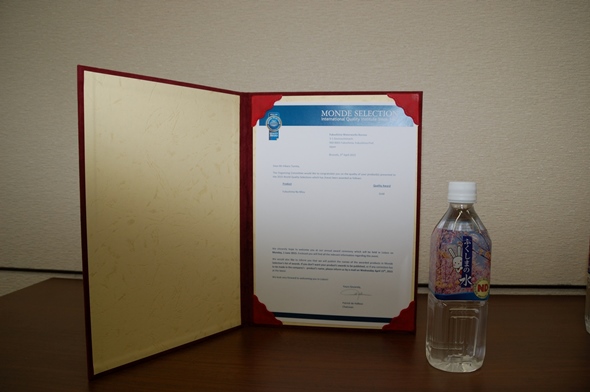
— Fukushima water receives international Monde gold award in 2015 and 2016 for its taste

International collusion at every level.

Reported on Fukushima Diary

Fukushima tap water is named “Fukushima water” by the city government and obtained “Monde Selection” in 2015 and 2016 for its taste.

From Fukushima Waterworks Bureau:

モンドロゴ(ブルー)2015

056

https://www.city.fukushima.fukushima.jp/suidou/?p=7982

From

Monde Selection — International Institute for Quality Selection

Our Mission:

Founded in 1961, Monde Selection’s mission is to test consumer products and grant them a bronze, silver, gold or grand gold quality award.

This quality label, awarded by a totally independent professional jury, offers the consumer and the producer numerous advantages.

Your Benefits:

A Monde Selection quality label offers undeniable advantages:

  • It BOOSTS SALES as consumers undeniably prefer a labelled product
  • It offers FREQUENT EXTERNAL CONTROL of the quality of your products and rewards your production team
  • It helps to POSITION YOUR PRODUCT and measure the national and international level of your competitors
  • It helps your company TO PROMOTE YOUR PRODUCT on national and international markets

http://www.monde-selection.com/


— La municipalité de Fukushima fait don de 10 000 bouteilles d’eau du robinet à celle de Kumamoto

Fukushima Diary
21-4-2016

Le 18 avril 2016, le Bureau des stations hydroliques de la municipalité de Fukushima a donné 10 000 bouteilles d’eau de leurs robinet à la municipalité de Kumamoto.

La ville de Kumamoto est une des principales zones sinistrées des séismes de 2016 de Kumamoto.
L’eau du robinet de Fukushima est baptisée “Eau de Fukushima” par sa municipalité et a obtenu, en 2015 et 2016 et pour son goût, le label “Sélection Mondiale”.

2 Fukushima city government donated 10,000 bottles of tap water to Kumamoto city

056

https://www.city.fukushima.fukushima.jp/suidou/?p=15191
https://www.city.fukushima.fukushima.jp/suidou/?p=7982

http://fukushima-diary.com/2016/04/fukushima-city-government-donated-10000-bottles-of-tap-water-to-kumamoto-city/

— Fukushima city government donated 10,000 bottles of their tap water to Kumamoto city

From Fukushima Diary

On 4/18/2016, Fukushima city Waterworks Bureau donated 10,000 bottles of their tap water to Kumamoto city.

Kumamoto city is one of the main disaster areas of 2016 Kumamoto earthquakes.

Fukushima tap water is named “Fukushima water” by the city government and obtained “Monde Selection” in 2015 and 2016 for its taste.

056

https://www.city.fukushima.fukushima.jp/suidou/?p=15191

https://www.city.fukushima.fukushima.jp/suidou/?p=7982

http://fukushima-diary.com/2016/04/fukushima-city-government-donated-10000-bottles-of-tap-water-to-kumamoto-city/