From Fukushima Fallout Awareness Network (FFAN)
Information on congressional briefing and follow-up: https://nislappdc.org/ffan-congressional-briefing/
FFAN initiatives: https://nislappdc.org/fukushima-fallout/

From Fukushima Fallout Awareness Network (FFAN)
Information on congressional briefing and follow-up: https://nislappdc.org/ffan-congressional-briefing/
FFAN initiatives: https://nislappdc.org/fukushima-fallout/
From the San Onofre Syndrome Team and the Fukushima Fallout Awareness Network
Transcript: https://nislappdc.org/wp-content/uploads/2024/07/Final-Transcript-FFAN-Congressional-Briefing-7.15.24.pdf
Recording: https://youtu.be/Cbk-gYgVI9s
Additional information and update: https://nislappdc.org/fukushima-fallout/
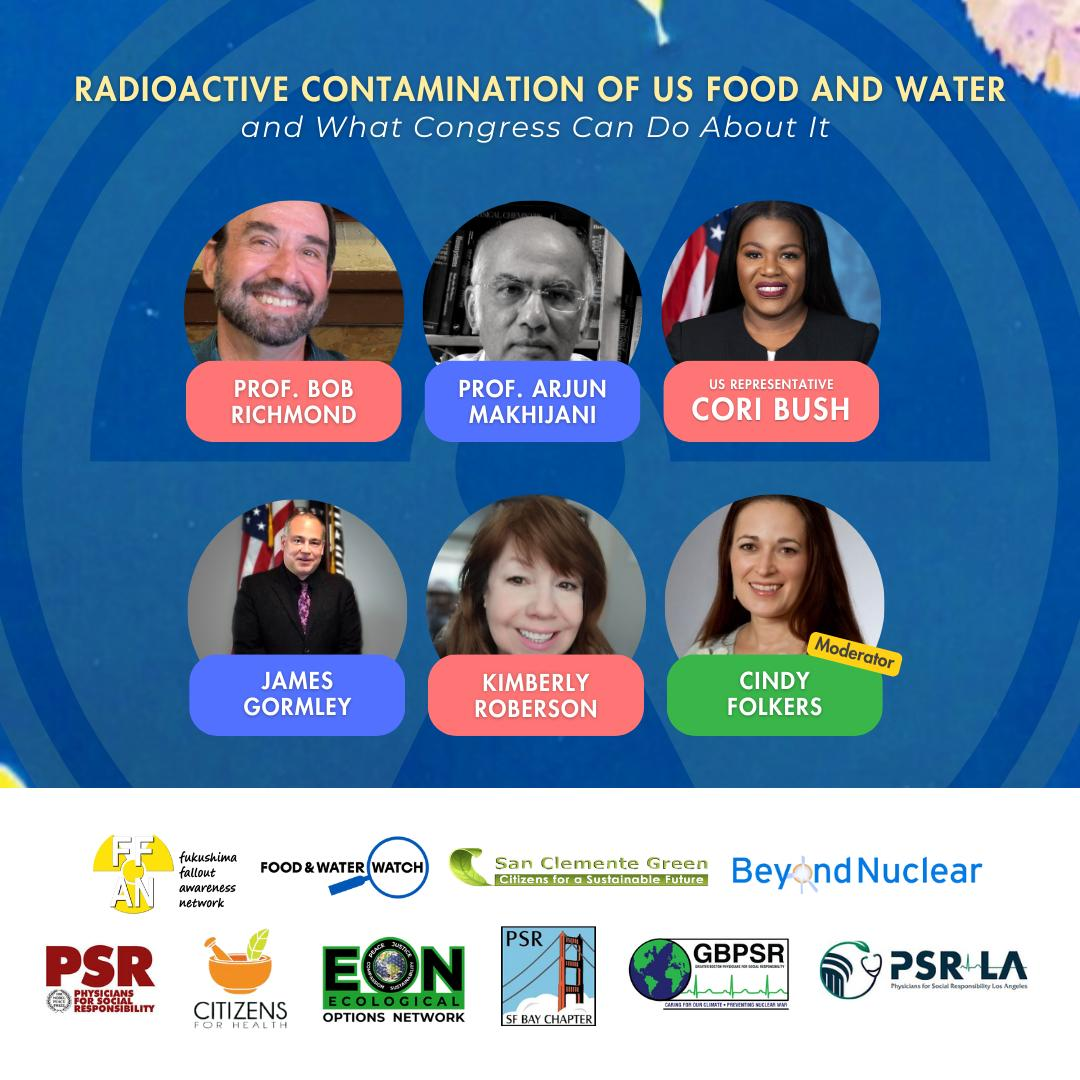
Radioactive Contamination of US Food and Water
and What Congress Can Do About It
Monday July 15, 2pm Eastern time
You’re invited to attend an online Congressional Briefing for members of Congress and their staffs on the growing problem of radioactive contamination of US food and water and what Congress can do about it.
The briefing will be held via Zoom on Monday, July 15 at 2pm Eastern time. Registration is required.
Distinguished experts and leaders presenting at the briefing include:
Radioactive contamination stands to get worse due to planned ongoing releases of radioactive wastewater from Fukushima Daiichi into the Pacific Ocean. Despite this, there are currently no binding FDA standards, very little testing or monitoring that has been made public, a lack of transparency about any such testing, and no labeling or other information available to US consumers about radioactivity in their food that can guide their choices. Food from Japan that exceeds Japan’s radioactivity standards and can’t be sold there is nonetheless sold and served to US consumers here and to US service men, women and their families overseas. Congress can and should use its oversight of the FDA and other powers to confront and ameliorate this growing public health threat.
The briefing is organized by the Fukushima Fallout Awareness Network and co sponsored by the NGO’s Beyond Nuclear, Citizens for Health, Ecological Options Network, Food and Water Watch, San Clemente Green, and Physicians for Social Responsibility (PSR National as well as PSR’s Greater Boston, Los Angeles, and San Francisco Bay Area Chapters)
For additional information and current campaign: https://nislappdc.org/ffan-congressional-briefing/
https://nislappdc.org/fukushima-fallout/
Also http://www.sanonofresyndrome.com


From Ojai Valley News
July 12, 2024
A grassroots group is kicking off a campaign to urge four local governments to sue the California Department of Toxic Substances Control (DTSC) over its failure to enforce cleanup agreements at a Simi Valley site contaminated in the 1940s and 1950s by thousands of rocket tests and nuclear-reactor experiments.
The campaign kickoff event is from 10 a.m. to 1 p.m., Saturday, July 13, at Strathearn Historical Park, 37 Strathearn Place, Simi Valley.
The event kicks off 10 days of in-person actions at upcoming supervisor and city council meetings.
A partial nuclear meltdown occurred in 1959, leaving radioactive fallout at the site.
Despite cleanup agreements being in place with The Boeing Company (Boeing), National Aeronautics and Space Administration (NASA), and the U.S. Department of Energy (DOE), the state has failed to demand they clean up the contamination to the standard originally agreed upon.
“We are asking four local governments to join together and sue the state to litigate over the final Environmental Impact Report,” said Larry Yee, a resident of Ojai and former chair of the Los Angeles Regional Water Quality Control Board.
Yee said the group is asking the Ventura County Board of Supervisors, Los Angeles County Board of Supervisors, and the cities of Los Angeles and Simi Valley to sue DTSC over the Environmental Impact Report recently issued for the site.
From Parents Against Santa Susana Field Laboratory
July 2024 Scheduled Actions
July 13: EVENT: SSFL Action Assembly, Strathearn Historical Ranch, Simi Valley
July 14: WATCH: In the Dark of the Valley Virtual Screening and QA Register
July 15: CALL: Elected representative phone banking
July 16: AMPLIFY: Reshare posts on social media & tag your representatives
July 17: EMAIL: Elected representative email banking
July 18: AMPLIFY: Share press stories with your networks
July 19: SIGN: Our open letter to local governments
July 20: AMPLIFY: Reshare posts on social media & tag your representatives
July 21: SIGN: Invite others to sign the www.Change.org/SantaSusana petition
July 22: CALL: Elected representatives
July 23: DEADLINE FOR BOARD OF SUPERVISORS TO FILE SUIT AGAINST DTSC
For more information: https://parentsagainstssfl.com/action-assembly
From Reuters
By Jane Chang
20 November 2019
SEOUL (Reuters) – Japan’s reluctance to disclose information about the release of radioactive water from its damaged Fukushima nuclear plant is hampering neighboring countries’ efforts to minimize the impact, the head of South Korea’s nuclear safety agency said on Wednesday.
Since the 2011 earthquake and tsunami caused a meltdown at some of the reactors the Fukushima plant, owner Tokyo Electric Power Co (Tepco) has been storing radioactive water in tanks at the site from the cooling pipes used to keep the fuel cores from melting. The utility will run out of space for the water in 2022.
Japan has not yet decided how to deal with the contaminated water, but its environment minister said in September that radioactive water would have to be released from the site into the Pacific Ocean.
“We have been raising Japan’s radioactive water issue to the international community to minimize the impact … but as Japan hasn’t disclosed any specific plan and process we would need more details to run simulations and study,” Uhm Jae-sik, chairman of the Nuclear Safety and Security Commission, told Reuters.
In addition to the Fukushima crisis, safety concerns about nuclear energy have increased in South Korea following a 2012 scandal over the supply of faulty reactors parts with forged documents, prompting a series of shutdowns of nuclear reactors.
South Korea, the world’s fifth-largest user of nuclear power, targets a long-term phase out of atomic power to allay public concerns.
“Regardless of the government’s energy policy change, our primary goal is ensuring the safety of nuclear power,” Uhm said.
South Korea operates 25 nuclear reactors, which generate about a third of the country’s total electricity. Of the 25 reactors, 10 are offline for maintenance, according to the website of Korea Hydro & Nuclear Power.
Posted under Fair Use Rules
From the Mainichi
August 23, 2016 (Mainichi Japan)
TOKYO (Kyodo) — Around 10,000 tons of contaminated water have pooled in underground trenches around the Nos. 1 to 4 reactor buildings of the crippled Fukushima Daiichi nuclear power plant, according to the plant operator Tokyo Electric Power Company Holdings Inc.
Tokyo Electric has no immediate plan to remove the water in the trenches where cables run for the nuclear power complex devastated by the March 2011 earthquake and tsunami disaster.
Water that flew into the trenches in the wake of the huge tsunami is believed to have been mixed with highly radioactive water leaking from the basements of reactor buildings and contaminated rainwater.
“Compared with around 70,000 tons of highly contaminated water that remain in the basements of the reactor buildings, (the water in the trenches) has a low level of concentration and thus poses little threat in terms of radiation exposure and the environment,” said an official of the utility known as TEPCO.
TEPCO said in a report issued in July — based on research conducted in fiscal 2015 — that it has found around 8,000 tons of toxic water in 17 locations in the trenches that connect with reactor buildings where highly radioactive water accumulates, as well as around 3,000 tons of toxic water at 11 locations in trenches that do not connect with reactor buildings.
Of the water in the trenches around the Nos. 1 to 4 reactor buildings, a removal procedure was completed by June for around 500 tons of water in a pipe that measured the highest level of radioactive cesium at 500,000 becquerels per liter.
The level of radioactive cesium in water at other locations in the trenches was mostly measured at several thousands becquerels or below.
The level in toxic water in the basements of reactor buildings has been measured at around dozens of millions becquerels at maximum.
TEPCO has said it will continue to monitor and measure the level of contamination in water in the trenches regularly and consider taking measures to remove the water in the future. But no concrete plan has been created yet.
The electricity firm has so far removed a total of around 10,000 tons of highly radioactive water at three locations in the trenches running in the seaside of the complex and completed the procedure to fill locations concerned with cement to prevent water leaks.
Still, the level of radioactive cesium remains unchecked at 40 locations in the trenches due to high radioactive levels as well as debris and other objects blocking the research operation…
Editor: This is after 5 years.
http://mainichi.jp/english/articles/20160823/p2g/00m/0dm/074000c
Posted under Fair Use Rules.
International collusion at every level.
Reported on Fukushima Diary
Fukushima tap water is named “Fukushima water” by the city government and obtained “Monde Selection” in 2015 and 2016 for its taste.
From Fukushima Waterworks Bureau:

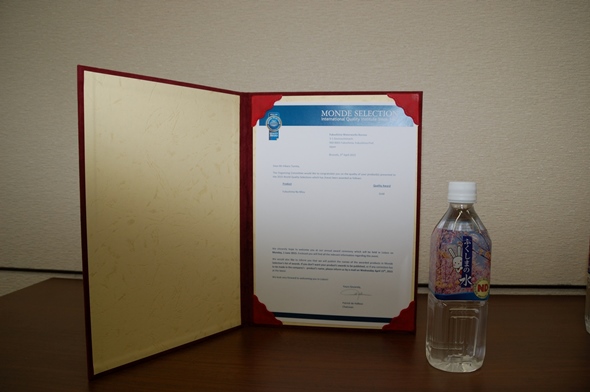
https://www.city.fukushima.fukushima.jp/suidou/?p=7982
From
Monde Selection — International Institute for Quality Selection
Our Mission:
Founded in 1961, Monde Selection’s mission is to test consumer products and grant them a bronze, silver, gold or grand gold quality award.
This quality label, awarded by a totally independent professional jury, offers the consumer and the producer numerous advantages.
Your Benefits:
A Monde Selection quality label offers undeniable advantages:
http://www.monde-selection.com/
 Heal Fukushima