— Hunters Point Naval Shipyard, SF — contamination and reports

From Committee to Bridge the Gap

A History of Extensive Radioactivity Use

ON JULY 16, 1945, THE USS INDIANAPOLIS DEPARTED Hunters Point Naval Shipyard carrying components of a bomb code-named “Little Boy,” including half of the highly enriched uranium then in existence in the world. Two hours later, after receiving word that the “Trinity” test of the first nuclear explosion on earth had succeeded earlier that day at Alamogordo, New Mexico, the Indianapolis was allowed to leave San Francisco harbor carrying its cargo to the island of Tinian in the Pacific. On August 6, a plane christened the Enola Gay left Tinian and dropped the assembled atomic bomb on Hiroshima.

About a year later, the nuclear arms race returned to Hunters Point. The first post-war nuclear tests, called OPERATION CROSSROADS, were conducted at the Bikini Atoll in the Marshall Islands in the Pacific, involving 42,000 sailors and more than 240 target and support ships. The tests went badly awry, contaminating the ships. More than 80 of the most contaminated ships, from this and subsequent tests, were brought back for “decontamination” to Hunters Point, then, as now, a predominantly low-income Black community. This process involved sandblasting the radioactivity off the ships in the open air, transferring the contamination from the ships to the surrounding area.

In 1989, Hunters Point was made a Superfund site, listed as one of the most polluted places in the country. Since then, the cleanup has been botched beyond description. CBG, working with Public Employees for Environmental Responsibility, pried out of EPA and made available to the news media EPA documents concluding that the Navy’s contractor had apparently fabricated or otherwise falsified radioactivity measurements at 90-97% of the survey units at the site. $250 million in taxpayer money was wasted; the tests would have to be redone.

CBG has issued a series of detailed reports (which you can find on the column to the left) on the problems at Hunters Point, which have been given significant press attention (e.g., front page of the San Francisco Chronicle, major TV news stories on NBC Bay Area). These studies— based on intensive research by CBG staffers Devyn Gortner, Maria Caine, Taylor Altenbern, Haakon Williams, and Audrey Ford, and a score of interns—disclosed that the problems went far beyond the fabrication of measurements. CBG revealed that radioactivity use at the site was far more extensive than generally realized, with numerous pathways for transporting contamination throughout the entire shipyard and into the neighboring community; that 90% of sites at Hunters Point had not been tested at all; that for those sites that were, 90% of the radionuclides of concern were not tested for. We showed that the cleanup standards employed by the Navy were decades out of date and far, far weaker than current EPA standards, which are required to be used at Superfund sites.

We disclosed that the Navy, after having promised to remove the contamination so that the site could be released for unrestricted residential use, shifted gears and decided to leave much of the contamination and just cover it with thin layers of soil or asphalt. Because the site is planned to be the largest redevelopment project in San Francisco history since the 1906 earthquake, those thin covers will have to be torn up and the contaminated soil beneath them excavated to build the more than 12,000 homes planned, exposing and lofting the contamination into the air. Drs. Howard Wilshire and William Bianchi prepared companion reports that showed that plant roots and burrowing animals would also bring the contamination back to the surface. We have prepared detailed critiques of testing plans by the Navy and the health department showing that they were incapable of detecting contamination at the levels requiring cleanup.

Three quarters of a century after the nuclear arms race set sail from Hunters Point, the toxic legacy remains for that impacted community, a victim of environmental injustice. We will continue our efforts to assist them, as they frankly have no one on their side from the parties responsible—the Navy, its contractors, and the captured regulators. Hunters Point is a striking reminder that the nuclear arms race threatens us globally and locally.

[This is in addtion to the Navy’s nuclear waste dump offshore San Francisco and the radioactive USS Independence which the Navy filled with nuclear waste and sank south of San Francisco, near Half Moon Bay in what is now the Monterey Bay National Marine Sanctuary.]

Hunters Point Reports

Report 1: Hunters Point Naval Shipyard: The Nuclear Arms Race Comes Home – October 2018

Report 2: The Great Majority of Hunters Point Sites Were Never Sampled for Radioactive Contamination — And the Testing That Was Performed Was Deeply Flawed – October 2018

Report 3: Hunters Point Shipyard Cleanup Used Outdated and Grossly Non-Protective Cleanup Standards – October 2018

Report 4: FROM CLEANUP TO COVERUP: How the Navy Quietly Abandoned Commitments to Clean Up Hunters Point Naval Shipyard and is Instead Covering Up Much of the Contamination – August 2019

Companion Reports Issued with Report 4:

Plant Uptake of Radionuclides and Toxic Chemicals from Contaminated Soils Below a Shallow Soil Cover by William Bianchi, PhD, August 2019

Bioturbation, Erosion, and Seismic Activity Make Shallow Soil Covers Ineffective at Isolating Contamination by Howard Wilshire, PhD, August 2019

Additional CBG Hunters Point Critiques:  

Critique of the Navy’s Draft Fifth Five-Year Review – May 2024

Critique of the Navy’s Protectiveness Review of its HPNS Building Cleanup Standards – November 2019

Critique of the Navy’s Protectiveness Review of its HPNS Soil Cleanup Standards – September 2019

Critique of the Navy’s Draft Five Year Review – September 2018

Critique of the California Department of Public Health Work Plan for a Partial Gamma Survey of Parcel A-1 Hunters Point Naval Shipyard – July 2018

Critique of the Work Plan for Retesting of Parcel G Hunters Point Naval Shipyard – August 2018

Critique of the Navy’s Parcel F Proposed Plan for Offshore Sediment Cleanup Hunters Point Naval Shipyard Superfund Site – May 2018

https://www.committeetobridgethegap.org/hunters-point-reports1/

— Webinar on how to comment on plutonium pit production, Thursday May 22

From Nuclear Watch New Mexico
https://nukewatch.org/

Virtual Workshop
On the nationwide programmatic
Environmental Impact Statement
on the expanded production of
plutonium “pit” bomb cores

Learn How to Make Effective Comments
at the Upcoming Public Hearings…
Speak your mind at an upcoming hearing on the government’s plan
to produce up to 120 new plutonium pits per year
for nuclear weapons for the next 50 years!

When: Thursday, May 22 at 6 – 7:30 EST / 3 – 4:30 PM PST
Zoom Link: https://tinyurl.com/3tta9vey

The workshop will feature:
Talking points and suggested scoping comments 
Explanation of procedural process
Question & answers with subject matter experts

Background: Pursuant to the National Environmental Policy Act, Nuclear Watch New Mexico, Savannah River Site Watch and Tri-Valley CAREs successfully sued the National Nuclear Security Administration (NNSA) over its failure to complete a required nationwide “programmatic environmental impact statement” (PEIS) for its most costly program ever, the expanded production of plutonium “pit” bomb cores. No future production is to maintain the safety and reliability of the existing nuclear weapons stockpile. Instead, all pit production will be for new design nuclear weapons.

To meet its enforced legal obligation, the NNSA is holding two virtual “scoping” hearings:

Tuesday, May 27, 2025:
5:00-7:30 pm EST, 4:00-6:30 pm CST, 3:00-5:30 pm MST and 2:00-4:30 pm PST
Meeting Link: https://bit.ly/PuPEISMtg1

Dial in by Phone: (571) 429-4592 Phone ID: 808 821 801#

AND

Wednesday, May 28, 2025:
7:00 pm-9:30 pm EST, 6:00 pm-8:30 pm CST, 5:00 pm-7:30 pm MST, and 4:00 pm-6:30 pm PST
Meeting Link: https://bit.ly/PuPEISMtg2

Dial in by Phone: (571) 429-4592 Phone ID: 989 289 432#

Please comment and let’s PACK these hearings!

This is a unique opportunity to comment on core nuclear weapons issues NATIONWIDE!

Click here for a 60-second explainer video!

Sponsored by

– Documentary “Television Event” airs covering impact of 1983 ABC film “The Day After”

From TelevisionEvent.com with schedule of air times
https://televisionevent.com/

TELEVISION EVENT is an archive-based feature documentary that views the dramatic climax of the Cold War through the lens of a commercial television network, as it narrowly succeeds in producing the most watched, most controversial made-for-TV movie, THE DAY AFTER (1983).

With irreverent humor and sobering apocalyptic vision, this film reveals how a commercial broadcaster seized a moment of unprecedented television viewership, made an emotional connection with an audience of over 100 million and forced an urgent conversation with the US President on how to collectively confront and resolve the most pressing issue of the time – nuclear proliferation. 

MY TEAM PRODUCED THIS FILM IN THE HOPES OF WAKING UP THE PUBLIC, SO WE DON’T SLEEPWALK INTO THE APOCALYPSE. THE DAY AFTER PROVED THAT, HOWEVER POLARIZED WE MAY BE IDEOLOGICALLY, WE CAN STILL COME TOGETHER, INFORM OURSELVES, AND ACT TO PREVENT THE OBSCENE DEVASTATION CAUSED BY NUCLEAR WEAPONS.” – DIRECTOR, JEFF DANIELS

Check website for schedule and watch on demand on Vimeo ($5).

— November 16: Forum on U.S. proposal to build up nuclear arsenal

From Los Alamos Study Group

Thursday, November 16, 2023
6-8 PM Mountain Time
Unitarian Universalist Congregation

107 W. Barcelona Road
Santa Fe, New Mexico
In-person
and webcast

Panel discussion on the Congressional Nuclear Strategy Commission’s proposed crash program to increase U.S. nuclear weapons production, deployment, and spending by 2035, along with rapid qualitative and quantitative increases in other strategic weapons.

Speakers:
Peter Kuznick
Steven Starr
Greg Mello

Register for webcast:
To join the meeting by Zoom, register in advance at this link:  https://us02web.zoom.us/meeting/register/tZclcemgpzIrH9GVf3g3ImNz1s8m1W6ilRoV.

Bulletin 333:

In late 2010, President Obama agreed to a wide-ranging plan to modernize the entire nuclear weapons establishment in negotiations with Senate Republicans over the ratification of New START. That plan involved the serial modernization or replacement of every single U.S. nuclear warhead factory, warhead, and delivery system. Since 2010 this plan has gradually evolved and expanded, and of course it has also greatly increased in cost.

Now, a radical increase in scale and pace of modernization, along with an increase in the size of nuclear forces, is being proposed by an influential bipartisan group appointed by Congress, as laid out in the The Final Report of the Congressional Commission on the Strategic Posture of the United States (Oct 2023). It was recently presented to the Senate (video 1) to general acclaim (“Bi-partisan support for strategic posture report in Senate Armed Services Committee hearing,” Exchange Monitor, Oct 19, 2023).

This report makes the claim that unless the U.S. greatly increases its nuclear weapons efforts along with other strategic system acquisitions over the 2027-2035 period, “deterrence” vis-a-vis Russia and China will be lost.

As regular readers of these Bulletins will know, that happens to be the period of time in which Los Alamos National Laboratory (LANL) is expected to make all the new plutonium warhead cores (“pits”) for what these authors hope will be an expanding U.S. nuclear arsenal. Absent new pits from LANL, no altogether new warheads will be possible.

This Thursday, November 16, from 6-8 pm, we will host a nationally-webcast, panel and audience discussion of this new strategic proposal at the Unitarian Universalist Congregation in Santa Fe, at 107 W. Barcelona Road (map). Panelists will include Peter Kuznick, who will speak on how this plan is being received internationally, Steven Starr, and myself. If you are local, please come in person if you can.

To join the meeting by Zoom, register in advance at this link: https://us02web.zoom.us/meeting/register/tZclcemgpzIrH9GVf3g3ImNz1s8m1W6ilRoV. After registering, you will receive a confirmation email containing information about joining the meeting.

…Many of you may be interested in this recent expose (with which we had a lot to do): “Chess, cards and catnaps in the heart of America’s nuclear weapons complexSearchlight New Mexico, Nov 8, 2023).

https://lasg.org/ActionAlerts/2023/Bulletin333.html

1 armed-services.senate(dot)gov/hearings/to-receive-testimony-on-the-findings-of-the-congressional-commission-on-the-strategic-posture-of-the-united-states

— NIRS: Tell Congress to reject American Nuclear Infrastructure Act — S. 4897

From Nuclear Information and Resource Service:

Last week, a U.S. Senate committee approved one of the worst pro-nuclear bills to ever come out of that body: the American Nuclear Infrastructure Act of 2020 — S. 4897.

What makes this bill so terrible? Among other things, it would spur additional uranium mining in this country, give away billions of dollars to the nuclear industry, and incentivize nuclear energy at the expense of renewables.

Whether or not you already took action on this bill, your members of Congress still need to know you oppose it. Tell your members of Congress to OPPOSE the American Nuclear Infrastructure Act today.

This bill is a hodgepodge of measures that will make everything that’s bad about nuclear energy even worse. Among other things, the bill would:

  • Expand uranium mining through the creation of a domestic uranium reserve. It does nothing to require federal agencies to mitigate the well-established environmental harms of uranium mining and milling practices, nor to require prompt and thorough reclamation and cleanup of mines and other nuclear facilities.
  • Create a 10-year subsidy for about half of the nuclear reactors in the country. Such a subsidy would crowd out investment in renewable energy, which unlike nuclear power is a real solution to climate change.
  • Introduce other harmful nuclear technologies, including reprocessing and more highly enriched uranium. Both increase nuclear weapons proliferation risks.
  • Do nothing to regulate the nuclear industry for climate change, earthquakes, or similar risks.

The American Nuclear Infrastructure Act does virtually nothing to curb the dangers of nuclear power. It worsens the environmental justice issues related to nuclear and extends a lifeline to this obsolete and dying industry at the expense of renewables, which are the real answer to the climate crisis.

The Senate Committee on Environment and Public Works has already approved this bill, so we have to act fast.

The bill hasn’t been introduced in the House yet, but we’re asking you to also email your representative just in case the bill moves there. Tell your members of Congress to OPPOSE the American Nuclear Infrastructure Act today.

Thanks for all you do!

The NIRS Team

Diane D’Arrigo
Luis Hestres
Denise Jakobsberg
Tim Judson

Nuclear Information and Resource Service
6930 Carroll Avenue Suite 340 | Takoma Park, Maryland 20912
3012706477 | nirs@nirs.org | nirs.org

— A People’s Peace Treaty with North Korea — sign and forward

From davidswanson.org

October 27, 2017

Alarmed by the threat of a nuclear war between the U.S. and North Korea, concerned U.S. peace groups have come together to send an open message to Washington and Pyongyang.

Click here to add your name to the People’s Peace Treaty.
https://act.rootsaction.org/p/dia/action4/common/public/?action_KEY=13108&tag=WBW171027&track=WBW171027

The People’s Peace Treaty will be sent to the governments and peoples of Korea, as well as to the U.S. Government. It reads, in part:

Recalling that the United States currently possesses about 6,800 nuclear weapons, and has threatened the use of nuclear weapons against North Korea in the past, including the most recent threat made by the U.S. President in his terrifying speech to the United Nations (“totally destroy North Korea”);

Regretting that the U.S. Government has so far refused to negotiate a peace treaty to replace the temporary Korean War Armistice Agreement of 1953, although such a peace treaty has been proposed by Democratic People’s Republic of Korea (DPRK) many times from 1974 on;

Convinced that ending the Korean War officially is an urgent, essential step for the establishment of enduring peace and mutual respect between the U.S. and DPRK, as well as for the North Korean people’s full enjoyment of their basic human rights to life, peace and development – ending their long sufferings from the harsh economic sanctions imposed on them by the U.S. Government since 1950.

Add your name now.

https://act.rootsaction.org/p/dia/action4/common/public/?action_KEY=13108&tag=WBW171027&track=WBW171027

The People’s Peace Treaty concludes:

NOW, THEREFORE, as a Concerned Person of the United States of America (or on behalf of a civil society organization), I hereby sign this People’s Peace Treaty with North Korea, dated November 11, 2017, Armistice Day (also Veterans Day in the U.S.), and
1) Declare to the world that the Korean War is over as far as I am concerned, and that I will live in “permanent peace and friendship” with the North Korean people (as promised in the 1882 U.S.-Korea Treaty of Peace, Amity, Commerce and Navigation that opened the diplomatic relations between the U.S. and Korea for the first time)***;
2) Express my deep apology to the North Korean people for the U.S. Government’s long, cruel and unjust hostility against them, including the near total destruction of North Korea due to the heavy U.S. bombings during the Korean War;
3) Urge Washington and Pyongyang to immediately stop their preemptive (or preventive) conventional/nuclear attack threats against each other and to sign the new UN Treaty on the Prohibition of Nuclear Weapons;
4) Call upon the U.S. Government to stop its large-scale, joint war drills with the armed forces of the Republic of Korea (South Korea) and Japan, and commence a gradual withdrawal of the U.S. troops and weapons from South Korea;
5) Call upon the U.S. Government to officially end the lingering and costly Korean War by concluding a peace treaty with the DPRK without further delay, to lift all sanctions against the country, and to join the 164 nations that have normal diplomatic relations with the DPRK;
6) Pledge that I will do my best to end the Korean War, and to reach out to the North Korean people – in order to foster greater understanding, reconciliation and friendship.

Sign your name by clicking here.

https://act.rootsaction.org/p/dia/action4/common/public/?action_KEY=13108&tag=WBW171027&track=WBW171027

Some noted signers: 
Christine Ahn, Women Cross DMZ
Medea Benjamin, Code Pink
Jackie Cabasso, Western States Legal Foundation, UFPJ
Gerry Condon, Veterans For Peace
Noam Chomsky, Emeritus Professor, M.I.T.
Blanch Weisen Cook, Professor of History and Women’s Studies, John Jay College of Criminal Justice, City University of New York
Joe Essertier, World Beyond War – Japan
Irene Gendzier, Emeritus Professor, Boston University
Joseph Gerson, Campaign for Peace, Disarmament and Common Security
Louis Kampf, Emeritus Professor, M.I.T.
Asaf Kfoury, Professor of Mathematics, Boston University
John Kim, Veterans For Peace
David Krieger, Nuclear Age Peace Foundation
John Lamperti, Emeritus Professor, Dartmouth College
Kevin Martin, Peace Action
Sophie Quinn-Judge, Temple University (retired)
Steve Rabson, Emeritus Professor, Brown University
Alice Slater, Nuclear Age Peace Foundation
David Swanson, World Beyond War, RootsAction
Ann Wright, Women Cross DMZ, Code Pink, VFP

After signing the petition, please use the tools on the next webpage to share it with your friends.

Background: 
President Jimmy Carter, “What I’ve Learned from North Korea’s Leaders,”Washington Post, Oct. 4, 2017
Col. Ann Wright (Ret.), “A Path Forward on North Korea, “ Consortiumnews,March 5, 2017
Leon V. Sigal, “Bad History,” 38 North, Aug. 22, 2017
Prof. Bruce Cumings, “A Murderous History of Korea,“ London Review of Books, May 18, 2017

http://davidswanson.org/a-peace-treaty-with-north-korea-and-you-can-sign-it/

*** The  1882 U.S.-Korea Treaty of Peace, Amity, Commerce and Navigation mentioned below was itself a coercive action forced on Korea by the United States to forcibly open the country to U.S. trade and presence. It’s time to have real peace and friendship with the Democratic People’s Republic of Korea.

— America’s war against the people of Korea: The historical record of U.S. war crimes

Global Research, April 30, 2017
Global Research 13 September 2013

The following text by Michel Chossudovsky was presented in Seoul, South Korea in the context of the Korea Armistice Day Commemoration, 27 July 2013

A Message for Peace. Towards a Peace Agreement and the Withdrawal of US Troops from Korea.

Introduction

Armistice Day, 27 July 1953 is day of Remembrance for the People of Korea.

It is a landmark date in the historical struggle for national reunification and sovereignty.

I am privileged to have this opportunity of participating in the 60th anniversary commemoration of Armistice Day on July 27, 2013.

I am much indebted to the “Anti-War, Peace Actualized, People Action” movement for this opportunity to contribute to the debate on peace and reunification.

An armistice is an agreement by the warring parties to stop fighting. It does signify the end of war.

What underlies the 1953 Armistice Agreement is that one of the warring parties, namely the US has consistently threatened to wage war on the DPRK for the last 60 years.

The US has on countless occasions violated the Armistice Agreement. It has remained on a war footing. Casually ignored by the Western media and the international community, the US has actively deployed nuclear weapons targeted at North Korea for more than half a century in violation of article 13b) of the Armistice agreement. 

The armistice remains in force. The US is still at war with Korea. It is not a peace treaty, a peace agreement was never signed.

The US has used the Armistice agreement to justify the presence of 37,000 American troops on Korean soil under a bogus United Nations mandate, as well as establish an environment of continuous and ongoing military threats. This situation of “latent warfare” has lasted for the last 60 years. It is important to emphasize that this US garrison in South Korea is the only U.S. military presence based permanently on the Asian continent.

Our objective in this venue is to call for a far-reaching peace treaty, which will not only render the armistice agreement signed on July 27, 1953 null and void, but will also lay the foundations for the speedy withdrawal of US troops from Korea as well as lay the foundations for the reunification of the Korean nation.

Michel Chossudovsky Presentation: 60th anniversary commemoration of Armistice Day on July 27, 2013, Seoul, ROK. 

<iframe width=”690″ height=”400″ src=”https://www.youtube.com/embed/U2xO7Cn_xDU&#8221; frameborder=”0″ allowfullscreen><!–iframe>

Armistice Day in a Broader Historical Perspective.

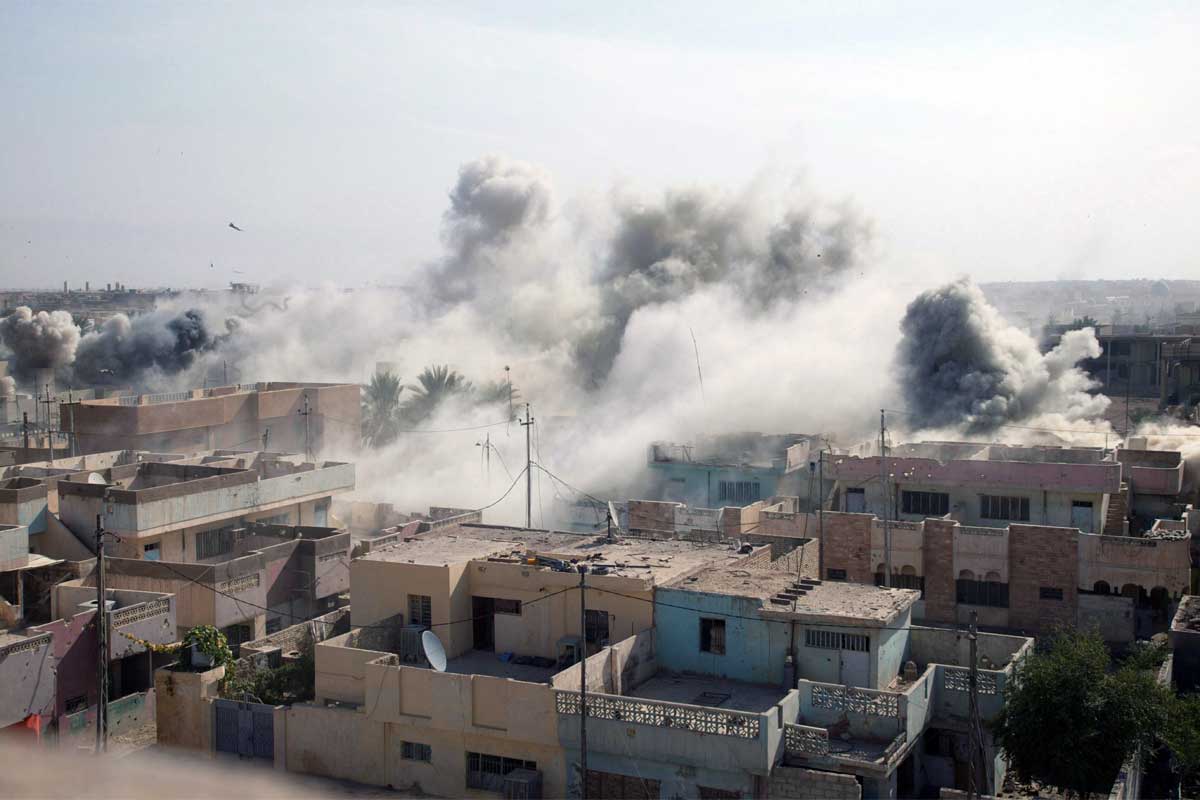
This commemoration is particularly significant in view of mounting US threats directed not only against Korea, but also against China and Russia as part of Washington’s “Asia Pivot”, not to mention the illegal occupation of Afghanistan and Iraq, the US-NATO wars against Libya and Syria, the military threats directed against Iran, the longstanding struggle of the Palestinian people against Israel, the US sponsored wars and insurrections in sub-Saharan Africa.

Armistice Day July 27, 1953, is a significant landmark in the history of US led wars.  Under the Truman Doctrine formulated in the late 1940s, the Korean War (1950-1953) had set the stage for a global process of militarization and US led wars. “Peace-making” in terms of a peace agreement is in direct contradiction with Washington “war-making” agenda.

Washington has formulated a global military agenda. In the words of four star General Wesley Clark (Ret) [image right], quoting a senior Pentagon official:

“We’re going to take out seven countries in 5 years, starting with Iraq, and then Syria, Lebanon, Libya, Somalia, Sudan and, finishing off, Iran” (Democracy Now March 2, 2007)

The Korean War (1950-1953) was the first major military operation  undertaken by the US in the wake of  World War II,  launched at the very outset of  what was euphemistically called “The Cold War”. In many respects it was a continuation of World War II, whereby Korean lands under Japanese colonial occupation were, from one day to the next, handed over to a new colonial power, the United States of America.

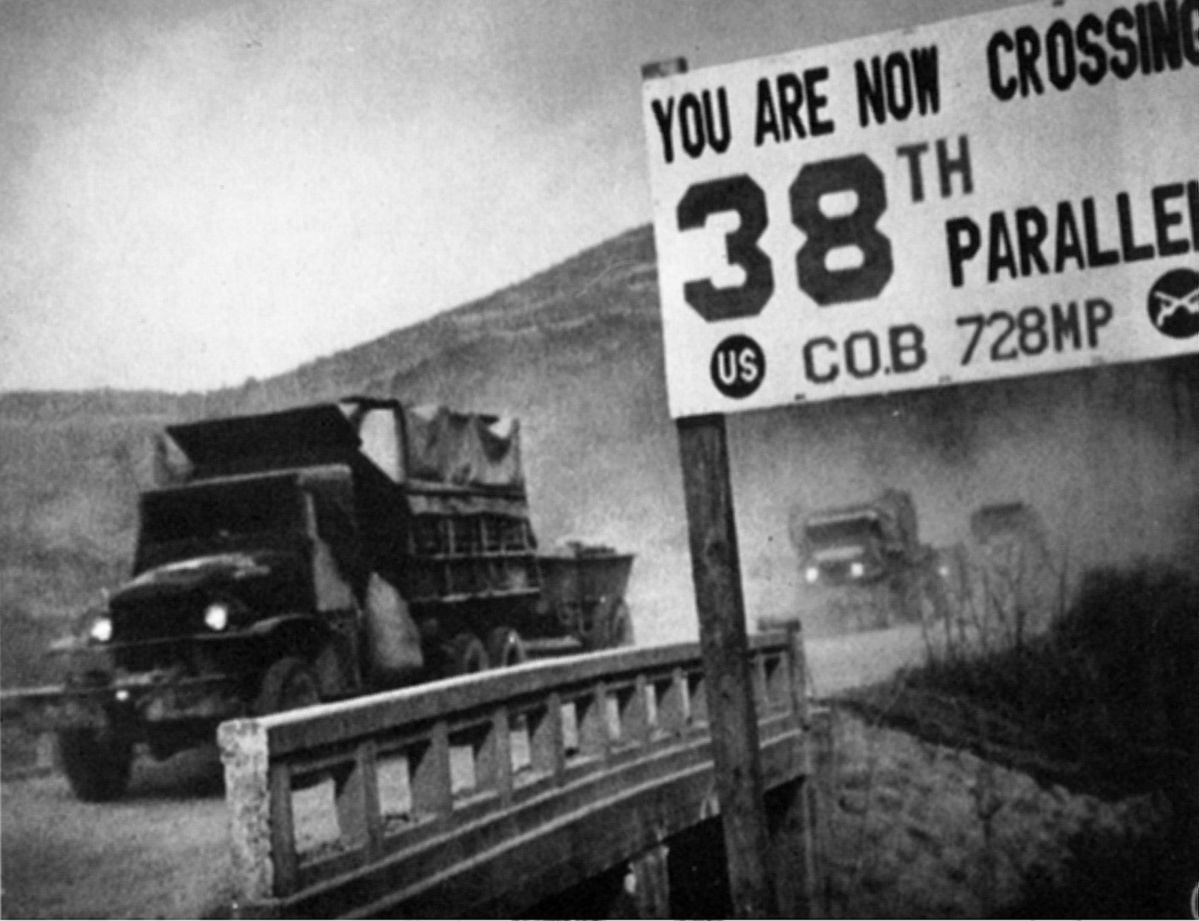
At the Potsdam Conference (July–August 1945), the US and the Soviet Union agreed to dividing Korea, along the 38th parallel.

There was no “Liberation” of Korea following the entry of US forces. Quite the opposite.

As we recall, a US military government was established in South Korea on September 8, 1945, three weeks after the surrender of Japan on August 15th 1945. Moreover,  Japanese officials in South Korea assisted the US Army Military Government (USAMG) (1945-48) led by General Hodge in ensuring this transition. Japanese colonial administrators in Seoul as well as their Korean police officials worked hand in glove with the new colonial masters.

From the outset, the US military government refused to recognize the provisional government of the People’s Republic of Korea (PRK), which was committed to major social reforms including land distribution, laws protecting the rights of workers, minimum wage legislation and  the reunification of North and South Korea.

The PRK was non-aligned with an anti-colonial mandate, calling for the “establishment of close relations with the United States, USSR, England, and China, and positive opposition to any foreign influences interfering with the domestic affairs of the state.”2

The PRK was abolished by military decree in September 1945 by the USAMG. There was no democracy, no liberation no independence.

While Japan was treated as a defeated Empire, South Korea was identified as a colonial territory to be administered under US military rule and US occupation forces.

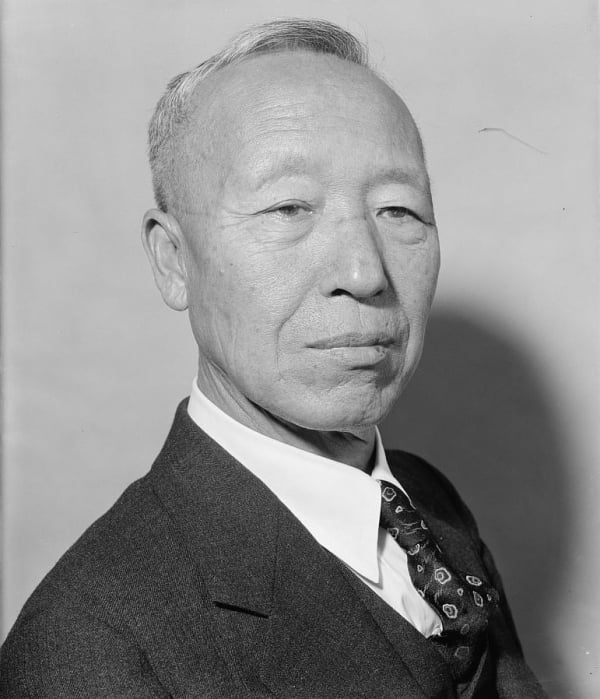
America’s handpicked appointee Sygman Rhee [left] was flown into Seoul in October 1945, in General Douglas MacArthur’s personal airplane.

The Korean War (1950-1953)

The crimes committed by the US against the people of Korea in the course of the Korean War but also in its aftermath are unprecedented in modern history.

Continue reading

— The “Doomsday Forum”: the Pentagon and war industry promote pre-emptive nuclear war

Global Research, April 28, 2017

Author’s Note

This article was first published on July 8, 2016

America’s pre-emptive nuclear doctrine was firmly entrenched prior to Donald Trump’s accession to the White House. The use of nukes against North Korea has been on the drawing-board of the Pentagon for more than half a century. 

In June 2016 under the Obama administration, top military brass together with the CEOs of the weapons industry debated the deployment of nuclear weapons against Russia, China, Iran and North Korea.

The event was intended to sensitize senior decision makers. The focus was on building a consensus (within the Armed Forces, the science labs, the nuclear industry, etc) in favor of pre-emptive nuclear war 

It was a form of “internal propaganda” intended for senior decision makers (Top Officials) within the military as well as the weapons industry. The emphasis was on “building peace” and “global security” through the “pre-emptive” deployment of nukes (Air, Land and Sea) against four designated “rogue” countries, which allegedly are threatening the Western World. 

One of keynote speakers at the Doomsday Forum, USAF Chief of Staff for Nuclear Integration, Gen. Robin Rand, is presently involved under the helm of Secretary of Defense General Mattis in coordinating the deployment of strike capabilities to East Asia. Gen. Robin Rand heads the Air Force’s nuclear forces and bombers. His responsibility consists in “moving ahead with plans to deploy its most advanced weapons to the [East Asian] region…” Recent reports confirm an unfolding consensus within the military establishment:

“Military leaders regularly, and since the change of administration, have listed China, Russia, North Korea, Iran, and ISIS as the major areas of concern for the future. From a security standpoint, tensions with North Korea continue to escalate, with reverberations throughout the region. In response to Pyongyang’s nuclear missile program, … the U.S. sped up the deployment of THAAD anti-missile interceptors to South Korea. This may reassure Seoul, and to a lesser extent Tokyo, but it has incensed Beijing.” Defense One, March 17, 2017

The unspoken truth is that the THAAD missiles to be stationed in South Korea are not intended for the DPRK, they are slated to be used against China and Russia.

Michel Chossudovsky, April 28, 2017

*     *     *

On June 21, 2017,  250 top military brass, military planners, corporate military-industrial  “defense” contractors, top officials and scientists from the nuclear weapons laboratories as well as prominent  academics gathered at the Crowne Plaza Hotel in Albuquerque, New Mexico to discuss, debate and promote the Pentagon’s One Trillion Dollar Nuclear Weapons program.

Continue reading

— Midnight approaching over Syria?

It is now two and a half minutes to midnight. The closest the world has ever been, according to the Bulletin of the Atomic Scientists, to a probable “global catastrophe”.
Global Research, April 23, 2017

To the elation of the western corporate media, Neocons like John McCain and Democons like Hillary Clinton – who had only just called for Trump to attack Syria 24 hours before he obliged – the US President unilaterally ordered the US Army, on April 6, to launch 59 Tomahawk cruise missiles at the Syrian military airfield in Ash Sha’irat near Homs. And managed to appease the entire ‘establishment’ he promised to oppose during his presidential campaign — that so vehemently attacked him for everything he did during his short time in the White House, previous to the attack.

Just to put their ‘elation’ into perspective: Of the top 100 newspapers in the US, Fairness and Accuracy in Reporting, a media watch group based in New York City, reports that 47 ran editorials on the attack; 39 clearly in favour of it, seven ambiguous (although some may argue that they too were in favour), and only one opposing it. Journalist Brian Williams, who was caught lying about going to Iraq with a Navy Seal team in a helicopter that was hit by a rocket propelled grenade, described the images of the cruise missile launch as “beautiful pictures” live on MSNBC. What he didn’t mention was that the missiles in those “beautiful pictures” killed seven Syrian Arab Army (SAA) soldiers and 7 (or 9) civilians according to reports.

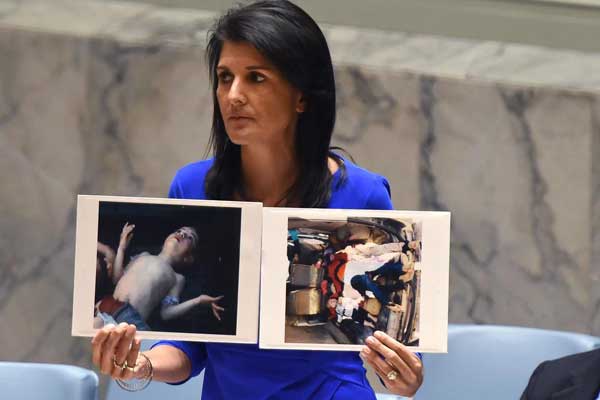
The attack was justified by the US saying (without conducting an investigation or presenting any evidence) that President Assad had used chemical weapons on Syrians in Idlib. This is precisely what the Russian government and others protested in the emergency UN Security Council meeting, called after the attack. Asking, why the US would not wait for the United Nations or other agencies to complete their investigations to find out what had really happened before acting?

Especially after the Russian Ministry of Defence released information about a Syrian army airstrike in Idlib on a rebel warehouse allegedly housing chemical weapons which, according to them, released the chemicals resulting in the deaths that were being used to vilify President Assad. And after what had happened in East Ghouta in 2013 when the US almost went to war with Syria, accusing President Assad of having used chemical weapons (similar to now), which was later proven to be false by many different agencies and individuals — including Pulitzer Prize winning Journalist Seymour Hersh, Former UN Weapons Inspector Richard Lloyd, the UN and its former Chief Prosecutor Carla Del Ponte (which was blacked out of the mainstream media).

Ray McGovern, who was head of the Soviet Foreign Policy branch of the CIA, reminded everyone in an interview with journalist Lee Stranahan right after the recent alleged chemical attack, that back in 2014, the UN Organisation for the Prohibition of Chemical Weapons (OPCW) had confirmed the destruction of all declared chemical weapons held by the Syrian government on board of a US maritime vessel, under UN supervision, following the East Ghouta incident. Moreover, in January 2016, the OPCW had again certified that the Syrian government was free of all chemical weapons.

Despite the mainstream media’s failure to report on all of these and more, what it most criminally failed to do is point out the illegality of the US strike on Syria, perhaps unsurprisingly, as has been the case starting with the (illegal under international law but ‘humanitarian’) NATO-US bombing of Yugoslavia in 1995.

Marjorie Cohn, Professor Emeritus at Thomas Jefferson School of Law, wrote in Consortium News,

“Regardless of who is responsible for the Khan Sheikhoun chemical deaths…Trump’s response violated both US and international law”.

This is because the US War Powers Resolution act only authorises the President to introduce US Armed Forces into hostilities or imminent hostilities in three situations, according to the professor:

First, after Congress has declared war, which has not happened in this case; second, in ‘a national emergency created by attack upon the United States, its territories or possessions, or its armed forces,’ which has not occurred; third, when there is ‘specific statutory authorisation,’ which there is not”. Making it illegal under US laws.

Meanwhile, the UN Charter prohibits the “use of force against the territorial integrity or political independence of any state”, except for in two cases. One, when done in self-defence after an armed attack (the US was not attacked). Two, after getting approval of the UN Security Council (which was not even sought). Making it illegal under international law as well.

The US administration had to, of course, be fully aware of this. And of the fact that Russia already had some armaments and military personnel placed in Syria to fight ISIS, Jabhat al-Nusra and the 50 other shades of extremists running rampant in the country, alongside the SAA, which the US attacked — despite risks of sparking a greater conflagration — although, reportedly, only after informing the Russians about it.

And what was the Russian response? To immediately suspend its flight safety memorandum over Syria with the US. Which, according to veteran journalist and correspondent-at-large of Asia Times, Pepe Escobar, meant that Russia, “if it chooses”, could “intercept any Pentagon flying object” from then on. Additionally sending its frigate — Admiral Grigorovich — into the Eastern Mediterranean, towards the location of the US destroyer that launched the cruise missiles into Syria.

Its Prime Minister, clearly unhappy with where things were headed, said that the attack put the US “on the verge of a military clash” with Russia. Meaning that if nothing else, what the attack did manage to do was “push the doomsday clock closer to midnight”, shattering hopes of de-escalating tensions following Trump being voted into the White House (as his campaign rhetoric had indicated towards a possible reconciliation with the Russian and Syrian governments). 

The key point about the current situation, however, was stressed on by President Putin. That trust between the two nations, because of the attack, was at its lowest since the end of the Cold War. And what that does is increase chances of ‘accidental collisions/conflicts’ or worse, which can quickly get out of hand, unleashing a chain of events that both sides may not live to regret.

And that is why cooler heads need to prevail and fast. That dialogue between the two nuclear armed powers have resumed since the attack is a positive step towards the de-escalation of tensions. However, the international community must point out that the habit of unilateral aggression, illegal under international law, adopted by the US and its allies ever since the end of the Cold War, is both unacceptable and unhelpful when it comes to solving crises around the world.

And as the Russians have vehemently been saying for a while now, will only be tolerated by countries on the receiving end for so long, before they start to take things into their own hands. At which point, you will have nuclear armed powers pointing their nukes at each other with hands on triggers, wondering whether they will and when, be forced to do the unthinkable — start a nuclear war/Armageddon. [Israel also has nuclear weapons]

It is now two and a half minutes to midnight. The closest the world has ever been, according to the Bulletin of the Atomic Scientists, to a probable “global catastrophe”.

Eresh Omar Jamal is a member of the Editorial team at The Daily Star.

Impending danger: today’s “super-fuzed”, super-powerful U.S. thermonuclear weapons directed against Russia. How is this going to end?

Global Research, March 16, 2017
Nuclear Mushroom

Today’s thermonuclear weapons are monstrously more powerful than the 15 kiloton Little Boy and 21 Kiloton Fat Man nukes used to destroy Hiroshima and Nagasaki.

An article by nuclear experts Hans Kristensen and Matthew McKinsie, together with ballistic missiles expert Theodore Postol explained the enhanced power of US submarine-launched ballistic missiles “with more than three times the number of warheads needed to destroy the entire fleet of Russian land-based missiles in their silos.”

Super-fuzing makes these weapons super-powerful, the authors saying “even the most accurate ballistic missile warheads might not detonate close enough to targets hardened against nuclear attack to destroy them.”

Super-fuzing lets them destroy them “by detonating above and around” them instead of too far away to be effective.

The technology lets nuclear armed US submarines be hugely more lethal than years earlier. They’re all equipped with super-fuzed warheads.

Increased US nuclear strike capability “has serious implications for strategic stability and perceptions of US nuclear strategy and intentions,” the authors explained.

Russia understands it gives Washington a more feasible first-strike capability, forcing it to take appropriate countermeasures.

Super-fuzing “kill capability” poses a greater risk that nuclear weapons by either country could be used in response to a feared attack, even when one hasn’t occurred, certainly not by Russia preemptively, in self-defense only.

America can monitor missile launches from space. Russia’s early warning radar is ground-based, giving it 15 minutes warning time compared to Washington’s 30 minutes – “creat(ing) a deeply destabilizing and dangerous strategic nuclear situation,” the authors stressed.

With US hostility toward Russia unchanged under Trump, the danger of nuclear war is as great as any time during the Cold War.

Super-fuzed warheads triple their lethality. It lets US submarines perform “a wider range of missions than was the case before” super-fuzing.

It’s officially called the arming, fuzing and firing (AF&F) system. It’s a potential doomsday weapon if enough of them are detonated.

America has enough of these weapons to destroy Russia’s silo-based ICBMs and have many remaining for other missions, including Russia’s non-hardened mobile nuclear capability – devastating, if launched, with potentially catastrophic consequences far beyond Russia.

America vastly enhanced the killing power of its nuclear arsenal, with greater first-strike capability than Russia, leaving it dangerously vulnerable.

“We cannot foresee a situation in which a competent and properly informed US president would order a surprise first strike against Russia or China,” the authors explained.

But our conclusion makes the increased sea-based offensive and defensive capabilities we have described seem all the more bizarre as a strategy for reducing the chances of nuclear war with either Russia or China.

Putin’s remarks to journalists last June at the St. Petersburg International Economic Forum indicate how he weighs the danger of America’s threat to Russia, saying:

No matter what we said to our American partners (to curb the arms race), they refused to cooperate with us. They rejected our offers, and continue to do their own thing.

… They rejected everything we had to offer…The Iranian threat does not exist, but missile defense systems are continuing to be positioned…

That means we were right when we said that they are lying to us.

Their reasons were not genuine, in reference to the ‘Iranian nuclear threat.’

(People in Western nations) do not feel a sense of the impending danger. This is what worries me.

A missile defense system is one element of the whole system of offensive military potential.

It works as part of a whole that includes offensive missile launchers.

One complex blocks, the other launches high precision weapons. The third blocks a potential nuclear strike, and the fourth sends out its own nuclear weapon in response.

This is all designed to be part of one system. I don’t know how this is all going to end.

What I do know is that we will need to defend ourselves.

Stephen Lendman lives in Chicago. He can be reached at lendmanstephen@sbcglobal.net

His new book as editor and contributor is titled “Flashpoint in Ukraine: How the US Drive for Hegemony Risks WW III.”

http://www.claritypress.com/LendmanIII.html

Visit his blog site at sjlendman.blogspot.com

Listen to cutting-edge discussions with distinguished guests on the Progressive Radio News Hour on the Progressive Radio Network.

http://www.globalresearch.ca/impending-danger-todays-super-fuzed-super-powerful-thermonuclear-weapons/5580097