— Our nuclear legacy: medical implications of radiation; news on Fukushima

From Helen Caldicott M.D.
https://www.helencaldicott.com/
June 22, 2024

Because I was so worried about the ignorance of the world’s media and politicians about radiation biology after the dreadful accident at Fukushima in Japan, I organized a 2 day symposium at the NY Academy of Medicine on March 11 and 12, 2013, titled The Medical and Ecological Consequences of Fukushima. It was addressed by some of the world’s leading scientists, epidemiologist, physicists and physicians who presented their latest data and findings on Fukushima [i] I hoped to attract representatives of the global media to educate them.

Background

The Great Eastern earthquake and massive tsunami on the east coast of Japan, caused the meltdown of three nuclear reactors within several days, and four hydrogen explosions in buildings 1,2, 3 and 4. Fukushima is now described as the greatest industrial accident in history. Massive quantities of radiation escaped into the air and water from these damaged reactors, three times more noble gases – argon, xenon and krypton than were released at Chernobyl, together with huge amounts of other radioactive elements, such as cesium, strontium, tritium, iodine, plutonium americium etc. Unfortunately the people of Japan were not notified of the meltdowns for 3 months because the government “did not want to create panic.”[ii]

A typical 1000 megawatt nuclear reactor contains as much radiation as that released by the explosions of 1000 Hiroshima sized bombs and the fissioned uranium becomes one billion times more radioactive than the original uranium because more than 200 intensely radioactive elements have been created whose half-lives range from seconds to millions of years. [iii]

So concerned was the Japanese government according to the then Prime Minister Naoto Kan, that they were considering plans to evacuate 35 million people from Tokyo, because other reactors including Fukushima Daiini on the east coast were also at risk.

Thousands of people fleeing from the smoldering reactors were not notified where the radioactive plumes were travelling despite the fact that the Japanese government and the US were tracking the radioactive plumes, so people fled directly into the path of the highest radiation concentrations where they were exposed to high levels of whole-body external gamma radiation being emitted by the radioactive elements inhaling radioactive air, and swallowing radioactive elements. Nor were these people supplied with inert potassium iodide which would have blocked the uptake of deadly radioactive iodine by their thyroid glands except in the town of Miharu. However prophylactic iodine was distributed to the staff of Fukushima Medical University in the days after the accident after extremely high levels of radioactive iodine – 1.9 million becquerels/kg were found in leafy vegetables near the University.[iv]This contamination was widespread in vegetables, fruit, meat, milk, rice and tea in many areas of Japan.[v]

The Fukushima meltdown disaster is not over and will never end. The radioactive fallout which remains toxic for hundreds to thousands of years covers large swathes of Japan will never be “cleaned up” and will contaminate food, humans and animals virtually forever. The three reactors which experienced total meltdowns I predict will never be dissembled or decommissioned and even TEPCO – Tokyo Electric Power Company – says it will take at least 30 to 40 years and the International Atomic Energy Agency predicts more than 40 years before they can make any progress because of the enormous levels of radiation at these damaged reactors.

Much of the temporary cooling systems cobbled together soon after the accident are composed of plastic piping held together with duct tape and several months ago the electricity supplying the pumps to circulate the water failed for 30 hours because a rat had eaten into the temporary electrical system putting the reactors and cooling pools at great risk as the water levels fell.

The fishing industry most likely will be destroyed on the east coast of Japan. The amount of radioactive water that has already been discharged into the Pacific is far greater than that released to the sea by Chernobyl. Fish caught out as far as 100 Km from Fukushima are radioactive and tuna caught off the coast of California are already contaminated by cesium 134 and 137 from Fukushima.[vi]In late June 2013 it was discovered that the levels of tritium in the Fukushima Port are the highest yet detected at 1,100 Becquerels per litre and this figure indicates huge quantities of radioactive water accompanied by many more dangerous radioactive elements are still escaping into the Pacific Ocean from leaking ground water and other sources.[vii]

Tritium is radioactive hydrogen H3 and there is no way to separate tritium from contaminated water. It is a soft beta emitter and a potent carcinogen with a half-life of 12.3 years and remains radioactive for more than 100 years. It concentrates in aquatic organisms including algae, seaweed, crustaceans and fish. Because it is tasteless, odorless and invisible, it will inevitably be ingested in food, including seafood for many decades. It combines in the DNA molecule – the gene – where it can induce mutations that later lead to cancer. It causes brain tumors, birth deformities, and cancers of many organs.

At the same time strontium 90, which induces bone cancer and leukemia has been detected in ground water near unit 2 at 30 times the so-called safety level. In other words there is no stability at the plant as huge quantities of radioactive elements, more than anyone has been able or willing to measure, have been continuously released into the air and water since the multiple meltdowns at the Fukushima Daiichi Complex.

This accident is enormous in its medical implications. It will induce an epidemic of cancer, as people inhale the radioactive elements, eat radioactive vegetables, rice, fish and meat, and drink radioactive milk and teas. In 1986, a single meltdown and explosion at Chernobyl covered 40% of the European land mass with radioactive elements. Already, according to a 2009 report published by the New York Academy of Sciences, over one million people have perished as a direct result of this catastrophe, yet this is just the tip of the iceberg because large parts of Europe and the food will remain radioactive for hundreds of years [viii]

Medical Implications of Radiation

Fact number one

No dose of radiation is safe. Each dose received by the body is cumulative and adds to the risk of developing malignancy or genetic disease.

Fact number two

Children are ten to twenty times more vulnerable to the carcinogenic effects of radiation than adults. Girls are twice as sensitive as boys and women are more sensitive than men. Fetuses are thousands of times more sensitive. Immuno-compromised patients are also extremely sensitive

Fact number three

Very high doses of radiation received from a nuclear meltdown or from a nuclear weapon explosion can cause acute radiation sickness, with alopecia, severe nausea and diarrhea and thrombocytopenia. Reports of such illnesses, particularly in children appeared within the first few months after the Fukushima accident.

Fact number four

As we all know, Ionizing radiation from radioactive elements, and radiation emitted from X ray machines and CT scanners, can be carcinogenic. The latent period of carcinogenesis for leukemia is 5-10 years and solid cancers 15-80 years. It has been shown that all modes of cancer can be induced by radiation, as well as over 2600 genetic diseases now described in the medical literature.

But as we increase the level of background radiation in our environment from medical procedures, X ray scanning machines at airports, or radioactive materials continually escaping from nuclear reactors and nuclear waste dumps, we will inevitably increase the incidence of cancer as well as the incidence of genetic disease in future generations.

Types of ionizing radiation

1. X rays (usually electrically generated), are electromagnetic, and only cause mutations the instant they pass through your body. You do not become radioactive but your genes may be mutated.

2. Similarly gamma radiation, is electromagnetic, emitted by radioactive materials generated in nuclear reactors and from some naturally occurring radioactive elements in the soil.

3. Alpha radiation, which is particulate, and composed of 2 protons and 2 neutrons, emitted from uranium atoms and from other dangerous elements generated in reactors (such as plutonium, americium, curium, einsteinium, etc- all known as alpha emitters and have an atomic weight greater than uranium). Alpha particles travel a very short distance in the human body. They cannot penetrate the layers of dead skin in the epidermis to damage living skin cells. But when these radioactive elements enter the lung, liver, bone or other organs, they transfer a large dose of radiation over a long period of time to a very small volume of cells. Most of these cells are killed, but some on the edge of the tiny radiation field remain viable to be mutated, and cancer may later develop. Alpha emitters are among the most carcinogenic materials known.

4. Beta radiation, like alpha also particulate, is a charged electron emitted from radioactive elements such as strontium 90, cesium 137, iodine 131 etc. The beta particle is light in mass, it travels further than an alpha particle but also, mutates genes.

5. Neutron radiation is released during the fission process in a reactor or a bomb. Reactor #1 at Fukushima has been periodically emitting neutron radiation as sections of the molten core become intermittently critical. Neutrons are large radioactive particles that travel many kilometers, and they pass through everything including concrete, steel etc. There is no way to hide from them and they are extremely mutagenic.

So, let’s describe just four of the radioactive elements that are continually being released into the air and water at Fukushima. Remember, though, there are over 200 such elements each with its own characteristics and pathways in the food chain and the human body. They are invisible, tasteless and odorless. When the cancer manifests it is impossible to determine its aetiology, but there is a large literature proving that radiation causes cancer including the data from Hiroshima and Nagasaki.

1. Cesium 137 is a beta and gamma emitter with a half-life of 30 years. That means in 30 years only half of its radioactive energy has decayed, so it is detectable as a radioactive hazard for over 300 years. Cesium, like all radioactive elements bio-concentrates in at each level of the food chain – from soil to grass, fruit and vegetables and tens to hundreds of times more in meat and milk andn the sea from algae to crustaceans to small fish to big fish.The human body stands atop the food chain. As an analogue of potassium, it becomes ubiquitous in all cells. It can induce brain cancer, rhabdomyosarcomas, ovarian or testicular cancer and, most importantly, genetic disease.

2. Strontium 90 is a high-energy beta emitter, half-life 28 years, detectably radioactive for 300 years. As a calcium analogue, it is a bone-seeker. It concentrates in the food chain, specifically milk (including breast milk), and is laid down in bones and teeth in the human body, where it can irradiate an osteoblast causing bone cancer; or a white blood cell inducing leukemia.

3. Radioactive iodine 131 is a beta and gamma emitter with a half-life of 8 days, hazardous for ten weeks. It bio-concentrates in the food chain, in vegetables and milk, and then the human thyroid gland where it is a potent carcinogen inducing thyroid disease and/or thyroid cancer. It is important to note that of 174,376 children under the age of 18 to have been examined by thyroid ultrasound in the Fukushima Prefecture, 12 have been definitively diagnosed with thyroid cancer and 15 more are suspected to have the disease. Almost 200,000 more children are yet to be examined. Of these 174,367 children 43.2% have either thyroid cysts and/or nodules.[ix]

Thyroid cancer is extremely rare in children- this is an extraordinary situation. In Chernobyl thyroid cancers were not diagnosed until 4 years post-accident. This early presentation indicates that these Japanese children almost certainly received a high dose of radioactive iodine but also points to the fact that high doses of other radioactive elements released during the meltdowns were received by the exposed population in Fukushima prefecture and elsewhere so the rate of cancer in Japan is almost certain to rise.

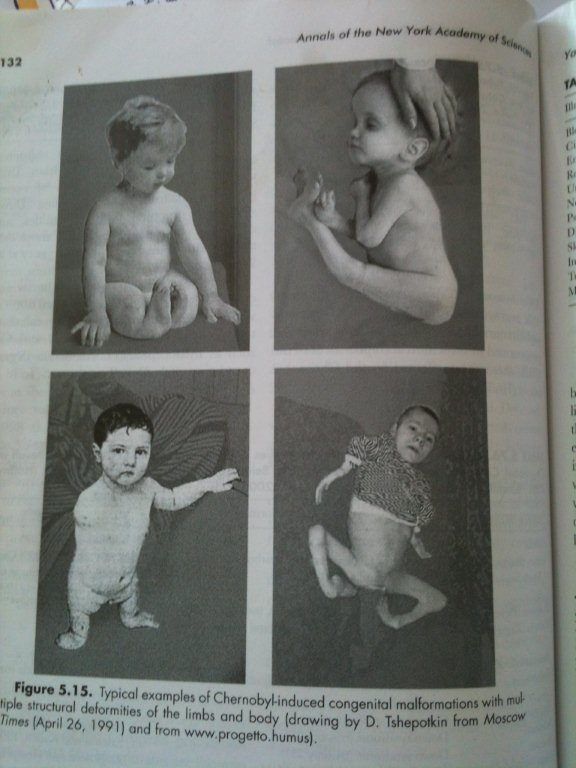
4. Plutonium, one of the most deadly, is an alpha emitter. So toxic that one millionth of a gram will induce cancer if inhaled into the lung. It is an iron analogue and combines with transferrin and it causes liver cancer, bone cancer, leukemia, or multiple myeloma. It concentrates in the testicles and ovaries where it can induce testicular or ovarian cancer, or genetic diseases in future generations. It also crosses the placenta where it is teratogenic like thalidomide, the morning sickness drug, did years ago. There are medical homes full of grossly deformed children near Chernobyl never before seen in the history of medicine.
The half-life of plutonium is 24,400 years, radioactive for 250,000 years, available to induce cancers, congenital deformities, and genetic diseases for virtually the rest of time.

Plutonium is also fuel for atomic bombs. 5 kilos is fuel for a weapon which would vaporize a city. Each reactor makes 250 Kg of plutonium a year. It is postulated that less than one kilo of plutonium, if adequately distributed, could kill induce lung cancer every person on earth.

Conclusion

In summary, the radioactive contamination and fallout from nuclear power plant accidents will have medical ramifications that will never cease because the food will continue to concentrate the radioactive elements for hundreds to thousands of years inducing epidemics of cancer, leukemia and genetic disease. Already we are seeing such pathology and abnormalities in birds and insects and because they reproduce very fast it is possible to observe disease caused by radiation over many generations within a relatively short space of time

Pioneering research conducted by Dr Tim Mousseau, an evolutionary biologist, in the exclusion zones of both Chernobyl and Fukushima has documented very high rates of tumors in birds, genetic mutations in birds and insects, many of the male barn swallows are sterile and many birds have smaller than normal brains. What happens to animals will happen to human beings.[x]

The effects of low‐dose radiation: Soviet science, the nuclear industry – and independence?

  • Author: Anders Pape Møller, Timothy A. Mousseau
  • Published: Feb 15, 2013 – From issue: Volume 10 Issue 1 (February 2013)

The Japanese government is desperately trying to “cleanup” radioactively contaminated soil, trees, leaves etc. But in reality all that can be done is collect it, place it in containers – the government contracted workers are using plastic bags, and transfer it to another location. It cannot be made neutral and it cannot be prevented from spreading in the future. Some contractors have allowed their workers to empty radioactive debris, soil and leaves into streams and other illegal places. Then the main question becomes – where to place the contaminated material stored safely away from the environment of thousands of years. There is no safe place in Japan for this to happen, let alone to store thousands of tons of high level radioactive waste which rests precariously at the 54 Japanese nuclear reactors.

Last but not least Australian uranium fueled the Fukushima reactors. Australia exports uranium for use in nuclear power plants to 12 countries including the US, Japan, France, Britain, Finland, Sweden, South Korea, China, Belgium, Spain, Canada and Taiwan. 270,000 metric tons of deadly radioactive waste exists in the world today with 12,000 metric tons being added yearly.

It must be isolated from the environment for one million years and no container lasts longer that 100 years. The isotopes will inevitably leak contaminating the food chain, inducing epidemics of cancer, leukemia, congenital deformities and genetic diseases for the rest of time.

This then is the legacy we leave to future generations

———————————————-

[i] helencaldicottfoundation.org, The Medical and Ecological Consequences of Fukushima March 11 and 12

[ii] National Diet of Japan Fukushima Nuclear Accident Independent Investigation Commission, July 2012

[iii] Chart of 211 Radioactive Poisons in 10-Year Old CANDU Spent Fuel
http://www.ccnr.org/hlw_chart.html#chart

[iv] http://ex-skf.blogspot.com/2013/06/fukushima-medical-university.html.

[v]Tests Find Cesium 172 times the limit in Miyagi Yacon Tea, The Asahi Simbun April 13, 20012; Trust Deficit, The Worst Fallout of Fukushima, Suvendrini Kakuchi, Inter Press Service News Agency, July 17, 2013

[vi] www.abc.net.au/am/content/2013/s3750728.htm

[vii] http://english.kyodonews.jp/news/2013/06/232195.html

[viii][viii] Chernobyl, Consequences of the Catastrophe for People and the Environment, Yablokov, Nesterenko and Nesterenko, Annals of the New York Academy of Sciences, Vol 1181, 2009

[ix] http://fukushimavoice-eng2.blogspot.com/2013/06/11th-prefectural-oversight-committee.html

[x] The effects of low‐dose radiation: Soviet science, the nuclear industry – and independence?

  • Author: Anders Pape Møller, Timothy A. Mousseau
  • Published: Feb 15, 2013 – From issue: Volume 10 Issue 1 (February 2013)

——————————–

For more information: https://www.helencaldicott.com/

— NASA scam declares SSFL exempt from cleanup

From Public Employees for Environmental Responsibility – PEER

For Immediate Release:  Thursday, October 1, 2020
Contact:  Jeff Ruch (510) 213-7028; Kirsten Stade kstade@peer.org

Nuclear Cleanup Scam on Supremely Contaminated Site

Historic Designation for Santa Susana Lab Excuses Remediation Obligations

Washington, DC — One of the nation’s most highly contaminated sites may escape cleanup by its designation as a cultural district for Native American artifacts, according to formal comments filed today by Public Employees for Environmental Responsibility (PEER).  This attempted maneuver seeks to expand a small loophole in a legally binding cleanup agreement to exempt the entire nearly 3,000-acre highly contaminated site, which includes a partial nuclear reactor core meltdown, from long overdue remediation.

Santa Susana Field Laboratory is a former nuclear reactor and rocket testing facility, home to a partial nuclear meltdown and numerous other radioactive accidents and toxic chemical releases.  It is located in Simi Valley, Ventura County, California, 30 miles northwest of downtown LA.

After a prolonged, tortured history, the site is now under a legally binding cleanup agreement requiring restoration of the site to its condition before it was polluted. There is a very narrow exemption for “Native American artifacts that are formally recognized as Cultural Resources.”

NASA, one of the site’s owners, has nominated the entire Santa Susana site as a Cultural District and declaring all 2,850 acres of soil, much of it extremely contaminated, exempt from cleanup as a purported “Native American artifact.”  This proposal adding the entire Santa Susana site to the National Register of Historic Places is now before the National Park Service.

“This scam by NASA has nothing to do with preserving cultural heritage but everything to do with weaseling out of expensive cleanup responsibilities,” stated Pacific PEER Director Jeff Ruch, noting that the cleanup was supposed to have been completed by the end of 2017, but has yet to begin. “There no good reason why this designation couldn’t wait until after the cleanup was completed.”

The PEER comments also point out that the NASA nomination –

  • Falsely claims designation will keep “the area in a state similar to when [tribal] ancestors used and occupied the area.”
  • Omits that there are already protections for identified cave paintings and grinding stones but this plan would artificially increase by a factor of more than 200 the protected area’s size to precisely match the boundaries of the entire 2,850-acre Santa Susana site; and
  • Glosses over the formal opposition of Ventura County, a fact which, by law, should preclude designation.

“Failure to clean Santa Susana leaves surrounding communities at risk of toxic migration,” added Ruch, pointing out wildfires and other natural events can spread contaminants far offsite.  “Nuclear and chemical waste are not cultural artifacts we want preserved.”

###


Read the PEER comments

View the opaque Federal Register Notice

https://www.peer.org/nuclear-cleanup-scam-on-supremely-contaminated-site/

Santa Susana Field Laboratory: NASA releases draft supplemental environmental statement covering soil cleanup. Comments due Dec. 9

From the National Aeronautics and Space Administration (NASA)

NOTE: The Federal Register notice does not give a due date for comments. It says the deadline is 45 days after the date of the Federal Register notice which was October 25. If you wish to submit comments, confirm the due date with NASA at the email address below.

Posted in the Federal Register
October 25, 2019

https://www.federalregister.gov/documents/2019/10/25/2019-23364/notice-of-availability-of-the-draft-supplemental-environmental-impact-statement-seis-for-soil

Click to access 2019-23364.pdf

Notice of Availability of the Draft Supplemental Environmental Impact Statement (SEIS) for Soil Cleanup Activities at Santa Susana Field Laboratory

AGENCY:

National Aeronautics and Space Administration (NASA).

ACTION:

Notice of Availability of the Draft Supplemental Environmental Impact Statement (SEIS) to the March 2014 Final Environmental Impact Statement (FEIS) for demolition and environmental cleanup activities for the NASA-administered portion of the Santa Susana Field Laboratory (SSFL), Ventura County, California. This SEIS will cover the soil cleanup activities at NASA’s portion of SSFL.

SUMMARY:

Pursuant to the National Environmental Policy Act (NEPA), as amended, the Council on Environmental Quality Regulations for Implementing the Procedural Provisions of NEPA, and NASA’s NEPA policy and procedures, NASA has prepared a Draft SEIS for soil cleanup activities at SSFL in Ventura County, California. The Draft SEIS has been prepared because there are significant new circumstances relevant to environmental concerns bearing on the proposed action and its impacts. Specifically, the estimated quantity of soil required to be removed has increased substantially since the publication of the 2014 FEIS. This increase has the potential to alter the environmental impacts that were evaluated in the 2014 FEIS. For this reason, NASA has determined it is appropriate to prepare a supplement to the 2014 FEIS.

DATES:

Interested parties are invited to submit comments, preferably in writing, within forty-five (45) calendar days from the date of publication in the Federal Register of the Notice of Availability of the Draft SEIS on October 25, 2019.

ADDRESSES:

Comments submitted by mail should be addressed to Peter Zorba, SSFL Project Director, 5800 Woolsey Canyon Road, Canoga Park, CA 91304. Comments may be submitted via email to msfc-ssfl-eis@mail.nasa.gov. The Draft SEIS may be reviewed at the following locations:

1. Simi Valley Library, 2969 Tapo Canyon Road, Simi Valley, CA 93063, Phone: (805) 526-1735.

2. Platt Library, 23600 Victory Blvd., Woodland Hills, CA 91367, Phone: (818) 340-9386.

3. California State University, Northridge Oviatt Library, 18111 Nordhoff Street, 2nd Floor, Room 265, Northridge, CA 91330, Phone: (818) 677-2285.

4. Department of Toxic Substances Control, 9211 Oakdale Avenue, Chatsworth, CA 91311, Phone: (818) 717-6521.

The Draft SEIS is also available on the internet at https://www.nasa.gov/​feature/​environmental-impact-statement-eis-for-demolition-and-environmental-cleanup-activities. The Federal Register Notice of Intent to prepare the Draft SEIS, issuedin the Federal Register on April 5, 2019, is also available on the internet at: https://ssfl.msfc.nasa.gov/​news#news20190405.

FOR FURTHER INFORMATION CONTACT:

Peter Zorba, SSFL Project Director, by email at msfc-ssfl-information@mail.nasa.gov. Additional information about NASA’s SSFL site, the proposed soil cleanup activities, and the associated planning process and documentation (as available) may be found on the internet at https://ssfl.msfc.nasa.gov or on the California Department of Toxic Substances Control (DTSC) website at https://www.dtsc.ca.gov/​SiteCleanup/​Santa_​Susana_​Field_​Lab/​.

For the full notice:

https://www.federalregister.gov/documents/2019/10/25/2019-23364/notice-of-availability-of-the-draft-supplemental-environmental-impact-statement-seis-for-soil

— San Francisco: Eco-fraud by the bay

From Public Employees for Environmental Responsibility (PEER)
Summer 2018 newsletter

Hot Property…in More Ways than One.
Hunters Point is being touted as San Francisco’s biggest
redevelopment since the 1906 earthquake.

San Francisco currently has a severe case of real estate fever,
pricing all but the rich out of its new housing market. The city’s poorest quarter, Bayview-Hunters Point in its southeast corner, is the latest epicenter of development mania. But, there is a big problem.

The Hunters Point Naval Shipyard hosted nuclear weapons work, including supposed decontamination of Navy ships used in Pacific hydrogen bomb tests–which left the shipyard with ultra-high radioactivity. It has been an EPA Superfund site since 1989.

Now, this nearly 30-year radiation cleanup has run off the tracks. PEER has obtained documents showing that the remaining contamination is far, far worse than previously reported:
• Almost 100% of the soil samples taken by the U.S. Navy’s contractor Tetra Tech re-examined by the  EPA are “falsified,” subject to deliberate manipulation and “neither reliable nor defensible”;
• Parcels transferred to San Francisco under false pretenses as suitable remain deeply contaminated; and
• Most every Tetra Tech radiation survey on the shipyard’s buildings is bogus.

One of the things that makes these findings so remarkable is that the Navy was on notice for years that it had a major data meltdown on its hands yet is still trying to cook the books. Of course, neither the Navy nor EPA revealed any of this. There are still more shoes to drop and we intend to make Hunters Point the poster child for meaningful Superfund reform.

– – – – – – – –

Don’t Eat the Tomatoes
In areas of Hunters Point certified as clean, residents are subject to
a curious covenant: they may not grow food unless they import
soil. This raises the question of what is meant by “clean.” It is especially important with respect to radiation, a pollutant that keeps
on giving.

Click to access PEEReview_Summer_18.pdf

Posted under Fair Use Rules

— Los Angeles: Public meetings on SSFL cleanup — Tell Dept. of Energy to clean up Santa Susana contamination, not leave it behind!

From the Santa Susana Field Laboratory Work Group
February 13, 2017

“Unless people rise up and our elected officials act strongly to enforce the promises, people in neighboring communities will be at perpetual risk from migrating radioactivity and toxic chemicals.”  Read New Ventura County Star Op-Ed: Santa Susana Field Lab Broken Promises

The Department of Energy (DOE) is attempting to break its obligation to clean up all of the nuclear and chemical contamination at the Santa Susana Field Laboratory (SSFL), proposing instead to leave between 34 -94% of the contamination not cleaned up. That is dangerous and unacceptable!

Urgent action is needed to protect communities near SSFL!

1. Attend one or both of the upcoming DOE hearings and voice your concerns.

  • Saturday, February 18, 2017, 9:00 a.m. – 12 p.m. Grand Vista Hotel, 999 Enchanted Way, Simi Valley, CA (Open house from 9 – 9:30 a.m.)
  • Tuesday, February 21, 2017, 6:00 p.m. – 9:00 p.m., Airtel Plaza Hotel, 7277 Valjean Avenue, Van Nuys, CA (Open house from 6 – 6:30 p.m.)

2. Submit a comment demanding that DOE clean up all contamination at SSFL.

3. Ask your friends, family, and neighbors to also submit a comment and attend the DOE hearings. Please forward this email and share on social media.
Background

The DOE recently released a Draft Environmental Impact Statement (DEIS) that proposes three alternative cleanup plans for its operational area of SSFL, which is where most of the nuclear contamination is located. The three alternatives would respectively leave up to 34%, 86% or up to 94% of the contamination on site, where it can continue to migrate and put nearby communities at risk.

All of the alternatives directly violate the Administrative Order on Consent (AOC) that DOE signed in 2010, which committed them to clean up all detectable contamination. DOE’s DEIS also fails to acknowledge that DOE as the polluter doesn’t have the authority to decide how much of the mess that it made is going to get cleaned up. The decision rests with the California Department of Toxic Substances Control, not DOE.

Click here to learn more about key problems with DOE’s DEIS. Click here to read the DEIS itself. Again, it is critical that as many people as possible attend the DOE hearings and submit comments demanding a full cleanup of SSFL. Thank you!.

The Santa Susana Field Laboratory (SSFL), also known as Rocketdyne, is a former nuclear and rocket engine testing facility that is contaminated with radiological and chemical pollutants. The 2,850 acre site is near Simi Valley, Chatsworth, Canoga Park, Woodland Hills, West Hills, Westlake Village, Agoura Hills, Oak Park, Calabasas, and Thousand Oaks. For over twenty-five years, the Santa Susana Field Laboratory Work Group has served to keep the community informed about the contamination at SSFL and assure it is thoroughly cleaned up.

To learn more visit www.ssflworkgroup.org or contact us at info@ssflworkgroup.org

— San Francisco Hunters Point land development on hold as falsification of toxics cleanup investigated

Earlier reporting on this situation.

From Hood Online

September 22, 2016

Hunters Point Shipyard Land Transfers On Hold As Toxic Waste Cleanup Investigated

By John Shutt

Regulators from the Environmental Protection Agency and California Department of Toxic Substances Control have told the Navy to stop transferring land from the Hunters Point Shipyard to developers while agencies investigate the extent of the falsification of data about the cleanup of toxic and radioactive materials at the site.

The regulatory action was first reported in the Ingleside-Excelsior Light last week, and stemmed from investigations into Navy contractor Tetra Tech.

NBC Bay Area reported earlier this year that a former Tetra Tech employee said he had been told to swap potentially contaminated soil samples for clean ones, dump potentially contaminated soil into open trenches around Hunters Point, sign falsified documents submitted to the government, and tamper with computer data about radiation levels. Other former workers said they were fired in retaliation after reporting violations to regulators.

The shipyard was declared a superfund site by the Environmental Protection Agency due to contamination from the Naval Radiological Defense Laboratory, located there from 1948 through 1969, and toxic waste left over from industrial use. The Navy is obligated to clean land at the shipyard before it is turned over for development.

EPA regional spokesperson Michele Huitric confirmed that investigations into Tetra Tech are ongoing, and said the EPA was aware of investigations by the Nuclear Regulatory Commission and the Navy. The Nuclear Regulatory Commission previously recommended a fine against Tetra Tech after they found the company had deliberately falsified data.

Part of the shipyard declared safe by regulators has already been transferred to developer FivePoint, a spinoff of Lennar Corporation, which is building residential housing. A FivePoint spokesman said that the Tetra Tech whistleblower reports are not related to Parcel A, the land they are building on.

“Parcel A was transferred in 2004, several years prior to the alleged soil mishandling, and after the Navy, USEPA, and State of California determined the property was cleaned up and safe for transfer,” said FivePoint spokesperson David Satterfield. “Parcel A was removed from the National Priorities List at that time and is no longer considered a federal superfund site.”

Bradley Angel from environmental activist group Greenaction said that he had confronted FivePoint officials at a recent sales event about the cleanup, and had been shown documents that indicated Tetra Tech worked on at least part of Parcel A.

“They took us into the back room and took out three big binders and opened the first one, and of course the first sentence was about Tetra Tech’s work at the Shipyard, but not, of course, about falsification of soil samples,” Angel said.

San Francisco Magazine reported yesterday that a July email from the Navy indicated that Tetra Tech may have done sampling on Parcel A.

Greenaction has called for Tetra Tech to be fired and for an independent investigation of toxin and radiation levels at the shipyard and in the surrounding area.

UC Santa Cruz researcher Dan Hirsch, part of a team preparing a report on the cleanup, said that not only had Tetra Tech falsified soil samples, the Navy has been using outdated remediation standards that allow much higher levels of toxic material than the EPA currently recommends—in some cases about 100 times higher—and radiation levels equivalent to 12 chest x-rays per year for residents.

“We found over and over again that the Navy used standards that EPA said they aren’t supposed to use,” Hirsh said.

Mayor Ed Lee and Supervisor Malia Cohen wrote to the Environmental Protection Agency on Sept. 19th requesting a meeting.

“The environmental cleanup of the property is a critical first step in the process of developing Hunters Point Shipyard—a project that will deliver desperately needed housing and long-overdue public benefits to the Hunters Point community,” read the letter. “For that reason, we are requesting a briefing with senior Environmental Protection Agency leadership, confidential if necessary, so that we may better understand the scope and timelines of the investigations, and any potential impacts to the overall schedule for the delivery of these public benefits.”

The Shipyard development is a major piece of the city’s strategy for developing the southeastern waterfront. FivePoint plans to build 1,400 units of housing on the land that has already transferred, but thousands of additional units are now in limbo.

http://hoodline.com/2016/09/hunters-point-shipyard-land-transfers-on-hold-as-toxic-waste-cleanup-investigated

Scientific organization requests assistance for initiatives, including nuclear waste decontamination

A short history of this excellent organization is below.

From The Planetary Association for Clean Energy Inc./ La Société planétaire pour l’assainissement de l’énergie, inc – PACE

Urgent PACE request for timely support:

We are involved in a number of initiatives internationally that are for the improvement of planetary affairs on a number of fronts and which do require support other than just volunteerism and sheer willpower..

Developments:

  • on-going negotiations in several nations for the clean-up of nuclear wastes, contaminated zones involving several techniques, as well as advanced logistics / assessment modalities. These negotiations are very demanding on our limited resources in preparing responses.
  • documentation preparations including on-site evidence gathering for a class action suit concerning existing and emerging electromagnetic field emissions when they are injurious to society and to at least 30% of population in developed areas. This case could have worldwide repercussions.

We are also involved, since more than a year, in advanced stages, prototyping stand-alone electrical energy supply for sustainable communities.

IF YOU WISH TO HAVE DETAILS ABOUT THESE HUMANITARIAN AND SCIENTIFIC DEVELOPMENTS, PLEASE ADVISE.

Therefore we are hereby requesting your support for such initiatives, which can be made out:

by PayPal, http://zapnuclearwaste.com/zap-nuclear-waste/donate-to-pace/.

by VISA/MasterCard (888) 639-7730 (toll-free in North America)

or by cheques / money order to:

PACE, Inc.
100 Bronson Avenue, Suite 1001
Ottawa K1R 6G8
Canada

We thank you for your interest and continued support!

Andrew Michrowski
President
paceincnet (at) gmail.com

http://pacenet.homestead.com

About PACE:

The Planetary Association for Clean Energy, Incorporated was founded in June 1975 in Ottawa, Canada, under the guidance of the Hon. Senator Chesley W. Carter, then Chair-person of the Senate’s Standing Committee on Health, Welfare and Science as well as member of the Senate Special Committee on Science Policy. With the Hon. Carter, a number of scientists undertook to make use of this Association to develop an international interdisciplinary network of advanced scientific thinking individuals and organizations. Together, these were to promote and steward “clean energy systems” for eventual implementation on a planetary-wide scale. 

Clean energy systems are defined as those which draw on natural supply, which are universal in application, which are inexpensive and which do not cause polluting residue.  

Already by 1976 such systems were being examined and promoted by the founders of the Association. This initial nucleus of scientists grew. In 1979, the Association became incorporated as a Canadian non-profit corporation. Its Federal Charter foresaw the role of facilitation of the discovery, research, development, demonstration and evaluation of clean energy systems. Another role cited is stewarding the planning, co-ordination and implementation of clean energy systems on planetary, continental, regional, local and individual scales. Experience has enjoined the network to act responsibly by serving as a monitor and an alert system for emerging “unclean” systems not considered by other groups.  

In 1980, the Association became a Learned Society and hosted its first sessions as such at the Université du Québec à Montréal (UQAM). Its network currently comprises about 3,500 individuals and institutions in over 60 nations. Its official publication is the Newsletter. Since 1981, books, proceedings, monographs and electronic publications have been released to both general and specialist audiences.  

In 1986, the Learned Society initiated sustained efforts towards international technological transfer through a Symposium/exhibition in Hull (Gatineau), Québec, followed by a 1989 presentation at the United Nations, where it is recognized as an Associate NGO, since 2004 in special consultative status with the Economic and Social Council (ECOSOC), since 2006 with the United Nations Human Rights Council 

In 1990, the University of Ottawa‘s Institute for Research on Environment and Economy has conferred an associative status to the Society.