— NRC commissioners fail to take action on critical safety issue at Diablo Canyon NPP

Mothers for Peace
October 3, 2023

San Luis Obispo, CA, October 4, 2023 — San Luis Obispo Mothers for Peace (MFP) and Friends of the Earth (FoE) today deplored a decision of the Commissioners of the Nuclear Regulatory Commission (NRC) for demonstrating a complete lack of concern for the safety and security of the people living near the Diablo Canyon Nuclear Power Plant. 

Disregarding expert evidence presented by MFP and FoE that the Diablo Canyon Unit 1 pressure vessel is at risk of dangerous embrittlement due to decades of neglect by Pacific Gas and Electric Co. (PG&E) and lax oversight by the NRC technical staff, the Commissioners refused to grant the groups’ hearing request or to order the immediate shutdown of the reactor for comprehensive testing of the reactor vessel’s condition.  

Instead, the Commissioners bucked the groups’ shutdown request back to the agency’s technical staff to consider whether to take enforcement action against PG&E. 

“We are appalled that the Commissioners are entrusting this important safety review to the same agency staff who for fifteen years has given PG&E repeated extensions of deadlines for essential tests and inspections,” said Diane Curran, attorney for MFP. Curran noted that the groups had intentionally petitioned the Commissioners, as the highest officers of the NRC, to exercise their legal responsibility for oversight of the technical staff.  

Nevertheless, the groups vowed to persevere. Hallie Templeton, Legal Director for FoE, said, “We plan to continue our rigorous watchdogging of PG&E and the NRC.” She added, “The Commissioners’ decision has raised a red flag to all of us. Anyone, including California politicians, who thinks the safety of Diablo Canyon can be entrusted to the federal government unquestioningly has just received a big wakeup call.” 

Linda Seeley, spokesperson for MFP, renewed the group’s call to the State of California to “go back to the original plan to close Diablo Canyon when it reaches its 40-year operating license limit in 2024 (Unit 1) and 2025 (Unit 2). Enough is enough.”  

https://mothersforpeace.org/nrc-commissioners-fail-to-take-action-on-critical-safety-issue-at-diablo-canyon/

And what about Unit 2 ????

Song: “I Don’t Want Your Missiles, Mister”

A folk protest song in the tradition of Peter Seeger and the Almanacs.

I Don’t Want Your Missiles, Mister
Adapted from Jim Garland
Lyrics by Geoff Francis

I don’t want your missiles, Mister,
Don’t want your nuclear submarines.
All I want is to live, Mister,
And without fear, to live in peace.

No, I don’t want the job you offer,
Toiling for your war machine.
All I want’s to see a future,
Where water’s pure and air is clean.

You say you will keep us safe, Mister,
But those are words I’ve heard before,
No more will I be counting bodies
Sacrificed in others’ wars.

Chorus

Call me dumb if you wish, Mister,
Call me green, or call me red.
This one thing I sure do know, Mister,
I’d rather be alive than dead.

Why do we have two parties, Mister,
With no discussion, no dissent?
When half a trillion dollars, Mister
Could clearly be much better spent.

Chorus

— PFAS and The Bomb

From Military Poisons

By Pat Elder
August 6, 2023

Trinity – July 16, 1945 – Made possible through the discovery and development of PFAS chemicals.

17th-century depiction of Daedalus & Icarus – Musee Antoine Vivenel, Compiègne, France

In Greek mythology, the tale of Daedalus and his son, Icarus provides a lesson that humanity has never learned. Daedalus created wings from feathers and wax. He warned Icarus not to fly too close to the sun for fear that the wax would melt. Icarus took off, exhilarated with the invention, and soared exuberantly toward the sun. His wings fell apart, and Icarus fell to his death.

Remarkable technologies may escape our control and imperil mankind. Two astonishing inventions in 1938 are like Daedalus’ fastening of wings to wax: the splitting of the uranium atom by German scientists and the discovery of per – and poly fluoroalkyl substances, (PFAS) by Dupont chemists in New Jersey.

It’s not a stretch. Both nuclear weaponry and PFAS chemicals are existential threats to humanity. Their development and use are inextricably linked. 

Trinity – July 16, 1945

PFAS was developed through the Manhattan Project.

J. Robert Oppenheimer and his crew needed a way to separate uranium to make the bomb. They used fluorine gas for this purpose. The scientists soon discovered that fluorine gas bonds with carbon molecules to make fluorochemicals, the most highly resistant coolants known – and a critical development leading to Trinity.

The Manhattan Project perfected a white powder that could extinguish fires better than any substance ever created. It repels grease, dirt, and water better than anything, ever. Imagine the military applications! PFAS never breaks down. It never goes away. It is bioaccumulative, and it is highly carcinogenic. Most alarmingly, it plays havoc on a woman’s reproductive system. It contributes to a host of childhood diseases. It threatens our immune system, and it has been linked to the spread of COVID 19 and other diseases. It’s in our bodies and our children are born with it.

It was used to manufacture Teflon products and Scotchguard, and waterproofing for a thousand products. It is still used widely. People haven’t gotten the message. PFAS is bad news for all of us.

March 4, 2016 – Firefighters strike a pose reminiscent of the Iwo Jima statue in Washington. A team of firefighters battle a huge fire during a live-fire training exercise at Hurlburt Field, Fla. (Photo: US Air Force)

The military has used PFAS in firefighting foam to extinguish super-hot petroleum-based fires since 1968.

If 500 bases participated in monthly firefighting foam drills from the early 1970’s until the early 2020’s, that might be 500 bases x 12 months x 50 years which comes to 300,000 separate environmental catastrophes. Some bases held fire training exercises weekly. The damage is incalculable, and it is with us forever.

Often, they’d create a 100-foot diameter crater about one to two feet deep; they’d fill it with jet fuel and a cocktail of oils, lubricants, and paints and ignite it. Then, the firefighters would snuff the flames with foam. The firefighters got sick, many with bladder and testicular cancer. The carcinogens from the foam were allowed to seep into groundwater and surface water. Drinking water sources are contaminated, as well as the food, especially the sea food we consume.

Wurtsmuth Air Force Base in Michigan closed 30 years ago but the people in the region cannot eat the local fish or wildlife today because it is poisonous. Food is poisoned by the chemicals worldwide.

Try to comprehend the concept of a highly toxic chemical, comprised of an indestructible fluorine-carbon bond that never breaks down in our bodies or the environment and continuously accumulates in us. 

Although billions of people are ingesting the substances in their drinking water, most of the PFAS in our bodies comes from eating contaminated fish and seafood that are loaded with the chemicals. The air, our lungs and our homes are filled with cancerous dust.

The EPA in the U.S. and regulatory agencies around the world are criminally negligent for doing little to protect public health.

Wherever there are nuclear weapons, PFAS is present. Nuclear-powered ships and those carrying nuclear weapons also carry huge quantities of the materials. After training exercises and frequent accidents, the chemicals are sprayed into the sea. 

We can’t get rid of it. We can’t bury it. We can’t incinerate it. We don’t know what to do with it and this is the truth. Notions of “cleaning up” PFAS are misguided.  

PFAS are the demons let loose from Pandora’s box. All 14,000 PFAS substances are believed to be toxic. The military and manufacturers should be forced to sthe making the compounds while taking measures to begin remediating the catastrophe at a cost that will likely exceed hundreds of billions of dollars.  

Rachel Carson is a latter-day prophet!

From Rachel Carson in her prophetic book, Silent Spring, 1962:

“If we are going to live so intimately with these chemicals, eating and drinking them, taking them into the very marrow of our bones – we had better know something about their nature and their power.”

The fish are poisoned with PFAS in Japan with some species containing more than 100,000 parts per trillion of PFOS in their filet. The U.S. military is responsible for much of this contamination. I will be travelling to Japan in September and October with three others with Veterans for Peace to address audiences and to test surface waters for PFAS in 20 cities. The U.S. military is not being regulated by states, the federal government or foreign “host” nations. The military’s toxic legacy is shrouded in secrecy. Please help us and make a note that your contribution is for the Japan delegation.

Financial support from the  Downs Law Group makes this work possible. The firm is working to provide legal representation to individuals with a high likelihood of exposure to PFAS and other contaminants.

The Downs Law Group employs attorneys accredited by the Department of Veterans Affairs to assist those who have served in obtaining VA Compensation and Pension Benefits they are rightly owed.

If you spent time in the military and you think you may be sick as a result of your service, think about joining this group to learn from others with similar issues. Are you interested in joining a multi-base class action lawsuit pertaining to illnesses stemming from various kinds of environmental contamination? Join the Veterans & Civilians Clean Water Alliance Facebook group. (2.4 K members and growing rapidly.)

https://www.militarypoisons.org/latest-news/pfas-and-the-bombnbsp

— Stand with the Algonquin people to protect Kitchi Sibi / Ottawa River and stop giant radioactive waste dump

From the Ottawa River Institute

Aug 3, 2023 by Lynn Jones, Ottawa River Institute

The Ottawa River is a Canadian Heritage River that flows for 1300 kilometers from its origin in central Quebec to its confluence with the St. Lawrence River at Montreal.

The Ottawa River is sacred for the Algonquin Anishinaabe People whose traditional territory it defines. In Algonquin it is called Kitchi Sibi, or “Great River.”

The Algonquin People have lived in the Ottawa River watershed since time immemorial. A strong ethic of environmental stewardship is part of their Anishinaabe worldview and they consider it their responsibility to protect the land and water for all life and future generations.

We are fortunate that the Algonquin People take their stewardship responsibility seriously. Right now, they are a strong protective force standing between a giant above-ground nuclear waste dump and the beautiful Kitichi Sibi that supports so many lifeforms and provides drinking water to millions of people downstream.

A multinational consortium (SNC-Lavalin, Fluor and Jacobs) wants to build the seven-story nuclear waste mound on the grounds of the Chalk River Laboratories, northwest of Ottawa, directly across the Ottawa River from the province of Quebec. If approved, it would hold one million tonnes of radioactive and other hazardous waste. The proposed dump is called the “NSDF,” and the proponent is “Canadian Nuclear Laboratories,” a wholly-owned subsidiary of the multinational consortium.

The Chalk River Laboratories site is heavily contaminated from eight decades of nuclear activities including production of plutonium for the US nuclear weapons program. The accumulated radioactive wastes at Chalk River were described in a 2011 Ottawa Citizen article â€œChalk River’s Toxic Legacy.”  The estimated cost for a proper cleanup is $16 billion. Chalk River Laboratories was privatized by the federal government in 2015 to quickly and cheaply reduce this enormous environmental liability.

The Chalk River site needs to be cleaned up but the proposed giant landfill is not the right approach according to many who have studied the proposal including Algonquin First Nations, retired senior scientists from Atomic Energy of Canada Limited, civil society groups and concerned citizens. The Assembly of First Nations and more than 140 municipalities, including Pontiac County, Ottawa, Gatineau and Montreal have passed resolutions of concern about the proposed project.

Critics say that the proposed site is unsuitable for a dump of any kind. It is located less than one kilometre from the Ottawa River and is surrounded by wetlands that drain into the river. The site is tornado and earthquake prone and the underlying bedrock is porous and fractured.

Other concerns include:
— Many of the radioactive materials destined for the dump, such as plutonium, will be hazardous for 100,000 years. The International Atomic Energy Agency says radioactive wastes such as these must be carefully stored out of the biosphere, not in an above-ground mound.
Dioxins, PCBs, asbestos, mercury, arsenic and hundreds of tonnes of lead would go into the dump along with thousands of tonnes of copper and iron and 33 tonnes of aluminum, tempting scavengers to dig into the mound after closure.
— The dump proponent is importing commercial and federal nuclear wastes to Chalk River for disposal in the NSDF. These shipments are happening despite a specific request from the City of Ottawa for cessation of radioactive waste imports into the Ottawa Valley.
— The mound would leak radioactive and hazardous contaminants into the Ottawa River during operation and after closure. The mound is expected to eventually disintegrate in a process referred to as “normal evolution.”
– There is no safe level of exposure to the radiation that would leak into the Ottawa River from the Chalk River mound. All of the escaping radioactive materials would increase risks of birth defects, genetic damage, cancer and other chronic diseases.
— The giant pile of leaking radioactive waste would be difficult to remediate. Remediation costs could exceed those of managing the wastes had they not been put in the mound. There are far better ways to manage radioactive waste and keep it out of the biosphere but they cost more money. It would be better to spend the money up front on high quality facilities farther away from a major drinking water source.

The environmental assessment for the NSDF has dragged on for seven years. The final licensing hearing is scheduled for August 10, 2023. The assessment and the decision about whether or not to license the dump are in the hands of Canada’s â€œcaptured nuclear regulator,” the Canadian Nuclear Safety Commission. CNSC staff continue to recommend approval of the dump. An Expert Panel  recommended in 2017 that the CNSC not be in charge of environmental assessment for nuclear projects. Participants in the environmental assessment for the NSDF have noted many serious flawsin the process. 

Weeklong licensing hearings in June 2022 were to have been the “final” hearings for the NSDF but in a surprise move, the CNSC decided to “keep the record open” for continued consultations with Kebaowek and Kitigan Zibi First Nations, two of the 11 Algonquin First Nations whose people have lived in the Ottawa River watershed for thousands of years and who have never ceded their territory to the Crown or the Canadian government.

During the extended consultations which wrapped up this past spring, Kebaowek and Kitigan Zibi First Nations conducted research at the proposed dump site. They documented extensive threats to their Indigenous rights and to biodiversity in the NSDF footprint in a booklet available online here. Their joint final submission outlines numerous potential legal failures and violations should the CNSC decide to license the NSDF on their unceded territory.

On June 20 at a press conference in Ottawa, Chiefs of Kebaowek and Kitigan Zibi First Nations along with two Algonquin Grand-Chiefs, together representing 10 of the 11 Algonquin First Nations, said very clearly that they do not consent to the construction of the NSDF on their unceded territory and that approving the dump without their consent would contradict the United Nations Declaration on the Rights of Indigenous Peoples. Earlier in June, their sister First Nation, the Algonquins of Pikwakanagan, signed an agreement with the proponent, offering consent for the NSDF in exchange for economic and business opportunities and a role in monitoring at the site.

This struggle seems destined to play out in the courts over many years. It seems tragic that so much time, energy and money have been expended on such a bad proposal. Canada’s poor nuclear governance system is largely to blame for this; there is literally no one minding the shop other than our captured nuclear regulator, the CNSC and nuclear reactor proponents at Natural Resources Canada. 

Thank goodness for our Algonquin brothers and sisters who are standing firm to protect Kitchi Sibi and actually have a good chance to eventually stop the madness.

Lynn Jones is a founding member of the Ottawa River Institute, a non-profit, charitable organization based in the Ottawa Valley. ORI’s mission is to foster sustainable communities and ecological integrity in the Ottawa River watershed.

https://www.ottawariverinstitute.ca/our-projects/chalk-river-nuclear-waste-cleanup

— Stranded spent nuclear fuel with nowhere to go: spent fuel factoids to ponder

From Ecological Options Network / No Nukes California
Compiled byJames Heddle, Mary Beth Brangan – EON

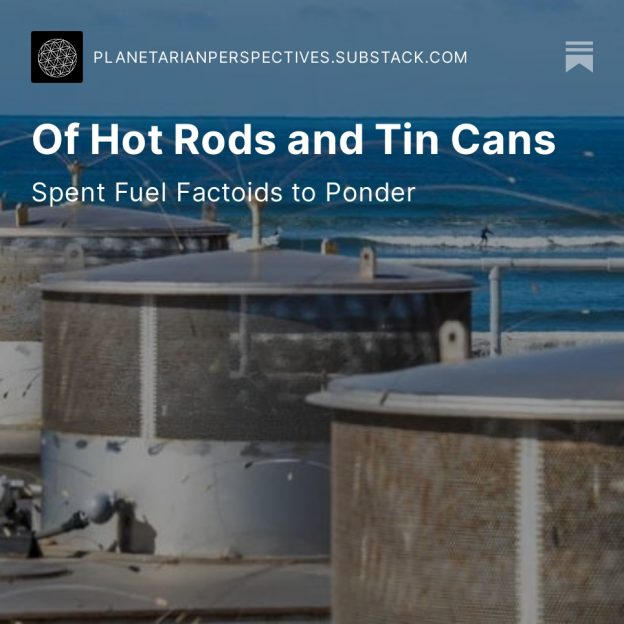
A view of the dry spent fuel storage facility in the foreground as surfers ride the waves at San Onofre State Beach, CA, April 21, 2022. Credit: Allen J. Schaben/Getty Images

Stranded Spent Nuclear Fuel with Nowhere to Go – A Clear & Present Threat to National Security

A string of pellets cased in the zircalloy cladding is called a fuel rod. Source

It is usually 4-5 meters long. Each rod contains 350-400 pellets. Source

Credit: world-nuclear.org

A human being standing close to an unshielded hot fuel rod would receive a lethal dose of radiation in just minutes. Source

Ten years after removal of spent fuel from a reactor, the radiation dose 1 meter away from a typical spent fuel assembly exceeds 20,000 rems per hour. A dose of 5,000 rems would be expected to cause immediate incapacitation and death within one week. Source

Each fuel assembly contains 179-264 rods. Source

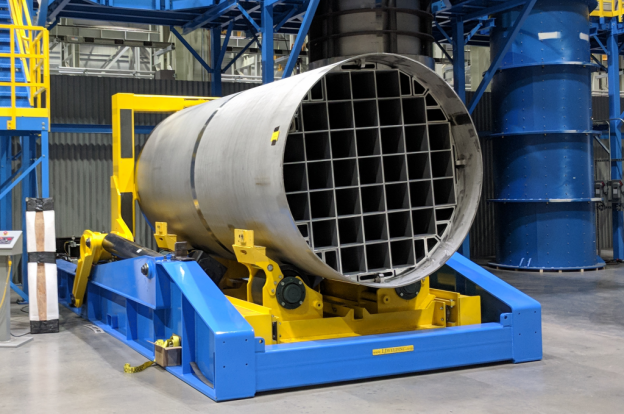
Holtec canisters each contain 37 fuel assemblies.

Photo: holtecinternational.com

Each canister contains more highly radioactive Cesium-137 than was released from Chernobyl. Source

Even a microscopic through-wall crack will release millions of curies of radiation into the environment states Dr. Kris Singh, President and CEO of Holtec. Source

The San Onofre ISFSI houses 73 vertical Holtec canisters. Source

Another 50 Areva NUHOM canisters sit in a separate, horizontal dry storage facility nearby on-site. Source

These containers do not have NRC approval for transport.

In any case, the U.S. Nuclear Waste Technical Review Board reports that this spent fuel will not be cool enough to move until the year 2100.

These canisters have a manufacturer’s ‘guarantee’ for only20 years.

Some canisters like these have been shown to fail in less than 20 years. Source

Some of the horizontal canisters at San Onofre are already 20 years old. Source

No Federal central repository for high level radioactive waste now exists, nor is likely to any time soon.

About 88,000 metric tons of spent nuclear fuel from commercial reactors remain stranded at reactor sites, and this number is increasing by some 2,000 metric tons each year. These 77 sites are in 35 states and threaten to become de facto permanent disposal facilities. A proposed new generation of SMRs will produce even more, more toxic forms of waste. Source

Any Questions?

Mary Beth Brangan and James Heddle Co-Direct EON, the Ecological Options Network.. The EON feature documentary S.O.S. – The San Onofre Syndrome – Nuclear Power’s Legacy will be released later this year.

https://nonukesca.net/of-hot-rods-and-tin-cans/

— Oppose Kings Bay Nuclear Trident base in Georgia — sign on letter due July 23, comments due July 24

From Nuclear Watch South

Dear Friends,

Nuclear Watch South invites all U.S. based organization and individuals
to sign the comments pasted below. Turn around time is tight!! The
Navy’s deadline to submit comments is Monday, July 24.

Send sign-ons to to Glenn Carroll atom.girl@nonukesyall.org by midnight
Sunday, July 23

Please include your name, title, organization, city, state or for
individuals your name, city and state.

We ask you to please circulate this sign-on opportunity widely! Nuclear
Watch South has traditionally focused on environmental concerns and is
not as well connected to the peace community as many of you!

The draft EA can be found here:
https://www.nepa(dot)navy(dot)mil/Current-Projects/Aircraft-Home-Basing-Ship-Homeporting/Columbia-Class/Documents/

You  may submit comments here:
https://www.nepa(dot)navy(dot)mil/Current-Projects/Aircraft-Home-Basing-Ship-Homeporting/Columbia-Class/Public-Commenting/

The Navy’s Environmental Assessment is narrow and concerned with
expanding Kings Bay Trident base to accommodate the new Columbia class
submarines, part of the nuclear weapons modernization program. Nuclear
Watch South has taken NEPA’s requirements to look at all impacts
seriously and is demanding a full EIS to include studying the impacts on
the North Atlantic right whales, whose Georgia birthing waters were only
first discovered as the Navy was displacing these creatures to the open
Atlantic Ocean by constructing Kings Bay. We bring the U.N. Treaty on
the Prohibition of Nuclear Weapons into the mix, and challenge the Navy
to contemplate that the environmental impact of nuclear weapons is,
ERRR, wholesale environmental destruction!

We invite U.S.-based organization and individuals to sign on to the
following comments on the draft EA:

July 24, 2023

Ms. Sara Goodwin
code: EV22.SG
6506 Hampton Blvd
Norfolk, VA 23508-1212

COMMENTS ON COLUMBIA CLASS HOMEPORTING EA | KINGS BAY TRIDENT SUBMARINE
BASE

Dear Ms. Goodwin,

Thank you for granting the request by Nuclear Watch South and others for
a deadline extension on the Columbia Class Homeporting Environmental
Assessment for Kings Bay Trident Submarine Base in the Cumberland Sound
near St. Marys, Georgia. The original deadline was June 25, 2023. We
requested a 90-day extension of which you granted 30 days for a July 24,
2023, deadline.

Nuclear Watch South (formerly Georgians Against Nuclear Energy) is
drafting these comments and inviting additional signatories. Nuclear
Watch South is a grassroots, direct action, environmental nonprofit
based in Georgia since 1977. The Kings Bay Trident nuclear submarine
base near St. Marys, Georgia, deploys enough nuclear firepower to
destroy all life on Earth. The environmental impact of Kings Bay is
planetary. Nuclear Watch South invites all U.S.-based organizations and
individuals to co-sign these comments.

BACKGROUND AND HISTORY OF KINGS BAY

Georgia’s 100 miles of Atlantic Ocean coastline is a globally unique,
fertile, and fragile marshland environment of barrier islands,
freshwater tidal forests, maritime forests, and endangered longleaf pine
forest. Georgia’s vast salt marshes support a staggering diversity of
plant and animal life nurturing the eggs and hatchlings of countless sea
creatures and providing significant nesting and migration habitat for
200 bird species.

Kings Bay, near the Georgia-Florida state line is home base for six
Trident submarines and deploys 25% of the U.S. nuclear arsenal. A
Trident submarine is the most expensive and deadly nuclear weapons
system on Earth. The only other nation to possess a similarly powerful
system is the United Kingdom, a longtime United States ally. The Trident
has been controversial since its inception as it upsets the so-called
MAD (Mutually Assured Destruction) power balance, fueling a dangerous
and costly international arms race.

The Navy conducted an Environmental Impact Statement (EIS) in 1977 when
Kings Bay Naval Submarine Base was first proposed. The EIS was performed
to fulfill environmental and public accountability requirements of the
newly instituted National Environmental Protection Act (NEPA) of 1969.
In 1979, construction began on Kings Bay. In 1984, it was first
discovered that the base had unwittingly intruded upon the (previously
unknown and apparently only) birthing waters for the critically
endangered North Atlantic right whales in the Cumberland Sound.

Kings Bay base began operations in 1989. The Soviet Union dissolved in
1991. At the same time, the U.S. nuclear weapons manufacturing complex
occupying vast reservations in more than a dozen states from Washington
to South Carolina was shuttering its reactors and facilities amidst
revelations of widespread nuclear contamination and vast inventories of
poorly managed radioactive wastes. The nuclear weapons complex suddenly
and belatedly became subject to environmental law and NEPA has since
proved to be a difficult filter through which to permit new nuclear
weapons manufacture. For example, the U.S. Department of Energy and
National Nuclear Security Agency have failed in five attempts over the
past 30 years to establish a plutonium pit production facility at the
Savannah River Site (SRS) on the South Carolina/Georgia state line
(Savannah River.

Nuclear weapons manufacturing has languished since 1990 in all
nuclear-armed nations and limited nuclear treaties have greatly reduced
nuclear stockpiles. All nuclear testing ceased in 1992. Trident
submarines now carry fewer nuclear weapons, but each Trident submarine
currently can deploy the explosive power of 1,825 Hiroshimas.

In 2021, the U.N. ratified the Treaty on the Prohibition of Nuclear
Weapons, presently counting 68 nations as parties. The treaty begins by
expressing the parties’ concern for “the catastrophic humanitarian
consequences that would result from any use of nuclear weapons, and
recognizing the consequent need to completely eliminate such weapons,
which remains the only way to guarantee that nuclear weapons are never
used again under any circumstances.” This landmark, game-changing Treaty
sets forth as international law that it is illegal to “develop, test,
produce, manufacture, otherwise acquire, possess or stockpile nuclear
weapons or other nuclear explosive devices.”

The North Atlantic right whale population rebounded from near extinction
when hunting the whales was outlawed in 1935. The whales encountered new
hazards, however, with the industrialization of shipping and fishing.
Ship strikes and entanglement in fishing gear are held responsible for
mortality events which are now decimating the whale population. The
current population of the critically endangered North Atlantic right
whale has crashed to fewer than 350 animals. National Oceanic and
Atmospheric Administration (NOAA) estimates 50 births per year are
required to avoid extinction of these ancient, magnificent marine
mammals. In 2022, only 15 North Atlantic right whales were born. _No
environmental study has ever been conducted of the impact of the North
Atlantic right whales’ protected birthing waters being occupied by the
massive Kings Bay naval station._

Continue reading

— My Humboldt Diary — exposé by nuclear whistleblower

My Humboldt Diary: A True Story of Betrayal of the Public Trust is a must-read exposé by whistleblower and former nuclear worker Bob Rowen documenting PG&E’s practices at Humboldt Bay Nuclear Power Plant near Eureka, California and retaliation against workers and others who raised safety issues, and the contamination from the plant, still unaddressed today.

“This book — My Humboldt Diary: A True Story of Betrayal of the Public Trust — is more than a telling of the story about PG&E’s Humboldt Bay Nuclear Power Plant. It is Bob Rowen’s account of what happened during his Humboldt Bay ordeal that turned him against nuclear power, caused him to become disenchanted with America’s system of justice, and made him realize how powerful and sinister America’s nuclear juggernaut truly is. His Diary explains why we must not allow even one more nuclear power plant to be built.”

PG&E / U.S. Atomic Energy Commission (predecessor of the Nuclear Regulatory Commission) claimed:
   “Nuclear energy is safe, clean, and economical.”

The Pacific Gas and Electric Company also claimed:
  “Everything we’ve done at Humboldt Bay has been in a fishbowl.”

Author Bob Rowen says, “Nothing could be further from the truth!”

My Humboldt Diary reveals the all too often intertwined nefarious behavior of corporate America and government. It provides historical knowledge for understanding the horrible legacy of the ill-fated Humboldt Bay Nuclear Power Plant. PG&E’s Humboldt Bay nuclear facility cost $33 million to build. The plant operated for a total of 13 years with many shutdowns during its operating life. The cost of decommissioning the plant is now approaching a BILLION dollars with no real end in sight.”

This stunning book is now in its second printing.

$15.99

Order today at https://myhumboldtdiary.com/order-now.html

https://myhumboldtdiary.com/index.html


Interviews with whistleblowers on Humboldt Bay:

https://healfukushima.org/2023/01/25/former-humboldt-bay-nuclear-plant-technician-pgampes-safety-problems-and-retaliation/
Bob Rowen interview

https://healfukushima.org/2023/01/25/nuclear-accident-at-pgampes-humboldt-bay-nuclear-plant-whistleblower-presents-the-evidence/
Scott Rainsford interview

https://healfukushima.org/2023/02/15/pge-humboldt-nuclear-power-plant-accident-the-cover-up/
Scott Rainsford interview – longer video

https://healfukushima.org/2023/01/25/humboldt-bay-problems-continue-pgampe-retaliates-against-decommissioning-expert/
Darrell Whitman interview

— DOE nuclear waste siting: ‘Consent-based’ or bribery?

‘ From Beyond Nuclear

June 11, 2023

The US Department of Energy on June 9 announced it will direct $26 million to “groups of university, nonprofit, and private-sector partners” who will help communities decide that they want to be the recipients of the country’s irradiated reactor fuel.

Having abjectly failed to find any safe, long-term radioactive waste management “solution” — possibly because there is none — while also failing to halt the production of nuclear waste, the DOE has now moved to what it calls “consent-based siting”.

The DOE’s interpretation of this term is that the recipients of the $26 million will “work with communities interested in DOE’s community-centered approach to storing and disposing of spent nuclear fuel.” In addition they would “ensure transparency and local support.”

But if past examples are any indicator, the “consenting” communities are likely to be those most deprived of resources, especially Indigenous communities and communities of color, who may feel pressured to accept the DOE largesse along with the fatal outcomes of living alongside high-level radioactive waste.

While U.S. Secretary of Energy Jennifer M. Granholm, insists that “it is vital” that “DOE works to be good stewards of the nation’s spent nuclear fuel,” the end result is more likely to be dumping radioactive waste on communities whose “consent” and willingness is driven by economic hardship.

energy(dot)gov/articles/doe-awards-26-million-support-consent-based-siting-spent-nuclear-fuel

https://beyondnuclear.org/consent-based-or-bribery/

— Despite scientific evidence and public opposition, Japan to start ocean wastewater discharge from Fukushima on June 12

TEPCO admitted that tritium (radioactive hydrogen) cannot be removed from the wastewater.

“When tritium gets inside the body, it’s at least as dangerous as any of the other radionuclides. And in some cases, it’s more than double as dangerous in terms of the effects of the radiation on the genetic material, on the proteins.”

— Timothy Mousseau, professor of biological sciences at the University of South Carolina,

From China Global Television Network

June 11, 2023

Japan plans to start sending seawater in an underwater tunnel built to release nuclear-contaminated water into the ocean from the Fukushima Daiichi nuclear power plant on June 12, local media reported on Friday citing news from the plant’s operator, Tokyo Electric Power Company (TEPCO).

According to TEPCO, the tunnel has been filled with about 6,000 tonnes of seawater this week for a two-week test before releasing the nuclear-contaminated water from the plant to a point about one kilometer offshore.

Japan is likely to officially begin its plan to dump the nuclear-contaminated wastewater into the ocean as early as the beginning of July. So far, the implementation of Japan’s plan still needs to await the outcome of the International Atomic Energy Agency’s (IAEA) meeting in late June.

In spite of the damage to the marine ecology and environment, Japan unilaterally pushed forward the discharge plan and constantly made excuses for its claim that “nuclear wastewater is safe.”

However, the content of Cs-137 (a radioactive element that is a common byproduct in nuclear reactors) in the marine fish caught in the harbor of the Fukushima Daiichi Nuclear Power Plant is 180 times that of the standard maximum stipulated in Japan’s food safety law, according to a statement released by the Chinese embassy in Japan on Monday, referring to data from a report released by TEPCO.

It also pointed out that there are more than 60 radionuclides, including tritium, carbon-14, cobalt-60, strontium-90 and iodine-129, in the nuclear-contaminated water. Some long-lived nuclides may spread with ocean currents and result in a bioconcentration effect, which will increase the total amount of radionuclides in the environment and cause unpredictable hazards to the marine ecosystem and human health. 

Continue reading

— Global Times uncovers more lies on Japan’s move to dump wastewater; ‘unacceptable’ experiment with Earth’s future, says senior expert

From Global Times

Xu Keyue and Xing Xiaojing
May 19, 2023

Although Japan suffered a lot from the atomic bombings in Hiroshima and Nagasaki in WWII as well as the Fukushima nuclear accident in March 2011, the Japanese government has seemingly failed to learn from history and insists on dumping nuclear-contaminated wastewater from the Fukushima Daiichi Nuclear Power Plant into the sea. The plan has continued to arouse opposition and skepticism at home and abroad.

Japanese lawmakers and international nuclear experts said in recent exclusive interviews with the Global Times that they are opposed to the dumping plan, stressing that this disposal is not the only way to deal with the nuclear-contaminated wastewater, and it is unacceptable to experiment with the future of the Earth.

Public opposition and recourse to the United Nations (UN) Convention on the Law of the Sea can be regarded as effective ways to prevent the Japanese government from insisting on pushing forward with the plan.

“I oppose the discharge of Fukushima nuclear-contaminated wastewater into the sea,” Junichi Tamatsukuri, Japanese lawmaker in Ibaraki Prefecture, told the Global Times.

Two nuclear accidents have occurred in and around his prefecture. The first was the Tokaimura critical nuclear accident in a small fuel preparation plant operated by JCO (formerly Japan Nuclear Fuel Conversion Co) in September 1999. The second was the Fukushima nuclear accident in March 2011. The two accidents severely affected the local economy, with consumers worried that food produced in Ibaraki contained radioactive substances that could harm their health. Many people have stopped visiting Ibaraki out of safety concerns.

“Local people from all walks of life have been working hard for years to recover from the economic losses caused by the two accidents,” Tamatsukuri said. “If the nuclear-contaminated wastewater from Fukushima is released into the sea this time, many industries such as fishing, agriculture, industry and tourism in Ibaraki Prefecture will be affected,” the lawmaker said.

Shaun Burnie, a senior nuclear expert at the Japan office of the international environmental organization Greenpeace, told the Global Times that the Japanese government and TEPCO have failed to explain their scientific justification for the discharge plan and have so far ignored the opposition of communities in Fukushima – especially the fishing communities.

Organically bound tritium (OBT) in the contaminated water is a “particular concern, because the amount to be discharged is on a vast scale,” said the expert who has been working on nuclear issues for nearly 40 years and radioactive waste discharge for more than 30 years.

“The Japanese government and TEPCO have deliberately miscommunicated on the risks of radionuclide tritium,” Burnie said. “They only focus on the external hazards, but the problem with tritium is when it is inside plants or seaweed, animals, fish or shellfish and humans,” Burnie said.

The scientific literature shows OBT has the potential to bio-accumulate and even potentially bio-magnify – as a slow energy radionuclide, when tritium is inside cells it can repeatedly damage the DNA structure. In this way, tritium is a much more dangerous radionuclide than the Japanese government and TEPCO have claimed, Burnie warned.

Continue reading