In Massachusetts, residential proximity to a nuclear power plant (NPP) was associated with significantly increased cancer incidence, with risk declining by distance, according to a new study led by Harvard T.H. Chan School of Public Health.
The study was published Dec. 17 in Environmental Health. It was conducted by researchers in the Department of Environmental Health, including corresponding author Yazan Alwadi, PhD student, and senior author Petros Koutrakis, professor of environmental sciences.
Despite widespread—and potentially expanding—reliance on nuclear power in the U.S., epidemiologic research investigating the health impacts of NPPs remains limited. Meanwhile, the results of studies conducted internationally vary significantly. To broaden the evidence base, the researchers assessed proximity of Massachusetts zip codes to nuclear power plants and 2000-2018 cancer incidence data collected by the Massachusetts Cancer Registry. They controlled for confounders such as air pollution and sociodemographic factors.
The researchers estimated that about 20,600 cancer cases in the state—roughly 3.3% of all the cases included in the study—were attributable to living near an NPP, with risk declining sharply beyond roughly 30 kilometers from a facility. The risk of developing cancer attributable to living near an NPP generally increased with age.
According to the researchers, the findings highlight the importance of acknowledging and addressing nuclear energy’s health impacts, particularly at a time when its expansion is being promoted as a solution to climate change.
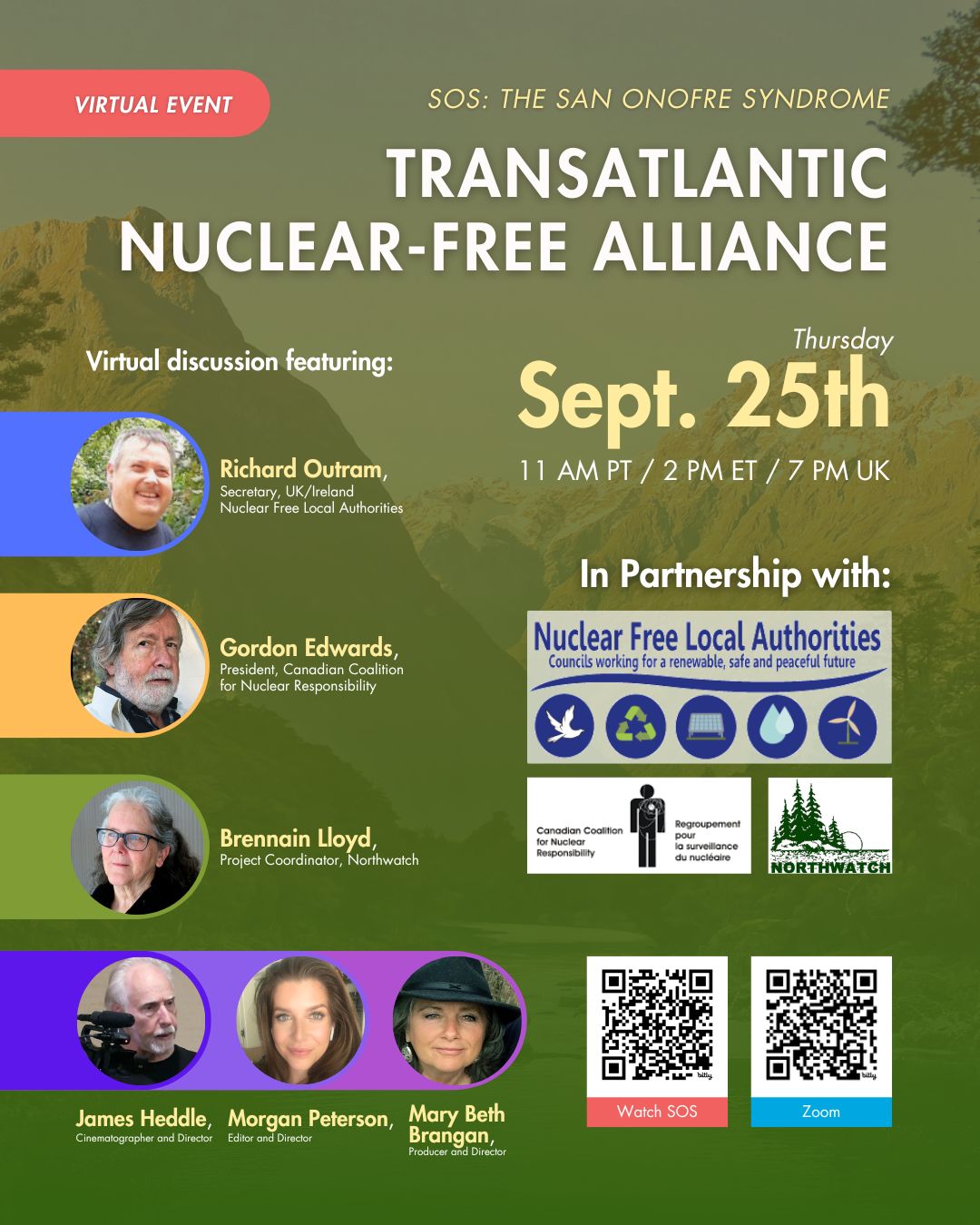
The Transatlantic Nuclear Free Alliance (TNFA) enters 2026, building on our collaboration with Richard Outram, former NFLA/MFP Chapter Secretary, now representing TNFA and the Welsh Anti-Nuclear Alliance (WANA), with a series of global webinars focused on critical issues impacting our local and global communities.
25 March 2026
11 am PT / 2 pm ET / 7 pm UK
The first webinar will focus on the impact of Radiation on Health. The event will take place on 25 March 2026, commemorating the 47th Anniversary of the Three Mile Island disaster.
Speakers:
Mary Olson, Generational Radiation Project (GRIP) USA
Eric Epstein, Three Mile Island Alert (TMIA) USA
Ian Fairlie, Independent Consultant on Radioactivity in the Environment UK
Gordon Edwards, Canadian Coalition for Nuclear Responsibility CAN
Richard Outram, Welsh Anti-Nuclear Alliance (WANA) UK
Mary Beth Brangan, (moderator) Ecological Options Network USA
Our distinguished panel of international speakers will share insights into the generational impacts of radioactivity and the current state of environmental safety.We are at an alarming “full circle” moment. With plans to restart Three Mile Island for Big Tech, the question remains: have we truly accounted for the long-term health legacy of 1979?
Join us 47 years later to look at the data the industry overlooks.
Future events will highlight the links between nuclear weapons & nuclear power (July) and the folly of reprocessing lethal radioactive waste (November).
Decision-makers are moving quickly to extend operation, and so must we. Join our efforts to protect Central Coast Communities for future generations.
URGENT CHALLENGE
Diablo Canyon nuclear plant was scheduled to retire in 2024 and 2025. However, Senate Bill 846 – passed in 2022 – has enabled extended operation. State and federal subsidies have been granted to support this effort. Pacific Gas & Electric Company has applied to the Nuclear Regulatory Commission for a 20-year license extension, although SB 846 asks for only 5 years.
WE NEED YOUR HELP
Donations are needed to pay for our attorneys, consultants, and expert witnesses. You can make a tax-deductible one-time or monthly donation online or mail checks to: San Luis Obispo Mothers for Peace, PO Box 3608, San Luis Obispo, CA 93403
Tax ID # 95-3080124
Attend meetings and support our efforts. Sign up for our Action Alerts on the Homepage!
WHAT ARE WE DOING?
Mothers for Peace, in collaboration with its partner organizations, is actively opposing extended operation of Diablo Canyon at every opportunity. Our legal team and experts represent us at the:
Nuclear Regulatory Commission
California Public Utilities Commission
California Coastal Commission
Regional Water Quality Control Board
Diablo Canyon Independent Safety Committee
9th Circuit Court of Appeals
PARTNER ORGANIZATIONS
Friends of the Earth
Environmental Working Group
Samuel Lawrence Foundation
Committee to Bridge the Gap
Environmental Defense Center
THE ISSUES
The Nuclear Regulatory Commission (NRC) exempted Pacific Gas & Electric Company (PG&E) from its Timely Renewal Rule, disregarding its own rules by approving continued operation of the Diablo Canyon reactors past their expiration dates without the required environmental reviews or opportunity for public hearings.
Unit 1’s reactor vessel was built with faulty material so is vulnerable to embrittlement. An embrittled reactor vessel can shatter like glass and cause a catastrophic meltdown. Despite this, PG&E has not tested for embrittlement for over 20 years – and the NRC has approved the exemptions.
The California Public Utilities Commission has approved extended operation without all the information required by SB 846 – and despite evidence that Diablo’s energy is not needed to avoid summer blackouts. There is new seismic evidence to show that the earthquake faults that run directly under the plant are vertical thrust faults, meaning they could cause much more ground motion than formerly estimated.
Diablo’s Once-Through Cooling System is out of compliance with the Clean Water Act. The facility circulates 2.5 billion gallons of seawater each day, releasing it back into the ocean 20º warmer and killing more than one billion fish in early life stages.
Extended operation of Diablo Canyon means the generation and onsite storage of even more high-level radioactive waste in an active seismic area.
ON JULY 16, 1945, THE USS INDIANAPOLIS DEPARTED Hunters Point Naval Shipyard carrying components of a bomb code-named “Little Boy,” including half of the highly enriched uranium then in existence in the world. Two hours later, after receiving word that the “Trinity” test of the first nuclear explosion on earth had succeeded earlier that day at Alamogordo, New Mexico, the Indianapolis was allowed to leave San Francisco harbor carrying its cargo to the island of Tinian in the Pacific. On August 6, a plane christened the Enola Gay left Tinian and dropped the assembled atomic bomb on Hiroshima.
About a year later, the nuclear arms race returned to Hunters Point. The first post-war nuclear tests, called OPERATION CROSSROADS, were conducted at the Bikini Atoll in the Marshall Islands in the Pacific, involving 42,000 sailors and more than 240 target and support ships. The tests went badly awry, contaminating the ships. More than 80 of the most contaminated ships, from this and subsequent tests, were brought back for “decontamination” to Hunters Point, then, as now, a predominantly low-income Black community. This process involved sandblasting the radioactivity off the ships in the open air, transferring the contamination from the ships to the surrounding area.
In 1989, Hunters Point was made a Superfund site, listed as one of the most polluted places in the country. Since then, the cleanup has been botched beyond description. CBG, working with Public Employees for Environmental Responsibility, pried out of EPA and made available to the news media EPA documents concluding that the Navy’s contractor had apparently fabricated or otherwise falsified radioactivity measurements at 90-97% of the survey units at the site. $250 million in taxpayer money was wasted; the tests would have to be redone.
CBG has issued a series of detailed reports (which you can find on the column to the left) on the problems at Hunters Point, which have been given significant press attention (e.g., front page of the San Francisco Chronicle, major TV news stories on NBC Bay Area). These studies— based on intensive research by CBG staffers Devyn Gortner, Maria Caine, Taylor Altenbern, Haakon Williams, and Audrey Ford, and a score of interns—disclosed that the problems went far beyond the fabrication of measurements. CBG revealed that radioactivity use at the site was far more extensive than generally realized, with numerous pathways for transporting contamination throughout the entire shipyard and into the neighboring community; that 90% of sites at Hunters Point had not been tested at all; that for those sites that were, 90% of the radionuclides of concern were not tested for. We showed that the cleanup standards employed by the Navy were decades out of date and far, far weaker than current EPA standards, which are required to be used at Superfund sites.
We disclosed that the Navy, after having promised to remove the contamination so that the site could be released for unrestricted residential use, shifted gears and decided to leave much of the contamination and just cover it with thin layers of soil or asphalt. Because the site is planned to be the largest redevelopment project in San Francisco history since the 1906 earthquake, those thin covers will have to be torn up and the contaminated soil beneath them excavated to build the more than 12,000 homes planned, exposing and lofting the contamination into the air. Drs. Howard Wilshire and William Bianchi prepared companion reports that showed that plant roots and burrowing animals would also bring the contamination back to the surface. We have prepared detailed critiques of testing plans by the Navy and the health department showing that they were incapable of detecting contamination at the levels requiring cleanup.
Three quarters of a century after the nuclear arms race set sail from Hunters Point, the toxic legacy remains for that impacted community, a victim of environmental injustice. We will continue our efforts to assist them, as they frankly have no one on their side from the parties responsible—the Navy, its contractors, and the captured regulators. Hunters Point is a striking reminder that the nuclear arms race threatens us globally and locally.
[This is in addtion to the Navy’s nuclear waste dump offshore San Francisco and the radioactive USS Independence which the Navy filled with nuclear waste and sank south of San Francisco, near Half Moon Bay in what is now the Monterey Bay National Marine Sanctuary.]
Three days before he died, Dan Hirsch gave this presentation to the NRC.
From Committee to Bridge the Gap
On July 16, 2025, Dan Hirsch, President of Committee to Bridge the Gap, gave a presentation to the NRC about the devastating consequences that would result from abandoning the linear no-threshold model of low-dose radiation exposure. Dan urged the NRC to tighten, not weaken, radiation protection standards.
Dan’s presentation was part of NRC’s public meeting to receive public input about President Trump’s Executive Order 14300 Section 5(b), which directs the NRC to “reconsider” its use of the linear no-threshold model of low-dose radiation exposure. The linear no-threshold model has long been the bedrock of radiation protection; without it, the public could be exposed to levels of radiation 100x to 1,000x higher than is allowed today.
In 2021, Dan gave a presentation on a related topic – the long history of underestimating radiation risks – to the National Academies of Science, Engineering, and Medicine. Check out this 2021 presentation by clicking here.
Unfortunately, this is wishful thinking. No doubt the BBC reporter was seeking a ‘feelgood’ headline but he was ill-informed. The fact is that nuclear reactors remain dangerous for decades after they have been closed, even with their fuels removed.
This is because closed reactors continue to emit radioactive tritiated water vapour and discharge tritiated liquid water for decades. (Tritium is the radioactive isotope of hydrogen with a half-life of 12.3 years.) Some also emit radioactive gaseous carbon-14 as well. (Carbon 14 is the radioactive isotope of carbon with a half-life of 5,760 years.)
In more detail, official UK emissions data reveal, for example, that the Trawsfynydd nuclear reactor which was closed in 1991 still emitted 13.6 billion Bq of tritium in 2023 more than 32 years later. And the same goes for long-closed reactors at all closed Magnox and AGR stations. Another example is the Canadian NPD reactor at Rolphton, Ontario which was closed in 1988. Five years later, high residual concentrations of tritium up to 82,000 Bq/g were found in its concrete bioshields. The tritium concentration was much higher than the ~300 Bq/g for C-14 – the next highest nuclide (Krasznai, 1993).
Here is a table showing UK emission/discharge data for 2023 (the latest available year) from DEFRA’s annual RIFE report.
(One becquerel (Bq) = one nuclear disintegration per second)
Annual HTO Releases (Bq) from nuclear reactors in 2023 from tables A.1.1 and A1.2 of Appendix 1 of RIFE 29 (2023). GBq/a (billion Bq/a)
Nuclear Station
Year closed
tritiated water vapour
tritiated water
total tritium
Total C-14 gaseous
Winfrith
1995
4.56
0.36 + 0.07
4.99
0.13
Winfrith (waste treatment)
294
N/A
294
–
Berkeley
1989
5.57
0.07
5.6
1.52
Bradwell
2002
6.10
1.2
7.3
0.42
Chapelcross
2004
1,700
nil
1,700
NA
Dungeness A
2006
54.9
1.87
56.8
0.39
*Dungeness B
2018
95.4
1.71
97.1
9.32
Hinkley A
2000
17.2
3.47
20.7
0.53
*Hinkley B
2022
90.9
241
332
0.21
Hunterston A
1989
0.37
–
0.37
0.06
*Hunterston B
2022
95.3
2.85
98.2
21.5
Oldbury
2012
13.5
0.09
13.6
0.65
Sizewell A
2006
18.9
0.26
19.2
340
Trawsfynydd
1991
13.6
3.83
17.4
1.44
Wylfa
2015
52.0
0.06
52.1
0.86
*some fuel still being removed in 2023
Why is tritium (and some C-14) still being emitted from these old reactors?
The short answer is that much tritium (and some C-14) is created in the concrete and metal structures of nuclear reactors during their operating years, which later slowly oozes out for decades.
The longer answer (not widely acknowledged by nuclear utilities) is complicated. During their operating years tritium (H-3) is produced in all nuclear reactors as it is both an activation product and a tertiary fission product. This happens in both water-cooled and gas-cooled reactors. In PWRs and BWRs, tritium from the cooling circuits (in the form of water and water vapour) enters the porous concrete matrices of the reactor shells and their containment structures during the ~30 year lifetimes of the reactors. In Magnox and AGRs, the hydrogen atoms in the hydration water of the chemical constituents of their concrete structures become activated. When all types of reactors are closed, tritium slowly oozes out of their concrete structures and containment shields for decades.
In more detail, the tritium concentrations in closed reactors are due to neutron activation of hydrogen, deuterium and Li-6 impurities in fuels, concrete structures, and metal structures . It also arises from tertiary fission (fission yield 0.01%) and diffusion from high levels of tritium in the cooling water and moderator in HWRs and LWRs (Kim et al, 2008). As stated by Kim ( 2009)
“During the lifetime of nuclear sites tritium becomes incorporated into the fabric of the buildings. When nuclear decommissioning works and environmental assessments are undertaken it is necessary to accurately evaluate tritium activities in a wide range of materials prior to any waste sentencing.”
Conventional computer models unfortunately give unreliable predictions of tritium concentrations in closed reactors. Older neutron codes alone (eg, ORIGEN-1 from Oak Ridge) incorrectly predict tritium levels. As stated by Kim et al (2008)
“Without an appreciation that two forms of tritium exist in concrete reactor bioshields, the H-3 content of samples may be severely underestimated using conventional analytical approaches”.
The two forms are strongly-bound and loosely-bound tritium. The former mainly originates from neutron capture on trace (1 part per 20,000) lithium (Li-6) within mineral phases, and requires temperatures in excess of 700 °C to achieve quantitative recovery. The weakly bound form of tritium can be liberated at significantly lower temperatures (100 °C) as HTO and is associated with dehydration of hydrous mineral components. ”
Kim et al (2008) added
“These findings exemplify the need to develop robust radioactive waste characterization procedures in support of nuclear decommissioning programs”.
These high tritium concentrations diffuse out of concrete only very slowly with diffusion rates through concrete of ~2 cm2 per year (Krasznai, 1993). This is confirmed by the evidence of continued high emissions of tritium from decommissioned reactors decades after their cessation.
Metals
In metals, tritium is retained by absorption of free water in the hydrated surface oxidation layer, by H ingress into bulk metal and also as lattice-bound tritium produced by neutron activation (Nishikawa M et al, 2006).
Croudace et al (2014) also found that significant tritium was incorporated in non-irradiated metals (eg stainless steel and copper), following prolonged exposure to tritiated water vapour (HTO) or tritium/hydrogen gas (HT) in nuclear facilities. In irradiated metals, an additional type of tritium was formed internally through neutron capture reactions. The amount formed depended on the concentration and distribution of trace lithium and boron in the metal. For example, steel containment vessels used for >20 years “exhibit tritium burdens greatly exceeding those predicted by simple gas solution in the parent metal” (Corcoran et al, 2017).
Investigation into the location of, and activity release from, vessel materials indicate the existence of two major tritium sources:- (i) bulk metal where in-depth contamination arises from diffusion/solution; and (ii) a highly active surface layer, responsible for holding the main tritium inventory (Corcoran et al, 2017) .
Conclusions
The conclusions are that closed reactors are not just ugly, redundant, hulks on the landscape: they are dangerous ones too. The public should be alerted to the radioactive emissions from disused reactors. Also nuclear power utilities should re-examine the computer models used to predict nuclide emission rates from disused reactors.
Croudace IW, Warwick PE, and Kim DJ (2014) Using Thermal Evolution Profiles to Infer Tritium Speciation in Nuclear Site Metals: An Aid to Decommissioning Anal. Chem., 2014, 86 (18), pp 9177–9185.
Kim DJ, Warwick PE and Croudace IW (2008) Tritium Speciation in Nuclear Reactor Bioshield Concrete and its Impact on Accurate Analysis. Anal. Chem., 2008, 80 (14), pp 5476–5480. http://pubs.acs.org/doi/abs/10.1021/ac8002787
I’m an independent consultant on radioactivity in the environment living in London UK. I’ve studied radiation and radioactivity at least since the Chernobyl accident in 1986. I’ve a degree in radiation biology from Bart’s Hospital in London and my doctoral studies at Imperial College in London and (briefly) Princeton University in the US concerned the radiological hazards of nuclear fuel reprocessing. I formerly worked as a civil servant on the regulation of radiation risks from nuclear power stations. From 2000 to 2004, I was head of the Secretariat of the UK Government’s CERRIE Committee on internal radiation risks. Since retiring from Government service, I have been a consultant on radiation matters to the European Parliament, local and regional governments, environmental NGOs, and private individuals. My areas of interest are the radiation doses and risks arising from the radioactive releases at nuclear facilities.
From Committee to Bridge the Gap News Release July 27, 2025
With deep sadness but also with heartfelt gratitude for a life well lived, the Committee to Bridge the Gap announces the death of its founder, Daniel O. Hirsch, on July 19th 2025 at his home in Ben Lomond, California. CBG board chair Jack Miles had earlier accepted Hirsch’s resignation as president of Bridge the Gap on the grounds of grievously worsening health. Anthony Zepeda, CBG secretary, had agreed to succeed Hirsch as president and had begun transitional meetings with CBG staff.
Committee to Bridge the Gap came formally into being as an organization in a meeting at UCLA after Hirsch had returned home to Los Angeles, and in its early years the organization addressed a variety of ongoing social and political issues, notably including the cause of peace and reconciliation in Israel/Palestine. Gradually, however, and particularly after Hirsch’s appointment as director of the Program on Environmental and Nuclear Policy at the University of California, Santa Cruz, nuclear safety became CBG’s central public-interest mission. Just two days before his death, Hirsch delivered a powerful public comment at a virtual hearing contesting Executive Order 14300 radically reducing radiation safety standards. In that spirit, the work of CBG will continue.
Privately, Hirsch, who never married, lived a life of monastic simplicity and frugality. Though an atheist, he maintained a close spiritual relationship with the sisters of Redwoods Monastery, in rural Humboldt County. By the terms of his will, the wealth he had accumulated through a lifetime of willed poverty will go to the poor. As the crippling effects of chronic Q-fever progressively incapacitated him, Dan Hirsch chose not to prolong a life whose continuation would only squander the wealth he had destined for others. May his memory be a blessing, most especially for all who sacrifice private comfort for the public good and all who when they speak truth to power, do so modestly and with meticulous attention to all the facts.
CBG will announce memorial services for Hirsch when plans are complete. Mourners may make donations in his honor to Doctors Without Borders doctorswithoutborders.org or Give Directly givedirectly.org
As reflected on CBG’s homepage, if it was about Santa Susana Field Lab, Hunters Point Naval Shipyard, Diablo Canyon Nuclear Power Plant, or San Onofre Nuclear Power Plant, Dan was on it.
Dan just testified at educational sessions intended to push back against the U.S. Nuclear Regulatory Commission’s attempt to do away with the Linear, No Threshold theory of ionizing radiation’s hazards to human health. (See the link to Dan’s slideshow he presented as public comment to NRC on July 16, 2025, posted at NIRS’s website, here.) He had worked at the cutting edge of protecting human health against the nuclear industry’s artificial radioactive pollution, for many decades, including at the National Academy of Science.
As documented in the MSNBC documentary film In the Shadow of the Valley, which also features interviews with Dan, at Santa Susana, his graduate students unearthed the 1959 meltdown, which had been covered up for 20 years.
He testified repeatedly about the seismic, and other risks, at Diablo Canyon, including before U.S. Senator Barbara Boxer’s (Democrat-California) Environment and Public Works Committee, more than a decade ago, as well as at grassroots sessions, such as those of San Luis Obispo Mothers for Peace, a few years ago.
Around two decades ago, Dan stopped a nuclear power industry spokesman dead in his tracks — not for the first time. On an NPR interview about energy and environment, focused on nuclear power, the industry spokesman kept bringing up climate protection. At one point, Dan said “I actually care about the climate,” which stopped the industry spokesman from disingenuously bringing it up again.
Update from Mothers for Peace, May 25, 2025: PG&E has now pulled the capsule, but it will take 12-18 months to test the capsule for embrittlement.
From Mothers for Peace March 18, 2025
Diablo Canyon Nuclear Plant Unit 1’s reactor vessel was built with faulty material, so it’s vulnerable to embrittlement. An embrittled reactor vessel can shatter like glass and cause a catastrophic meltdown. Despite this, PG&E has not tested for embrittlement for over 20 years.
PG&E has now committed to removing Capsule B from Unit 1 to test for embrittlement during the upcoming April outage. Previous attempts to remove this capsule have been unsuccessful.
On March 18, 2025, Mothers for Peace sent a letter to the CEO of PG&E, Patti Poppe, setting forth its expectation that Capsule B will finally be removed during this upcoming April outage and subsequently tested for embrittlement so we will learn if it’s safe to operate.
We are compelled to send this letter because of previous failures by PG&E to test the Diablo Canyon Nuclear Plant for embrittlement. We agree with the 9th Circuit Court of Appeals when they state:
We share Petitioners’ concerns about the public health and safety implications of repeatedly postponing Capsule B’s withdrawal. It has been about two decades since PG&E withdrew and tested a surveillance capsule from the Unit 1 reactor vessel—and even longer since a surveillance capsule withdrawn from Unit 1 generated credible data. Although Unit 1’s operating license has now officially expired, the reactor continues to operate under the NRC’s “timely 10 renewal” rule because PG&E has submitted a license renewal application. San Luis Obispo Mothers for Peace, 100 F.4th at 1056–58 (citing 10 C.F.R. § 2.109(b)). Capsule B remains a key source of data for the license renewal period. Under the current schedule, PG&E is slated to remove Capsule B in the spring of 2025 and use it to inform the company’s pending license renewal application for Unit 1. Any further delay in Capsule B’s withdrawal will mean that PG&E lacks a critical data source about the future integrity of the reactor vessel, without which a future license renewal may be subject to legal challenge.
San Luis Obispo Mothers for Peace v. NRC, 2025 U.S. App. LEXIS 1104 at *10 (9th Cir.) January 17, 2025
Background: Read about the Mothers for Peace brief filed in March 2024.
Award-Winning UCLA Earthquake Scientist Files Declaration to the NRC Requesting Shutdown of Diablo Canyon.
SAN LUIS OBISPO, CA – MAY 15, 2025 – A leading earthquake expert has called for the immediate shutdown of California’s last operating nuclear power plant, warning that a proposed decision by the NRC dismissing seismic risks at Diablo Canyon is incomplete and illogical and fails to address significant evidence that seismic risks are too high to meet federal safety standards.
In a formal declaration submitted today to the Nuclear Regulatory Commission (NRC) Petition Review Board (PRB), Dr. Peter Bird, Emeritus Professor of Earth Sciences at UCLA, states that continued operation of the Diablo Canyon Power Plant (DCPP) presents “an unacceptable risk of a serious earthquake-caused accident,” and that the NRC is obligated to shut it down under its own safety guidelines.
Dr. Bird’s declaration criticized the NRC for refusing to open an enforcement proceeding sought a year ago by environmental organizations. Instead, the NRC parroted unsupported and illogical claims by PG&E that the reactors are safe to operate and ignored Dr. Bird’s strong evidence and analysis demonstrating that the risk of an earthquake-caused core damage accident at DCPP is high enough to warrant immediate shutdown under the NRC’s own guidance.
“I continue to hold the view that the risk of a serious earthquake-caused accident at DCPP is unacceptable, and that immediate shutdown is warranted under NRC’s existing guidelines,” wrote Dr. Bird, a globally recognized authority in earthquake modeling with nearly five decades of experience.
Submitted on behalf of petitioners San Luis Obispo Mothers for Peace (SLOMFP), Friends of the Earth (FoE) and the Environmental Working Group (EWG), Dr. Bird’s declaration criticized the NRC for failing to conduct a competent and independent review of “grave concerns regarding the severe risk of an earthquake-induced accident during continued operation of Diablo Canyon nuclear reactors.”
Dr. Peter Bird now serves as Professor of Geophysics and Geology, Emeritus at UCLA with 49 years of experience in seismic activity and earthquake modeling. Holding a doctorate in Geophysics from MIT, Dr. Bird is the founding architect of the Global Earthquake Activity Model (2015).
The Bird declaration to the NRC warns that PG&E’s modeling for seismic activity “assumes that a majority of large earthquakes affecting Diablo Canyon are strike-slip and disregards the significant contribution of thrust faulting earthquake sources under the Diablo Canyon site.”
The nuclear reactors at Diablo Canyon, owned and operated by Pacific Gas & Electric (PG&E), were slated to close in 2024 and 2025 when its operating licenses were set to retire because the plants would eventually become “too expensive to operate” compared to available renewable energy resources. The “Joint Proposal” to shut Diablo Canyon, signed by environmental groups, unions, and PG&E was certified by the CA Public Utilities Commission (CPUC) in 2018. It did not address the unacceptably high risk for a seismic-induced reactor meltdown. However, the reactors’ licenses were extended after California Governor Gavin Newsom brokered a deal with PG&E, offering a $1.4 billion taxpayer-funded subsidy to keep the DCPP operational.
Hallie Templeton, an attorney for FoE, said: “Allowing Diablo Canyon to operate without a competent and independent review of the seismic risks addressed in the petition puts millions of California residents in danger and risks a major radioactive disaster, akin to Fukushima, along the California coast. PG&E can’t say they haven’t been warned.”
Diane Curran, legal counsel for SLOMFP, said: “We are very disappointed with the NRC’s proposed decision to allow DCPP to keep operating without a full review of the significant seismic risk to the reactors. It would be irrational and irresponsible for the NRC to permit PG&E to operate DCPP, especially with an aging and deteriorating Unit 1 reactor vessel, without addressing the concerns brought forward by one of the world’s top seismic experts. Listen to the science!”
Bernadette Del Chiaro, Senior Vice President, California at EWG, said: “The potential environmental and human health consequences of a major radioactive disaster along the California coast, similar to the 2011 Fukushima Daiichi incident, are simply unacceptable. It is imperative that all possible precautions are taken to ensure the structural integrity and operational safety of a nuclear facility located in an area with ‘unacceptable risk of earthquakes. The risks highlighted in the petition warrant an unbiased and expert evaluation to determine the true extent of the potential dangers to Californians. To keep Diablo open without this crucial review would place countless lives in jeopardy.”



 Heal Fukushima