Steven Starr, implications of radioactive cesium contamination — Part I

From Ratical.org

( PDF format )

The Implications of The Massive Contamination of Japan With Radioactive Cesium
Steven Starr

Senior Scientist, Physicians for Social Responsibility
Director, University of Missouri, Clinical Laboratory Science Program
Helen Caldicott Foundation Fukushima Symposium
New York Academy of Medicine, 11 March 2013

Contents
Introduction
Presentation
Biographical Sketch of Steven Starr
Bibliography of Recently Published Works

from TUC Radio’s 10-part Fukushima Symposium Mini-Series
Recordings from March 11 and 12, 2013

Broadcast quality mp3 of the 30 minute program is here: < http://tucradio.org/Starr_FUKU_SYM_FOUR.mp3> (20.8 MB)

( PDF format )

Title

Thank you very much. It’s a pleasure to be here today. A large number of highly radioactive isotopes released by the destruction of the Fukushima Daiichi nuclear power plant grossly contaminated the Japanese mainland. Most of these radionuclides had short half lives which meant they would essentially disappear in a matter of days or months. For many of those who were exposed to them there will be major health consequences.

However, there were some radioactive elements that will not rapidly disappear. And it is these long-lived radionuclides that will remain to negatively affect the health of all complex life forms that are exposed to them.

Cesium-137

Chief among them is Cesium-137, which has taken on special significance because it is has proven to be the most abundant of the long-lived radionuclides that has remained in the environment following the nuclear disasters at Chernobyl and Fukushima. It has a 30 year radioactive half life which is why it persists in the environment. Scientists now believe that it will be 180 to 320 years before the Cesium-137 around the destroyed Chernobyl reactor actually disappears from the environment.

Cesium is water soluble and quickly makes its way into soils and waters. It is in the same atomic family as potassium and it mimics it, acting as a macronutrient. It quickly becomes ubiquitous in contaminated ecosystems.

It is distributed by the catastrophic accidents at nuclear power plants because large quantities of volatile radioactive cesium build up inside the fuel rods of nuclear reactors. Thus any accident at a nuclear reactor that causes the fuel rods to rupture, melt, or burn will cause the release of highly radioactive cesium gas.

Long-lived radionuclides such as Cesium-137 are something new to us as a species. They did not exist on Earth in any appreciable quantities during the entire evolution of complex life. Although they are invisible to our senses they are millions of times more poisonous than most of the common poisons we are familiar with. They cause cancer, leukemia, genetic mutations, birth defects, malformations, and abortions at concentrations almost below human recognition and comprehension. They are lethal at the atomic or molecular level.

They emit radiation, invisible forms of matter and energy that we might compare to fire, because radiation burns and destroys human tissue. But unlike the fire of fossil fuels, the nuclear fire that issues forth from radioactive elements cannot be extinguished. It is not a fire that can be scattered or suffocated because it burns at the atomic level—it comes from the disintegration of single atoms.

Thus, radioactivity is a term which indicates how many radioactive atoms are disintegrating in a time period. We measure the intensity of radioactivity by the rate of the disintegrations and the energy they produce.

Radioactivity

One Becquerel is equal to one atomic disintegration per second.

One Curie is defined as that amount of any radioactive material that will decay at a rate of 37 billion disintegrations per second.

So one Curie equals 37 billion Becquerels.
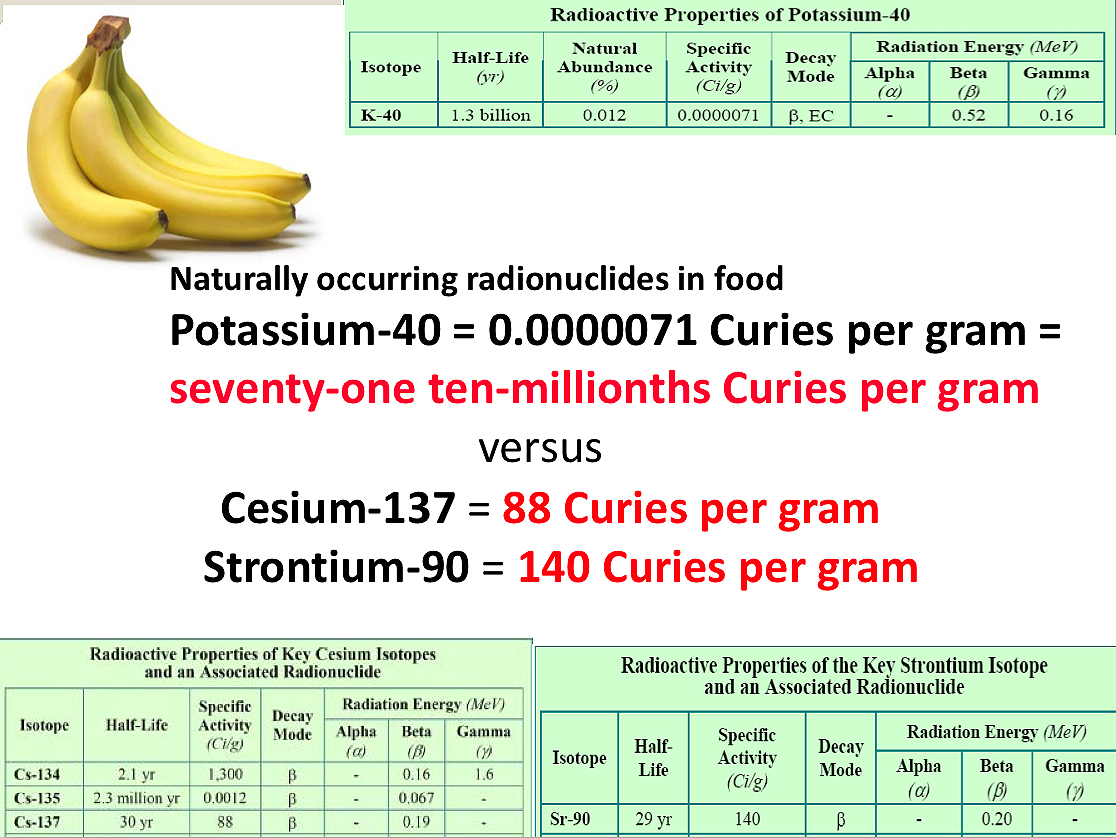
Potassium-40

Sometimes these man-made radionuclides are compared to naturally occurring radionuclides, such as Potassium-40, which is always found in bananas and other fruits. However this is a false comparison since naturally occurring radioactive elements are very weakly radioactive. In the lab chart the radioactivity is described as the “specific activity”. Note that Potassium-40 has a specific activity of 71 ten millionths of a Curie per gram. Compare that to the 88 Curies per gram for Cesium-137. This is like comparing a stick of dynamite to an atomic bomb.

Highly-radioactive fission products such as Cesium-137 and Strontium-90 emit 10 to 20 million times more radiation per unit volume than does Potassium-40. So which one of these would you rather have in your bananas?
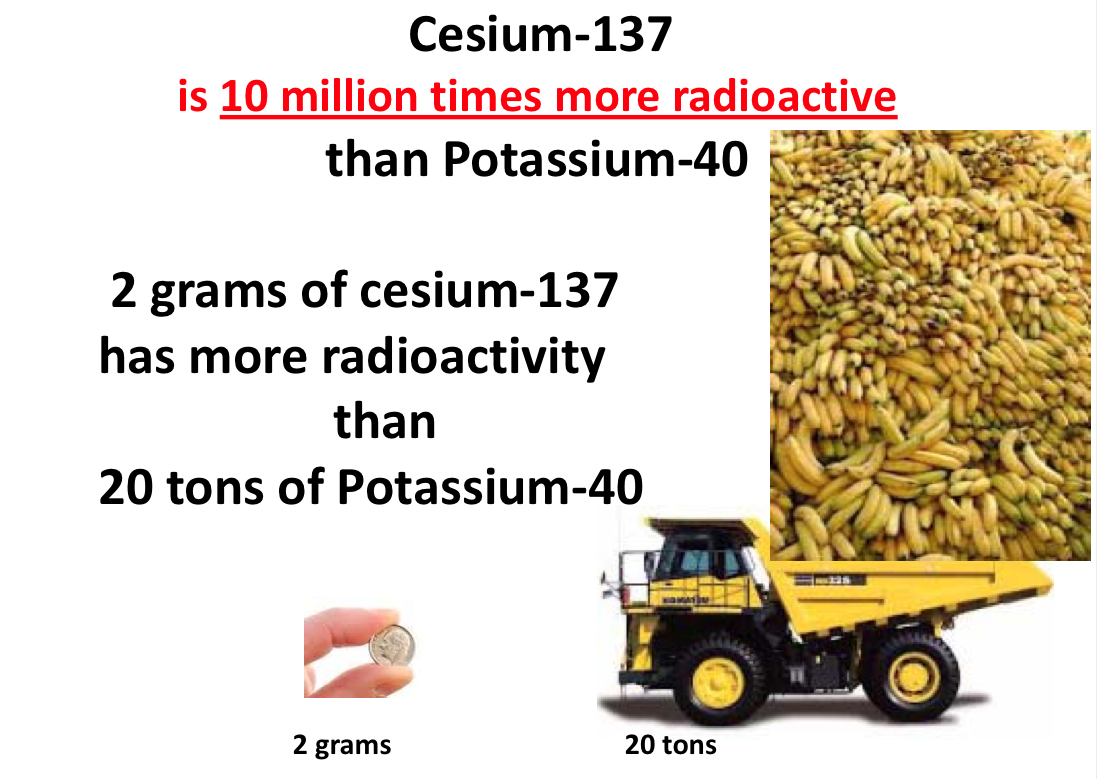
Cs-137 10 million times more radioactive than Potassium-40

It is in fact the amount of Cesium-137 deposited per square kilometer of land that defines the degree to which an area is classified as being too radioactive to work or live. One may get an idea of the extreme toxicity of Cesium-137 by considering how little of it is required to make a large area of land uninhabitable.
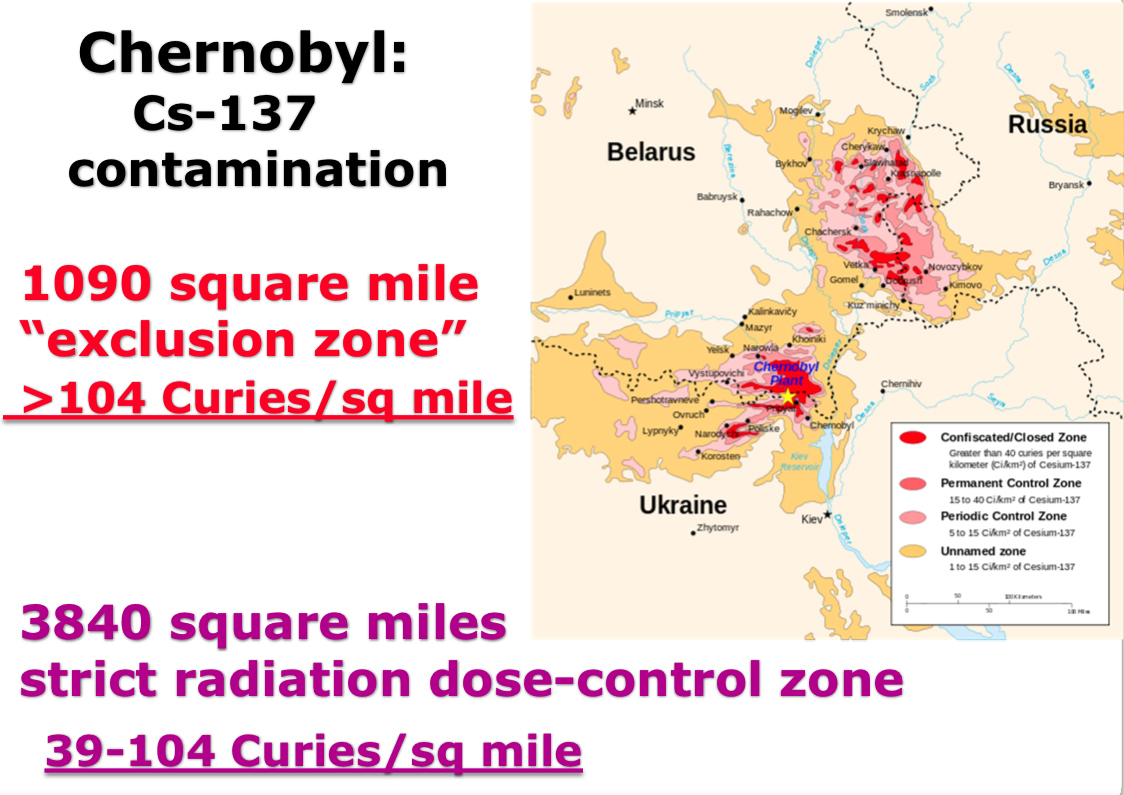
Chernobyl: Cs-137 contamination

The lands that were grossly contaminated by the destruction of the Chernobyl nuclear power plant are classified by the number of Curies of radiation per square kilometer. There were 3840 square miles of land contaminated with 15 to 40 Curies of radiation per square kilometer. These lands are considered strict radiation dose-control zones.
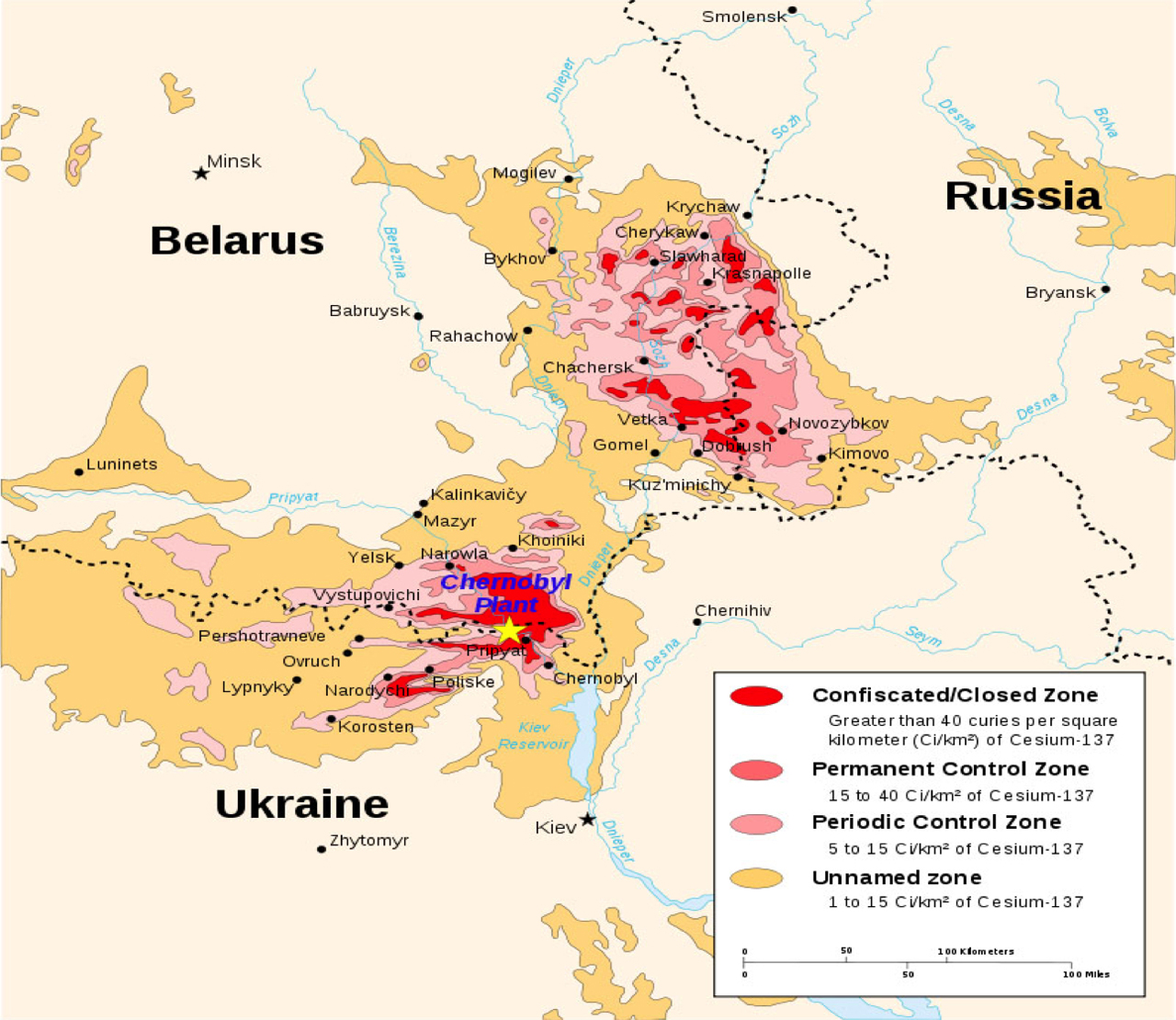
Chernobyl: Cs-137 contamination
High Resolution Map Detail

The 1100 square mile uninhabitable exclusion zone that surrounds the destroyed Chernobyl reactor has greater than 40 Curies of radioactivity per square kilometer. For those more familiar with square miles, that would be 104 Curies per square mile.

Consider again that one gram of Cesium-137 has 88 Curies of radioactivity.

Thus, as little as one third of a gram of Cesium-137, made into microparticles and distributed as a smoke or gas over an area of one square kilometer, will make that square kilometer uninhabitable.
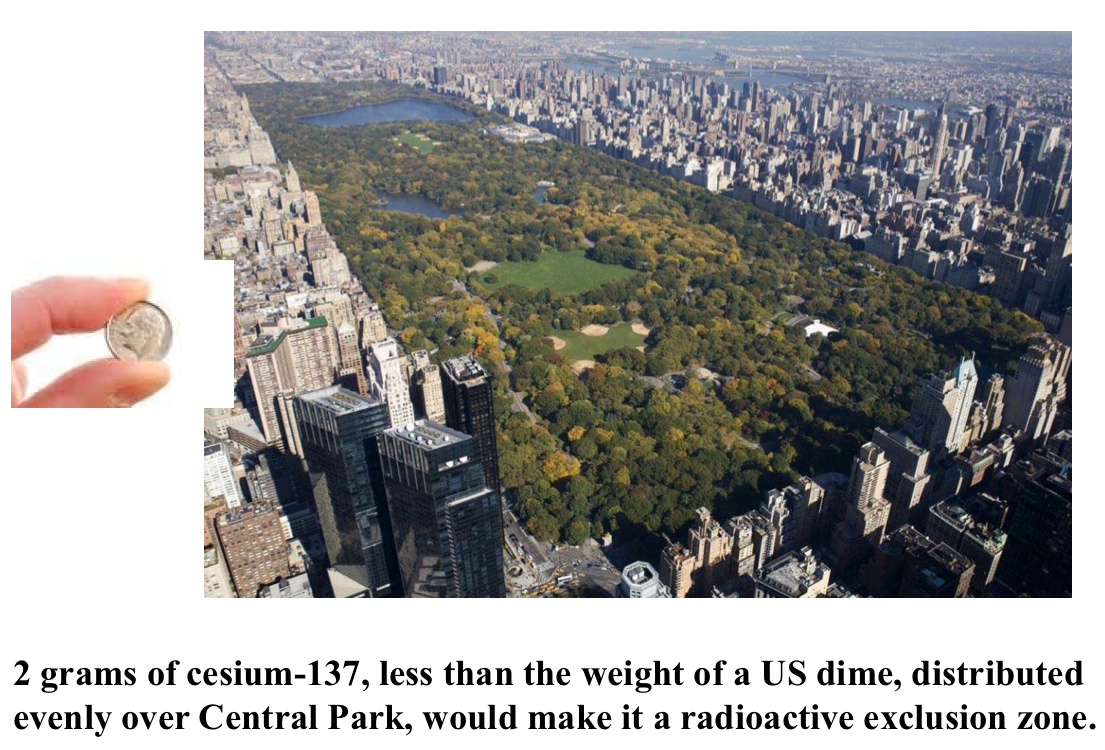
2 grams of Cs-137 - less than the weight of a US dime, distributed evenly over CentralPark, would make it a radioactive exclusion zone

Less than two grams of Cesium-137, a piece smaller than an American dime, if made into microparticles and evenly distributed as a radioactive gas over an area of one square mile, will turn that square mile into an uninhabitable radioactive exclusion zone. Central Park in New York City can be made uninhabitable by 2 grams of microparticles of Cesium-137. Hard to believe, isn’t it?

Remember, these nuclear poisons are lethal at the atomic level. There are as many atoms in one gram of Cesium-137 as there are grains of sand in all the beaches of the world. That’s 1021 atoms—10 to the 21st power. 1480 trillion of them or 1.48 times 10 to the 12th power are disintegrating every second, releasing invisible nuclear energy. So this works out to about one and a half million disintegrations per second per square meter. We can see how this works then.
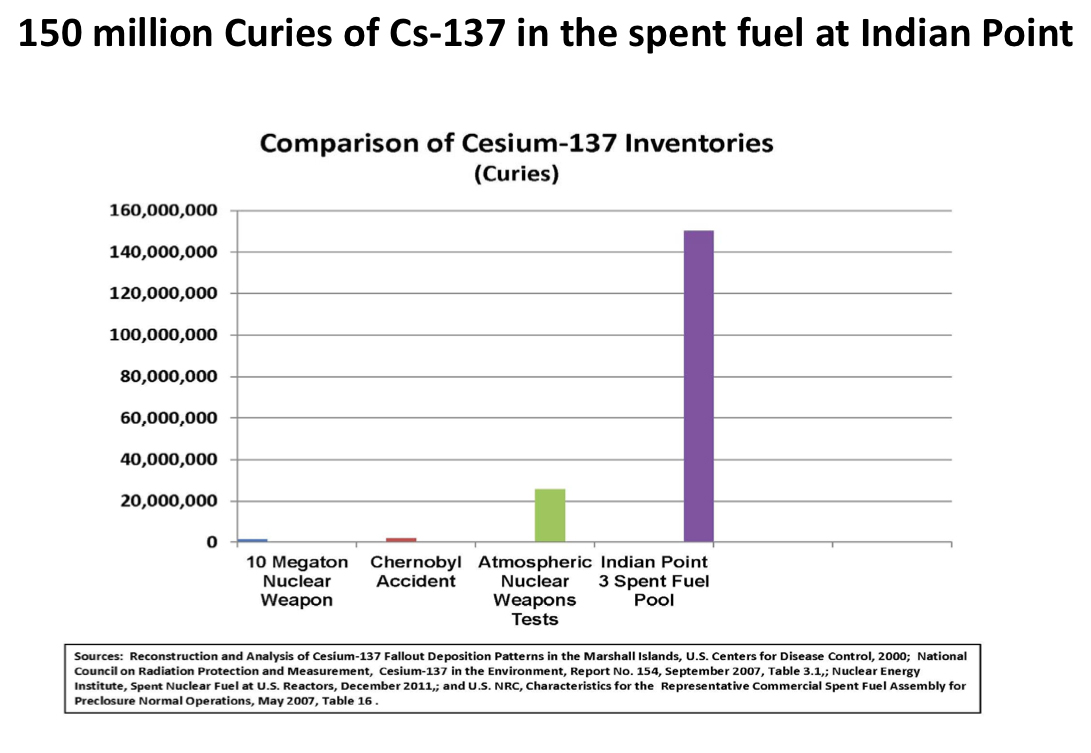
150 million Curies Cs-137 in the spent fuel at Indian Point. Sources: Reconstruction and Analysis of Cesium-137 Fallout Deposition Patterns in the Marshall Islands, U.S. Centers for Disease Control, 2000; National Council on Radiation Protection and Measurement, Cesium-137 in the Environment, Report No. 154, September 2007, Table 3.1,; Nuclear Energy Institute, Spent Nuclear Fuel at U.S. Reactors, December 2011,; and U.S. NRC, Characteristics for the Representative Commercial Spent Fuel Assembly for Preclosure Normal Operations, May 2007, Table 16.

Note the immense inventories of Cesium-137: 150 million Curies that are located in the nearby spent fuel pool at Indian Point Nuclear Power Plant which is about 40 miles from here by road and less than that as the radioactive cloud flies. Many of the 104 US commercial nuclear reactors and power plants have more than 100 million Curies of Cesium-137 in their spent fuel pools. This is many times more than in the spent pools at Fukushima.

So now that we have some idea of the extreme toxicity of Cesium-137, let’s look at the extent of the contamination of the Japanese mainland.

Fukushima Explosion, March 11, 2011

It is now known that the reactors 1, 2, and 3 at Fukushima Daiichi all melted down and melted through the steel reactor vessels within a few days following the earthquake and tsunami of March 11, 2011. This was not made public by either TEPCO or the Japanese government for two months.

Editor‘s note: this transcript was created from the broadcast quality audio recording program featuring Steven Starr produced by Maria Gilardin in her Fukushima Symposium Mini Series on TUC Radio. Starting with the PDF file in the March 11 Documents tab of < http://www.totalwebcasting.com/view/?id=hcf#>, the text below was fashioned using Maria’s Introduction and Mr. Starr’s actual presentation. (All highlighted text in the original PDF – e.g., underlining, italics, bold – is represented below as underlined text.) The slides were generated from copy generously provided by Mr. Starr. I am grateful for the assistance of Steven Starr and Maria Gilardin in assembling this presentation.

http://www.ratical.org/radiation/Fukushima/StevenStarr.html


Nevada’s atomic test legacy: underground aquifers are radioactive

…polluted 1.6 trillion gallons of water…About a third of the [underground atomic] tests were conducted directly in aquifers…

Federal drinking water standards in 2009 when this article was written

..For alpha particles, the standard is 15 picocuries per liter; for long-term radionuclides, it’s 50 picocuries per liter

radioactivity in the water reaches millions of picocuries per liter.

From Los Angeles Times

Nevada’s hidden ocean of radiation

by Ralph Vartabedian
November 13, 2009

YUCCA FLAT, NEV. — A sea of ancient water tainted by the Cold War is creeping deep under the volcanic peaks, dry lake beds and pinyon pine forests covering a vast tract of Nevada.

Over 41 years, the federal government detonated 921 nuclear warheads underground at the Nevada Test Site, 75 miles northeast of Las Vegas. Each explosion deposited a toxic load of radioactivity into the ground and, in some cases, directly into aquifers.

When testing ended in 1992, the Energy Department estimated that more than 300 million curies of radiation had been left behind, making the site one of the most radioactively contaminated places in the nation.

During the era of weapons testing, Nevada embraced its role almost like a patriotic duty. There seemed to be no better use for an empty desert. But today, as Nevada faces a water crisis and a population boom, state officials are taking a new measure of the damage.

——————————

For The Record
Los Angeles Times Wednesday, November 18, 2009 Correction
Nevada radiation: An article in Friday’s Section A about contaminated water at the Nevada Test Site said the federal drinking water standard for radiation is 20 picocuries per liter. There are actually three standards, depending on the type of radiation: For alpha particles, the standard is 15 picocuries per liter; for long-term radionuclides, it’s 50 picocuries per liter; and for short-lived tritium, it’s 20,000 picocuries per liter. The article also said the test site is northeast of Las Vegas; it is northwest.

—————————-

They have successfully pressured federal officials for a fresh environmental assessment of the 1,375-square-mile test site, a step toward a potential demand for monetary compensation, replacement of the lost water or a massive cleanup.

“It is one of the largest resource losses in the country,” said Thomas S. Buqo, a Nevada hydrogeologist. “Nobody thought to say, ‘You are destroying a natural resource.’ “

In a study for Nye County, where the nuclear test site lies, Buqo estimated that the underground tests polluted 1.6 trillion gallons of water. That is as much water as Nevada is allowed to withdraw from the Colorado River in 16 years — enough to fill a lake 300 miles long, a mile wide and 25 feet deep.

At today’s prices, that water would be worth as much as $48 billion if it had not been fouled, Buqo said.

Although the contaminated water is migrating southwest from the high ground of the test site, the Energy Department has no cleanup plans, saying it would be impossible to remove the radioactivity. Instead, its emphasis is on monitoring.

Federal scientists say the tainted water is moving so slowly — 3 inches to 18 feet a year — that it will not reach the nearest community, Beatty, about 22 miles away, for at least 6,000 years.

Still, Nevada officials reject the idea that a massive part of their state will be a permanent environmental sacrifice zone.

Access to more water could stoke an economic boom in the area, local officials say. More than a dozen companies want to build solar electric generation plants, but the county cannot allow the projects to go forward without more water, said Gary Hollis, a Nye County commissioner.

The problem extends beyond the contamination zone. If too much clean water is pumped out of the ground from adjacent areas, it could accelerate the movement of tainted water. When Nye County applied for permits in recent years to pump clean water near the western boundary of the test site, the state engineer denied the application based on protests by the Energy Department.

(The department did not cite environmental concerns, perhaps to avoid acknowledging the extent of the Cold War contamination. Instead, federal officials said the pumping could compromise security at the test site, which is still in use.)

“Those waters have been degraded,” said Republican state Assemblyman Edwin Goedhart of Nye County, who runs a dairy with 18,000 head of livestock. “That water belongs to the people of Nevada. Even before any contamination comes off the test site, I look at this as a matter of social economic justice.”

Continue reading

Knock, knock, is anyone home at the EPA?

The Bridgeton/West Lake Superfund site is a radioactive disaster adjoining St. Louis, Missouri.

From Center for Health, Environment & Justice

February 15, 2016

EPA has gone dark. McCarthy is awaiting the end of her term and no one is protecting the American citizens or our environment.

It is outrageous that Administrator Gina McCarthy refuses to acknowledge the citizens living near the Bridgeton/West Lake Superfund site. What is wrong with her? Just Moms STL wrote a letter requesting a meeting in May of 2015 and never even received an acknowledgement that they asked for a meeting. They traveled to Washington, DC anyway in hopes of seeing McCarthy after their federal delegation of senators and congress representatives sent a letter to encourage McCarthy to meet with them. The community received nothing from the office of the Administrator. Not a call, a letter or even an e-mail saying she had a prior commitment or was on travel.

A second letter was sent this past fall to say the community leaders are planning to travel to Washington, D.C. in February and would she please meet with them to discuss the Superfund site which has been mismanaged by her regional staff. Again there was silence. I personally called every day but one in the month of January and February leading up to the date that local people were traveling to D.C. On many occasions when I called, all I received was a voice mail message that asked me to leave a message and someone would get back to me. I left message after message and no one, not a single person from the agency returned my call.

On a few occasions I actually talked to a woman who answered the phone. She was courteous and respectful and always promised to deliver the message to scheduling department. “Someone will call you back soon.” But no one ever called. The citizens living around the site began a telephone campaign to McCarthy’s office. It was only a week until they travel to D.C. and no one provided an answer if McCarthy would meet or not. The community sold cupcakes, brownies, t-shirts, and worked hard to raise the funds to visit D.C. and meet with the Administrator to explain what was going on from their perspective.

With a slim chance of meeting with McCarthy, now two years since their first request for a meeting was made, they climbed on a plane and came to D.C. While there they met with their congressional delegation, allies in the field but never had a meeting with McCarthy. Also they were never denied a meeting; it was deafeningly silent. My goodness if the answer is “NO” then say so. To say nothing is irresponsible, inexcusable and further victimizing the victims.

I stood outside of McCarthy’s office at 9 a.m. the last day of the groups visit. From the sidewalk I called her office and explained that local leaders are downstairs and waiting for a response from McCarthy before they need to leave for the airport. The public relations office sent down a two young people to receive the letter the community had for McCarthy, outlining their concerns. They apologized that McCarthy wasn’t available to meet. She couldn’t have told the citizens before they left St. Louis that she couldn’t meet? It is not a big request to ask for a simple yes or no of availability.

My take away . . . fire McCarthy. My tax dollars should not be spent on someone who works in government and ignores the citizens of the United States. All she had to do on both occasions is say I’m sorry I’ve got a previous engagement. Common courtesy should be a requirement of federal employment.

http://chej.org/2016/02/knock-knock-is-anyone-home-at-epa/

Take action on Diablo Canyon NPP: tell California State Lands Commission to do full CEQA review / update

UPDATE:
The Commission approved a new permit for PG&E at Diablo Canyon without an environmental review and rushed a new staff report, without adequate public review time.
Two hearings were held by the California Lands Commission — April 5, 2016 and June 28, 2016. The transcripts are below. At the second hearing, after public comments and comments by the commission, Lieutenant Governor Gavin Newsom moved to approve a new lease for PG&E, without an environmental review and without giving the public 30-days to review a revised staff report. He also applauded the agreement by PG&E to close Diablo Canyon in 9 years at the close of its license.

Meeting transcripts:
https://www.slc.ca.gov/Meeting_Transcripts/2016_Documents/04-05-2016_Transcripts.pdf
The Diablo Canyon hearing begins on p. 55

https://www.slc.ca.gov/Meeting_Transcripts/2016_Documents/06-28-2016_Transcripts.pdf
The Diablo Canyon hearing begins on p. 78

From Mothers for Peace

California’s Lieutenant Governor, Gavin Newsom, serves on the three-member State Lands Commission.  This Commission leases the land to PG&E for the Diablo Canyon Nuclear Power Plant.  These leases are due to expire in 2018 and 2019.

ACTION: Send an email to the Commission asking the staff to prepare a full California Environmental Quality Act (CEQA) review for the land leases before considering a renewal. Also ask that the meeting scheduled for April 5 be held in San Luis Obispo County.  Send the message to:  Jennifer.Lucchesi at slc.ca.gov

Gavin Newsom Speaks on Diablo Canyon

20,000 drums of radioactive waste waiting in Idaho for disposal

From the Post Register

February 25, 2016

Containers filled with radioactive waste continue to stack up in the desert west of Idaho Falls.

There are nearly 20,000 steel drums filled with the transuranic waste, waiting to find a permanent resting place. The waste is in a holding pattern as a New Mexico nuclear waste repository slowly recovers from a pair of 2014 accidents.

The Waste Isolation Pilot Plant near Carlsbad, N.M. is scheduled to reopen to limited operations in December, U.S. Department of Energy officials told the Idaho National Laboratory Site Citizens Advisory Board last week.

But DOE officials said there is still much uncertainty about when Idaho will be cleared to begin shipping out its growing stockpile of waste. That’s because even when the repository known as WIPP reopens, it’s still not expected to be back at full strength for several more years as additional repairs are made. In addition, other federal facilities around the country will be hoping to send their growing waste collections all at once, too, creating a bottleneck.

“I think it’s fair to say that once does WIPP does resume operations, it will be at a much slower pace than what we were accustomed to before the shutdown,” said Brad Bugger, a supervisor at DOE’s Idaho Operations Office.

That continued uncertainty about when the waste will leave Idaho has led to new concerns that the DOE will miss another state-mandated cleanup milestone in the 1995 Settlement Agreement. The agreement said the transuranic waste — which continues to be slowly uncovered and repackaged at the desert site — needs to be gone from the state by the end of 2018.

“It’s going to be a challenge,” to meet the deadline, said Susan Burke, INL coordinator for the Idaho Department of Environmental Quality. She added that continuing to process and package the waste into drums — even if it can’t yet be shipped outside Idaho — is still safer for the environment and human health than leaving it in place.

The waste includes tools, rags, clothing, sludge and dirt — anything contaminated with a transuranic element such as plutonium. Most of it came from the now-closed Rocky Flats Plant outside Denver, where nuclear weapon components were made.

Truckloads of waste, held in wooden and fiberglass boxes and metal drums, were shipped to the site in the 1970s and ’80s, where it was dumped and covered over with dirt. For years DOE cleanup contractors have been working to carefully clean up the mess that was left behind.

In a recent interview, Idaho Attorney General Lawrence Wasden said he is keeping an eye on the approaching 2018 deadline. DOE is already out of compliance with the Settlement Agreement due to liquid waste that was supposed to be treated by 2012. The department also is in violation of a Settlement Agreement requirement to ship a running average of 2,000 cubic meters of transuranic waste out of the state each year.

“I certainly believe we have time right now if the Department of Energy is willing — and we’re trying to engage them in conversation about that 2018 deadline — that we can find a way to resolve some of that,” Wasden said. “One of those (ways to resolve the problem) would be to have a prioritization of shipments to WIPP once it is open.”

Continue reading

Explosion heard in Iwaki City, 60 km from Fukushima, still unidentified

From Fukushima Diary

Unidentified explosive sound heard in Iwaki city twice on 8th Feb

Iwaki city citizens reported to police, fire department and city hall that they heard something explode on 2/8/2016.

It reportedly sounded like thunder or exploding meteorite. It also shook the buildings and windows.

The most reports were sent from Onahama area. The cause hasn’t been identified nor any damage was reported.

Onahama area is approx. 60km from Fukushima plant. Tepco has not announced anything about the plant status related to this issue.

Video and sound can be watched here.

http://togetter.com/li/935857

http://blog.livedoor.jp/kinisoku/archives/4579163.html

http://fukushima-diary.com/2016/02/unidentified-explosive-sound-heard-in-iwaki-city-twice-on-8th-feb/

Possible explosion in Iwaki city still unidentified

February 19, 2016

The cause of the possible explosion still have not been identified.

NIED (National Research Institute for Earth Science and Disaster Prevention) observed weak tremor that last for a few tens of seconds around 15:30 of 2/8/2016, when the explosive sound was observed in Iwaki city.  The tremor was measured even in Hitachi city of Ibaraki prefecture. However NIED denies the possibility of an earthquake because the tremor was observed in widespread area at once. They also denied the possibility of meteorite.

Meteorite was not seen by anyone either.

Ministry of defense comments none of their fighter aircraft flew above Iwaki city that time.

However, none of the investigation has been implemented for the potential connection with Fukushima plant so far.

http://maguro.2ch.sc/test/read.cgi/poverty/1455859525/l50

http://fukushima-diary.com/2016/02/possible-explosion-in-iwaki-city-still-unidentified/

PG&E covers up continued safety problems at Diablo Canyon

From the Lompoc Record
February 25, 2016

Nuke plant poses risks

PG&E recently reported to the NRC its analysis of an incident that occurred on Dec. 31, 2014, at the Diablo Canyon nuclear plant.

PG&E described it as an “event or condition that could have prevented the fulfillment of the safety function of structures or systems needed to remove residual heat and mitigate the consequences of an accident.” Do they mean meltdown?

Just how small of a problem was this that took over a year to diagnose, repair and report? Did they shut down part of the plant during that year, or did they continue to operate without knowing the cause of the problem?

Once again we are reminded that while we sleep, the possibility of a nuclear disaster at Diablo is very real. How many safety regulations have been fudged away over the years? What health risks are people living downwind from these reactors subjected to?

The way for California to safely meet carbon emission standards is by using renewable sources, not by keeping Diablo open. Renewables mean no carbon or highly toxic radioactive waste hanging around for 250,000 years.

Shut it down now, before it’s too late.

by Simone Malboeuf
Los Osos

http://lompocrecord.com/news/opinion/mailbag/hartmann-nuke-risks-oil-trains/article_9f1703e4-4a34-5f16-997c-6be468a26bc9.html

Posted under Fair Use Rules.


Group to monitor trial of former TEPCO executives to clarify truth about Fukushima disaster

From Asahi Shimbun

By MASAKAZU HONDA/ Staff Writer

January 27, 2016

Lawyers, journalists and scientists will form a group to help expose the truth and spread details about the Fukushima nuclear disaster during the criminal trial of three former executives of Tokyo Electric Power Co.

“We will encourage the court to hold a fair trial while transmitting information regarding the trial across the nation,” said an official of the planned organization, whose name is translated as “support group for the criminal procedure on the Fukushima No. 1 nuclear power plant.”

Tsunehisa Katsumata, former chairman of TEPCO, the operator of the crippled plant, and two former vice presidents, Sakae Muto and Ichiro Takekuro, face mandatory charges of professional negligence resulting in death and injury.

Although the trial is still months away, 33 people are now setting up the group, including Ruiko Muto, who heads an organization pursuing the criminal responsibility of TEPCO and government officials for the Fukushima nuclear disaster.

Tetsuji Imanaka, an assistant professor of nuclear engineering at the Kyoto University Research Reactor Institute, and Norma Field, a professor emeritus of East Asian Studies at the University of Chicago, have also joined.

Three reactors melted down at the Fukushima No. 1 nuclear plant after the Great East Japan Earthquake and tsunami struck on March 11, 2011. A number of hospital patients died in the chaotic evacuation.

About 14,000 residents of Fukushima Prefecture filed a criminal complaint against TEPCO executives, government officials and scientists in 2012, saying they were aware of the dangers to the Fukushima nuclear plant from a tsunami, but they failed in their responsibility to take proper countermeasures.

Tokyo prosecutors twice decided not to indict the three former TEPCO executives. However, the Tokyo No. 5 Committee for the Inquest of Prosecution, a panel of citizens, decided to forcibly indict the three in July last year.

“It has been almost five years since the disaster, but many details, including their foreseeability of the tsunami, remain unclear,” said science writer Takashi Soeda, one of the group’s co-founders. “As TEPCO has not unveiled a sufficient amount of information even in inquiries conducted by the Diet and the government or in civil lawsuits, the truth must be uncovered through the legal force of a criminal trial.”

Five lawyers appointed by the Tokyo District Court will act as prosecutors in the trial.

Legal experts expect the lawyers will indict the former TEPCO executives and release a statement naming the victims around March 11, the fifth anniversary of the triple disaster that still haunts the Tohoku region.

Charges near for former TEPCO executives over Fukushima nuclear disaster

From Asahi Shimbun

February 26, 2016

Lawyers on Feb. 29 are expected to indict three former executives of Tokyo Electric Power Co. on charges of professional negligence resulting in death and injury in connection with the 2011 Fukushima nuclear disaster.

The indictment mandated by a citizens panel will be filed at the Tokyo District Court by lawyers serving as prosecutors.

Tsunehisa Katsumata, a 75-year-old former TEPCO chairman, and two former vice presidents, Sakae Muto, 65, and Ichiro Takekuro, 69, led the utility when the Great East Japan Earthquake and tsunami on March 11, 2011, triggered the meltdowns at the Fukushima No. 1 nuclear power plant.

The indictment will say the three former executives were aware that such a large tsunami could strike the coast of the Tohoku region, but they did not take measures to protect the nuclear plant.

The indictment will also argue that their failure to carry out their professional duties led to the deaths of patients at hospitals in mandatory evacuation zones as well as injuries to other residents during the evacuation.

A criminal complaint was filed against the three former executives by residents and citizens groups.

The Tokyo District Public Prosecutors Office in September 2013 decided not to indict the former executives, saying it was difficult for TEPCO to forecast such a large-scale natural disaster hitting the nuclear plant.

However, the Tokyo No. 5 Committee for the Inquest of Prosecution in July 2014 overrode the prosecutors’ decision, and sent the case back to them for a further look.

But the prosecutors again decided not to indict the three.

The citizens panel in July 2015 again overrode the decision, saying the three former executives should face mandatory indictment and be tried in court.

Court-appointed lawyers will serve as the prosecutors in the trial.

THE ASAHI SHIMBUN

http://ajw.asahi.com/article/0311disaster/fukushima/AJ201602260087

Posted under Fair Use Rules.

TEPCO begins burning contaminated workers’ clothing

The radiation will go into the air and add to the contamination spreading far and wide.

“lightly contaminated”, “low-level radiation” — more cover-up by TEPCO and the news media

From Asahi Shimbun

By HIROMI KUMAI/ Staff Writer
February 26, 2016

OKUMA, Fukushima Prefecture–Tokyo Electric Power Co. has started to incinerate the thousands of boxes of lightly contaminated waste, including clothing used by workers, at the Fukushima No. 1 nuclear power plant to reduce the amount of tainted waste on the site.

TEPCO, the plant operator, fired up a special on-site incinerator on Feb. 25 to burn protective suits, gloves, socks and other work clothes worn by plant workers that became contaminated with low-level radiation.

The operation will reduce the amount of tainted work clothing accumulating at the plant during decommissioning operations since the nuclear disaster unfurled in March 2011. The garments cannot be processed outside the plant due to the radiation.

The clothing being incinerated are items with the lowest levels of contamination that have been stored in tens of thousands of 1 cubic-meter special boxes. The number of containers reached 66,000 at the end of last year.

The incinerator is equipped with two types of filters that can reduce the radioactive levels of the exhaust air to less than one-millionth, while reducing the capacity of the waste to about 2 percent.

The incinerator can burn a maximum of 14 tons of items per day when it is operated to capacity for 24 hours. The ash residue will be stored in metallic barrels on the plant compound.

The incineration project was authorized by the Nuclear Regulation Authority in July 2014. TEPCO began operational tests of the incinerator using untainted waste last fall.