— Grassroots group campaigns for Santa Susana cleanup lawsuit — July actions

From Ojai Valley News
July 12, 2024

A grassroots group is kicking off a campaign to urge four local governments to sue the California Department of Toxic Substances Control (DTSC) over its failure to enforce cleanup agreements at a Simi Valley site contaminated in the 1940s and 1950s by thousands of rocket tests and nuclear-reactor experiments.

The campaign kickoff event is from 10 a.m. to 1 p.m., Saturday, July 13, at Strathearn Historical Park, 37 Strathearn Place, Simi Valley.

The event kicks off 10 days of in-person actions at upcoming supervisor and city council meetings.

A partial nuclear meltdown occurred in 1959, leaving radioactive fallout at the site.

Despite cleanup agreements being in place with The Boeing Company (Boeing), National Aeronautics and Space Administration (NASA), and the U.S. Department of Energy (DOE), the state has failed to demand they clean up the contamination to the standard originally agreed upon.

“We are asking four local governments to join together and sue the state to litigate over the final Environmental Impact Report,” said Larry Yee, a resident of Ojai and former chair of the Los Angeles Regional Water Quality Control Board.

Yee said the group is asking the Ventura County Board of Supervisors, Los Angeles County Board of Supervisors, and the cities of Los Angeles and Simi Valley to sue DTSC over the Environmental Impact Report recently issued for the site.

To read more OVN | VCSUN coverage of the SSFL contamination and efforts to get it cleaned up CLICK HERE

https://www.ojaivalleynews.com/news/environment/grassroots-group-campaigns-for-simi-toxic-site-cleanup/article_d69a66a0-407e-11ef-8643-bbe4f5c52d56.html

From Parents Against Santa Susana Field Laboratory

July 2024 Scheduled Actions

July 13: EVENT: SSFL Action Assembly, Strathearn Historical Ranch, Simi Valley

July 14: WATCH: In the Dark of the Valley Virtual Screening and QA Register

July 15: CALL: Elected representative phone banking

July 16: AMPLIFY: Reshare posts on social media & tag your representatives

July 17: EMAIL: Elected representative email banking

July 18: AMPLIFY: Share press stories with your networks

July 19: SIGN: Our open letter to local governments

July 20: AMPLIFY: Reshare posts on social media & tag your representatives

July 21: SIGN: Invite others to sign the www.Change.org/SantaSusana petition

July 22: CALL: Elected representatives

July 23: DEADLINE FOR BOARD OF SUPERVISORS TO FILE SUIT AGAINST DTSC

For more information: https://parentsagainstssfl.com/action-assembly

— During Typhoon Hagibis, at least 14 levees broke in Fukushima Prefecture

Posted on Fukushima 311 Watchdogs:

safe_image.php.jpg

Photo Credit.
October 16, 2019
From Fairewinds:
News outlets worldwide are reporting that at least 66 residents of Japan have died as a result of Typhoon Hagibis. Our hearts reach out to the people of Japan and the families of the deceased.
The news coverage from Reuters caught our attention due to its research that Fukushima Prefecture was apparently the region hardest hit by the typhoon. According to the Reuters story entitled: Rescuers slog through mud as Japan typhoon death toll rises to 66:
“The highest toll was in Fukushima prefecture north of Tokyo, where levees burst in at least 14 places along the Abukuma River, which meanders through a number of cities in the largely agricultural prefecture. At least 25 people died in Fukushima, including a mother and child who were caught in flood waters, NHK said…. Residents in Koriyama, one of Fukushima’s larger cities, said they were taken by surprise by the flooding. Police were searching house-to-house to make sure nobody had been left behind or was in need of help.
“The river has never flooded like this before, and some houses have been completely swept away. I think it might be time to redraw hazard maps or reconsider evacuation plans,” said Masaharu Ishizawa, a 26-year-old high school teacher …”
Fukushima prefecture is very mountainous and largely remote. The radioactive fallout, which spread throughout Japan after the three Fukushima nuclear meltdowns in 2011, is impossible to clean up in these inaccessible mountainous areas that lie throughout Fukushima Prefecture. Even in populous Tokyo, more than one-year after the meltdowns, Fairewinds’ research identified randomly selected Soil Samples Would Be Considered Nuclear Waste in the US, which we discussed in the video on Fairewinds’ website.
It is our belief from our ongoing research that the ensuing flooding induced by Typhoon Hagibis is moving significant amounts of radiation from high in the mountains down to cities, towns, and farmland in Japan. Our analysis on several radiation sampling trips to the prefecture proves that there are huge amounts of residual radiation that were previously trapped in the soil.
Now, due to the heavy rain, subsequent river flooding, and burst levees (dams) this radioactive soil is moving and being pushed from the mountains down into more populous areas where people live and crops are grown. Once again it appears that government authorities and rescue organizations are ignoring this new, long-term threat, or have not been apprised by the JAEA (Japan Atomic Energy Agency) and nuclear power industry of the monumental health risks involved.
See also:

https://dunrenard.wordpress.com/2019/10/20/at-least-14-levees-broke-in-fukushima-prefecture/comment-page-1/#comment-18405

— University of Hawaii research shows radiation in Hawaii soil 2016 as bad as 7 prefectures in Japan 2 weeks after Fukushima

From Nuke Professional
July 18, 2016

Stock here

Breaking! University of Hawaii Research Shows Radiation in Hawaii Soil 2016 as Bad as 7 Prefectures in Japan 2 weeks After Fukushima

Story here
http://www.hawaii.edu/news/2016/06/03/geology-graduates-investigate-fukushima-derived-radioactivity-in-hawaii/

1200 Bq/M2 in Hawaii, most from potassium, about 400 Bq/M2 from Radioactive Cesium 137

Most wild mushrooms in Hawaii around 50 Bq/kG, but some as high as 100 Bq/kG

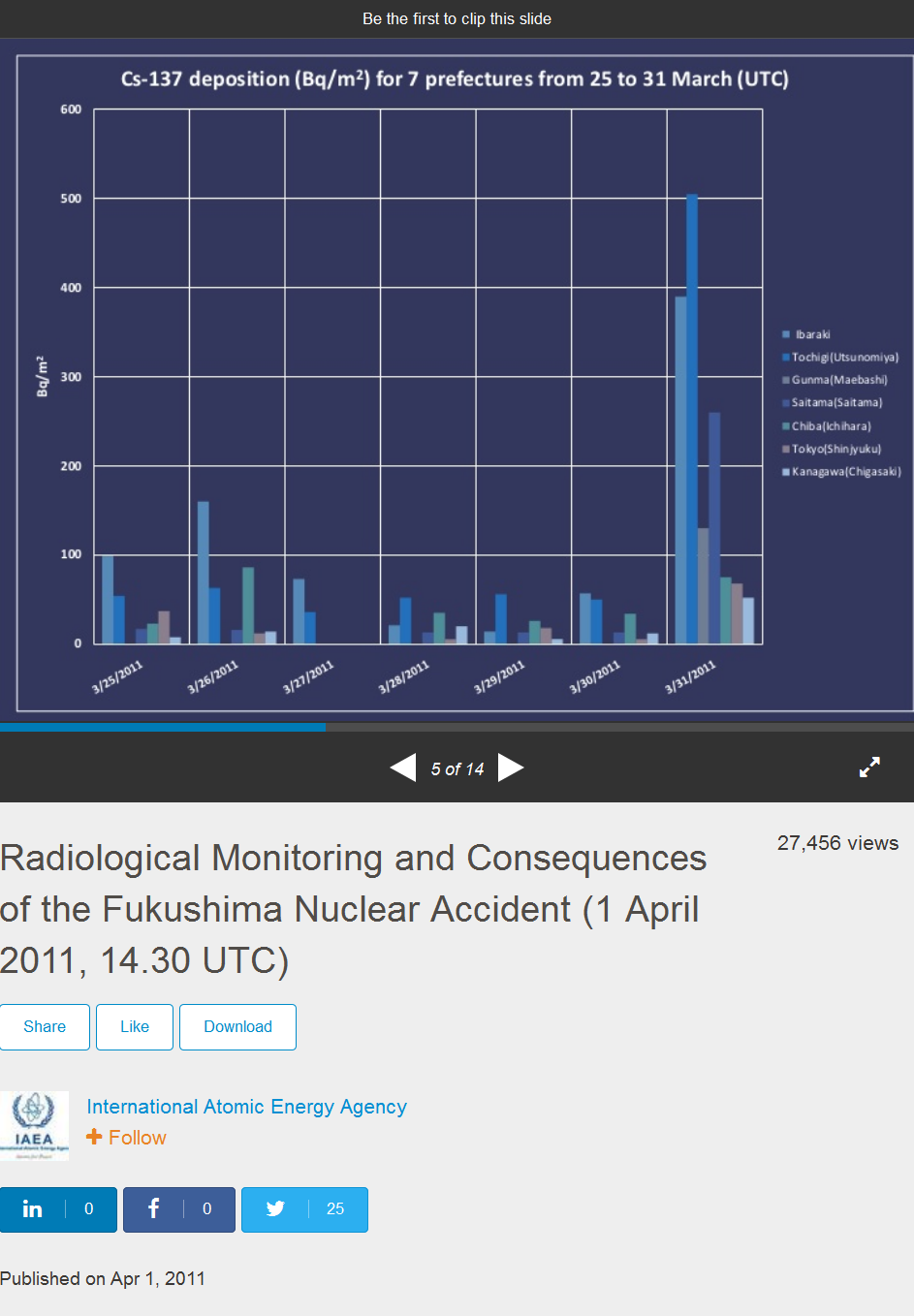
2 weeks after Fukushima the IAEA published findings of ground contamination in 7 prefectures around Fukushima.   These are shown below.

Only 1 Prefecture in Japan exceeded 400 Bq/M2 after Fukushima — Most of Hawaii now exceeds 400 Bq/M2 of Radioactive Cesium 137.

In the news report covering the release of this University study, a paid industry troll shows up and asks the authors to try to minimize the perception of danger by comparing the radiation level to “bananas”.

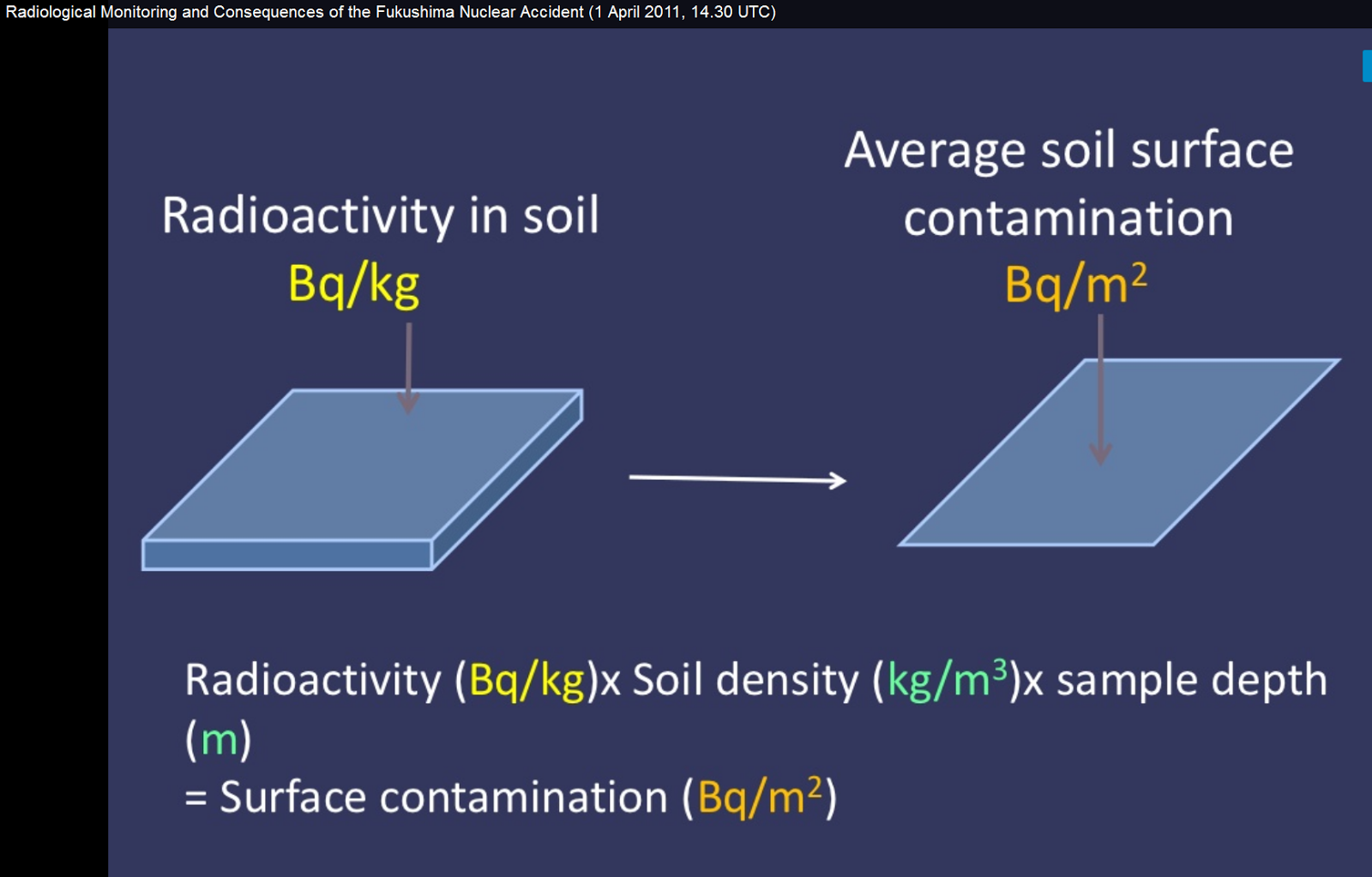
Also this paid troll, pretending to be a life long expert, doesn’t even know basics of measuring and presenting information on radiation.    Bq/M2 is simplistic as shown in this IAEA slide presentation


Then the troll gets schooled by a U of Hawaii Associate Professor……

Cesium concentrations measured in soil in Bq/kg were converted to Bq/m2 using soil bulk densities measured for each soil sample. This way it is possible to estimate the total inventory of deposited cesium per area. It is common to express these quantities in units of Bq/m2 in the scientific literature. For reference these soils samples had 2 to 3 times as much naturally occurring radioactive potassium than cesium.
Bioaccumulation was addressed by looking at mushroom cesium concentrations – you can read about it more in Trista’s thesis:http://www.soest.hawaii.edu/GG/resources/theses/McKenzie_Trista_Senior_Thesis.pdf
and details about the fish study can be found here:
http://www.soest.hawaii.edu/GG/resources/theses/Azouz_Senior_Thesis.pdf
There are no limits for soil Cs content, only for fish, so the 300 Bq/kg limit relates to fish consumption.

http://nukeprofessional.blogspot.com/2016/07/breaking-university-of-hawaii-research.html