Three days before he died, Dan Hirsch gave this presentation to the NRC.
From Committee to Bridge the Gap
On July 16, 2025, Dan Hirsch, President of Committee to Bridge the Gap, gave a presentation to the NRC about the devastating consequences that would result from abandoning the linear no-threshold model of low-dose radiation exposure. Dan urged the NRC to tighten, not weaken, radiation protection standards.
Dan’s presentation was part of NRC’s public meeting to receive public input about President Trump’s Executive Order 14300 Section 5(b), which directs the NRC to “reconsider” its use of the linear no-threshold model of low-dose radiation exposure. The linear no-threshold model has long been the bedrock of radiation protection; without it, the public could be exposed to levels of radiation 100x to 1,000x higher than is allowed today.
In 2021, Dan gave a presentation on a related topic – the long history of underestimating radiation risks – to the National Academies of Science, Engineering, and Medicine. Check out this 2021 presentation by clicking here.
Update from Mothers for Peace, May 25, 2025: PG&E has now pulled the capsule, but it will take 12-18 months to test the capsule for embrittlement.
From Mothers for Peace March 18, 2025
Diablo Canyon Nuclear Plant Unit 1’s reactor vessel was built with faulty material, so it’s vulnerable to embrittlement. An embrittled reactor vessel can shatter like glass and cause a catastrophic meltdown. Despite this, PG&E has not tested for embrittlement for over 20 years.
PG&E has now committed to removing Capsule B from Unit 1 to test for embrittlement during the upcoming April outage. Previous attempts to remove this capsule have been unsuccessful.
On March 18, 2025, Mothers for Peace sent a letter to the CEO of PG&E, Patti Poppe, setting forth its expectation that Capsule B will finally be removed during this upcoming April outage and subsequently tested for embrittlement so we will learn if it’s safe to operate.
We are compelled to send this letter because of previous failures by PG&E to test the Diablo Canyon Nuclear Plant for embrittlement. We agree with the 9th Circuit Court of Appeals when they state:
We share Petitioners’ concerns about the public health and safety implications of repeatedly postponing Capsule B’s withdrawal. It has been about two decades since PG&E withdrew and tested a surveillance capsule from the Unit 1 reactor vessel—and even longer since a surveillance capsule withdrawn from Unit 1 generated credible data. Although Unit 1’s operating license has now officially expired, the reactor continues to operate under the NRC’s “timely 10 renewal” rule because PG&E has submitted a license renewal application. San Luis Obispo Mothers for Peace, 100 F.4th at 1056–58 (citing 10 C.F.R. § 2.109(b)). Capsule B remains a key source of data for the license renewal period. Under the current schedule, PG&E is slated to remove Capsule B in the spring of 2025 and use it to inform the company’s pending license renewal application for Unit 1. Any further delay in Capsule B’s withdrawal will mean that PG&E lacks a critical data source about the future integrity of the reactor vessel, without which a future license renewal may be subject to legal challenge.
San Luis Obispo Mothers for Peace v. NRC, 2025 U.S. App. LEXIS 1104 at *10 (9th Cir.) January 17, 2025
Background: Read about the Mothers for Peace brief filed in March 2024.
Award-Winning UCLA Earthquake Scientist Files Declaration to the NRC Requesting Shutdown of Diablo Canyon.
SAN LUIS OBISPO, CA – MAY 15, 2025 – A leading earthquake expert has called for the immediate shutdown of California’s last operating nuclear power plant, warning that a proposed decision by the NRC dismissing seismic risks at Diablo Canyon is incomplete and illogical and fails to address significant evidence that seismic risks are too high to meet federal safety standards.
In a formal declaration submitted today to the Nuclear Regulatory Commission (NRC) Petition Review Board (PRB), Dr. Peter Bird, Emeritus Professor of Earth Sciences at UCLA, states that continued operation of the Diablo Canyon Power Plant (DCPP) presents “an unacceptable risk of a serious earthquake-caused accident,” and that the NRC is obligated to shut it down under its own safety guidelines.
Dr. Bird’s declaration criticized the NRC for refusing to open an enforcement proceeding sought a year ago by environmental organizations. Instead, the NRC parroted unsupported and illogical claims by PG&E that the reactors are safe to operate and ignored Dr. Bird’s strong evidence and analysis demonstrating that the risk of an earthquake-caused core damage accident at DCPP is high enough to warrant immediate shutdown under the NRC’s own guidance.
“I continue to hold the view that the risk of a serious earthquake-caused accident at DCPP is unacceptable, and that immediate shutdown is warranted under NRC’s existing guidelines,” wrote Dr. Bird, a globally recognized authority in earthquake modeling with nearly five decades of experience.
Submitted on behalf of petitioners San Luis Obispo Mothers for Peace (SLOMFP), Friends of the Earth (FoE) and the Environmental Working Group (EWG), Dr. Bird’s declaration criticized the NRC for failing to conduct a competent and independent review of “grave concerns regarding the severe risk of an earthquake-induced accident during continued operation of Diablo Canyon nuclear reactors.”
Dr. Peter Bird now serves as Professor of Geophysics and Geology, Emeritus at UCLA with 49 years of experience in seismic activity and earthquake modeling. Holding a doctorate in Geophysics from MIT, Dr. Bird is the founding architect of the Global Earthquake Activity Model (2015).
The Bird declaration to the NRC warns that PG&E’s modeling for seismic activity “assumes that a majority of large earthquakes affecting Diablo Canyon are strike-slip and disregards the significant contribution of thrust faulting earthquake sources under the Diablo Canyon site.”
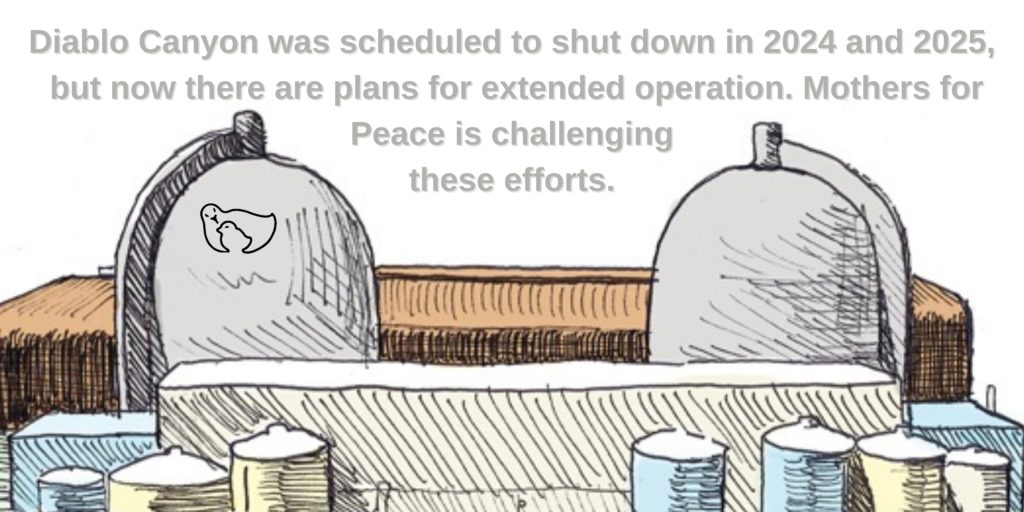
The nuclear reactors at Diablo Canyon, owned and operated by Pacific Gas & Electric (PG&E), were slated to close in 2024 and 2025 when its operating licenses were set to retire because the plants would eventually become “too expensive to operate” compared to available renewable energy resources. The “Joint Proposal” to shut Diablo Canyon, signed by environmental groups, unions, and PG&E was certified by the CA Public Utilities Commission (CPUC) in 2018. It did not address the unacceptably high risk for a seismic-induced reactor meltdown. However, the reactors’ licenses were extended after California Governor Gavin Newsom brokered a deal with PG&E, offering a $1.4 billion taxpayer-funded subsidy to keep the DCPP operational.
Hallie Templeton, an attorney for FoE, said: “Allowing Diablo Canyon to operate without a competent and independent review of the seismic risks addressed in the petition puts millions of California residents in danger and risks a major radioactive disaster, akin to Fukushima, along the California coast. PG&E can’t say they haven’t been warned.”
Diane Curran, legal counsel for SLOMFP, said: “We are very disappointed with the NRC’s proposed decision to allow DCPP to keep operating without a full review of the significant seismic risk to the reactors. It would be irrational and irresponsible for the NRC to permit PG&E to operate DCPP, especially with an aging and deteriorating Unit 1 reactor vessel, without addressing the concerns brought forward by one of the world’s top seismic experts. Listen to the science!”
Bernadette Del Chiaro, Senior Vice President, California at EWG, said: “The potential environmental and human health consequences of a major radioactive disaster along the California coast, similar to the 2011 Fukushima Daiichi incident, are simply unacceptable. It is imperative that all possible precautions are taken to ensure the structural integrity and operational safety of a nuclear facility located in an area with ‘unacceptable risk of earthquakes. The risks highlighted in the petition warrant an unbiased and expert evaluation to determine the true extent of the potential dangers to Californians. To keep Diablo open without this crucial review would place countless lives in jeopardy.”
Virtual Workshop On the nationwide programmatic Environmental Impact Statement on the expanded production of plutonium “pit” bomb cores
Learn How to Make Effective Comments at the Upcoming Public Hearings…
Speak your mind at an upcoming hearing on the government’s plan to produce up to 120 new plutonium pits per year for nuclear weapons for the next 50 years!
The workshop will feature: Talking points and suggested scoping comments Explanation of procedural process Question & answers with subject matter experts
Background: Pursuant to the National Environmental Policy Act, Nuclear Watch New Mexico, Savannah River Site Watch and Tri-Valley CAREs successfully sued the National Nuclear Security Administration (NNSA) over its failure to complete a required nationwide “programmatic environmental impact statement” (PEIS) for its most costly program ever, the expanded production of plutonium “pit” bomb cores. No future production is to maintain the safety and reliability of the existing nuclear weapons stockpile. Instead, all pit production will be for new design nuclear weapons.
To meet its enforced legal obligation, the NNSA is holding two virtual “scoping” hearings:
Tuesday, May 27, 2025: 5:00-7:30 pm EST, 4:00-6:30 pm CST,3:00-5:30 pm MST and 2:00-4:30 pm PST Meeting Link: https://bit.ly/PuPEISMtg1
Dial in by Phone: (571) 429-4592 Phone ID: 808 821 801#
AND
Wednesday, May 28, 2025: 7:00 pm-9:30 pm EST, 6:00 pm-8:30 pm CST, 5:00 pm-7:30 pm MST, and 4:00 pm-6:30 pm PST Meeting Link: https://bit.ly/PuPEISMtg2
Dial in by Phone: (571) 429-4592 Phone ID: 989 289 432#
Please comment and let’s PACK these hearings!
This is a unique opportunity to comment on core nuclear weapons issues NATIONWIDE!
San Luis Obispo Mothers for Peace, et al. v. United States Nuclear Regulatory Commission, et al.
Our attorney, Diane Curran, will be arguing before the Ninth Circuit Court of Appeals in Phoenix, AZ regarding the NRC’s denial of a hearing request for the operating license held by Pacific Gas and Electric Co. for Unit 1 of the Diablo Canyon nuclear plant.
Vistra Energy is demolishing part of the former PG&E power plant at Moss Landing in Monterey County, California, and building a large lithium-ion battery storage facility there. According to very credible reports from people that worked for PG&E and GE, GE built a breeder nuclear reactor for PG&E at Moss Landing in the late 1960s. If true, that could pose significant radioactive contamination risks to demolition workers and the surrounding environment. Demolition must be immediately halted.
The public isn’t aware that a nuclear reactor of any type exists or existed at Moss Landing, but according to sources, GE nuclear power division in San Jose designed and built a breeder reactor for PG&E at Moss Landing in 1968, and it began operation in approximately 1969. It was a very expensive reactor, and it was not for power generation. It operated until the mid to late 1970s when it was shut down for unknown reasons. The control room, and possibly the reactor itself, were underneath the #6 or #7 535-foot smoke stacks. There was an access stairwell to the underground reactor control room, with a metal railing surround. After the reactor was shut down, the control room access was still visible.
A former worker at Moss Landing witnessed small planes periodically flying through the steam of the smoke stacks, presumably taking air samples. That person was told the smoke stack emissions were only steam, but any reactor emissions might have been vented out the tall stacks.
When a person who helped build the reactor later went to work for PG&E in the 1980s and inquired about the reactor and how it was functioning, PG&E employees told the person, “It doesn’t exist,” and “Shut the f*** up or you’re finding a new job”. That next weekend, PG&E filled in the access stairwell with concrete and cut off the metal railing at ground level.
One former employee went to Monterey County Planning Department to research if permits had been issued for the reactor and didn’t find any record of permits. In response to FOIA requests, the NRC also did not find any responsive records on the reactor, meaning they have no records or they have no records they will disclose to the public.
A breeder reactor is for the purpose of making plutonium for the military and for nuclear bombs. PG&E and GE operated a breeder reactor together at Vallecitos beginning in 1957. This type of reactor does not produce energy. One source suggested the Moss Landing reactor was to make off-the-books plutonium.
If the reactor existed, it was operated by PG&E at the same time as the company was operating the Humboldt Bay Nuclear Power Plant, called by Science Magazine “the dirtiest of the nation’s power reactors” [1]. It would have had the same safety problems, the same lack of AEC/NRC oversight, and potentially the same high radioactive emissions and contamination to the surrounding area. The area around the power plant and underground, including any control room and ground water, may be highly polluted with radioactive elements including hot particles and plutonium, considered by experts to be the deadliest of poisons, with no safe level of ingestion or inhalation. Contamination would pose hazards to local residents, to the waterways and ocean, to groundwater, to agricultural products, and to workers on the site.
State, federal, and local authorities have been notified of the situation including NRC, DOE, CDC ATSDR, California DTSC, CalEPA, CDPH, Monterey County EHIB, and the Monterey County Board of Supervisors, but to date, they have taken no known steps to investigate the situation or have refused to do so. Nuclear and environmental experts, civic groups, non-profit organizations, and other resources have also been informed about this situation,
Meanwhile, Vistra Energy continues demolishing equipment and buildings at the site.
Action steps needed now:
— Demolition work at Moss Landing by Vistra and other companies must be halted immediately due to the danger to workers and the surrounding environment from possible contaminated equipment and buried radioactive materials, pending an investigation.
— A thorough and public investigation must take place immediately into the complete history of PG&E’s uses and facilities at Moss Landing and the existence and extent of any radioactive contamination there.
— Removal and remediation of any and all contaminated soils and machinery, including excavation, must be undertaken by licensed professionals with full transparency. And any soil and debris already removed must be tracked and dump sites notified of its possible contamination.
— If radioactive gases were vented through the smoke stacks, their level of radioactive contamination must be assessed.
— The risk of fire and explosion of the lithium-ion batteries onsite adds another element of risk to any onsite radioactive contamination and potential dispersal offsite. This may necessitate the shut-down of the battery energy storage facilities until an investigation is completed.
San Luis Obispo, CA, October 4, 2023 — San Luis Obispo Mothers for Peace (MFP) and Friends of the Earth (FoE) today deplored a decision of the Commissioners of the Nuclear Regulatory Commission (NRC) for demonstrating a complete lack of concern for the safety and security of the people living near the Diablo Canyon Nuclear Power Plant.
Disregarding expert evidence presented by MFP and FoE that the Diablo Canyon Unit 1 pressure vessel is at risk of dangerous embrittlement due to decades of neglect by Pacific Gas and Electric Co. (PG&E) and lax oversight by the NRC technical staff, the Commissioners refused to grant the groups’ hearing request or to order the immediate shutdown of the reactor for comprehensive testing of the reactor vessel’s condition.
Instead, the Commissioners bucked the groups’ shutdown request back to the agency’s technical staff to consider whether to take enforcement action against PG&E.
“We are appalled that the Commissioners are entrusting this important safety review to the same agency staff who for fifteen years has given PG&E repeated extensions of deadlines for essential tests and inspections,” said Diane Curran, attorney for MFP. Curran noted that the groups had intentionally petitioned the Commissioners, as the highest officers of the NRC, to exercise their legal responsibility for oversight of the technical staff.
Nevertheless, the groups vowed to persevere. Hallie Templeton, Legal Director for FoE, said, “We plan to continue our rigorous watchdogging of PG&E and the NRC.” She added, “The Commissioners’ decision has raised a red flag to all of us. Anyone, including California politicians, who thinks the safety of Diablo Canyon can be entrusted to the federal government unquestioningly has just received a big wakeup call.”
Linda Seeley, spokesperson for MFP, renewed the group’s call to the State of California to “go back to the original plan to close Diablo Canyon when it reaches its 40-year operating license limit in 2024 (Unit 1) and 2025 (Unit 2). Enough is enough.”
Hybrid meetings with public comment in Illinois, Texas, Pennsylvania, and Georgia.
Press Release from the Nuclear Regulatory Commission
Docket ID NRC-2018-0296
March 14, 2023 CONTACT: Scott Burnell, 301-415-8200
NRC Seeks Comment on Proposed Revision to Generic Environmental Impact Statement for Renewing Reactor Licenses
The Nuclear Regulatory Commission will hold four additional hybrid meetings around the country as the agency seeks comment on a proposed rule to update the agency’s license renewal Generic Environmental Impact Statement.
The meetings will be accessible via Microsoft Teams. Those interested in attending online should register ahead of time by clicking on the webinar link in the meeting notices below. The meetings will be from 6-8 p.m. local time at each location, and the staff will host a 30-minute open house prior to each meeting.
The meetings will be: March 28 at the Marriott Chicago Naperville, 1801 N. Naperville Blvd. in Naperville, Illinois; March 30 at the Marriott Dallas/Fort Worth Westlake, 1301 Solana Blvd., Building 3, in Westlake, Texas; April 4 at the Alloy King of Prussia, 301 West DeKalb Pike in King of Prussia, Pennsylvania; and April 6 at the Courtyard by Marriott Atlanta Decatur Downtown/Emory, 130 Clairemont Ave. in Decatur, Georgia.
The proposed rule is in response to a 2022 Commission order that concluded the license renewal GEIS did not analyze the environmental impacts of a subsequent license renewal term (from 60 to 80 years of operation). The proposed rule amends the relevant rule language to account for initial license renewal and one term of subsequent license renewal, redefines the number and scope of the environmental issues that must be addressed during the review of each application for license renewal, and updates related guidance to fully address subsequent renewal.
The GEIS covers environmental topics relevant to all nuclear power plant operators seeking renewed licenses. The document accounts for new or revised environmental impacts, changes in regulations or guidance, and applies what the agency has learned during previous license renewals.
The public meetings are one method for submitting comments before the May 2 deadline. Staff will consider the comments before finalizing the rule and GEIS for Commission consideration.
Comments can also be submitted via regulations.gov under Docket ID NRC-2018-0296, via email to Rulemaking.Comments@nrc.gov,
or via mail to Secretary, U.S. Nuclear Regulatory Commission, Washington, DC 20555-0001, ATTN: Rulemaking and Adjudications Staff.
Scott Rainsford, a former US Coast Guard member, discovered a serious nuclear incident at the PG&E owned nuclear power plant in Humboldt California. This was the first commercial power plant in California and according to Rainsford this incident and release of radioactive material was covered up by PG&E and the US government.
Additional references following transcript.
UNOFFICIAL TRANSCRIPT (based on auto-transcript)
Dec 12, 2020
Steve: This is Steve Zeltzer with Work Week and I’m speaking with Scott Rainsford. And Scott is formerly in the coast guard and safety expert. And he has some information he wanted to talk to us about this morning in relationship to Humboldt nuclear power plant. And that was PG&E’s first nuclear power plant, the first one as a matter of fact in California, and it had some issues which we’ve gone into in the past with Bob Rowan who was a PG&E health and safety inspector at the plant. And he had some issues and he was retaliated against.
And Scott has done some videos and documentaries about what was going on at that plant. So, welcome to Work Week, Scott.
Scott: Well thank you
Steve: So Scott, you were in the Coast Guard in 1978. Why don’t you talk about how you came to become involved with the Humboldt nuclear power plant?
Scott: Prior to coming up to Humboldt County, I was a marine science technician in active duty Coast Guard. And I operated several laboratories on board a high endurance cutter in the coast guard for a number of years. So there was a fair amount of scientific background. So when I came up here to go to Humboldt State University majoring in oceanography and geology — the Coast Guard Reserve up here is mostly a search and rescue port security facility with small boats and helicopter station – they didn’t exactly know what to do with my expertise. So my commanding officer in the Coast Guard Reserve which I transferred from active duty into the reserve, earned a little extra money for my college studies, decided that, “Hey you understand wind and weather tides and currents. Why don’t you visit the major facilities in the area and see if you can update their contingency plan?”
So a meeting was arranged where I went to the reactor, PG&E’s nuclear reactor unit 3, and reviewed what their contingency plan was.
So in late 1977, winter of ’77 – ’78, I went to the reactor. I sat down, I read their contingency plan, and then I asked if they ever had a chance to use it, because I wanted to see how well it had worked.
They brought me out a report marked “confidential” which was written by a man named Shiffer. Now this report was a nuclear operator’s log.
When a reactor is operating,there’s someone in charge called a nuclear operator and he keeps a log with a time annotation and then what happens in every major occurrence during his watch.
Now the operator’s log that I was presented with described an accident that occurred on July 17 1970. And this log was that I was provided was only, say, three pages long or so, typewritten double-spaced, almost triple-spaced, and it describes the following:
There was a loss of outside power. And the reactor at the time was operating at full power which was about 65 megawatts of power. The reactor pressure was 1104 psi. The coolant temperature was 560 degrees Fahrenheit.
And all of a sudden when they lost power, the feed water pumps shut down, which means that there is a loss of coolant and the safety systems started failing one after another after another – a cavalcade of failures and he didn’t, he did not understand why this was happening.
Now July 17, 1970, was a Friday. It also happened to be a training day at the reactor. So there were an excess of trained qualified people there. Listed as the operating, nuclear operator was a man named Leach and while he was operating the reactor, Mr. Shiffer, who was not only a senior nuclear operator, licensed but he was also a licensed nuclear engineer, he was one of PG&E’s best and brightest, Stanford University, chemically-trained, also trained at Vallacito’s research reactor down in the San Francisco East Bay area. So he was highly qualified.
So when this accident started, he took command of the reactor from Mr. Leach, and he started directing people to try and figure out why everything was failing. And things were progressing so fast that he had a hard time keeping up
So a number of electrical monitoring systems had failed, and probably the two most important were a device that keeps a log of the coolant level in the reactor, and another piece of important equipment would be the main pressure sensor which also failed.
So this is what is supposed to happen: when you lose outside power, as I mentioned, the feed water pumpshut down. What happens when that occurs is the reactor is producing a large amount of heat, and without the heat being able to be discharged through the normal power- producing process through a heat exchanger, the heat builds up very fast in the reactor and boils the liquid coolant in the reactor, which causes the pressure to jump very fast.
So what was supposed to happen was in that occurrence, there is a vital piece of equipment called an isolation condenser. Some people call it an emergency condenser, because that’s the primary function of this device. And what it does is it takes this high pressure steam coming from the reactor that’s out of specification, and runs this radioactive steam through this condenser. It’s a large vat partially filled with water with baffles that the steam goes through. The steam is cooled down, condensed back into water, cooling quality water, and that put back into the reactor to keep the core covered. It failed because a condensate return valve failed open. Later the investigation revealed that a gate in that valve had been installed backwards. So without that device in operation, they could not control the pressure in the reactor vessel without losing coolant water that was not being replaced.
One of the backups is pressure relief valves. There were several of them. Each valve that opened releases steam from the reactor at the rate of 400,000 pounds per hour, which equates to 800 gallons per minute. And that steam, the radioactive steam, is piped into a device called a taurus, or pressure suppression pool. It’s a donut-shaped device that’s shown in my video, and it deposits that steam, that radioactive steam, into that container.
So without the emergency condensor functioning, the reactor is losing coolant water in the form of steam at a remarkable rate.
So Mr. Shiffer, who had taken command, figured that he better shut this down, otherwise he’s going to uncover the core, which did happen. And we know that there’s several ways to determine that the core was uncovered. But when he shut these pressure relief valves down, several pipes in the reactor started bursting. For example, a inch-and-a-half in diameter high-strength stainless steel pipe going from the reactor for the purposes of instrumentation came out, that goes out from the reactor into the dry well, there was a four -and-a-half inch rupture in that pipe.
There was a baffle, stainless steel baffle, also in that system, that was affected by the pressure, which also ruptured.
So the plant is starting to come apart. There was, according to witness reports, abstract (abject) panic in the control room.
The control room when they lost power, every emergency indicator alarm sounded. The control room was on battery power, but the batteries did not provide power to much else in the facility. They were mostly to power the control room indicators.
So what’s supposed to happen is whenever the reactor is operating, the one of the other two petroleum-based units, generators, must be working for the sole reason that in case of an emergency, they could supply emergency outside power to the reactor. That unit number two was in operation. The circuit that goes, the emergency circuit that goes from unit two to the reactor unit three failed, because a maintenance crew several months before had left an electrical cable disconnected in the switch yard, and they didn’t know it.
So that backup system failed.
So eventually it came down to a propane generator which worked, did work according to specification, but it only supplied enough power for some of the emergency instruments and enough power to scram the reactor, which means the control rods were inserted all the way into the reactor.
But there’s still a large amount of heat being produced. It’s not a light switch shut off.
So Mr. Shiffer, faced with this loss of outside power, which by the way was caused by another maintenance crew going to a substation called Mitchell Heights, which is oh perhaps four or five miles away, as the crow flies. And at 9:21, this maintenance person was going to do some maintenance on a high tension line, high voltage line at that substation. The maintenance worker failed to verify that this 60,000 volt line was dead, when in actuality, it was live. He tried to open an oil circuit breaker, which is the most competent circuit breaker, before working on that line. He couldn’t operate it, because in the mechanism on the previous day, another maintenance crew had left a block of wood in that mechanism, preventing this next day the maintenance worker from using the oil circuit breaker. So this maintenance person opened an air circuit breaker which is not competent to handle the transient of an operating hot 60,000 volt line. It melted. There was a fireball. That’s what caused the power outage at the reactor. That’s what was delivering the voltage to the nuclear unit.
Faced with all these failing systems, with the situation where you had the the reactor coming apart, ruptured pipes, ruptured stainless steel baffles, rapid loss of coolant to the reactor in the form of steam, Mr Shiffer started calling for help
And I’m reading this at the reactor during this visit.
And his first call was to Vallecitos research reactor where he was trained. And he said, “We’ve got this situation. What do we do?” And I’m condensing this, of course.
And they didn’t know. They referred him to research facilities and in the midwest near Chicago also near, the Dresden facility, a nuclear complex 30 miles outside of Chicago
He asked them, “We’ve got this situation. What do I do?” They did not have an answer.
They recommended that he call the military.
So being in the military, I knew that the experts in the field of nuclear power at that time were the Navy. And indeed many of the nuclear operators at reactors throughout the country were prior Navy nuclear operators. And the experts in the Navy are in Idaho at Bettis Naval Research Center, 30 miles west of Idaho Falls.
So he contacted them. He got a plan, and the report that I was reading, that I held in my hand, did not spell out what this plan was, but it just said that they delivered a plan.
So Mr. Shiffer called Vallecito’s research reactor again and said, “This is what the Navy has recommended I do. “
And Vallecitos said, “You better get permission from the home office at 245 Market Street in San Francisco to proceed with that plan,” because they were very concerned about what this plan entailed.
So Shiffer did that. He called the home office, told them what the plan was, and asked if he had permission to proceed. And in this report, the response from home office said, and I’ve got almost the exact wording, it said, “Do what the military says.”
So after that, in this report, there were a number of readings in the form of numbers, and the first one to my memory was 1220.
It was not labeled, but it could only be one of two things, both with the same result.
One was the pressure.
Now as I said before, the main pressure sensor in the reactor was down because it was on outside power which failed, and it was not supplied emergency power from the propane generator. But they did have a pressure sensor by the turbine board which measures pressure at the turbine in an area away from the reactor. So they were taking pressure readings from this turbine board, and it showed the pressures substantially out of specifications — too high — and which means, it indicated that the emergency condenser had failed.
Also, the other use or potential reading that the 1220 indicates, that’s what the setting was for the pressure relief valves to open. And if the pressure relief valves opened at 1220 psi, that means that the emergency condenser, the isolation condenser, had failed.
So it both indicated the same thing.
So following that was approximately a dozen other readings. Most of them were labeled, and I cannot remember all of them, but immediately after those readings on this report that I held in my hand, Mr. Shiffer called the Humboldt County sheriff’s department activating the contingency plan, which obviously is the reason that they presented this paperwork to me for that day.
So when the contingency plan is activated, it’s only done in an extreme emergency.
There is a legally mandated amount of monitoring must happen to establish the level of radiation released and where it went.
So I asked to see the result of that monitoring, and my request was denied.
So at that point I was probably white as a ghost, and I was not able to take a copy of that nuclear operator’s log because it was marked “confidential”.
So I went back to my Coast Guard unit to report what I had seen to my commanding officer, and as I showed in my video, there were a line ofpeople at the reserve unit that said, “We know. We know. The Coast Guard District will handle it.”
And I protested. I said, “No. This is serious.”
And they said, “We know. The Coast Guard 12th District will handle this. Drop it.”
So I did. So as years went by, I befriended a number of people in the community, and a lot of people that that I knew were coming down with cancer and dying.
And I asked them you know, “Where did you grow up? Where do you live? Where did you go to school?” And a lot of them said, “I grew up by the nuclear power plant.””I went to South Bay Elementary School.”
Now for those that do not know, South Bay Elementary School is just a few hundred yards downwind from the reactor. I say downwind, because it was the prevailing wind pattern during most of the year. So whatever comes out of that reactor goes towards the South Bay Elementary School.
PG&E operated 36 monitoring stations throughout the region. The furthest north is by Humboldt State University about 10 miles away to the north. The furthest south is towards a town called Fortuna. And seven of those 36 monitoring stations have constant air monitors that also revealed the amount of particulates in the air.
And that was one of Bob Rowen’s primary duties was to collect the results of those monitoring stations.
One of the things that got him in trouble was he noticed that one of the seven air monitors was at South Bay Elementary School, and it had been taken down. And he said that he thought it was crazy to reduce the amount of monitoring at that elementary school. And he protested that, and that got him in trouble. And he did not understand why the single most important monitoring station of all the 36 would be reduced.
So I went to that school in later years and looked at what was there and briefed the superintendent — I believe his name was Paul Meyer; Imight be an error, this was years ago. And briefed them that there had been an accident and if he had been informed of this accident.
He said, “No, but I’m on the citizens advisory board or community advisory board – CAB — and I’ll ask PG&E.” So I never did hear another response from him.
So there was an investigation by the Atomic Energy Commission.
What eventually happened, according to records, was they were able to deliver outside power to the reactor from unit two. They found the disconnected cable and delivered power. The feed water pumps came back on. The reactor had returned to normal. Supposedly at the end of what this report said was “no big deal”. However, I found that there was some major inconsistencies and deceptions in this report.
Years later I tried through the process of FOIA’s Freedom of Information Act, to get more information on this incident, and I was thwarted every time.
I went through the university, Humboldt State University journalism department to help compose a FOIA, and they assigned a journalism student to help deliver this FOIA. It was good practice for him as well. And we received about a hundred pages of description of this accident in which you could only read a handful of pages. They were not redacted; they were just so out of focus, there was no possibility of reading what had been delivered.
So I called the Nuclear Regulatory Commission and asked for a redo, and they said, Well, you can file another FOIA, but you need to be aware that there are six or seven reasons that we can deny you this information. And they sent me a letter confirming what they had said.
So that’s just one example of several FOIAs that I later attempted.
So I’m going to take a break here, okay, Steve?
Steve: Okay, we’ve been speaking with Scott Rainsford, and he was with the coast guard and he discovered a nuclear accident at the Humboldt nuclear plant run by PG&E.
Now, Scott, you’ve been talking about the accident that took place and the fact that it was covered up, it was kept secret by PG&E and by the government. And you’ve come forward with this information about it, and you’re concerned that people were actually contaminated as a result of the release during that incident, that accident.
Why has this been kept covered up? And don’t you think that the people of Humboldt, the people of California deserve to know what happened at the Humboldt plant during this accident and shut down
Scott: Very much so. I discovered that through my own research and investigation that the nuclear core, the fuel core, had been uncovered. During this event, a greater reason why Shiffer shut off the pressure relief valves is he discovered that, through all these readings that the military required him to get, that they had uncovered the core.
Now when the core gets uncovered, the fuel cladding that PG&E had installed after the original failed stainless steel cladding fuel rods from before, that Bob Rowen was so concerned with because they immediately started cracking and failing and caused the plant to be recognized as the dirtiest plant in the country at the time, and you’ll see that in a report in Science magazine, June 18, 1971, an article written by Gillette.
So PG&E replaced the stainless steel fuel cladding fuel rods with a much more competent zircaloy-clad fuel rod. That is a much more expensive fuel rod and that’s what the military uses, because under normal operation, those fuel rods are much more competent.
However, they have a flaw, and that’s flaw is in the loss of coolant accident, in other words uncovering the core, the core is, as the liquid water falls below the level of the fuel rods, the fuel rods are now bathed in high temperature steam. Steamcannot cool a fissioning fuel rod. They overheat, and at a certain temperature, a chemical reaction occurs. It’s an exothermic redux reaction, for you chemists out there. And so they create their own heat, adding to the problem. The chemical reaction produces ZrO2. In other words, the zirconium is oxidized, and it produces hydrogen gas at an extremely fast rate. Empirically, under empirical conditions, hydrogen gas is explosive at 18 per cent by volume in an oxygenated environment. Under reactor conditions, it has been found that it’s explosive at roughly 14 per cent by volume. So it happens fast.
So when they uncovered the core, and the pressure relief valves were opened, hydrogen gas and this steam and the breakdown of the zircaloy- clad fuel rods which crack and blister under those conditions, all that volume of gas was going into the pressure suppression pool, otherwise known as a taurus. If that concentration goes up to 14 per cent, it’s gonna explode. That’s what caused Fukushima reactors to explode. The same thing. The fuel at Fukushima was uncovered. It was a high temperature steam environment. The chemical reaction occurred. It produced a large amount of hydrogen gas. It built up to 14 to 18 percent, and exploded. You can see it on the internet.
So that’s another reason why Shiffer shut off those pressure relief valves.
So what do you do with this pressure, that’s building up that’s causing the reactor to come apart?
They had to get rid of the pressure and this hydrogen gas.
So, they could release it to the environment, but they didn’t want to do that because it was extremely contaminated because of the breakdown of the fuel rods. When the fuel rods break down with the cracks and blisters, it gives direct access of the environment to those fuel pellets inside the fuel rod. So it’s heavily contaminated.
So what they decided to do, and what’s in this report of the accident, is they created a pathway from the reactor into the refueling building.
Now before they did this, they sent an emergency evacuation alarm to the refueling building to get everyone out, because people worked there. And so they sent the alarm electronically originally, but they weren’t sure in electrical chaos that it had worked. So they sent a man named Leroy Marsh who was trained to be and get a license for an assistant control operator. They sent him into the reactor with a half respirator and a device called a cutie pie which is a radiation monitoring device.
He enters the building. There’s no alarm, emergency evacuation alarm, on the outside of the building but there is on the inside. So he goes inside, and he observes a number of things.
One, and this is all in his testimony by the way in the investigative report, he goes in the building and he verifies that everyone was out, but the emergency evacuation alarm was not sounding.
Also he verified that the constant air monitor that monitors radiation levels inside the refueling building was not working.
He also verified that the fans that were used to create a negative pressure system in the refueling building were not working because they were on outside power which had failed.
So to explain to the listeners what this negative pressure system is for: under normal operation, powerful fans take the air inside the refueling building and send it through the gaseous waste stack. Some people would say it’s a smoke stack, but that’s where radioactive gases at a normal level under normal operation, that’s how it escapes. It’s like their smokestack to the factory. And that’s regulated. And in the process of going up that gaseous waste stack, there is charcoal filtration system. The fans push the air from the refueling building through these charcoal filtration systems, and this is an attempt to reduce any radioactive particles that are emitted from the plant.
So with that system down, the pressure inside the refueling building would rapidly equalize with the pressure outside the building.
So when they decided to dump the reactor pressure and the building-up of the hydrogen gas from the reactor during this accident into the refueling building, it increases the pressure inside the refueling building, so it’s gonna tend to leak.
Now normally when you go into the refueling building, there’s a double set of doors. There’s a room where people can change into protective clothing after they go through a door, a usual metal door similar to a naval ship, and then they go, after they’ve changed, they go through another door to get into the refueling building. So there’s a layer of protection there.
But there’s also a large set of doors big enough to allow a railroad train car to come in, because usually once a year, a railroad, a special railroad car comes to the reactor to pick up spent fuel pool that needs to be reprocessed. So a powerful crane picks up this large container from the railroad car and lifts it, and this container is submerged where the spent fuel rods are, the rods are transferred, and then the transfer cask is re-attached to the railroad car, and off it goes to reprocessing. And so there’s very, very large doors to do that. So this hydrogen gas can leak there also.
Steve: And we’re again speaking with Scott Rainsford. Now Scott, one of the issues that you’ve addressed is that there are rising sea levels which may threaten the radioactive material that’s still on the Humboldt site and also these canisters of radioactive material. Do you have any concerns about these decommissioned nuclear plants now, today, and not only in Humboldt but also San Luis Obispo and Diablo Canyon, San Onofre and Diablo Canyon when it becomes decommissioned .
Scott: On August 26th of last year, 2019, there was a Nuclear Regulatory Commission meeting in Eureka, California. I spoke at that meeting. A number of people spoke at the meeting. The purpose of the meeting was to get a collection of people who were citizens or community advisory board members to pass on to these other reactors who were being, that were being decommissioned, the best practices, to relay information to the community and give PG&E feedback from the community about what the community wanted.
One of the speakers, and it’s on videotape that you can get, was an expert in sea level rise of California. The name escaped me at the moment. But this PhD level person got up and said that sea level rise is happening twice as fast in northern California as elsewhere, and that is because this is a subduction zone, a geological subduction zone. So this area along the coast is sinking about the same rate the sea level rise is rising. So this expert said that in so many years where the six casks, where high-level special nuclear material is contained will be an island in so many years.
Hold on, I’m getting a dry throat here.
Steve: That’s okay.
Scott: So at that meeting, I said, we were only allowed so many minutes, I relayed what happened here: six casks, each one weighing 85 tons,and they’re created, the casks are made by a company called Holtec. Five of the six carry special nuclear material, meaning the spent fuel which are deadly poisonous. They’re very hot. They’re very radioactive. They have, they will be that way for generations. And the sixth cask holds the high-level remnants of the reactor, and since they were larger than the fuel rods — the five casks holding the fuel rods have two lids: a welded steel lid stainless steel and then a concrete lid. The sixth cask here in Humboldt County only has one lid. It has a concrete lid, but the steel welded cap is not there because of the size of the reactor remnants. So that is a big concern.
It’s in a tsunami zone. It’s being threatened by bluff erosion. There’s only, like, 115 feet of bluff remaining where those Holtec casks are placed. That bluff has receded 1480 feet from, I believe, it was 18, well, in 60 years it receded 1480 feet. So basically it was like being 20 and 30 feet per year.
So the point was that those casks cannot stay there. And a man named Steve Madrone who is Fifth District Supervisor of our county spoke about that in that presentation on August 26, 2019, saying that it’s ridiculous to have those casks stored there.
People bad-mouthed Fukushima because they did not build a protective wall high enough to fight off a tsunami that was expected to overrun their protective wall. You know, how could they be so negligent? Here we’ve got these Holtec casks, 500 times worth, in a tsunami zone, on an earthquake fault, with the receding bluff. And the situation is getting just nothing but worse.
It’s insanity. So one member of the audience called it, these casks, Chernobyl in a can.
So it’s ridiculous. When I was at that reactor reading the nuclear operators’ log in the winter of 1977-78 ,and I saw this accident had occurred, I asked to see the results of the monitoring, and that request was denied.
So I looked at the investigation that the AEC had conducted which I eventually was able to get through the Union of Concerned Scientists. It’s about a 160-page report, and in that report it says on page 38 that, and you’ll see in my video that the first yellow highlighted section was a statement by Edward Weeks, the plant engineer of the nuclear reactor Unit Number Three. And he said that radiation was being released subsequent to this accident at the rate of 24,500 micro curies per second, which was below the allowed level legally at the time. However, there were spikes in this gaseous waste stack monitoring systems. They said about a decade in size, which means by a factor of 10, which would place the readings of quarter of a million microcuries per second coming out of the gaseous waste stack to the public.
Ed Weeks said that he believed that was just due to electrical transients because of the electrical problems in the reactor during this accident. I reject that explanation because it’s the examination of the inspectors of AEC found that the devices which measure radiation escaping from that gaseous waste stack were on emergency power provided by the propane generator, but the fans necessary to pull the sample through those devices were on outside power and when they lost outside powers, the fans stopped.So the fan blades would create a barrier of the sample to go into these monitoring machines. So I believe that the transient readings of a quarter of a million microcuries per second going up that stack were real, and that level is many times the allowed limit.
Now what people need to understand is after this investigation was done, the results of the investigation were presented to United States Congress Congressional Committee called the Joint Committee on Atomic Energy, a committee that was established in 1946 and existed until it was abolished in 1977 by the United States Supreme Court because this committee had powers that no committee in the history of this nation before, during, or after today
had ever had. They had veto power over any law that was provided or presented in the remainder of Congress, and the only check and balance they had was they were supposed to review any decision they made to the President of the United States. In 1970, that was
President Nixon, and you see in my video that the chairman of that committee was a man named Chester Hollyfield, nicknamed Chet Hollyfield, a Democrat federal representative from Southern California. The vice chair was John O. Pastore, a U.S. senator from Rhode Island. The committee had 18 members – nine senators and nine federal state representatives.
So they made a decision very clear to cover up what happened at this accident, and the documents clearly show that there was a cover-up. It was a very, very bad cover-up.
So all of it can be demonstrated. So the problem is, you lie for a reason. I believe that reason is the community was heavily contaminated.
Mike Manetas, a college professor at Humboldt State University, was asked to try and figure out why there was a big cancer outbreak in the town of Ferndale which is downwind of the plant. That was in 1985. And they found that there was a latency period between certain levels of ionized radiation exposure and the development of cancer, and it was determined to be 15 to 25 years. So if there was a big outbreak in Ferndale, California, in 1985 and 1990, if you add 15 to 25 years to this accident in 1970, you come up with 1985 to 1990.
So the powers that be in this industry withheld from me when I was at the reactor reading this nuclear operator’s log, they denied the monitoring results, the information providing the monitoring results. I’m convinced that they’re denying the level of the radiation exposure to the community.
Steve: I want to thank you for talking about this issue of health and safety, the unknown shutdown and dangerous accident at the Humboldt nuclear power plant run by PG&E and the coming dangers of rising tide and the possibility of further contamination and the lack of real protection of nuclear facilities on the coast of California, not just at Humboldt nuclear power plant which has been decommissioned, but San Onofre nuclear power plant and Diablo canyon nuclear power plant which will also be decommissioned.
CALIFORNIA GROUPS TO PG&E: YOU CAN’T CUT CORNERS ON DIABLO CANYON EXTENSION
Following Successful Petition For NRC To Deny Request to Resume Diablo Canyon Renewal Application, Environmental Groups File New Response Asserting PG&E Request for Exemption to Operate Past 40-Year Lifespan Must be Denied.
SAN LUIS OBISPO, CA – FEBRUARY 13, 2023 – On January 24, the U.S. Nuclear Regulatory Commission (NRC) denied a formal request by Pacific Gas & Electric (PG&E) to resume reviewing a 2009 license renewal application to extend the operating life of Diablo Canyon’s twin nuclear reactors, which the company withdrew in 2018. In conjunction, Petitioners San Luis Obispo Mothers for Peace (SLOMFP), Friends of the Earth (FoE), and the Environmental Working Group (EWG) today filed a new petition demanding that the NRC finish its legal obligation to keep Diablo Canyon on schedule to close its twin units in 2024 and 2025 and repudiate PG&E’s recent request for exemption from the “Timely Renewal Rule.”
According to the petitioners, PG&E has no lawful path to continued uninterrupted operation of the Diablo Canyon nuclear reactors after its operating licenses expire in November 2024 (Unit 1) and August 2025 (Unit 2). Granting an exemption from this rule would force the NRC to cram the three-year safety and environmental review process and offer a public hearing into a mere ten months. The catalog of issues the NRC staff must review is so extensive that to cram a complex government review into the short ten-month period between the submission of the license renewal application and the expiration of the Unit 1 license would be difficult if not impossible. Completion of the NRC’s review process, including public hearings, is essential to assure that continued operation of the reactors will be safe for the public and the environment.
Diane Curran, legal counsel for Mothers for Peace, said: “There is absolutely no precedent for the exemption requested by PG&E. The NRC has never allowed a reactor to operate past its license expiration dates without thoroughly assessing the safety and environmental risks. And it must do so in this case too.”
Further, Curran observed that “it would be irrational and irresponsible for the NRC to permit PG&E to operate aging and deteriorating reactors encumbered by aging equipment risks, seismic risks and environmental impacts without a thorough environmental and safety review.”
“NRC’s recent decision to reject PG&E’s request to renew its outdated, withdrawn license renewal application gave us hope that the law is being properly and thoroughly applied to this risky decision,” said Hallie Templeton, Legal Director for Friends of the Earth. “An operating permit extension for any nuclear power plant has major implications for people and the planet. With Diablo Canyon receiving only minimal – if any – safety updates in decades, PG&E’s push to reduce the NRC’s review from several years to several months creates an especially deadly equation. Today’s filing clearly outlines why NRC must proceed with the utmost care and caution, as mandated by a federal law.”
Caroline Leary, an attorney for EWG, said: “PG&E argued to the NRC that its request for an exemption from federal regulations was necessitated by the California Legislature’s vote in favor of extending Diablo’s operation. But nothing in S.B. 846, the law passed by the Legislature, calls upon NRC to relax its safety or environmental regulations for the purpose of extending Diablo Canyon’s operation. In fact, the law relies on the NRC to ensure that if Diablo Canyon continues to operate, it will not put the public or the environment at risk.”
Just as the NRC stood its ground and upheld its own policies by denying PG&E’s request to resurrect its 2009 license renewal application, it should also deny PG&E’s request for an exemption of the timely renewal rule.
The NRC’s January 24 decision [1] affirmed recent arguments in the earlier petition by San Luis Obispo Mothers for Peace (SLOMFP), Friends of the Earth (FoE), and Environmental Working Group (EWG) that resuming review of PG&E’s withdrawn license renewal application would be unlawful. The organizations demanded successfully that the NRC deny PG&E’s October 31, 2022, request to resume review of the application.
The decision prevents PG&E from circumnavigating NRC regulations that require the company to file a new and up-to-date license renewal application, which would take 3-5 years. PG&E previously admitted that the application was severely outdated and could not be updated or completed until late 2023 – a year before the Unit 1 license term expires. It now appears that PG&E may have to close Diablo Canyon when its licenses expire in the fall 2024 (Unit 1) and spring 2025 (Unit 2) and keep them closed unless and until the NRC approves a new license renewal application.



 Heal Fukushima