— July 15, 2024: Congressional briefing on radioactive contamination of U.S. food and water

From the San Onofre Syndrome Team and the Fukushima Fallout Awareness Network
Transcript: https://nislappdc.org/wp-content/uploads/2024/07/Final-Transcript-FFAN-Congressional-Briefing-7.15.24.pdf
Recording: https://youtu.be/Cbk-gYgVI9s
Additional information and update: https://nislappdc.org/fukushima-fallout/

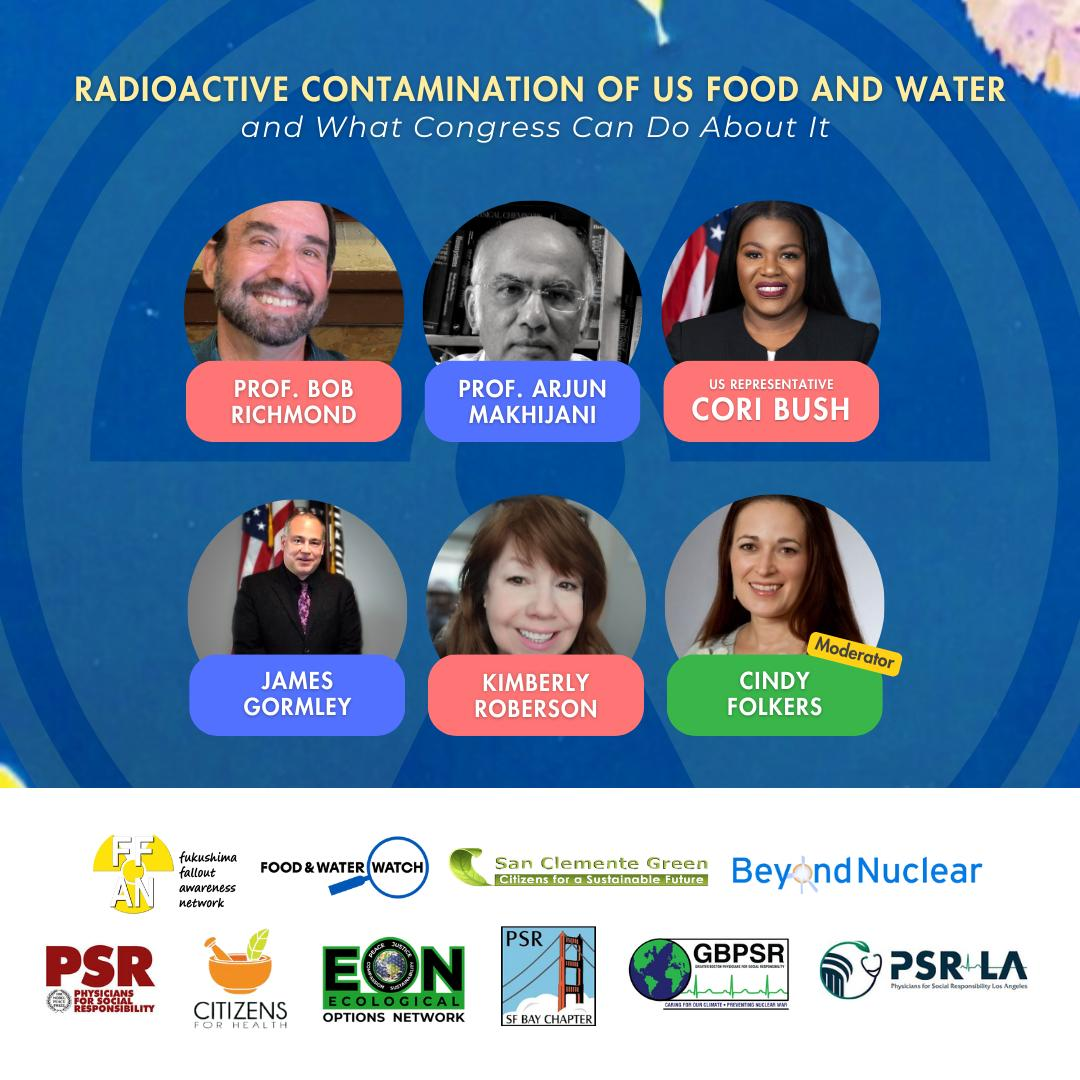
Radioactive Contamination of US Food and Water
and What Congress Can Do About It

Monday July 15, 2pm Eastern time

You’re invited to attend an online Congressional Briefing for members of Congress and their staffs on the growing problem of radioactive contamination of US food and water and what Congress can do about it.

The briefing will be held via Zoom on Monday, July 15 at 2pm Eastern time. Registration is required.

Distinguished experts and leaders presenting at the briefing include:

  • US Congresswoman Cori Bush – Representing Missouri’s 1st Congressional District (invited)
  • Arjun Makhijani – Nuclear engineer, President of the Institute for Energy and Environmental Research, author of Exploring Tritium’s Dangers, member of an independent scientists’ panel commissioned by the Pacific Islands Forum Secretariat to review radioactive dumping from Fukushima into the Pacific
  • Prof. Bob Richmond – University of Hawaii Marine Biologist, expert in biological uptake of radiation in the oceans, member of the Pacific Islands Forum Secretariat panel on Fukushima
  • Kimberly Roberson – Project Director, Fukushima Fallout Awareness Network (FFAN). She served on the board of National Association of Nutrition Professionals and helped organize the FFAN Coalition which petitioned FDA for better food regulations following the Fukushima disaster.
  • James Gormley – President and Senior Policy Advisor of Citizens for Health and a leading consumer health advocate
  • Moderator Cindy Folkers – Radiation and Health Hazard Specialist with Beyond Nuclear

Radioactive contamination stands to get worse due to planned ongoing releases of radioactive wastewater from Fukushima Daiichi into the Pacific Ocean. Despite this, there are currently no binding FDA standards, very little testing or monitoring that has been made public, a lack of transparency about any such testing, and no labeling or other information available to US consumers about radioactivity in their food that can guide their choices. Food from Japan that exceeds Japan’s radioactivity standards and can’t be sold there is nonetheless sold and served to US consumers here and to US service men, women and their families overseas. Congress can and should use its oversight of the FDA and other powers to confront and ameliorate this growing public health threat.

The briefing is organized by the Fukushima Fallout Awareness Network and co sponsored by the NGO’s Beyond Nuclear, Citizens for Health, Ecological Options Network, Food and Water Watch, San Clemente Green, and Physicians for Social Responsibility (PSR National as well as PSR’s Greater Boston, Los Angeles, and San Francisco Bay Area Chapters)

For additional information and current campaign: https://nislappdc.org/ffan-congressional-briefing/
https://nislappdc.org/fukushima-fallout/
Also http://www.sanonofresyndrome.com

— Petition: Help Kyoto fight the dangerous Ohi plant restart.

From Green Action, Japan

Sign the petition here.

Kyoto, the ancient capital of Japan, is cherished worldwide for its countless World Heritage sites and cultural treasures. Kyoto also shares a northern border with Fukui prefecture, the location of the highest concentration of nuclear power plants in the world. This is particularly alarming since the Japanese archipelago is riddled with earthquake faults and volcanoes.

Citizens from nations around the world can support Kyoto’s Governor and Mayor’s efforts to protect Kyoto. Let us stand with them to prevent another Fukushima disaster!

We are deeply concerned that the Japanese national government wants everything “back to normal” by the 2020 Olympics: Fukushima accident evacuees back to the Fukushima region, nuclear power plants restarted–everything back to pre-Fukushima days.

After the Fukushima accident, the world saw unprecedented citizen protest against the restart of nuclear power in Japan. Particularly prominent was the protest against the Ohi nuclear power plant in Fukui. The Ohi plant is less than 60 kilometers (37 miles) from the city center of Kyoto. It is deeply concerning that the plant is slated to restart in March 2018. An Ohi restart will threaten millions of Kyoto residents and Lake Biwa, the largest lake in Japan from which 14 million people receive their drinking water. A serious accident could have devastating effects on Kyoto’s world-famous cultural treasures and World Heritage sites.

The Governor and Mayor of Kyoto have petitioned the national government for the right to say yes/no to restart, to have control over Kyoto’s fate. Their plea has been answered with silence. The Japanese government must respond promptly and positively to assure Kyoto has the right to protect itself. This petition will enable the governor and mayor to show they have worldwide support.

Help Kyoto fight Ohi restart! 
Please see English language video:
https://youtu.be/di1BqYaOl8I

Sign the petition here.

From Nuclear Information and Resource Service
http://www.nirs.org
February 23, 2018

Our friends at Green Action in Japan need our help! The governor of Japan’s Fukui Province approved the restart of two reactors at the Ohi nuclear plant near Kyoto, only a few hundred miles from the Fukushima nuclear disaster.

This took place in the face of much public opposition, and we are supporting the activists of Kyoto as they fight to keep the reactors off line.

On February 16th, Kyoto citizens and others from the surrounding region went to Kyoto City to urge legislators to oppose Ohi nuclear power plant restart.

Sign their petition–international signatures really help!

And please spread the word!

Thanks for all you do!

Tim Judson
Executive Director


— TV reporter: “Woah! Dead whales!” Record high number of dead whales in Hawaii; “Carcasses scattered throughout islands”; low numbers of calves and cows off Hawaii, Philippines, Japan; “Possible health effects” from Fukushima radiation (VIDEO)

“Swimming through that for eight hours a day for an entire year could have possible health effects,”
Dr. Ken Buesseler, Woods Hole Oceanographic Institution

What do whales do for the other 16 hours a day, Dr. Buesseler? Stop the smoke and mirrors! 

Educational comments posted with the article as well. 

From ENE News

February 5, 2017

KGMB, Jan 17, 2017 (emphasis added): Officials investigate record number of humpback whale deaths… Six humpback whale carcasses have washed up onto Hawaii shores since November. That’s double the number typically found in a season, which runs from November to May… The previous record [of five] whale carcasses found in Hawaii waters was in 2013… Biologists aren’t sure what’s behind the increase in deaths. “It is higher than usual. It’s almost double this early in the season for what we’d get in a whole season,” said [NOAA’s] David Schofield… Since November, whale carcasses have been scattered throughout the main Hawaiian islandsBiologists are investigating to see if the whales starved or if there’s a problem with the ocean’s healthofficials will be meeting with partners in Alaska and Washington D.C. to investigate further.

KGMB reporter Mahealani Richardson, Jan 17, 2017: Woah! Dead whales! Wildlife officials are investigating a mystery over a record number of humpback whale deaths

Other recent whale deaths in Hawaii

KHON, Nov 22, 2016: Beached melon-headed whale euthanized on Maui… “The body condition was significantly compromised…” said [NOAA’s] Aliza Milette-Winfree… a necropsy will be done to determine what made it sick.

KHON, Oct 23, 2016: A pregnant dwarf sperm whale found dead on Maui’s Makena shoreline… this is very unusual because these whales normally live in deep waters… samples have been sent to the mainland to see if the whale also had any diseases… [NOAA] reported that a witness saw two small whales stranded in Makena…

AP, Aug 26, 2016: Experts are reporting the sighting of a sickly humpback whale off Maui. [NOAA’s] Malia Chow said Friday the animal is emaciated and covered in whale lice… She says the animal’s poor condition is a mystery.

Hakai Magazine, May 25, 2016: No-Show Pacific Ocean Humpbacks Stump Scientists… Whale researchers from around the Pacific are reporting that far fewer whales showed up in their usual wintering grounds…  [NOAA’s Ed Lyman] says he started noticing changes in December 2015… [He] was getting calls from tour boat operators asking where the whales were. “Something happened this year,” agrees Jim Darling, a researcher with the nonprofit Whale Trust Maui. “It almost seemed as if the females didn’t bother to show up”… the density of cows and calves was especially low… Darling also reported hearing from colleagues in the Philippines and Japan of similarly low whale numbers… Also striking was the low number of calves… Puerto Vallarta, Mexico, also saw fewer whales than normal says Oscar Frey, an oceanographer… he observed “the least number of mothers with babies that I have ever seen.”

How about in 2017? — The Garden Island, Jan 30, 2017: Annual whale count… [Jean Souza, HINMS Kauai programs coordinator] said the Kauai sites… saw an average of four whale viewings within a 15-minute time count period… down from the six sightings of the 2016 count.

Dr. Ken Buesseler, Woods Hole Oceanographic Institution, Jan 7, 2017: “We know there can be health effects from exposure to any amount of radiation… the highest level we’ve seen north of Hawaii is 10 Becquerels per cubic meter. Swimming through that for eight hours a day for an entire year could have possible health effects, but that additional dose is one thousand times smaller than a single dental X-ray.”

Watch KGMB’s broadcast here