From Fukushima Fallout Awareness Network (FFAN)
Information on congressional briefing and follow-up: https://nislappdc.org/ffan-congressional-briefing/
FFAN initiatives: https://nislappdc.org/fukushima-fallout/

From Fukushima Fallout Awareness Network (FFAN)
Information on congressional briefing and follow-up: https://nislappdc.org/ffan-congressional-briefing/
FFAN initiatives: https://nislappdc.org/fukushima-fallout/
From the San Onofre Syndrome Team and the Fukushima Fallout Awareness Network
Transcript: https://nislappdc.org/wp-content/uploads/2024/07/Final-Transcript-FFAN-Congressional-Briefing-7.15.24.pdf
Recording: https://youtu.be/Cbk-gYgVI9s
Additional information and update: https://nislappdc.org/fukushima-fallout/
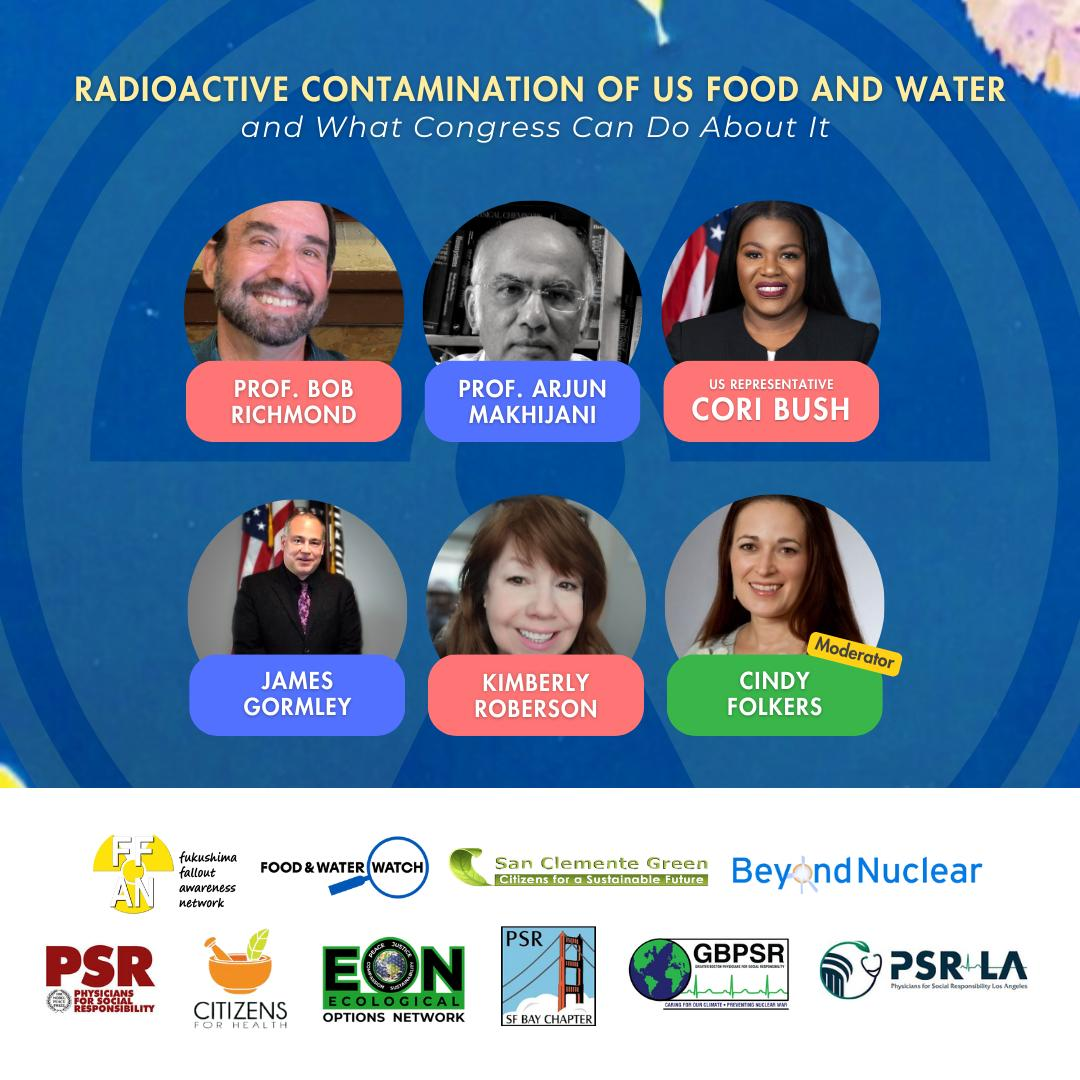
Radioactive Contamination of US Food and Water
and What Congress Can Do About It
Monday July 15, 2pm Eastern time
You’re invited to attend an online Congressional Briefing for members of Congress and their staffs on the growing problem of radioactive contamination of US food and water and what Congress can do about it.
The briefing will be held via Zoom on Monday, July 15 at 2pm Eastern time. Registration is required.
Distinguished experts and leaders presenting at the briefing include:
Radioactive contamination stands to get worse due to planned ongoing releases of radioactive wastewater from Fukushima Daiichi into the Pacific Ocean. Despite this, there are currently no binding FDA standards, very little testing or monitoring that has been made public, a lack of transparency about any such testing, and no labeling or other information available to US consumers about radioactivity in their food that can guide their choices. Food from Japan that exceeds Japan’s radioactivity standards and can’t be sold there is nonetheless sold and served to US consumers here and to US service men, women and their families overseas. Congress can and should use its oversight of the FDA and other powers to confront and ameliorate this growing public health threat.
The briefing is organized by the Fukushima Fallout Awareness Network and co sponsored by the NGO’s Beyond Nuclear, Citizens for Health, Ecological Options Network, Food and Water Watch, San Clemente Green, and Physicians for Social Responsibility (PSR National as well as PSR’s Greater Boston, Los Angeles, and San Francisco Bay Area Chapters)
For additional information and current campaign: https://nislappdc.org/ffan-congressional-briefing/
https://nislappdc.org/fukushima-fallout/
Also http://www.sanonofresyndrome.com

From Slashgear
Brittany A. Roston – Mar 16, 2017

A new report out of PLOS reveals that humpback whales are congregating in very large (relatively speaking) super-groups near South Africa, in some cases comprising pods as large as 200 whales. These large whale collectives are said to be engaging in feeding behavior, something that itself is unusual for the species, as it typically feeds on Antarctic krill in the southern polar region.
Humpback whales are creatures of habit, tending to feed during certain times in cold waters and breed during other times in warmer waters. Their migration patterns partly dependent on ocean temperatures, and their typical congregations are small. Data on these migration patterns, and feeding and breeding habits, go back decades.
Lately, though, researchers have noticed that humpback whales are collecting together in larger than typical numbers in pods with between 20 and 200 whales. Together (loosely so), these whales are engaging in feeding behavior in regions near South Africa where they would typically be engaging in breeding behaviors. Researchers have observed these large feeding pods in the October/November months in 2011, 2014, and 2015.
According to the new report, no one is sure why these whales are forming such large numbers and why they’re deviating from their typical feeding habits. The report states the whales in these super-groups tend to be only about five body lengths away from their nearest whale neighbor, and that they’re engaging in ‘repetitive diving behavior’ indicative of feeding. All signs point toward some large scale prey being present in the region, though researchers haven’t been able to sample for it out of fear of entangling the whales in the sampling gear.
SOURCE: PLOS
https://www.slashgear.com/humpback-whales-are-forming-massive-and-unusual-super-groups-16478886/
Posted under Fair Use Rules.
“Humpbacks normally feed farther offshore.”
What happens when the food runs out everywhere?
Associated Press
Unusual number of whales seen in San Francisco Bay
May 12, 2016
SAN FRANCISCO (AP) — Migrating humpback whales have been swimming into San Francisco Bay in unprecedented numbers during the past two weeks — an onslaught that experts say could be caused by an unusual concentration of anchovies near shore.
As many as four humpbacks at a time have been spotted flapping their tails and breaching in bay waters, apparently feeding on the anchovies and other schooling fish during incoming tides, the San Francisco Chronicle reported (http://bit.ly/1TB4C8p) Thursday.
It’s normal for gray whales to wander into the bay, but humpbacks generally feed farther offshore and are not accustomed to navigating shallow water and narrow straits such as those in San Francisco Bay, the newspaper reported.
Mary Jane Schramm, a spokeswoman for the Greater Farallones National Marine Sanctuary, said she and other marine experts worry that the whales could swamp boats while breaching, get hit by a ship or spooked by people who paddle or sail out to see them.
KSBW-TV reports a humpback whale was rescued in Monterey Bay this week after it became tangled in crab gear. On Thursday afternoon, a pair of whales surfaced near Golden Gate Bridge as two kite surfers came dangerously close to them.
Some have expressed excitement at seeing the whales.
“I had never seen humpback whales before, and it was awesome,” said Laurie Duke, 54, who volunteers at the Marine Mammal Center and Golden Gate Cetacean Research. “They were mostly coming partially out of the water, showing their tails.’
Schramm said the animals could get into trouble if they head any direction except west because the potential for disease and skin problems is greater in fresh and brackish water.
“The deeper they get into the bay, the more acoustically confusing it becomes,” she said of the whale’s sense of direction.
The whales are migrating north after likely giving birth in the waters off Mexico and Central America, Schramm said.
Schramm’s biggest fear is that the giant visitors will go the way of Humphrey, a famous 40-ton humpback who caused pandemonium in 1985 when he swam through the Carquinez Strait, up the Sacramento River and into a creek.
Large numbers of whales were reported last year near the Golden Gate Bridge due to a concentration of anchovies.
http://www.sfgate.com/news/article/San-Francisco-Bay-humpback-whale-sightings-alarm-7464427.php
Posted under Fair Use Rules.
Researchers can’t tell exactly what’s driving the die-off…”Those ocean life patterns are just not working the way they have in the past,” said Michael Milstein, a spokesman for the National Oceanic and Atmospheric Administration.
From the Oregonian
By
Email the author | Follow on Twitter
March 10, 2016
Charts on website
Nearly a year into a West Coast sardine fishing ban enacted to protect the collapsing population, the fish formerly worth more than $8 million to Oregon’s economy have shown no signs of a comeback.
New federal research indicates numbers of the small, silvery, schooling fish have plummeted further than before the fishing moratorium, dashing any hope of lifting it in 2016.
With the current sardine population hovering at 7 percent of its 2007 peak, fishermen now say they expect to wait a decade or more to revive the fishery.
“I don’t want to take a pessimistic view, but I would think we’ll be shut down until 2030,” said Ryan Kapp, a Bellingham fisherman who advises the Pacific Fishery Management Council on sardines and other fish.
Sardines aren’t struggling in isolation. Other fish near the bottom of the marine food web, such as anchovies and herring, are also down. The shortage of sustenance is rippling upward to create crises for predator species from seals to seabirds.
Researchers can’t tell exactly what’s driving the die-off, nor how long it will last. Some say the crash can be attributed to cyclical boom-and-bust population dynamics sardines have always exhibited.
Others argue overfishing played a role, driving sardine populations down too far and too fast to blame it on a natural population flux.
Then there’s the unavoidable presence of the “warm blob,” a lingering mass of overheated water that for more than two years has wreaked havoc on sea life off the Pacific coast.
“Those ocean life patterns are just not working the way they have in the past,” said Michael Milstein, a spokesman for the National Oceanic and Atmospheric Administration, the federal agency that tracks sardine numbers. “There’s a feeling that a lot of this is environmentally-driven.”
RIPPLES IN THE FOOD CHAIN
The Pacific fishery council’s rules call for a fishery shutdown if the total weight of adult sardines falls below 150,000 metric tons. When the population fell below that threshold last spring, council members scrambled to enact a midseason shutdown.
Federal scientists last month estimated sardine biomass has dropped below 65,000 tons this year.
Even with fishing pressures lifted, sardines could struggle to bounce back in an ocean devoid of their main food source. The lipid-rich coldwater plankton that sardines like to eat have become scarcer in West Coast waters, replaced by tropical species with less appeal to the region’s predators. Scientists suspect the warm blob is causing the plankton shift.
Without that food source, “the whole system can suffer,” said Kerry Griffin, who manages sardines for the Pacific Fishery Management Council.
The end result is ominous for more than just fishermen. Oily sardines are a key food source for larger ocean-going animals. As that option becomes scarce, predators switch to less-nutritious food options and can end up starving.
Scientists believe that chain reaction is already playing out in a big way. A group of National Oceanic and Atmospheric Administration researchers last week released a study linking the sardine collapse to the surge in starving sea lion pups washing ashore along the California coast. The scientists who authored the study say they expect the mass starvation that stranded 3,000 pups last year to continue as long as forage fish numbers remain low.
Similar phenomena have been observed among other species that target small schooling fish for food. Brown pelicans are failing to breed, dead Guadalupe fur seals are washing ashore in California, undersize salmon are returning to Canadian spawning grounds and seabirds are washing ashore weakened or dead on the Oregon coast.
OVERFISHING?
Environmentalists for years warned that a sardine collapse was imminent. Now they have begun lobbying to get more conservative harvest policies in place before the fishery reopens.
Research shows that overfishing intensifies the cyclical downturns of sardines and other small fish, and ocean conservation groups argue current West Coast standards are too permissive to prevent overfishing.
Ben Enticknap, a Portland-based campaign manager for the international conservation group Oceana, said the group is pushing the council to adopt new standards that would trigger a fishing ban once the sardine stock drops below 640,000 metric tons. That trigger point is more than four times higher than the current level.
The group is also lobbying for a rule to prohibit fishermen from hauling in more than 15 percent of the adult population in a given season. In the final years of harvest before last year’s shutdown, fishermen caught as much as 28 percent of the adult sardines in the water.
“Fundamental flaws in management have to be fixed, or this crash will be repeated in the future,” Enticknap said.
CAUTIOUS OPTIMISM
Although the overall results of this year’s sardine count were discouraging, scientists say there’s a glimmer of hope.
Several years of poor reproduction helped drive down the sardine population. In their latest trawl, scientists saw evidence that 2015 was a good spawning year.
It’s too soon to tell whether the reproductive success signals a turning point.
“There are some potentially positive signs there,” Milstein said, but in order to boost population counts, “the young need to survive long enough to make it into the mature population.”
–Kelly House
khouse@oregonian.com
503-221-8178
@Kelly_M_House
http://www.oregonlive.com/environment/index.ssf/2016/03/as_pacific_sardine_collapse_wo.html
Posted under Fair Use Rules.
 Heal Fukushima