From Helen Caldicott M.D.
https://www.helencaldicott.com/
June 22, 2024
Because I was so worried about the ignorance of the world’s media and politicians about radiation biology after the dreadful accident at Fukushima in Japan, I organized a 2 day symposium at the NY Academy of Medicine on March 11 and 12, 2013, titled The Medical and Ecological Consequences of Fukushima. It was addressed by some of the world’s leading scientists, epidemiologist, physicists and physicians who presented their latest data and findings on Fukushima [i] I hoped to attract representatives of the global media to educate them.
Background
The Great Eastern earthquake and massive tsunami on the east coast of Japan, caused the meltdown of three nuclear reactors within several days, and four hydrogen explosions in buildings 1,2, 3 and 4. Fukushima is now described as the greatest industrial accident in history. Massive quantities of radiation escaped into the air and water from these damaged reactors, three times more noble gases – argon, xenon and krypton than were released at Chernobyl, together with huge amounts of other radioactive elements, such as cesium, strontium, tritium, iodine, plutonium americium etc. Unfortunately the people of Japan were not notified of the meltdowns for 3 months because the government “did not want to create panic.”[ii]
A typical 1000 megawatt nuclear reactor contains as much radiation as that released by the explosions of 1000 Hiroshima sized bombs and the fissioned uranium becomes one billion times more radioactive than the original uranium because more than 200 intensely radioactive elements have been created whose half-lives range from seconds to millions of years. [iii]
So concerned was the Japanese government according to the then Prime Minister Naoto Kan, that they were considering plans to evacuate 35 million people from Tokyo, because other reactors including Fukushima Daiini on the east coast were also at risk.
Thousands of people fleeing from the smoldering reactors were not notified where the radioactive plumes were travelling despite the fact that the Japanese government and the US were tracking the radioactive plumes, so people fled directly into the path of the highest radiation concentrations where they were exposed to high levels of whole-body external gamma radiation being emitted by the radioactive elements inhaling radioactive air, and swallowing radioactive elements. Nor were these people supplied with inert potassium iodide which would have blocked the uptake of deadly radioactive iodine by their thyroid glands except in the town of Miharu. However prophylactic iodine was distributed to the staff of Fukushima Medical University in the days after the accident after extremely high levels of radioactive iodine – 1.9 million becquerels/kg were found in leafy vegetables near the University.[iv]This contamination was widespread in vegetables, fruit, meat, milk, rice and tea in many areas of Japan.[v]
The Fukushima meltdown disaster is not over and will never end. The radioactive fallout which remains toxic for hundreds to thousands of years covers large swathes of Japan will never be “cleaned up” and will contaminate food, humans and animals virtually forever. The three reactors which experienced total meltdowns I predict will never be dissembled or decommissioned and even TEPCO – Tokyo Electric Power Company – says it will take at least 30 to 40 years and the International Atomic Energy Agency predicts more than 40 years before they can make any progress because of the enormous levels of radiation at these damaged reactors.
Much of the temporary cooling systems cobbled together soon after the accident are composed of plastic piping held together with duct tape and several months ago the electricity supplying the pumps to circulate the water failed for 30 hours because a rat had eaten into the temporary electrical system putting the reactors and cooling pools at great risk as the water levels fell.
The fishing industry most likely will be destroyed on the east coast of Japan. The amount of radioactive water that has already been discharged into the Pacific is far greater than that released to the sea by Chernobyl. Fish caught out as far as 100 Km from Fukushima are radioactive and tuna caught off the coast of California are already contaminated by cesium 134 and 137 from Fukushima.[vi]In late June 2013 it was discovered that the levels of tritium in the Fukushima Port are the highest yet detected at 1,100 Becquerels per litre and this figure indicates huge quantities of radioactive water accompanied by many more dangerous radioactive elements are still escaping into the Pacific Ocean from leaking ground water and other sources.[vii]
Tritium is radioactive hydrogen H3 and there is no way to separate tritium from contaminated water. It is a soft beta emitter and a potent carcinogen with a half-life of 12.3 years and remains radioactive for more than 100 years. It concentrates in aquatic organisms including algae, seaweed, crustaceans and fish. Because it is tasteless, odorless and invisible, it will inevitably be ingested in food, including seafood for many decades. It combines in the DNA molecule – the gene – where it can induce mutations that later lead to cancer. It causes brain tumors, birth deformities, and cancers of many organs.
At the same time strontium 90, which induces bone cancer and leukemia has been detected in ground water near unit 2 at 30 times the so-called safety level. In other words there is no stability at the plant as huge quantities of radioactive elements, more than anyone has been able or willing to measure, have been continuously released into the air and water since the multiple meltdowns at the Fukushima Daiichi Complex.
This accident is enormous in its medical implications. It will induce an epidemic of cancer, as people inhale the radioactive elements, eat radioactive vegetables, rice, fish and meat, and drink radioactive milk and teas. In 1986, a single meltdown and explosion at Chernobyl covered 40% of the European land mass with radioactive elements. Already, according to a 2009 report published by the New York Academy of Sciences, over one million people have perished as a direct result of this catastrophe, yet this is just the tip of the iceberg because large parts of Europe and the food will remain radioactive for hundreds of years . [viii]
Medical Implications of Radiation
Fact number one
No dose of radiation is safe. Each dose received by the body is cumulative and adds to the risk of developing malignancy or genetic disease.
Fact number two
Children are ten to twenty times more vulnerable to the carcinogenic effects of radiation than adults. Girls are twice as sensitive as boys and women are more sensitive than men. Fetuses are thousands of times more sensitive. Immuno-compromised patients are also extremely sensitive
Fact number three
Very high doses of radiation received from a nuclear meltdown or from a nuclear weapon explosion can cause acute radiation sickness, with alopecia, severe nausea and diarrhea and thrombocytopenia. Reports of such illnesses, particularly in children appeared within the first few months after the Fukushima accident.
Fact number four
As we all know, Ionizing radiation from radioactive elements, and radiation emitted from X ray machines and CT scanners, can be carcinogenic. The latent period of carcinogenesis for leukemia is 5-10 years and solid cancers 15-80 years. It has been shown that all modes of cancer can be induced by radiation, as well as over 2600 genetic diseases now described in the medical literature.
But as we increase the level of background radiation in our environment from medical procedures, X ray scanning machines at airports, or radioactive materials continually escaping from nuclear reactors and nuclear waste dumps, we will inevitably increase the incidence of cancer as well as the incidence of genetic disease in future generations.
Types of ionizing radiation
1. X rays (usually electrically generated), are electromagnetic, and only cause mutations the instant they pass through your body. You do not become radioactive but your genes may be mutated.
2. Similarly gamma radiation, is electromagnetic, emitted by radioactive materials generated in nuclear reactors and from some naturally occurring radioactive elements in the soil.
3. Alpha radiation, which is particulate, and composed of 2 protons and 2 neutrons, emitted from uranium atoms and from other dangerous elements generated in reactors (such as plutonium, americium, curium, einsteinium, etc- all known as alpha emitters and have an atomic weight greater than uranium). Alpha particles travel a very short distance in the human body. They cannot penetrate the layers of dead skin in the epidermis to damage living skin cells. But when these radioactive elements enter the lung, liver, bone or other organs, they transfer a large dose of radiation over a long period of time to a very small volume of cells. Most of these cells are killed, but some on the edge of the tiny radiation field remain viable to be mutated, and cancer may later develop. Alpha emitters are among the most carcinogenic materials known.
4. Beta radiation, like alpha also particulate, is a charged electron emitted from radioactive elements such as strontium 90, cesium 137, iodine 131 etc. The beta particle is light in mass, it travels further than an alpha particle but also, mutates genes.
5. Neutron radiation is released during the fission process in a reactor or a bomb. Reactor #1 at Fukushima has been periodically emitting neutron radiation as sections of the molten core become intermittently critical. Neutrons are large radioactive particles that travel many kilometers, and they pass through everything including concrete, steel etc. There is no way to hide from them and they are extremely mutagenic.
So, let’s describe just four of the radioactive elements that are continually being released into the air and water at Fukushima. Remember, though, there are over 200 such elements each with its own characteristics and pathways in the food chain and the human body. They are invisible, tasteless and odorless. When the cancer manifests it is impossible to determine its aetiology, but there is a large literature proving that radiation causes cancer including the data from Hiroshima and Nagasaki.
1. Cesium 137 is a beta and gamma emitter with a half-life of 30 years. That means in 30 years only half of its radioactive energy has decayed, so it is detectable as a radioactive hazard for over 300 years. Cesium, like all radioactive elements bio-concentrates in at each level of the food chain – from soil to grass, fruit and vegetables and tens to hundreds of times more in meat and milk andn the sea from algae to crustaceans to small fish to big fish.The human body stands atop the food chain. As an analogue of potassium, it becomes ubiquitous in all cells. It can induce brain cancer, rhabdomyosarcomas, ovarian or testicular cancer and, most importantly, genetic disease.
2. Strontium 90 is a high-energy beta emitter, half-life 28 years, detectably radioactive for 300 years. As a calcium analogue, it is a bone-seeker. It concentrates in the food chain, specifically milk (including breast milk), and is laid down in bones and teeth in the human body, where it can irradiate an osteoblast causing bone cancer; or a white blood cell inducing leukemia.
3. Radioactive iodine 131 is a beta and gamma emitter with a half-life of 8 days, hazardous for ten weeks. It bio-concentrates in the food chain, in vegetables and milk, and then the human thyroid gland where it is a potent carcinogen inducing thyroid disease and/or thyroid cancer. It is important to note that of 174,376 children under the age of 18 to have been examined by thyroid ultrasound in the Fukushima Prefecture, 12 have been definitively diagnosed with thyroid cancer and 15 more are suspected to have the disease. Almost 200,000 more children are yet to be examined. Of these 174,367 children 43.2% have either thyroid cysts and/or nodules.[ix]
Thyroid cancer is extremely rare in children- this is an extraordinary situation. In Chernobyl thyroid cancers were not diagnosed until 4 years post-accident. This early presentation indicates that these Japanese children almost certainly received a high dose of radioactive iodine but also points to the fact that high doses of other radioactive elements released during the meltdowns were received by the exposed population in Fukushima prefecture and elsewhere so the rate of cancer in Japan is almost certain to rise.
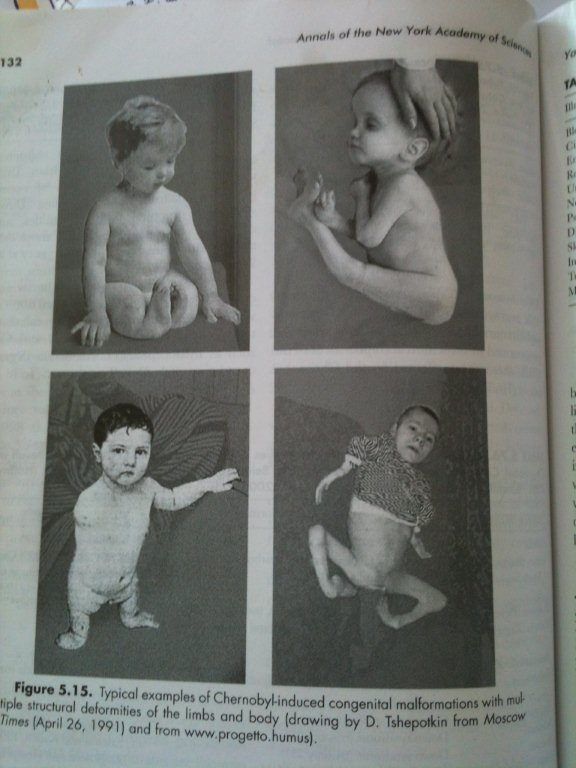
4. Plutonium, one of the most deadly, is an alpha emitter. So toxic that one millionth of a gram will induce cancer if inhaled into the lung. It is an iron analogue and combines with transferrin and it causes liver cancer, bone cancer, leukemia, or multiple myeloma. It concentrates in the testicles and ovaries where it can induce testicular or ovarian cancer, or genetic diseases in future generations. It also crosses the placenta where it is teratogenic like thalidomide, the morning sickness drug, did years ago. There are medical homes full of grossly deformed children near Chernobyl never before seen in the history of medicine.
The half-life of plutonium is 24,400 years, radioactive for 250,000 years, available to induce cancers, congenital deformities, and genetic diseases for virtually the rest of time.
Plutonium is also fuel for atomic bombs. 5 kilos is fuel for a weapon which would vaporize a city. Each reactor makes 250 Kg of plutonium a year. It is postulated that less than one kilo of plutonium, if adequately distributed, could kill induce lung cancer every person on earth.
Conclusion
In summary, the radioactive contamination and fallout from nuclear power plant accidents will have medical ramifications that will never cease because the food will continue to concentrate the radioactive elements for hundreds to thousands of years inducing epidemics of cancer, leukemia and genetic disease. Already we are seeing such pathology and abnormalities in birds and insects and because they reproduce very fast it is possible to observe disease caused by radiation over many generations within a relatively short space of time
Pioneering research conducted by Dr Tim Mousseau, an evolutionary biologist, in the exclusion zones of both Chernobyl and Fukushima has documented very high rates of tumors in birds, genetic mutations in birds and insects, many of the male barn swallows are sterile and many birds have smaller than normal brains. What happens to animals will happen to human beings.[x]
The effects of low‐dose radiation: Soviet science, the nuclear industry – and independence?
- Author: Anders Pape Møller, Timothy A. Mousseau
- Published: Feb 15, 2013 – From issue: Volume 10 Issue 1 (February 2013)
The Japanese government is desperately trying to “cleanup” radioactively contaminated soil, trees, leaves etc. But in reality all that can be done is collect it, place it in containers – the government contracted workers are using plastic bags, and transfer it to another location. It cannot be made neutral and it cannot be prevented from spreading in the future. Some contractors have allowed their workers to empty radioactive debris, soil and leaves into streams and other illegal places. Then the main question becomes – where to place the contaminated material stored safely away from the environment of thousands of years. There is no safe place in Japan for this to happen, let alone to store thousands of tons of high level radioactive waste which rests precariously at the 54 Japanese nuclear reactors.
Last but not least Australian uranium fueled the Fukushima reactors. Australia exports uranium for use in nuclear power plants to 12 countries including the US, Japan, France, Britain, Finland, Sweden, South Korea, China, Belgium, Spain, Canada and Taiwan. 270,000 metric tons of deadly radioactive waste exists in the world today with 12,000 metric tons being added yearly.
It must be isolated from the environment for one million years and no container lasts longer that 100 years. The isotopes will inevitably leak contaminating the food chain, inducing epidemics of cancer, leukemia, congenital deformities and genetic diseases for the rest of time.
This then is the legacy we leave to future generations
———————————————-
[i] helencaldicottfoundation.org, The Medical and Ecological Consequences of Fukushima March 11 and 12
[ii] National Diet of Japan Fukushima Nuclear Accident Independent Investigation Commission, July 2012
[iii] Chart of 211 Radioactive Poisons in 10-Year Old CANDU Spent Fuel
http://www.ccnr.org/hlw_chart.html#chart
[iv] http://ex-skf.blogspot.com/2013/06/fukushima-medical-university.html.
[v]Tests Find Cesium 172 times the limit in Miyagi Yacon Tea, The Asahi Simbun April 13, 20012; Trust Deficit, The Worst Fallout of Fukushima, Suvendrini Kakuchi, Inter Press Service News Agency, July 17, 2013
[vi] www.abc.net.au/am/content/2013/s3750728.htm
[vii] http://english.kyodonews.jp/news/2013/06/232195.html
[viii][viii] Chernobyl, Consequences of the Catastrophe for People and the Environment, Yablokov, Nesterenko and Nesterenko, Annals of the New York Academy of Sciences, Vol 1181, 2009
[ix] http://fukushimavoice-eng2.blogspot.com/2013/06/11th-prefectural-oversight-committee.html
[x] The effects of low‐dose radiation: Soviet science, the nuclear industry – and independence?
- Author: Anders Pape Møller, Timothy A. Mousseau
- Published: Feb 15, 2013 – From issue: Volume 10 Issue 1 (February 2013)
——————————–
For more information: https://www.helencaldicott.com/

 Heal Fukushima