Burying radioactive nuclear waste poses enormous risks By David Suzuki July 31, 2024
he spent fuel will remain radioactive for hundreds of thousands of years, and contamination and leaks are possible during storage, containment, transportation and burial.
As the consequences of burning dirty, climate-altering fossil fuels hit harder by the day, many are seizing on nuclear power as a “clean” energy alternative. But how clean is it?
Although it may not produce the emissions that burning fossil fuels does, nuclear power presents many other problems. Mining, processing and transporting uranium to fuel reactors creates toxic pollution and destroys ecosystems, and reactors increase risks of nuclear weapons proliferation and radioactive contamination. Disposing of the highly radioactive waste is also challenging. http://large(dot)stanford(dot)edu/courses/2021/ph241/radzyminski2/
The people living in Ignace and South Bruce, Ontario, are learning about the potential dangers firsthand. The Nuclear Waste Management Organization (NWMO), a not-for-profit corporation representing nuclear power companies, has identified those communities as potential sites for disposing of six million bundles of highly radioactive waste in a “deep geological repository.” The federal government has agreed to the organization’s plans.
It’s an all-too-common story: environmentally damaging projects foisted on communities that need the money such projects promise.
In this case, the NWMO has already paid Indigenous and municipal governments large sums to accept its plans — ignoring communities that will also be affected along transportation routes or downstream of burial sites.
According to Canadian Dimension, industry expects to ship the wastes “in two to three trucks per day for fifty years, in one of three potential containers.” None of the three containment methods has been subjected to rigorous testing.
Even without an accident, trucking the wastes will emit low levels of radiation, which industry claims will produce “acceptable” exposure. Transferring it from the facility to truck and then to repository also poses major risks.
Although industry claims storing high-level radioactive waste in deep geological repositories is safe, no such facility has been approved anywhere in the world, despite many years of industry effort.
Canadian Dimension says, “a growing number of First Nations have passed resolutions or issued statements opposing the transportation and/or disposal of nuclear waste in northwestern Ontario, including Lac Seul First Nation, Ojibway Nation of Saugeen, Grassy Narrows First Nation, Fort William First Nation, and Wabaseemoong Independent Nations.”
“Our Nations have not been consulted, we have not given our consent, and we stand together in saying ‘no’ to the proposed nuclear waste storage site near Ignace.”
All have good reason to be worried. As Canadian Dimension reports, “All of Canada’s commercial reactors are the CANDU design, where 18 months in the reactor core turns simple uranium into an extremely complex and highly radioactive mix of over 200 different radioactive ingredients. Twenty seconds exposure to a single fuel bundle would be lethal.”
The spent fuel will remain radioactive for hundreds of thousands of years, and contamination and leaks are possible during storage, containment, transportation and burial. Industry, with its usual “out of sight, out of mind” approach, has no valid way to monitor the radioactive materials once they’re buried.
With 3.3 million bundles of spent fuels already waiting in wet or dry storage at power plants in Ontario, New Brunswick, Quebec and Manitoba, and many more to come, industry is desperate to find a place to put it all.
Even with the many risks and no site yet chosen for burial, industry and governments are looking to expand nuclear power, not just with conventional power plants but also with “small modular reactors,” meaning they could be spread more widely throughout the country.
Nuclear power is enormously expensive and projects always exceed budgets. It also takes a long time to build and put a reactor into operation. Disposing of the radioactive wastes creates numerous risks. Energy from wind, solar and geothermal with energy storage costs far less, with prices dropping every day, and comes with far fewer risks.
Industry must find ways to deal with the waste it’s already created, but it’s time to move away from nuclear and fossil fuels. As David Suzuki Foundation research confirms, renewable energy from sources such as wind and solar is a far more practical, affordable and cleaner choice.
David Suzuki is a scientist, broadcaster, author and co-founder of the David Suzuki Foundation. Written with David Suzuki Foundation Senior Writer and Editor Ian Hanington.
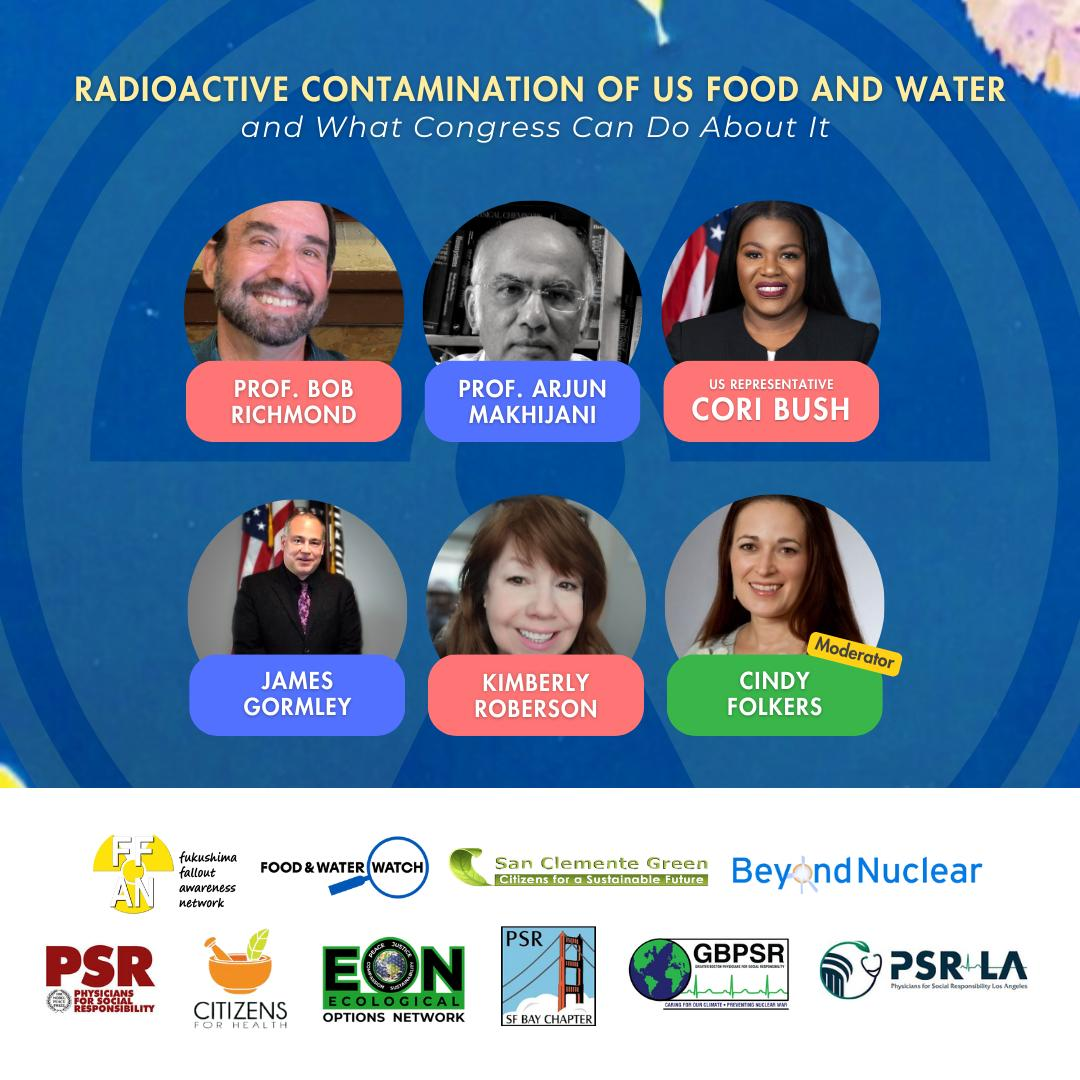
Radioactive Contamination of US Food and Water and What Congress Can Do About It Monday July 15, 2pm Eastern time
You’re invited to attend an online Congressional Briefing for members of Congress and their staffs on the growing problem of radioactive contamination of US food and water and what Congress can do about it.
The briefing will be held via Zoom on Monday, July 15 at 2pm Eastern time. Registration is required.
Distinguished experts and leaders presenting at the briefing include:
US Congresswoman Cori Bush – Representing Missouri’s 1st Congressional District (invited)
Arjun Makhijani – Nuclear engineer, President of the Institute for Energy and Environmental Research, author of Exploring Tritium’s Dangers, member of an independent scientists’ panel commissioned by the Pacific Islands Forum Secretariat to review radioactive dumping from Fukushima into the Pacific
Prof. Bob Richmond – University of Hawaii Marine Biologist, expert in biological uptake of radiation in the oceans, member of the Pacific Islands Forum Secretariat panel on Fukushima
Kimberly Roberson – Project Director, Fukushima Fallout Awareness Network (FFAN). She served on the board of National Association of Nutrition Professionals and helped organize the FFAN Coalition which petitioned FDA for better food regulations following the Fukushima disaster.
James Gormley – President and Senior Policy Advisor of Citizens for Health and a leading consumer health advocate
Moderator Cindy Folkers – Radiation and Health Hazard Specialist with Beyond Nuclear
Radioactive contamination stands to get worse due to planned ongoing releases of radioactive wastewater from Fukushima Daiichi into the Pacific Ocean. Despite this, there are currently no binding FDA standards, very little testing or monitoring that has been made public, a lack of transparency about any such testing, and no labeling or other information available to US consumers about radioactivity in their food that can guide their choices. Food from Japan that exceeds Japan’s radioactivity standards and can’t be sold there is nonetheless sold and served to US consumers here and to US service men, women and their families overseas. Congress can and should use its oversight of the FDA and other powers to confront and ameliorate this growing public health threat.
The briefing is organized by the Fukushima Fallout Awareness Network and co sponsored by the NGO’s Beyond Nuclear, Citizens for Health, Ecological Options Network, Food and Water Watch, San Clemente Green, and Physicians for Social Responsibility (PSR National as well as PSR’s Greater Boston, Los Angeles, and San Francisco Bay Area Chapters)
A grassroots group is kicking off a campaign to urge four local governments to sue the California Department of Toxic Substances Control (DTSC) over its failure to enforce cleanup agreements at a Simi Valley site contaminated in the 1940s and 1950s by thousands of rocket tests and nuclear-reactor experiments.
The campaign kickoff event is from 10 a.m. to 1 p.m., Saturday, July 13, at Strathearn Historical Park, 37 Strathearn Place, Simi Valley.
The event kicks off 10 days of in-person actions at upcoming supervisor and city council meetings.
Despite cleanup agreements being in place with The Boeing Company (Boeing), National Aeronautics and Space Administration (NASA), and the U.S. Department of Energy (DOE), the state has failed to demand they clean up the contamination to the standard originally agreed upon.
“We are asking four local governments to join together and sue the state to litigate over the final Environmental Impact Report,” said Larry Yee, a resident of Ojai and former chair of the Los Angeles Regional Water Quality Control Board.
Yee said the group is asking the Ventura County Board of Supervisors, Los Angeles County Board of Supervisors, and the cities of Los Angeles and Simi Valley to sue DTSC over the Environmental Impact Report recently issued for the site.
Because I was so worried about the ignorance of the world’s media and politicians about radiation biology after the dreadful accident at Fukushima in Japan, I organized a 2 day symposium at the NY Academy of Medicine on March 11 and 12, 2013, titled The Medical and Ecological Consequences of Fukushima. It was addressed by some of the world’s leading scientists, epidemiologist, physicists and physicians who presented their latest data and findings on Fukushima [i] I hoped to attract representatives of the global media to educate them.
Background
The Great Eastern earthquake and massive tsunami on the east coast of Japan, caused the meltdown of three nuclear reactors within several days, and four hydrogen explosions in buildings 1,2, 3 and 4. Fukushima is now described as the greatest industrial accident in history. Massive quantities of radiation escaped into the air and water from these damaged reactors, three times more noble gases – argon, xenon and krypton than were released at Chernobyl, together with huge amounts of other radioactive elements, such as cesium, strontium, tritium, iodine, plutonium americium etc. Unfortunately the people of Japan were not notified of the meltdowns for 3 months because the government “did not want to create panic.”[ii]
A typical 1000 megawatt nuclear reactor contains as much radiation as that released by the explosions of 1000 Hiroshima sized bombs and the fissioned uranium becomes one billion times more radioactive than the original uranium because more than 200 intensely radioactive elements have been created whose half-lives range from seconds to millions of years. [iii]
So concerned was the Japanese government according to the then Prime Minister Naoto Kan, that they were considering plans to evacuate 35 million people from Tokyo, because other reactors including Fukushima Daiini on the east coast were also at risk.
Thousands of people fleeing from the smoldering reactors were not notified where the radioactive plumes were travelling despite the fact that the Japanese government and the US were tracking the radioactive plumes, so people fled directly into the path of the highest radiation concentrations where they were exposed to high levels of whole-body external gamma radiation being emitted by the radioactive elements inhaling radioactive air, and swallowing radioactive elements. Nor were these people supplied with inert potassium iodide which would have blocked the uptake of deadly radioactive iodine by their thyroid glands except in the town of Miharu. However prophylactic iodine was distributed to the staff of Fukushima Medical University in the days after the accident after extremely high levels of radioactive iodine – 1.9 million becquerels/kg were found in leafy vegetables near the University.[iv]This contamination was widespread in vegetables, fruit, meat, milk, rice and tea in many areas of Japan.[v]
The Fukushima meltdown disaster is not over and will never end. The radioactive fallout which remains toxic for hundreds to thousands of years covers large swathes of Japan will never be “cleaned up” and will contaminate food, humans and animals virtually forever. The three reactors which experienced total meltdowns I predict will never be dissembled or decommissioned and even TEPCO – Tokyo Electric Power Company – says it will take at least 30 to 40 years and the International Atomic Energy Agency predicts more than 40 years before they can make any progress because of the enormous levels of radiation at these damaged reactors.
Much of the temporary cooling systems cobbled together soon after the accident are composed of plastic piping held together with duct tape and several months ago the electricity supplying the pumps to circulate the water failed for 30 hours because a rat had eaten into the temporary electrical system putting the reactors and cooling pools at great risk as the water levels fell.
The fishing industry most likely will be destroyed on the east coast of Japan. The amount of radioactive water that has already been discharged into the Pacific is far greater than that released to the sea by Chernobyl. Fish caught out as far as 100 Km from Fukushima are radioactive and tuna caught off the coast of California are already contaminated by cesium 134 and 137 from Fukushima.[vi]In late June 2013 it was discovered that the levels of tritium in the Fukushima Port are the highest yet detected at 1,100 Becquerels per litre and this figure indicates huge quantities of radioactive water accompanied by many more dangerous radioactive elements are still escaping into the Pacific Ocean from leaking ground water and other sources.[vii]
Tritium is radioactive hydrogen H3 and there is no way to separate tritium from contaminated water. It is a soft beta emitter and a potent carcinogen with a half-life of 12.3 years and remains radioactive for more than 100 years. It concentrates in aquatic organisms including algae, seaweed, crustaceans and fish. Because it is tasteless, odorless and invisible, it will inevitably be ingested in food, including seafood for many decades. It combines in the DNA molecule – the gene – where it can induce mutations that later lead to cancer. It causes brain tumors, birth deformities, and cancers of many organs.
At the same time strontium 90, which induces bone cancer and leukemia has been detected in ground water near unit 2 at 30 times the so-called safety level. In other words there is no stability at the plant as huge quantities of radioactive elements, more than anyone has been able or willing to measure, have been continuously released into the air and water since the multiple meltdowns at the Fukushima Daiichi Complex.
This accident is enormous in its medical implications. It will induce an epidemic of cancer, as people inhale the radioactive elements, eat radioactive vegetables, rice, fish and meat, and drink radioactive milk and teas. In 1986, a single meltdown and explosion at Chernobyl covered 40% of the European land mass with radioactive elements.Already, according to a 2009 report published by the New York Academy of Sciences, over one million people have perished as a direct result of this catastrophe, yet this is just the tip of the iceberg because large parts of Europe and the food will remain radioactive for hundreds of years . [viii]
Medical Implications of Radiation
Fact number one
No dose of radiation is safe. Each dose received by the body is cumulative and adds to the risk of developing malignancy or genetic disease.
Fact number two
Children are ten to twenty times more vulnerable to the carcinogenic effects of radiation than adults. Girls are twice as sensitive as boys and women are more sensitive than men. Fetuses are thousands of times more sensitive. Immuno-compromised patients are also extremely sensitive
Fact number three
Very high doses of radiation received from a nuclear meltdown or from a nuclear weapon explosion can cause acute radiation sickness, with alopecia, severe nausea and diarrhea and thrombocytopenia. Reports of such illnesses, particularly in children appeared within the first few months after the Fukushima accident.
Fact number four
As we all know, Ionizing radiation from radioactive elements, and radiation emitted from X ray machines and CT scanners, can be carcinogenic. The latent period of carcinogenesis for leukemia is 5-10 years and solid cancers 15-80 years. It has been shown that all modes of cancer can be induced by radiation, as well as over 2600 genetic diseases now described in the medical literature.
But as we increase the level of background radiation in our environment from medical procedures, X ray scanning machines at airports, or radioactive materials continually escaping from nuclear reactors and nuclear waste dumps, we will inevitably increase the incidence of cancer as well as the incidence of genetic disease in future generations.
Types of ionizing radiation
1. X rays (usually electrically generated), are electromagnetic, and only cause mutations the instant they pass through your body. You do not become radioactive but your genes may be mutated.
2. Similarly gamma radiation, is electromagnetic, emitted by radioactive materials generated in nuclear reactors and from some naturally occurring radioactive elements in the soil.
3. Alpha radiation, which is particulate, and composed of 2 protons and 2 neutrons, emitted from uranium atoms and from other dangerous elements generated in reactors (such as plutonium, americium, curium, einsteinium, etc- all known as alpha emitters and have an atomic weight greater than uranium). Alpha particles travel a very short distance in the human body. They cannot penetrate the layers of dead skin in the epidermis to damage living skin cells. But when these radioactive elements enter the lung, liver, bone or other organs, they transfer a large dose of radiation over a long period of time to a very small volume of cells. Most of these cells are killed, but some on the edge of the tiny radiation field remain viable to be mutated, and cancer may later develop. Alpha emitters are among the most carcinogenic materials known.
4. Beta radiation, like alpha also particulate, is a charged electron emitted from radioactive elements such as strontium 90, cesium 137, iodine 131 etc. The beta particle is light in mass, it travels further than an alpha particle but also, mutates genes.
5. Neutron radiation is released during the fission process in a reactor or a bomb. Reactor #1 at Fukushima has been periodically emitting neutron radiation as sections of the molten core become intermittently critical. Neutrons are large radioactive particles that travel many kilometers, and they pass through everything including concrete, steel etc. There is no way to hide from them and they are extremely mutagenic.
So, let’s describe just four of the radioactive elements that are continually being released into the air and water at Fukushima. Remember, though, there are over 200 such elements each with its own characteristics and pathways in the food chain and the human body. They are invisible, tasteless and odorless. When the cancer manifests it is impossible to determine its aetiology, but there is a large literature proving that radiation causes cancer including the data from Hiroshima and Nagasaki.
1. Cesium 137 is a beta and gamma emitter with a half-life of 30 years. That means in 30 years only half of its radioactive energy has decayed, so it is detectable as a radioactive hazard for over 300 years. Cesium, like all radioactive elements bio-concentrates in at each level of the food chain – from soil to grass, fruit and vegetables and tens to hundreds of times more in meat and milk andn the sea from algae to crustaceans to small fish to big fish.The human body stands atop the food chain. As an analogue of potassium, it becomes ubiquitous in all cells. It can induce brain cancer, rhabdomyosarcomas, ovarian or testicular cancer and, most importantly, genetic disease.
2. Strontium 90 is a high-energy beta emitter, half-life 28 years, detectably radioactive for 300 years. As a calcium analogue, it is a bone-seeker. It concentrates in the food chain, specifically milk (including breast milk), and is laid down in bones and teeth in the human body, where it can irradiate an osteoblast causing bone cancer; or a white blood cell inducing leukemia.
3. Radioactive iodine 131 is a beta and gamma emitter with a half-life of 8 days, hazardous for ten weeks. It bio-concentrates in the food chain, in vegetables and milk, and then the human thyroid gland where it is a potent carcinogen inducing thyroid disease and/or thyroid cancer. It is important to note that of 174,376 children under the age of 18 to have been examined by thyroid ultrasound in the Fukushima Prefecture, 12 have been definitively diagnosed with thyroid cancer and 15 more are suspected to have the disease. Almost 200,000 more children are yet to be examined. Of these 174,367 children 43.2% have either thyroid cysts and/or nodules.[ix]
Thyroid cancer is extremely rare in children- this is an extraordinary situation. In Chernobyl thyroid cancers were not diagnosed until 4 years post-accident. This early presentation indicates that these Japanese children almost certainly received a high dose of radioactive iodine but also points to the fact that high doses of other radioactive elements released during the meltdowns were received by the exposed population in Fukushima prefecture and elsewhere so the rate of cancer in Japan is almost certain to rise.
4. Plutonium, one of the most deadly, is an alpha emitter. So toxic that one millionth of a gram will induce cancer if inhaled into the lung. It is an iron analogue and combines with transferrin and it causes liver cancer, bone cancer, leukemia, or multiple myeloma. It concentrates in the testicles and ovaries where it can induce testicular or ovarian cancer, or genetic diseases in future generations. It also crosses the placenta where it is teratogenic like thalidomide, the morning sickness drug, did years ago. There are medical homes full of grossly deformed children near Chernobyl never before seen in the history of medicine.
The half-life of plutonium is 24,400 years, radioactive for 250,000 years, available to induce cancers, congenital deformities, and genetic diseases for virtually the rest of time.
Plutonium is also fuel for atomic bombs. 5 kilos is fuel for a weapon which would vaporize a city. Each reactor makes 250 Kg of plutonium a year. It is postulated that less than one kilo of plutonium, if adequately distributed, could kill induce lung cancer every person on earth.
Conclusion
In summary, the radioactive contamination and fallout from nuclear power plant accidents will have medical ramifications that will never cease because the food will continue to concentrate the radioactive elements for hundreds to thousands of years inducing epidemics of cancer, leukemia and genetic disease. Already we are seeing such pathology and abnormalities in birds and insects and because they reproduce very fast it is possible to observe disease caused by radiation over many generations within a relatively short space of time
Pioneering research conducted by Dr Tim Mousseau, an evolutionary biologist, in the exclusion zones of both Chernobyl and Fukushima has documented very high rates of tumors in birds, genetic mutations in birds and insects, many of the male barn swallows are sterile and many birds have smaller than normal brains. What happens to animals will happen to human beings.[x]
The effects of low‐dose radiation: Soviet science, the nuclear industry – and independence?
Author: Anders Pape Møller, Timothy A. Mousseau
Published: Feb 15, 2013 – From issue: Volume 10 Issue 1 (February 2013)
The Japanese government is desperately trying to “cleanup” radioactively contaminated soil, trees, leaves etc. But in reality all that can be done is collect it, place it in containers – the government contracted workers are using plastic bags, and transfer it to another location. It cannot be made neutral and it cannot be prevented from spreading in the future. Some contractors have allowed their workers to empty radioactive debris, soil and leaves into streams and other illegal places. Then the main question becomes – where to place the contaminated material stored safely away from the environment of thousands of years. There is no safe place in Japan for this to happen, let alone to store thousands of tons of high level radioactive waste which rests precariously at the 54 Japanese nuclear reactors.
Last but not least Australian uranium fueled the Fukushima reactors. Australia exports uranium for use in nuclear power plants to 12 countries including the US, Japan, France, Britain, Finland, Sweden, South Korea, China, Belgium, Spain, Canada and Taiwan. 270,000 metric tons of deadly radioactive waste exists in the world today with 12,000 metric tons being added yearly.
It must be isolated from the environment for one million years and no container lasts longer that 100 years. The isotopes will inevitably leak contaminating the food chain, inducing epidemics of cancer, leukemia, congenital deformities and genetic diseases for the rest of time.
This then is the legacy we leave to future generations
———————————————-
[i] helencaldicottfoundation.org, The Medical and Ecological Consequences of Fukushima March 11 and 12
[ii] National Diet of Japan Fukushima Nuclear Accident Independent Investigation Commission, July 2012
[v]Tests Find Cesium 172 times the limit in Miyagi Yacon Tea, The Asahi Simbun April 13, 20012; Trust Deficit, The Worst Fallout of Fukushima, Suvendrini Kakuchi, Inter Press Service News Agency, July 17, 2013
[viii][viii] Chernobyl, Consequences of the Catastrophe for People and the Environment, Yablokov, Nesterenko and Nesterenko, Annals of the New York Academy of Sciences, Vol 1181, 2009
In light of Peter Dutton’s enthusiastic endorsement of the latest nuclear reactors, it is pertinent to review this technology in depth.
There are three types of SMRs which generate less than 300 megawatts of electricity compared with current day 1000 megawatt reactors.
Light water reactors designs – smaller versions of present-day pressurized water reactors using water as the moderator
These SMRs will be expensive because the cost per unit capacity increases with decrease in reactor size. To alleviate costs, it is suggested that safety rules be relaxed, including reducing security requirements and a reduction in the 10 mile emergency planning zone to 1000 feet.
Non-light water designs
High-temperature gas cooled reactors HTGR or pebble bed reactors. Five billion tiny fuel kernels consisting of highly-enriched uranium or plutonium will be encased in tennis-ball-sized graphite spheres which must be made without cracks or imperfections –otherwise they could lead to an accident. A total of 450,000 such spheres will slowly and continuously be released from a fuel silo, passing through the reactor core, and then re-circulated ten times, and cooled by helium gas operating at high very temperatures (900 C).
A reactor complex will consist of four HTGR modules located underground, and run by just two operators in a central control room.
Should temperatures unexpectedly exceed 1600 C the carbon coating will release dangerous radioactive isotopes into the helium gas, and at 2000C the carbon would ignite creating a fierce graphite Chernobyl-type fire.
Although HTGRs produce small amounts of low-level waste they create larger volumes of high-level waste than conventional large reactors.
Liquid metal fast reactors (PRISM)
Fueled by plutonium or highly enriched uranium, and cooled by either liquid sodium, or a lead-bismuth molten coolant. Liquid sodium burns or explodes when exposed to air or water and lead-bismuth is extremely corrosive producing very volatile radioactive elements when irradiated.
Should a crack occur in the reactor complex, liquid sodium escaping would burn or exploding. Without coolant, the plutonium fuel could reach critical mass, triggering a massive nuclear explosion scattering plutonium to the four winds. One millionth of a gram of plutonium induces cancer and it lasts for 500,000 years.
There are two types of fast reactors, a simple plutonium fueled reactor and a “breeder” in which the plutonium reactor core is surrounded by a blanket of uranium 238 which captures neutrons and converts to plutonium.
The plutonium fuel, obtained from spent reactor fuel currently in storage pools at large light water reactors, will be fissioned and converted to shorter lived isotopes – cesium and strontium which last 600 years instead of 500,000. Called “transmutation”, the industry claims that this is an excellent way to get rid of plutonium wastes – fallacious, because only 10% fissions leaving 90% of the plutonium intact.
Fast reactors require a massive infrastructure including a reprocessing plant to dissolve radioactive waste fuel rods in nitric acid, chemically removing the plutonium and a fuel fabrication facility to create new fuel rods. A total of 10,160 kilos of plutonium is required to operate a fuel cycle at a fast reactor and just 2.5 kilos is fuel for a nuclear weapon.
Fast reactors and breeders provide extraordinary long-term medical dangers and the perfect situation for nuclear weapons proliferation.
TELEVISION EVENT is an archive-based feature documentary that views the dramatic climax of the Cold War through the lens of a commercial television network, as it narrowly succeeds in producing the most watched, most controversial made-for-TV movie, THE DAY AFTER (1983).
With irreverent humor and sobering apocalyptic vision, this film reveals how a commercial broadcaster seized a moment of unprecedented television viewership, made an emotional connection with an audience of over 100 million and forced an urgent conversation with the US President on how to collectively confront and resolve the most pressing issue of the time – nuclear proliferation.
MY TEAM PRODUCED THIS FILM IN THE HOPES OF WAKING UP THE PUBLIC, SO WE DON’T SLEEPWALK INTO THE APOCALYPSE. THE DAY AFTER PROVED THAT, HOWEVER POLARIZED WE MAY BE IDEOLOGICALLY, WE CAN STILL COME TOGETHER, INFORM OURSELVES, AND ACT TO PREVENT THE OBSCENE DEVASTATION CAUSED BY NUCLEAR WEAPONS.” – DIRECTOR, JEFF DANIELS
Check website for schedule and watch on demand on Vimeo ($5).
From Global Network Against Weapons and Nuclear Energy in Space October 31, 2023
U.S. Ambassador to Japan Rahm Emanuel speaks about local seafood inside commissary at Yokota Air Base, Japan[this base is contaminated with PFAS — see note below]
U.S. to feed troops Japanese seafood amid Fukushima radiation fears –Washington has agreed to help offset a Chinese ban on imports following Japan’s release of nuclear wastewater into the ocean
The U.S. government has agreed to buy Japanese seafood for its military to help mitigate the economic fallout from Japan’s decision to release radioactive wastewater from its destroyed Fukushima Daiichi Nuclear Power Plant into the Pacific Ocean.
The American armed forces will sign a long-term contract with Japanese seafood suppliers to help counter China’s ban on imports from Japan, U.S. ambassador to Tokyo Rahm Emmanuel told the media on Monday.
“I’ve served the products to my own children; I continue to eat the products from the Fukushima area,” he said. “I’ve served the fish products to some of the highest elected officials in the United States government and armed forces, and we will continue to stand with our friends in Japan.”
Former U.S. House Speaker Kevin McCarthy is among those who dined with Emanuel on Japanese seafood, the ambassador said.
He said the seafood deal begins with scallops from Hokkaido, the northernmost of Japan’s four main islands, but eventually all types of fish will be sold in the commissaries at all 17 U.S. installations in Japan, at farmers markets on some U.S. bases and served on U.S. Navy ships.
This is how much the Biden administration loves our troops. Anything to keep Japan onside for the coming war with China.
Controversial Rahm Emanuel has been President Obama’s Chief of Staff, President Clinton’s Senior Advisor, and Mayor of Chicago.
PFAS Contamination at Yokata Two wells near Yokata Air Base were tested and found to be severely contaminated with PFAS compounds. PFAS spills occurred there between 2010 and 2012, including one 800 gallon spill that seeped into the ground water., but the U.S. Air Force admits no responsibility. Hundreds of area residents have been tested and on average found to have above 20 parts per billion in their blood, “a level the American National Academies of Sciences says is dangerous and merits a barrage of clinical tests to diagnose expected diseases.” PFAS results from mainland Japan, Pat Elder, November 30, 2023 https://www.militarypoisons.org/latest-news/pfas-results-from-mainland-japan
Vistra Energy is demolishing part of the former PG&E power plant at Moss Landing in Monterey County, California, and building a large lithium-ion battery storage facility there. According to very credible reports from people that worked for PG&E and GE, GE built a breeder nuclear reactor for PG&E at Moss Landing in the late 1960s. If true, that could pose significant radioactive contamination risks to demolition workers and the surrounding environment. Demolition must be immediately halted.
The public isn’t aware that a nuclear reactor of any type exists or existed at Moss Landing, but according to sources, GE nuclear power division in San Jose designed and built a breeder reactor for PG&E at Moss Landing in 1968, and it began operation in approximately 1969. It was a very expensive reactor, and it was not for power generation. It operated until the mid to late 1970s when it was shut down for unknown reasons. The control room, and possibly the reactor itself, were underneath the #6 or #7 535-foot smoke stacks. There was an access stairwell to the underground reactor control room, with a metal railing surround. After the reactor was shut down, the control room access was still visible.
A former worker at Moss Landing witnessed small planes periodically flying through the steam of the smoke stacks, presumably taking air samples. That person was told the smoke stack emissions were only steam, but any reactor emissions might have been vented out the tall stacks.
When a person who helped build the reactor later went to work for PG&E in the 1980s and inquired about the reactor and how it was functioning, PG&E employees told the person, “It doesn’t exist,” and “Shut the f*** up or you’re finding a new job”. That next weekend, PG&E filled in the access stairwell with concrete and cut off the metal railing at ground level.
One former employee went to Monterey County Planning Department to research if permits had been issued for the reactor and didn’t find any record of permits. In response to FOIA requests, the NRC also did not find any responsive records on the reactor, meaning they have no records or they have no records they will disclose to the public.
A breeder reactor is for the purpose of making plutonium for the military and for nuclear bombs. PG&E and GE operated a breeder reactor together at Vallecitos beginning in 1957. This type of reactor does not produce energy. One source suggested the Moss Landing reactor was to make off-the-books plutonium.
If the reactor existed, it was operated by PG&E at the same time as the company was operating the Humboldt Bay Nuclear Power Plant, called by Science Magazine “the dirtiest of the nation’s power reactors” [1]. It would have had the same safety problems, the same lack of AEC/NRC oversight, and potentially the same high radioactive emissions and contamination to the surrounding area. The area around the power plant and underground, including any control room and ground water, may be highly polluted with radioactive elements including hot particles and plutonium, considered by experts to be the deadliest of poisons, with no safe level of ingestion or inhalation. Contamination would pose hazards to local residents, to the waterways and ocean, to groundwater, to agricultural products, and to workers on the site.
State, federal, and local authorities have been notified of the situation including NRC, DOE, CDC ATSDR, California DTSC, CalEPA, CDPH, Monterey County EHIB, and the Monterey County Board of Supervisors, but to date, they have taken no known steps to investigate the situation or have refused to do so. Nuclear and environmental experts, civic groups, non-profit organizations, and other resources have also been informed about this situation,
Meanwhile, Vistra Energy continues demolishing equipment and buildings at the site.
Action steps needed now:
— Demolition work at Moss Landing by Vistra and other companies must be halted immediately due to the danger to workers and the surrounding environment from possible contaminated equipment and buried radioactive materials, pending an investigation.
— A thorough and public investigation must take place immediately into the complete history of PG&E’s uses and facilities at Moss Landing and the existence and extent of any radioactive contamination there.
— Removal and remediation of any and all contaminated soils and machinery, including excavation, must be undertaken by licensed professionals with full transparency. And any soil and debris already removed must be tracked and dump sites notified of its possible contamination.
— If radioactive gases were vented through the smoke stacks, their level of radioactive contamination must be assessed.
— The risk of fire and explosion of the lithium-ion batteries onsite adds another element of risk to any onsite radioactive contamination and potential dispersal offsite. This may necessitate the shut-down of the battery energy storage facilities until an investigation is completed.





 Heal Fukushima