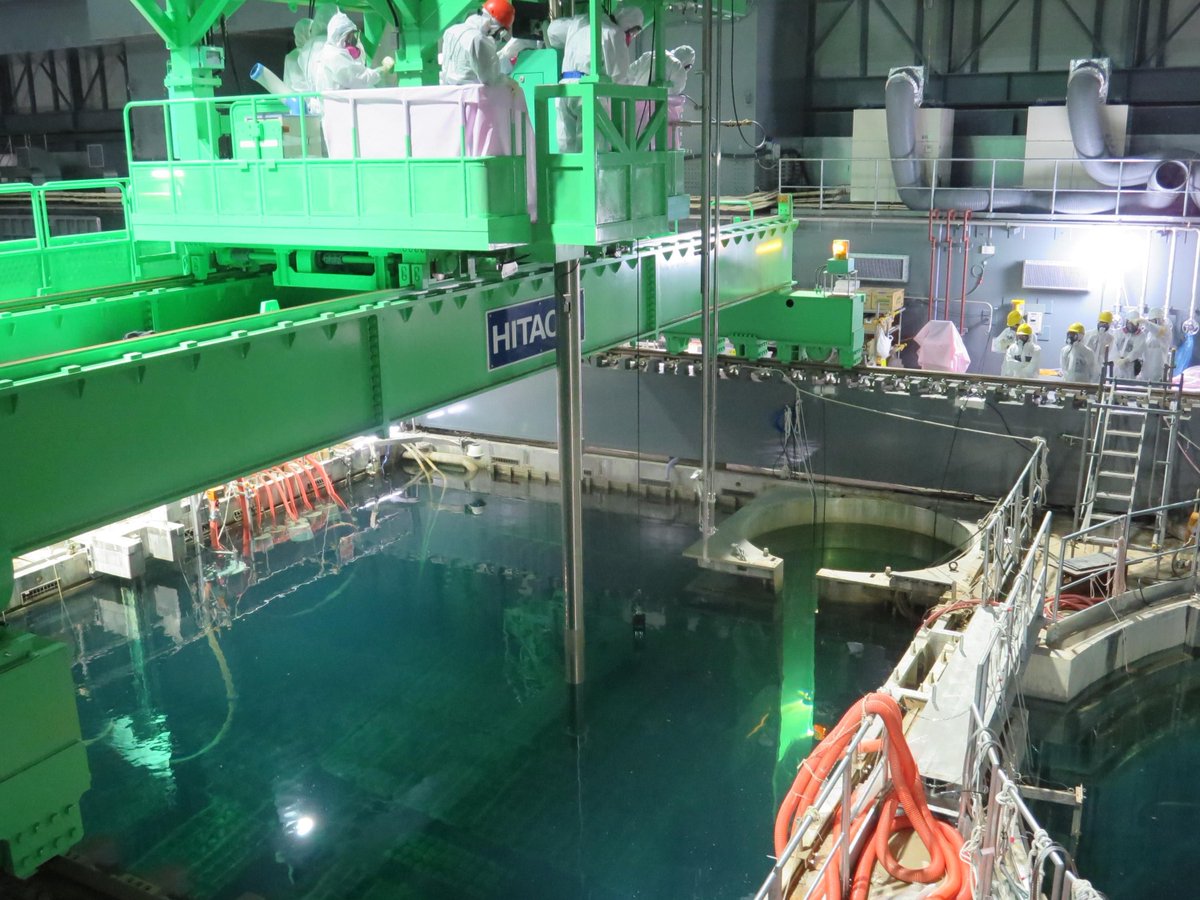
— China issues warning on Fukushima radiation

From Global Times
By Xuyang Jingjing in Tokyo and Zhang Yiqian in Beijing
February 15, 2017

○ The Chinese Embassy in Japan issued a warning over Fukushima radiation last Sunday, causing panic in China

○ Meanwhile, in Japan, everything went on normally, tourists and residents remain largely unaffected by the matter

○ In recent years, as the popularity of Japan as a tourist destination increases, Chinese people have developed a love-hate relationship with their neighbor. Any political rift or societal change between the two countries can cause large-scale effects.

An update of an old issue in Japan has sent ripples across the East China Sea to shake China. After the Tokyo Electric Power Company (TEPCO) announced its latest analysis of the inside of its crippled nuclear plant in Fukushima that showed the radiation level there has seemingly risen from 73 sieverts per hour to 530 – a potentially lethal dose – the news has been traveling fast on the Chinese Internet.

[Editor: This was misinformation; the reading was taken in an new area that TEPCO had not been able to measure before — it was not an increase. Experts say that as they are able to get farther inside, they will find higher measurements.

From Helen Caldicott: The radiation measurement was 530 sieverts, or 53,000 rems (Roentgen Equivalent for Man). The dose at which half an exposed population would die is 250 to 500 rems. So “potentially” lethal is a lie. This radiation level is even frying robots.]

Last Sunday, the Chinese Embassy in Japan issued a safety warning in reaction to this announcement, telling Chinese citizens to manage their travel plans to avoid potential radiation risks that may come if nuclear material leaks out into the surrounding environment. The warning caused even more discussion and when rumors started spreading, many Chinese became worried, some even canceling their trips to Japan.

Business as usual

A couple of weeks after the news came out, people in Japan seemed as calm and reserved as ever. There are still many Chinese tourists on the streets and in shops. According to Chinese tourism agencies, their business has been basically unaffected.

The director of a large Chinese travel agency told the Global Times last Sunday that Fukushima wasn’t a regular travel destination for Chinese tourists anyway, and the company doesn’t offer any travel packages there.

Li Dan, manager of a branch of the Beijing-based Tianping International Travel Agency, said that there haven’t been any tour groups traveling to Fukushima since the 2011 earthquake and resulting tsunami. She also said that even tourists who travel independently do not usually go to Fukushima.

Last week, Will Davis, a member of the American Nuclear Society, refuted claims that radiation levels are soaring at the Fukushima No. 1 nuclear power plant as “demonstrably false.” In a post on the society’s blog, Davis wrote that the readings have not changed and that TEPCO’s reported 530 sieverts per hour estimate was not “unimaginable” or particularly worrying.

His argument is that rather than a real increase from 73 to 530 sieverts, the 530 reading is simply a more accurate estimate of the radiation level at a particularly affected area that has remained relatively unchanged over the past few years.

Compared with China, news of the radiation levels in Fukushima has not generated much discussion in Japan. The responses from the media or public to the Chinese safety alert are also few.

For people living in Tokyo, three hours’ drive from Fukushima, life has continued as usual. While they feel a little concerned whenever such reports come out, they are not actively worried in their daily lives, several Japanese white-collar workers said.

For people trying to get their lives back to normal in the affected area, their biggest headache and frustration is the bad reputation and rumors that dog their agricultural products.

In supermarkets, consumers who are concerned about radiation contamination choose more expensive products from different areas over cheaper product from Fukushima. Local residents, NGOs and governments are still working to scrub the stain off the reputation of food produced in Fukushima.

Continue reading

— Japanese agency launches investigation to stop “negative effects of groundless rumors” on Fukushima products

From Asahi Shimbun

Agency to probe reasons behind underpricing of Fukushima items

By NORIYOSHI OHTSUKI/ Senior Staff Writer

February 15, 2017

Prices of agricultural products and foodstuffs from Fukushima Prefecture declined after the nuclear plant accident in March 2011, and almost six years later, have yet to recover to pre-disaster levels.

Now the government is seeking to ascertain why these items are still being sold at lower prices, suspecting that wholesalers are deliberately underpricing products being shipped from the prefecture.

The Reconstruction Agency will survey wholesalers’ purchase prices of Fukushima-made food products, according to sources.

The agency believes crops and other items grown in the prefecture are being undersold because of the negative effects of groundless rumors stemming from the accident at the Fukushima No. 1 nuclear power plant. The latest decision is aimed at preventing the spread of those rumors.

The agency’s plan is expected to be included in a draft revision of the Law on Special Measures for the Reconstruction and Revitalization of Fukushima, to be submitted during the current Diet session.

Since the Great East Japan Earthquake and tsunami on March 11, 2011, triggered the nuclear accident, Fukushima-made foodstuffs have been shipped only after their radioactivity levels are confirmed to be below safety standards.

The levels for those agricultural and other products typically fall below detectable levels, meaning most foodstuffs from Fukushima Prefecture are completely safe to eat.

Despite the fact, trading prices of rice and beef produced in the prefecture are still nearly 10 percent lower than national averages, according to the agency.

The agency suspects that the prices have not recovered to their pre-disaster levels not only because consumers tend to avoid Fukushima-made articles, but also because they are “purchased at unreasonably low rates” at the time of shipping.

When prices to wholesalers of food products grown in the prefecture are lower than pre-disaster rates, farmers can be compensated for the difference by Tokyo Electric Power Co., operator of the Fukushima No. 1 nuclear plant.

“Some wholesalers may knock down the price, misusing the compensation system,” said a source at the Reconstruction Agency.

To prevent the abuse of the compensation system, the special measures law will be amended to include a plan to conduct “a survey to make clear why they (Fukushima-made products) are suffering from sluggish sales.”

Based on the revised law, the agency will survey the prices farmers are selling their crops for to wholesalers, how much consumers are paying for the agricultural products and other trading prices of foodstuffs from Fukushima Prefecture.

After identifying the reason for the lower prices, the agency will offer instructions and advice to wholesalers and other related parties.

http://www.asahi.com/ajw/articles/AJ201702150001.html

Posted under Fair Use Rules


— Helen Caldicott: The Fukushima nuclear meltdown continues unabated

Global Research, February 14, 2017
Independent Australia 13 February 2017

Global Research Editor’s Note

In 2011, with foresight and scientific analysis Dr. Helen Caldicott focussed on the implications of the Fukushima disaster at a Press Conference in Montreal organized by Global Research. The 2011 GRTV video presentation featuring Dr. Caldicott tells us the truth. This is the most devastating catastrophe in human history.  And six years ago Helen Caldicott analyzed in detail the significance of this tragic event. (M. Ch)

Dr Helen Caldicott, explains recent robot photos taken of Fukushima’s Daiichi nuclear reactors: radiation levels have not peaked, but have continued to spill toxic waste into the Pacific Ocean — but it’s only now the damage has been photographed. 

Recent reporting of a huge radiation measurement at Unit 2 in the Fukushima Daichi reactor complex does not signify that there is a peak in radiation in the reactor building. All that it indicates is that, for the first time, the Japanese have been able to measure the intense radiation given off by the molten fuel, as each previous attempt has led to failure because the radiation is so intense the robotic parts were functionally destroyed.

Satellite image shows damage at Fukushima Nuclear Power Plant (via ecowatch.com).

The radiation measurement was 530 sieverts, or 53,000 rems (Roentgen Equivalent for Man). The dose at which half an exposed population would die is 250 to 500 rems, so this is a massive measurement. It is quite likely had the robot been able to penetrate deeper into the inner cavern containing the molten corium, the measurement would have been much greater. These facts illustrate why it will be almost impossible to “decommission” units 1, 2 and 3 as no human could ever be exposed to such extreme radiation. This fact means that Fukushima Daichi will remain a diabolical blot upon Japan and the world for the rest of time, sitting as it does on active earthquake zones.

Robot image of Fukushima Daiichi Unit 2 reactor (Source: tepco.co.jp)

What the photos taken by the robot did reveal was that some of the structural supports of Unit 2 have been damaged. It is also true that all four buildings were structurally damaged by the original earthquake some five years ago and by the subsequent hydrogen explosions so, should there be an earthquake greater than seven on the Richter scale, it is very possible that one or more of these structures could collapse, leading to a massive release of radiation as the building fell on the molten core beneath. But units 1, 2 and 3 also contain cooling pools with very radioactive fuel rods — numbering 392 in Unit 1, 615 in Unit 2, and 566 in Unit 3; if an earthquake were to breach a pool, the gamma rays would be so intense that the site would have to be permanently evacuated.

The fuel from Unit 4 and its cooling pool has been removed. But there is more to fear. The reactor complex was built adjacent to a mountain range and millions of gallons of water emanate from the mountains daily beneath the reactor complex, causing some of the earth below the reactor buildings to partially liquefy. As the water flows beneath the damaged reactors, it immerses the three molten cores and becomes extremely radioactive as it continues its journey into the adjacent Pacific Ocean.

Six years later, radiation levels at Fukushima are so high not even a robot can survive inside http://buff.ly/2lzNesd 

Every day since the accident began, 300 to 400 tons of water has poured into the Pacific where numerous isotopes – including cesium 137, 134, strontium 90, tritium, plutonium, americium and up to 100 more – enter the ocean and bio-concentrate by orders of magnitude at each step of the food chain — algae, crustaceans, little fish, big fish then us. Fish swim thousands of miles and tuna, salmon and other species found on the American west coast now contain some of these radioactive elements, which are tasteless, odourless and invisible. Entering the human body by ingestion they concentrate in various organs, irradiating adjacent cells for many years.

The cancer cycle is initiated by a single mutation in a single regulatory gene in a single cell and the incubation time for cancer is any time from 2 to 90 years.

Continue reading

— Los Angeles: Public meetings on SSFL cleanup — Tell Dept. of Energy to clean up Santa Susana contamination, not leave it behind!

From the Santa Susana Field Laboratory Work Group
February 13, 2017

“Unless people rise up and our elected officials act strongly to enforce the promises, people in neighboring communities will be at perpetual risk from migrating radioactivity and toxic chemicals.”  Read New Ventura County Star Op-Ed: Santa Susana Field Lab Broken Promises

The Department of Energy (DOE) is attempting to break its obligation to clean up all of the nuclear and chemical contamination at the Santa Susana Field Laboratory (SSFL), proposing instead to leave between 34 -94% of the contamination not cleaned up. That is dangerous and unacceptable!

Urgent action is needed to protect communities near SSFL!

1. Attend one or both of the upcoming DOE hearings and voice your concerns.

  • Saturday, February 18, 2017, 9:00 a.m. – 12 p.m. Grand Vista Hotel, 999 Enchanted Way, Simi Valley, CA (Open house from 9 – 9:30 a.m.)
  • Tuesday, February 21, 2017, 6:00 p.m. – 9:00 p.m., Airtel Plaza Hotel, 7277 Valjean Avenue, Van Nuys, CA (Open house from 6 – 6:30 p.m.)

2. Submit a comment demanding that DOE clean up all contamination at SSFL.

3. Ask your friends, family, and neighbors to also submit a comment and attend the DOE hearings. Please forward this email and share on social media.
Background

The DOE recently released a Draft Environmental Impact Statement (DEIS) that proposes three alternative cleanup plans for its operational area of SSFL, which is where most of the nuclear contamination is located. The three alternatives would respectively leave up to 34%, 86% or up to 94% of the contamination on site, where it can continue to migrate and put nearby communities at risk.

All of the alternatives directly violate the Administrative Order on Consent (AOC) that DOE signed in 2010, which committed them to clean up all detectable contamination. DOE’s DEIS also fails to acknowledge that DOE as the polluter doesn’t have the authority to decide how much of the mess that it made is going to get cleaned up. The decision rests with the California Department of Toxic Substances Control, not DOE.

Click here to learn more about key problems with DOE’s DEIS. Click here to read the DEIS itself. Again, it is critical that as many people as possible attend the DOE hearings and submit comments demanding a full cleanup of SSFL. Thank you!.

The Santa Susana Field Laboratory (SSFL), also known as Rocketdyne, is a former nuclear and rocket engine testing facility that is contaminated with radiological and chemical pollutants. The 2,850 acre site is near Simi Valley, Chatsworth, Canoga Park, Woodland Hills, West Hills, Westlake Village, Agoura Hills, Oak Park, Calabasas, and Thousand Oaks. For over twenty-five years, the Santa Susana Field Laboratory Work Group has served to keep the community informed about the contamination at SSFL and assure it is thoroughly cleaned up.

To learn more visit www.ssflworkgroup.org or contact us at info@ssflworkgroup.org

— Los Angeles: DOE breaks agreement to clean up Santa Susana Field Lab contamination; may leave behind 94%

For action and upcoming meetings, go to http://www.ssflworkgroup.org

From the Ventura County Star

February 11, 2017

Our region has just been hit by two significant events that affect the health of our community.

While we have long awaited some relief for our drought, torrential rainstorms inundated the Santa Susana Field Lab, one of the most polluted places in the state. Runoff from far lesser storms in recent years resulted in more than 200 instances in which highly toxic and radioactive contaminants migrated off site at levels in excess of state pollution limits, and one can only imagine the effect these recent large storms have had.

Around the same time, the Department of Energy broke its solemn cleanup commitments and announced it would leave as much as 94 percent of the soil contaminated at the field lab site not cleaned up. Unless people rise up and our elected officials act strongly to enforce the promises, people in neighboring communities will be at perpetual risk from migrating radioactivity and toxic chemicals.

The field lab housed 10 nuclear reactors, of which at least four suffered accidents, including a partial nuclear meltdown in 1959. There was a factory for fabricating reactor fuel rods out of plutonium, perhaps the most dangerous substance on earth. In a “hot lab” there, highly irradiated nuclear fuel rods shipped in from around the nation were cut apart, with several radioactive fires.

It illegally burned radioactive and chemically hazardous wastes in open air pits, by shooting barrels of the waste with rifles to ignite them, with the toxic plumes blown over surrounding communities. It conducted tens of thousands of rocket tests, many using very dangerous fuels, and then flushed out the engines with a million gallons of toxic solvents that were allowed to simply percolate into the soil and groundwater.

The result of this shameful violation of basic environmental protections is widespread contamination of groundwater, surface water and soil with strontium-90, cesium-137, plutonium-239, perchlorate, PCBs, dioxins, heavy metals, volatile organic compounds and much more. And because the site sits in the hills overlooking more than 500,000 people within 10 miles, the contamination wants to flow off site to the places and people below.

The site has been fined more than $1 million in recent years for allowing pollutants to migrate off the property at levels deemed unsafe for people or the environment. And as long as the site doesn’t get cleaned up, that will continue.

These awful materials cause cancers including leukemia, genetic defects, neurological and developmental disorders and other health problems. A federally funded study by Dr. Hal Morgenstern of the University of Michigan found a greater than 60 percent increase in key cancers in people living near the site compared with people living farther away. Another government-funded study by a team from UCLA led by Dr. Yoram Cohen concluded that numerous pollutants from the site had migrated off site at levels in excess of EPA levels of concern.

For these reasons, the community was joyous in 2010 when the Department of Energy and NASA signed legally binding agreements with the California Department of Toxic Substances Control requiring all contamination that could be detected in the soil to be cleaned up by 2017.

It is now 2017 and the cleanup hasn’t even begun. And the DOE just issued a draft environmental impact statement breaking the 2010 cleanup agreement and saying it will only consider three options, none of which comply with its past commitments.

One would leave 34 percent of the contamination in place. A second would leave 86 percent. And the third would walk away from a staggering 94 percent of the contaminated soil, just leaving it in place. The 2010 agreement barred any consideration of leave-in-place alternatives.

The DOE has essentially thumbed its nose at California. Even if the cleanup agreement didn’t exist, the decision on how much toxic pollution to clean up doesn’t rest with the polluter, but with the state regulator. The DOE can’t decide to just walk away from most of the contamination.

But the state has been remarkably silent so far in response to this assault on its authority. Indeed, it has in its own actions undercut the cleanup agreement it signed. Toxic Substances Control is years late on its own environmental impact report and has been busy undermining the cleanup in other ways as well.

In 2010, we were promised that, with a couple of narrow exceptions, all of the soil contamination that could be detected would be cleaned up. Now it appears likely than close to none will be, and the people in the area will continue to be at perpetual risk from migrating radioactive and toxic contamination — unless they speak out now, loud and clear, and their elected representatives do the same.

Robert Dodge, a family physician in Ventura, serves on the boards of Physicians for Social Responsibility, the Nuclear Age Peace Foundation and Citizens for Peaceful Resolutions. Daniel Hirsch is director of the Program on Environmental and Nuclear Policy at UC Santa Cruz and president of the Committee to Bridge the Gap.


http://www.vcstar.com/story/opinion/columnists/2017/02/11/dodge-hirsch-santa-susana-field-lab-broken-promises/97766134/

Posted under Fair Use Rules.

— Lost in translation: Fukushima readings are not new spikes, just the same “hot mess” that’s always been there

From Beyond Nuclear
February 9, 2017

The ongoing Fukushima nuclear catastrophe has been back in the news lately following record high readings at the reactor site. Radiation levels were estimated to be 530 sieverts per hour, the highest recorded since the triple core meltdown in March 2011.

But upon further examination, the story has been misreported, in part due to mistranslation. In fact, according to Nancy Foust of SimplyInfo.org, interviewed on Nuclear Hotseat, there was no spike. High readings were in expected locations that TEPCO was only able to access recently. Therefore, the reading became evident because workers were getting closer to the melted fuel in more dangerous parts of the facility. In other words, it’s not a new hot mess, just the same hot mess it’s always been, pretty much from the beginning. The good news is nothing has changed. The bad news is – nothing has changed.

The confusion was initially caused by a translation error that SimplyInfo.org thinks occurred between the Kyoto News and Japan Times.  Since this happened, Foust and her group have been trying to get news sources to correct the stories, with limited success.

The elevated radiation levels are inside containment (good news) in ruined unit 2 and were discovered using a camera, not proper radiation monitors. Therefore, the high reading may not be reliable since it is an estimate based on interference data with the camera. (It has been reported that the 530 Sievert/hour figure could be 30% too low, or 30% too high. 530 Sieverts/hour equates with 53,000 Rems/hour, a dose rate that would deliver a fatal dose of radiation to a person a short distance away, with no radiation shielding, in a minute or less exposure time.) TEPCO is planning on sending in a robot properly equipped with radiation detectors to take a reliable reading. Although no date has been given, TEPCO indicates it expects to deploy the robot within 30 days or so…

http://www.beyondnuclear.org/japan/2017/2/9/lost-in-translation-fukushima-readings-are-not-new-spikes-ju.html

— San Francisco: EPA & Navy used wrong and unsafe standard for radioactive/toxins cleanup; EPA Superfund manager stonewalls at public meeting

Lily Lee, EPA Cleanup Project Manager, Superfund Division
Interviewed on February 8, 2017 at a community meeting on the cleanup problems and fraud at the San Francisco Superfund site. The Superfund site is located at the former Hunters Point Naval Shipyard and Naval Radiological Defense Laboratory.

Ms. Lee was interviewed by Labor Video Project, and then asked questions by Dan Hirsch, UCSC Executive Director on Environmental and Radioactive Policy, on the cleanup and EPA exposure guidelines. Her answers, as Superfund Cleanup Project Manager, are surprising.

This is why these agencies organize “poster” open house format meetings. They do not want to be asked these important questions in front of an audience, and they certainly don’t want to be forced to answer. Of course, as public employees, they don’t want to be seen as avoiding or stonewalling, and they certainly don’t want to go on the record admitting negligence or indifference in implementing rules.

In a meeting in another town on a public health issue, members of the public refused to put up with this style of format. They pulled chairs into the center of the room, sat down as a group, and demanded to have a presentation made to them as a whole. Rather than do that, the people in charge gathered up their materials and walked out. Unless forced, they will not submit to a regular meeting format.

https://youtu.be/J_YVou0kmQI

Interview of Lily Lee, EPA, begins at 29:13

This transcript begins toward the end of her interview with Labor Video Project

Lee: …We are here to say that I am doing my job every day the same way I have been and I will keep doing so to ensure that the cleanup here is meeting all of the health-based standards

LVP: I understand that 50% of the black population, African-American population, their children have asthma and other toxins from living out here. Is that of concern to you?

Lee: What we do here is that we set the standards for cleanup based on health-protective levels and then we ensure that when the Navy’s cleanup is happening, both during the process and when they’re done, that it meets our health-based standards to protect people from health conditions such as asthma.

[“Health-protective levels” and “health-based standards” — The EPA has repeatedly loosened exposure guidelines for radioactivity which they acknowledge increases the percentage of the population that will develop cancer. If the EPA uses these terms often enough, do they believe they will become accurate?

Her following interchange with Dan Hirsch reveals that she does not enforce EPA’s own standards, and she further says that steady exposure to radiation at the level of 25 millirem is something the body can cope with.]

Hirsch: Did the EPA’s criteria in effect at that time — I’m not talking about doing an analysis years later that it wasn’t that big of a mistake — why was the mistake made in the first place? Why did EPA allow clean-up standards that were contradicting EPA’s then current standards?

Lee: And again, I wasn’t there at that time and I tried to look for records about this information, and I’ve unfortunately not been able to find those records, but what I can tell you is that I am looking at the current standards, the current PRG calculator which is unfortunately in flux right now, and we are looking to see, revisit these standards to determine whether or not they would fall within the circle risk (?) range using site-specific factors.

Hirsch: I mean, you know you’re playing a game about this over and over again. The public was told you were cleaning up to a one in a million risk. You’ve seen EPA standards, but it turns out the Navy didn’t do that and used standards that are very much weaker than the ones that they said they would be using, and EPA said should be used at that time.

You’re now saying you’re seeing whether, okay it was a mistake but whether the mistake was mistake of a 300 fold. That isn’t very reassuring to the public.

I want to come back to the central issue. Do you agree that 25 millirems should not have been used, that was, even at the time, something the EPA said that was not acceptable and not protective.

Lee: I want to explain that some of the language that you saw in the footnotes referenced the 25 millrems but wasn’t necessarily the only standard that the Navy would be required to meet that

Hirsch (interrupting): In the tables, they actually estimate the dose for the other standard that they met, and for several of those, that was 25 millirem. So they actually did use 25 millirem. They shouldn’t have

Lee (interrupting) ___waste?

Hirsch: And structures.

Lee: Okay, and structures.

Hirsch: And they’re not supposed to according to EPA guidelines.

That’s 12 chest x-rays a year. They’re saying it’s okay for people to get a chest x-ray a month from the moment of conception to the moment of birth. Even the EPA says that level of radiation is outside the upper limit of your acceptable risk range.

So do you concede that they used a cleanup number that EPA said, even at the time, should not have been used?

Lee: So, I would like to talk about the chest x-ray which is an acute dose meaning a dose that people would get in one situation during the chest x-ray itself as being different from what’s relevant here at the base which would be a dose that would be over time continuously across year. So that wouldn’t be something

Hirsch (interrupting): Your own agency says there is no difference. EPA formally said that getting a chest x-ray a month is no different than getting a thirtieth of a chest x-ray every day for those months. That there is no… It’s linear, so the rate at which you get it doesn’t matter.

You know that’s your own agency’s official position.

Lee: So, if you can get a small dose that’s over a period of time, your body does have some recovery and

Hirsch (interrupting): Excuse me, are you saying that EPA believes that radiation is potentially good for you – the hormesis theory? Or that, or are you also saying that the risk is not linear with dose? Because the official position of EPA is just the opposite of what you’ve just said.

Lee: So, thank you for sharing your perspective. I am saying that those kinds of exposures are different, and I am also saying as I have said before that we are looking at the original standards to see if under the current version of the PRG calculator which is going to be changed soon, that that will still fall within the national contingency plan superfund regulation range of acceptable.

Hirsch: I want you to answer once and for all whether the standards that they chose were consistent or inconsistent with EPA’s guidance in effect at the time they chose them. Not whether going back years later and trying to say whether it was a 300 fold mistake.

Was the standard chosen by the Navy and approved by the EPA inconsistent with EPA’s Superfund guidance in effect at the time?

Lee: And I’d let you know that I don’t have information about what the standards were in effect at the time and I’m going to go back and look at that information some more. I’ve done some research

Hirsch (interrupting): ___the 25 millirem was back then considered unacceptable? Back in 2013? Do you not know the ___ in 2013 is not acceptable? So why was 25 millirem allowed to be used?

Lee: As I said, we are going to be checking the current version of EPA calculator

Hirsch (interrupting): Why was a cleanup standard allowed to be used that was not consistent with your guidance? I’m not talking about whether a post doc analysis as to whether it is too huge a mistake. I’m talking about whether it was a mistake. 25 millirem, is it not today, and wasn’t it in 2013, outside the level that EPA said was protective? It was a level that EPA said should not be used for cleanup standards. Am I not right about that?

Lee: I will go back and check to make sure.

Hirsch: Don’t you know that 25 millirem EPA has always, has said for long periods of time and certainly in the last years, is not to be used at Superfund sites?

Lee: I have seen that guidance information before.

Hirsch: Alright. Well, then, let’s just admit, can’t you, that they used a cleanup standard that was incompatible with Superfund guidance in effect at the time. Can you admit that?

Lee: As I said, I will go back and check that information.

— San Francisco Hunters Point land development on hold as falsification of toxics cleanup investigated

Earlier reporting on this situation.

From Hood Online

September 22, 2016

Hunters Point Shipyard Land Transfers On Hold As Toxic Waste Cleanup Investigated

By John Shutt

Regulators from the Environmental Protection Agency and California Department of Toxic Substances Control have told the Navy to stop transferring land from the Hunters Point Shipyard to developers while agencies investigate the extent of the falsification of data about the cleanup of toxic and radioactive materials at the site.

The regulatory action was first reported in the Ingleside-Excelsior Light last week, and stemmed from investigations into Navy contractor Tetra Tech.

NBC Bay Area reported earlier this year that a former Tetra Tech employee said he had been told to swap potentially contaminated soil samples for clean ones, dump potentially contaminated soil into open trenches around Hunters Point, sign falsified documents submitted to the government, and tamper with computer data about radiation levels. Other former workers said they were fired in retaliation after reporting violations to regulators.

The shipyard was declared a superfund site by the Environmental Protection Agency due to contamination from the Naval Radiological Defense Laboratory, located there from 1948 through 1969, and toxic waste left over from industrial use. The Navy is obligated to clean land at the shipyard before it is turned over for development.

EPA regional spokesperson Michele Huitric confirmed that investigations into Tetra Tech are ongoing, and said the EPA was aware of investigations by the Nuclear Regulatory Commission and the Navy. The Nuclear Regulatory Commission previously recommended a fine against Tetra Tech after they found the company had deliberately falsified data.

Part of the shipyard declared safe by regulators has already been transferred to developer FivePoint, a spinoff of Lennar Corporation, which is building residential housing. A FivePoint spokesman said that the Tetra Tech whistleblower reports are not related to Parcel A, the land they are building on.

“Parcel A was transferred in 2004, several years prior to the alleged soil mishandling, and after the Navy, USEPA, and State of California determined the property was cleaned up and safe for transfer,” said FivePoint spokesperson David Satterfield. “Parcel A was removed from the National Priorities List at that time and is no longer considered a federal superfund site.”

Bradley Angel from environmental activist group Greenaction said that he had confronted FivePoint officials at a recent sales event about the cleanup, and had been shown documents that indicated Tetra Tech worked on at least part of Parcel A.

“They took us into the back room and took out three big binders and opened the first one, and of course the first sentence was about Tetra Tech’s work at the Shipyard, but not, of course, about falsification of soil samples,” Angel said.

San Francisco Magazine reported yesterday that a July email from the Navy indicated that Tetra Tech may have done sampling on Parcel A.

Greenaction has called for Tetra Tech to be fired and for an independent investigation of toxin and radiation levels at the shipyard and in the surrounding area.

UC Santa Cruz researcher Dan Hirsch, part of a team preparing a report on the cleanup, said that not only had Tetra Tech falsified soil samples, the Navy has been using outdated remediation standards that allow much higher levels of toxic material than the EPA currently recommends—in some cases about 100 times higher—and radiation levels equivalent to 12 chest x-rays per year for residents.

“We found over and over again that the Navy used standards that EPA said they aren’t supposed to use,” Hirsh said.

Mayor Ed Lee and Supervisor Malia Cohen wrote to the Environmental Protection Agency on Sept. 19th requesting a meeting.

“The environmental cleanup of the property is a critical first step in the process of developing Hunters Point Shipyard—a project that will deliver desperately needed housing and long-overdue public benefits to the Hunters Point community,” read the letter. “For that reason, we are requesting a briefing with senior Environmental Protection Agency leadership, confidential if necessary, so that we may better understand the scope and timelines of the investigations, and any potential impacts to the overall schedule for the delivery of these public benefits.”

The Shipyard development is a major piece of the city’s strategy for developing the southeastern waterfront. FivePoint plans to build 1,400 units of housing on the land that has already transferred, but thousands of additional units are now in limbo.

http://hoodline.com/2016/09/hunters-point-shipyard-land-transfers-on-hold-as-toxic-waste-cleanup-investigated

— Cover-up of radioactive and toxic waste at San Francisco; whistleblowers fired; 25 millirem used for testing in violation of EPA standards

Video by the Labor Video Project
53:53

The 420-acre shipyard was one of the nation’s most notorious Superfund sites, home to a federal nuclear program begun in 1946 that included a secret laboratory [Naval Radiological Defense Laboratory] where tests were conducted to determine the effects of radiation on living organisms. Military equipment and ships contaminated by atomic bomb explosions were kept at Hunters Point, and the grounds were polluted with petroleum fuels, pesticides, heavy metals, PCBs, organic compounds and asbestos. — SF Chronicle, February 7, 2017

On February 8, 2017, government agencies held a  meeting on the state of clean up at San Francisco’s former Hunters Point Naval Shipyard. It was an open format”  meeting with poster boards and reps scattered around the room, forcing people to individually talk with reps. This was done instead of a real meeting before the whole audience — presentations by the various oversight agencies and questions and answers from audience which would put them on record for their remarks and which everyone could hear. “A government propaganda show,” said a community advocate. This format was deliberately chosen for lack of accountability.

The Navy representative refused to answer a request to hold a meeting with presentations and debate.

Government representatives included:

Nina Bacey, California Dept of Toxic Substances Control
Amy Browntell, SF Department of Public Health
Lily Lee, EPA Cleanup Project Manager, Superfund Division
Zach?, U.S. Navy
Malia Cohen, SF Board of Supervisors

Community advocates who spoke on camera included:

Marie Harris, Green Action
Bradley Angel, Green Action
Dr. Ray Tomkins, environmental scientist
Daniel Hirsch, UCSC Executive Director on Environmental and      Nuclear Policy; Founder, Committee to Bridge the Gap

Comments and interviews:

3:10 Interview of Nina Bacey, California DTSC

16:13 Interview of Amy Brownell, SF Public Health

18:37 Marie Harris, Green Action

20:10 Bradley Angel, Green Action

22:11 Dr. Ray Tomkins, environmental scientist — on the testing

29:13 Interview of Lily Lee, EPA

35:10 Daniel Hirsch (UCSC) questions Lily Lee (EPA)

41:40 Interview of Malia Cohen, SF Supervisor

45:07 Bradley Angel, Green Action

From the Labor Video Project

Cover up blows up at SF Hunters Point Naval Shipyard “Clean-up” Meeting, 2-7-17

At a meeting at San Francisco Hunters Point superfund site, the US Navy, EPA, California Department of Toxic Substances and San Francisco Department of Public Health tried to explain what they are doing about the systemic falsification of testing at the highly contaminated site. There has been on Federal, state or local criminal investigation of the intimidation, workplace bullying and termination of health and safety testers and whistleblowers at Test America and Tetra Tech. The US Navy also said they are still employing Tetra Tech around the United States.

Continue reading

— Explosion at Flamanville nuclear power plant in France, officials say no risk of contamination

From RT

February 9, 2017

https://www.rt.com/news/376796-blast-france-nuclear-plant/video/

FILE PHOTO General view of the operating nuclear power plant in Flamanville, north-western France © Charles Platiau / Reuters

An explosion has occurred at Flamanville Nuclear Power Plant, in France’s north-west, officials told local media, adding that several people were slightly injured after inhaling the fumes, though there is no nuclear risk.

The incident occurred at 9:45 local time (08:45 GMT) in an engine room, Électricité de France (EDF) said in a statement. The power at Reactor №1 was “disconnected automatically” after the blaze started in an engine room in the non-nuclear part of the facility.

At least five people have been slightly injured inhaling the fumes caused by the blast, AFP reports citing authorities.

There is no contamination risk to locals, authorities said.

According to AFP, the Unit 1 reactor will still temporarily be shut down, however.

It is a significant technical failure but it is not a nuclear accident” because the explosion occurred “outside the nuclear zone,” Olivier Marmion, director of the prefect’s office, told AFP.

A @EDFFlamanville 1, départ de feu maîtrisé en zone non nucléaire. Aucune victime et pas de conséquence pour la sûreté et l’environnement.

The nuclear plant located in the Flamanville commune has two pressurized water reactors that produce 1.3 GWe (gigawatt electrical) each. The reactors were built in 1986 and 1987. A third reactor will be completed by 2018.

The plant is owned by Électricité de France (EDF), a French electric utility company, headquartered in Paris.

https://www.rt.com/news/376796-blast-france-nuclear-plant/