Judge halts Takahama nuclear reactors

Fires at two U.S. nuclear plants; emergency declarations by NRC

Oconee Nuclear Plant in North Carolina — March 7, 2016
Watts Bar Nuclear Plant in Tennessee — March 9, 2016

From ENE News

ALERT: Emergency at US nuclear plant after “massive” fire and multiple explosions — “All of a sudden we heard this loud boom and the whole ground started shaking” — “Intense Flames… Heavy Black Smoke… Chaos” — 100s of fire personnel called in — “We ask that the public stay away from the area” (VIDEOS)

3-8-16

U.S. Nuclear Regulatory Commission, Mar 7, 2016 (emphasis added): [Oconee Nuclear Station, SC] EMERGENCY DECLARATION DUE TO FIRE/EXPLOSION IN THE MAIN TRANSFORMER… At 1520 EST, the licensee declared a Notification of Unusual Event… personnel were applying additional foam to prevent a re-flash… Offsite assistance was requested with three local fire departments… At 1658 EST, the licensee declared an Alert [when] the fire damaged an overhead power line that supplies emergency power to all three units at Oconee.

WHNS transcript, Mar 7, 2016: People fishing on the lake… reported hearing a loud boom and seeing black smoke, and then steam… Witnesses say there were two explosions… This afternoon [was] chaos… Fire crews [were] all on scene at the Oconee nuclear plant after a massive electrical fire… Fire Official: “It’s also in very close proximity to the buildings… I know they worked on… preventing the transformer from impinging on any of the other structures”… People in the area were very concerned when they saw heavy black smokeWitness: “All of a sudden we heard this loud boom and the whole ground started shaking.”… It’s a scary situation… [An official] said it was a very rare problem.

Loudspeaker at Oconee Nuclear Station: “Attention all site personnel… This is an emergency message… An unusual event has been declared for Unit 1… TSC – OSC [Technical Support Center – Onsite Operational Support Center] activation is necessary and the TSC – OSC has not yet been activated. Activate the TSC – OSC — I repeat, activate the TSC – OSC.”

WYFF, Mar 7, 2016: Scott Batson, site vice president [said] the intense flames and smoke came from oil burning… Batson said because a cable burned in the fire fell and caused other equipment to be affected, which led to the “unusual event” to be upgraded to an alert.

FOX Carolina, Mar 7, 2016: Hundreds of fire personnel sprang into action after a fire started at the Oconee Nuclear Plant.

WSPA transcript, Mar 7, 2016: Nearby Resident:I freaked out – you see a fire, smoke at a a power plant”… Fire Chief: “When you’re responding to a call, and you can see it when you leave the station like that, it really kind of gets your adrenaline going.”

Oconee County Emergency Management, Mar 7, 2016: “We ask that the public stay away from the area as emergency personnel and Duke Energy staff work.”

Greenville News, Mar 6, 2016: The alert was necessary because the problem could have affected operations of the plant itself… The transformer is 25 to 30 feet from the turbine building that serves Unit 1 and about 100 yards from the reactor building

WLOS, Mar 6, 2016: A transformer burst into flames at an Upstate nuclear power station…. Officials did ask the public to stay away from the area… The fire chief also said crews are continuing to work with on-site personnel to ensure… there is no further extension.

From last month: ALERT: Fire/explosion at North Carolina nuclear plant (VIDEO)

Watch broadcasts: WHNS | WSPA | Loudspeaker Announcement

EMERGENCY: Fire breaks out at another US nuclear plant — Blaze ignites in turbine building — “It took so long to put out” — Alert issued to government officials (VIDEO)

March 10, 2016

U.S. Nuclear Regulatory Commission, Mar 9, 2016 (emphasis added): WATTS BAR [Tennessee]… Emergency Class: UNUSUAL EVENT… EMERGENCY DECLARED… UNUSUAL EVENT DECLARED DUE TO A FIRE GREATER THAN 15 MINUTES… Watts Bar Unit 2 declared an Unusual Event at 0342 EST based on a fire greater than 15 minutes in the turbine building – 2B Hotwell pump motor… Notified DHS… DOE, FEMA… and Nuclear SSA…

WBIR, Mar 9, 2016: An electrical fire overnight at TVA’s Watts Bar Nuclear Plant in southeast Tennessee triggered an alert… It took about 29 minutes from the time the fire was discovered until it was extinguished by the Watts Bar Fire Brigade. The pump was in a part of the plant that is hard to access, and that’s why it took so long to put out. Because the fire burned longer than 15 minutes, a Notice of Unusual Event (NUE) was declared. The NUE triggered an alert to TEMA and other agencies… Unit 2 is fueled but is non-operational. The hot well is where the steam from power generation ends up after being condensed back into water.

WTVC, Mar 9, 2016: TVA spokesman Scott Brooks says the fire broke out at 3:45 a.m. in one of the pump motors, one that received an operating license back in October.

Power Engineering, Mar 9, 2016: Watts Bar 2 Shut Down After Turbine Building Fire — Workers with the Tennessee Valley Authority (TVA) declared an Unusual Event at Watts Bar Unit 2 in Tennessee due to a fire inside the turbine building… The cause is under investigation.

Chattanooga Times Free Press, Mar 10, 2016: Fire at Watts Bar… triggers emergency event

Chattanooga Times Free Press, Mar 9, 2016: Fire in Watts Bar pump motor on Thursday declared an emergency… fire ignited early Wednesday in one of the pump motors for TVA’s newest reactors, forcing the federal utility to declare the lowest of emergency classifications at the plant even before it has produced any power… The Watts Bar Unit 2 reactor will be the first new nuclear reactor added to America’s nuclear grid since the other Watts Bar unit started up in 1996. TVA has spent more than $5 billion to build the unit through a series of starts and stops in construction since the project began in 1973.

WRCB, Mar 9, 2016: Fire in Watts Bar pump motor today brings emergency declaration

WJHL, Mar 9, 2016: TVA: Watts Bar Dam generating unit caught on fire… Tennessee Valley Authority was alerted of an “usual event” [and] was able to extinguish the fire after the alert.

Watch WBIR’s broadcast here


http://enenews.com/alert-emergency-nuclear-plant-after-massive-fire-multiple-explosions-all-sudden-heard-loud-boom-ground-started-shaking-videos

http://enenews.com/fire-breaks-another-nuclear-plant-emergency-event-declared-long-put-alert-issued-government-officials-video

Leaking beachfront nuclear reactor near Miami threatening Florida everglades

Posted on Zero Hedge
3-10-16

Submitted by Claire Bernish via TheAntiMedia.org,

According to a study released by Miami-Dade County Mayor Carlos Gimenez on Monday, the waters of Biscayne Bay measured 215 times the level of radioactive tritium as is found in normal ocean water.

Tritium is a radioactive isotope traceable to nuclear plant cooling tower operations. In this case, the leak appears to be emanating from the aging canals in the Turkey Point Nuclear Generating Station located nearby.

“This is one of several things we were very worried about,” said South Miami Mayor and biological sciences professor, Philip Stoddard, as the Miami New Times reported. “You would have to work hard to find a worse place to put a nuclear plant, right between two national parks and subject to hurricanes and storm surge.”

Biscayne Bay harbors one of the largest coral reefs on the planet and is situated near the Everglades. Hot, salty water from the canals appears to be flowing back into both national parks, which has caused concern among environmentalists and others from the time Turkey Point planned to expand its reactors in 2013.

“They argued the canals were a closed system, but that’s not how water works in South Florida,” Stoddard remarked.

“How much damage is that cooling canal system causing the bay is a question to be answered,” Everglades Law Center Attorney Julie Dick told the Miami Herald prior to reviewing the report. “There are a lot more unknowns than knowns and it just shows how much more attention we need to be paying to that cooling canal system.”

Tritium, a hydrogen isotope, is considered a precursor indication of leaks from nuclear plants, as it ‘travels’ or spreads faster than, and often precedes, other radioactive agents.

“While the tritium levels far fall below levels experts consider dangerous, the telltale tracer provided the critical link that high levels of ammonia and phosphorus in sections of bay bottom — pollution that is more damaging to marine life — likely came from the canals,” the Herald explained. Samples for the county monitoring study were gathered during December and January — and the tritium levels seem to show Florida Power & Light in violation of both local water laws and federal operating permits.

FPL, which operates Turkey Point, will likely receive another violation due to the leak — the county issued a citation in October for tainted groundwater — to force FPL to bring the plant into compliance, the Herald reported Tuesday.

After news of the report made headlines, critics, including environmentalists, nearby rock miners, and Rep. Jose Javier Rodriguez, came forward in full force calling for the Environmental Protection Agency to intervene in the matter.

“For years our state regulators have failed to take seriously the threat to our public safety, to our drinking water, and to our environment posed by FP&L’s actions at Turkey Point,” Rodriguez asserted, according to the New Times.“Evidence revealed this week of radioactive material in Biscayne Bay is the last straw and I join those calling on the U.S. EPA to step in and do what our state regulators have so far refused to do — protect the public.”

The leak also serves as possible confirmation for environmentalists who have suspected radioactive leaks from Turkey Point as the cause of algae blooms appearing in the bay for years.

“Biscayne Bay has not traditionally had algae blooms,” explained executive director for Miami Waterkeeper Rachel Silverstein, reported the Herald. “That’s from pollution. From sewers, septic tanks and now we know, cooling canals.”

Indeed, though FPL claims it continues to protect the health of the bay, as the Herald noted, Turkey Point has created issues for the waterways since the facility began producing more energy three years ago. “When you look at the big picture,” FPL environmental director, Matt Raffenberg, insisted, the canals “are not impacting Biscayne Bay.”

At a meeting on Tuesday, county commissioners discussed the imperative need to bring FPL and Turkey point into compliance with the law.

“We’ve had stop gap measures we’ve approved,” Gimenez said. “So far they’ve not proved to be the solution.”

Referencing the last time FPL was forced to implement changes following a lawsuit in the 1970s, he added, “It’s time we enter the 21st century.”

FPL’s continued problems with Turkey Point might have finally crossed the legal line by violating the federal Clean Water Act.

“There’s a certain validation to critics in seeing this result in the study,” Stoddard said. “But more important, it’s now crossed the threshold of federal law here.”

http://www.zerohedge.com/news/2016-03-10/leaking-beachfront-nuclear-reactor-near-miami-threatening-florida-everglades

Posted under Fair Use Rules.

Experts had long criticized potential weakness in GE Mark 1 design of Fukushima reactors — 23 reactors of same design in U.S.

Written at the beginning of the disaster.

From New York Times

MARCH 15, 2011

The warnings were stark and issued repeatedly as far back as 1972: If the cooling systems ever failed at a “Mark 1” nuclear reactor, the primary containment vessel surrounding the reactor would probably burst as the fuel rods inside overheated. Dangerous radiation would spew into the environment.

Now, with one Mark 1 containment vessel damaged at the embattled Fukushima Daiichi nuclear plant and other vessels there under severe strain, the weaknesses of the design — developed in the 1960s by General Electric — could be contributing to the unfolding catastrophe.

A fuel storage pool in the Fukushima plant reactor building. Surrounding this and reactors like it is a containment vessel, the last line of defense if cooling fails. Credit Jiji Press/Agence France-Presse — Getty Images

When the ability to cool a reactor is compromised, the containment vessel is the last line of defense. Typically made of steel and concrete, it is designed to prevent — for a time — melting fuel rods from spewing radiation into the environment if cooling efforts completely fail.

In some reactors, known as pressurized water reactors, the system is sealed inside a thick steel-and-cement tomb. Most nuclear reactors around the world are of this type.

But the type of containment vessel and pressure suppression system used in the failing reactors at Japan’s Fukushima Daiichi plant is physically less robust, and it has long been thought to be more susceptible to failure in an emergency than competing designs. In the United States, 23 reactors at 16 locations use the Mark 1 design, including the Oyster Creek plant in central New Jersey, the Dresden plant near Chicago and the Monticello plant near Minneapolis.

G.E. began making the Mark 1 boiling-water reactors in the 1960s, marketing them as cheaper and easier to build — in part because they used a comparatively smaller and less expensive containment structure.

American regulators began identifying weaknesses very early on.

In 1972, Stephen H. Hanauer, then a safety official with the Atomic Energy Commission, recommended that the Mark 1 system be discontinued because it presented unacceptable safety risks. Among the concerns cited was the smaller containment design, which was more susceptible to explosion and rupture from a buildup in hydrogen — a situation that may have unfolded at the Fukushima Daiichi plant. Later that same year, Joseph Hendrie, who would later become chairman of the Nuclear Regulatory Commission, a successor agency to the atomic commission, said the idea of a ban on such systems was attractive. But the technology had been so widely accepted by the industry and regulatory officials, he said, that “reversal of this hallowed policy, particularly at this time, could well be the end of nuclear power.”

In an e-mail on Tuesday, David Lochbaum, director of the Nuclear Safety Program at the Union for Concerned Scientists, said those words seemed ironic now, given the potential global ripples from the Japanese accident.

“Not banning them might be the end of nuclear power,” said Mr. Lochbaum, a nuclear engineer who spent 17 years working in nuclear facilities, including three that used the G.E. design.

Questions about the design escalated in the mid-1980s, when Harold Denton, an official with the Nuclear Regulatory Commission, asserted that Mark 1 reactors had a 90 percent probability of bursting should the fuel rods overheat and melt in an accident.

Industry officials disputed that assessment, saying the chance of failure was only about 10 percent.

Michael Tetuan, a spokesman for G.E.’s water and power division, staunchly defended the technology this week, calling it “the industry’s workhorse with a proven track record of safety and reliability for more than 40 years.”

Mr. Tetuan said there are currently 32 Mark 1 boiling-water reactors operating safely around the globe.

“There has never been a breach of a Mark 1 containment system,” he said.

Several utilities and plant operators also threatened to sue G.E. in the late 1980s after the disclosure of internal company documents dating back to 1975 that suggested that the containment vessel designs were either insufficiently tested or had flaws that could compromise safety.

The Mark 1 reactors in the United States have undergone a variety of modifications since the initial concerns were raised. Among these, according to Mr. Lochbaum, were changes to the torus — a water-filled vessel encircling the primary containment vessel that is used to reduce pressure in the reactor. In early iterations, steam rushing from the primary vessel into the torus under high pressure could cause the vessel to jump off the floor.

Photo

In the late 1980s, all Mark 1 reactors in the United States were also retrofitted with venting systems to help reduce pressure in an overheating situation.

It is not clear precisely what modifications were made to the Japanese boiling-water reactors now failing, but James Klapproth, the chief nuclear engineer for General Electric Hitachi, said a venting system was in place at the Fukushima plants to help relieve pressure.

The specific role of the G.E. design in the Fukushima crisis is likely to be a matter of debate, and it is possible that any reactor design could succumb to the one-two punch of an earthquake and tsunami like those that occurred last week in Japan.

Although G.E.’s liability would seem limited in Japan — largely because the regulatory system in that country places most liability on the plant operator — the company’s stock fell 31 cents to $19.61 in trading Tuesday.

Posted under Fair Use Rules.

A peace pledge for government officials and candidates to sign

From Peaceful Skies Coalition

Click to access CandidatePeacePledge.pdf

Stand for Peace. Take the Pledge.

There is a strong desire for peace both within the United States and around the world. Awareness continues to grow that the use of warfare rather than peacemaking has created dangerous fallout, the impacts of which affect everyone.

2016 is the time to recommit to peacemaking.

Therefore, it is imperative that all elected officials commit to address the tragic environmental, financial, and human costs of US militarism. I understand that not only federal funding goes to militarism, but that state and local governments also fund the military.

As a candidate for elected office I commit to this Candidate Peace Pledge:

  1. I will work to end the global epidemic of violence by prioritizing diplomacy, peacemaking, and the demilitarization of the police. I will work to stop wars, declared and undeclared.
  2. If elected to office in 2016, I will prioritize economic conversion and demilitarizing the economy.
  3. I will work for the cleanup of all toxic military sites and protection of the public health. Biological, chemical and nuclear warfare research, development, use, and waste across the US and around the world has resulted in the destruction of human and environmental health. It is an obligation of all levels of government to repair the damage to the highest degree possible.


http://www.peacefulskies.org

Steven Starr, implications of radioactive cesium contamination — Introduction

From Ratical.org

The Implications of The Massive Contamination of Japan With Radioactive Cesium
Steven Starr

Senior Scientist, Physicians for Social Responsibility
Director, University of Missouri, Clinical Laboratory Science Program
Helen Caldicott Foundation Fukushima Symposium
New York Academy of Medicine, 11 March 2013

Contents
Introduction
Presentation
Biographical Sketch of Steven Starr
Bibliography of Recently Published Works

Introduction by Maria Gilardin
from TUC Radio’s 10-part Fukushima Symposium Mini-Series
Recordings from March 11 and 12, 2013
Broadcast quality mp3 of the 30 minute program is here: < http://tucradio.org/Starr_FUKU_SYM_FOUR.mp3> (20.8 MB)

The first time radiation contamination came to the attention of the American public was in 1979 when on March 28 a nuclear reactor at Three Mile Island, Pennsylvania, had a partial meltdown. A huge controversy developed as to what radionuclides had been released and what the health effects might be.

The overwhelming problem being that a lay person cannot see or smell nuclear radiation and also that health effects, such as cancer, in most cases do not occur immediately. Then and now the public and media are dependent on radiation monitors run by the nuclear industry and safety standards set by government agencies such as the EPA or the ICRP, the International Commission on Radiological Protection.

Only five weeks after the Three Mile Island accident 70,000 people from all over the country came to Washington DC for a rally to Stop Nuclear Power. California governor Jerry Brown spoke, as well as the actress Jane Fonda, and whistle blower, nuclear chemist, and MD, John Gofman. The comedian Dick Gregory made an amazing and inspiring point:

What we’re doing here today is more important than the Vietnamese war, it’s more important than dealing with racism, than dealing with sexism, than dealing with hunger. Because I can feel hunger. I can see war. I can feel racism. I can feel sexism. I cannot see radiation. I cannot smell radiation. I cannot hear radiation. I look around one day and I am dead. Somewhere, you have to.

So I say to you today, when you leave here, you have to give radiation an odor. You have to give radiation a sound. So go back into your communities. And be willing to go to jail if it comes to that. Because I’d rather see you in jail with the jails filled up, than the graveyards running over.

That was Dick Gregory on March 28, 1979.

I do not know if the world renowned Japanese film maker Akira Kurosawa heard those words. But in his 1990 movie Dreams he inserted a nightmare segment: Mount Fuji in Red. It shows the serial explosion of six nuclear reactors spewing radiation. In Kurosawa’s imagination the radiation had been colored by the engineers so it would become visible. And the last images of Mount Fuji in Red show a father desperately swinging his jacket into a cloud of red Cesium-137 trying to protect his wife and their two children.

No color had been added to the Cesium-137 dispersed by the Fukushima disaster and secrecy still prevails on part of the industry and government. But much more so than in 1979, people’s monitoring efforts and the voices of scientists, who still risk their careers for speaking out, give us a deeper understanding of nuclear radiation. Very sadly also we now have studies from the aftermath of Chernobyl when proof can be found as to how radiation damages the environment and health, especially of children, and how it persists for much, much longer that any one of our personal life spans.

A whole group of of responsible scientists had come to New York City on the two year anniversary of the disaster at Fukushima Daiichi. Among them Steven Starr from the Clinical Laboratory Science Program at the University of Missouri.

When I heard him speak concisely and crisply about Cesium-137 and what people in Japan are facing; how cesium moves, persists, accumulates, how it enters the body with contaminated food, and what organs it damages; I felt that he is one of the few scientists who actually can make radiation visible. In one brief quote he conjured up the nuclear fire, and the fact that we are trying to understand and cope with something totally new.

Long-lived radionuclides such as Cesium-137 are something new to us as a species. They did not exist on Earth in any appreciable quantities during the entire evolution of complex life. Although they are invisible to our senses they are millions of times more poisonous than most of the common poisons we are familiar with. They cause cancer, leukemia, genetic mutations, birth defects, malformations, and abortions at concentrations almost below human recognition and comprehension. They are lethal at the atomic or molecular level.

They emit radiation, invisible forms of matter and energy that we might compare to fire, because radiation burns and destroys human tissue. But unlike the fire of fossil fuels, the nuclear fire that issues forth from radioactive elements cannot be extinguished. It is not a fire that can be scattered or suffocated because it burns at the atomic level—it comes from the disintegration of single atoms.

That was a brief preview of Steven Starr’s talk at the New York Academy of Medicine, recorded on March 11, 2013. Steven Starr is Senior Scientist with Physicians for Social Responsibility. Here is his full presentation:


Title

( PDF format )

Editor‘s note: this transcript was created from the broadcast quality audio recording program featuring Steven Starr produced by Maria Gilardin in her Fukushima Symposium Mini Series on TUC Radio. Starting with the PDF file in the March 11 Documents tab of < http://www.totalwebcasting.com/view/?id=hcf#>, the text below was fashioned using Maria’s Introduction and Mr. Starr’s actual presentation. (All highlighted text in the original PDF – e.g., underlining, italics, bold – is represented below as underlined text.) The slides were generated from copy generously provided by Mr. Starr. I am grateful for the assistance of Steven Starr and Maria Gilardin in assembling this presentation.

http://www.ratical.org/radiation/Fukushima/StevenStarr.html

Steven Starr, implications of radioactive cesium contamination – Part II

From Ratical.org

( PDF format )

The Implications of The Massive Contamination of Japan With Radioactive Cesium
Steven Starr

Senior Scientist, Physicians for Social Responsibility
Director, University of Missouri, Clinical Laboratory Science Program
Helen Caldicott Foundation Fukushima Symposium
New York Academy of Medicine, 11 March 2013

Contents
Introduction
Presentation
Biographical Sketch of Steven Starr
Bibliography of Recently Published Works

from TUC Radio’s 10-part Fukushima Symposium Mini-Series
Recordings from March 11 and 12, 2013

Broadcast quality mp3 of the 30 minute program is here: < http://tucradio.org/Starr_FUKU_SYM_FOUR.mp3> (20.8 MB)

( PDF format )

——————————————————

Cont’d

The greatest amounts of highly radioactive gases were released shortly after the meltdowns and 80% of this gas released by the reactors is believed to have traveled away from Japan over the Pacific. However the remaining 20% was dispersed over the Japanese mainland.

US Dept of Energy: Plume Model predictions for Fukushima fallout

US Dept of Energy: Plume Model predictions for Fukushima fallout

On March 11th, the US National Nuclear Security Administration offered the use of its NA-42 Aerial Measuring System to the Japanese and US governments. The National Atmospheric Release Advisory Center of the Lawrence Livermore Lab stood up to provide atmospheric modeling projections. The next two slides were produced by Lawrence Livermore and presumably given to the Japanese government.

March 13-15: Radioactive plume images Lawrence Livermore National Laboratory

March 13-15: Radioactive plume images Lawrence Livermore National Laboratory

On March 14th, the easterly winds which had been blowing the highly-radioactive gases and aerosols coming from Fukushima out to sea, shifted and pushed the radioactive plume back over the Japanese mainland. You can see the progression. The red indicates the radioactive plume.

Radioactive plume over Tokyo

Radioactive plume over Tokyo

Note that the images indicate that the plume first went south over Tokyo and then reversed and went north as the wind changed. All the areas where the radioactive gases passed over were contaminated. However the heaviest contamination occurred where rainfall was occurring and the radiation rained out. This accounts for the patchy deposition of the radioactive fallout.

Maps: Prof. Yukio Hayakawa of Gunma Univ AND Japanese Science Ministry Sept 2011

Maps: Prof. Yukio Hayakawa of Gunma Univ AND Japanese Science Ministry Sept 2011

Eight months after the disaster, the Japanese Science Ministry released this map, which shows that 11,580 square miles, which is 30,000 square kilometers, which represents 13% of the Japanese mainland, had been contaminated with long-lived radioactive cesium. Note that the official map does not note any Cesium-137 contamination in the Tokyo metropolitan area, unlike an unofficial survey done at about the same time by Professor Yukio Hayakawa of Gunma University. Given the fact that the Japanese government and TEPCO denied for two months that any meltdowns had occurred at Fukushima, one must look at all official data with a healthy degree of skepticism.

4500 square miles (or earlier today we heard 7700 square miles)—which is an area larger than the size of Connecticut—was found to have radiation levels that exceeded Japan’s previously allowable exposure rate of 1 millisievert per year.

Rather than evacuate this area, Japan chose to raise its acceptable radiation-exposure rate by 20 times, from 1 millisievert to 20 millisieverts per year.

Fukushima "exclusion" zone approximately 300 square miles; 159,000 Japanese made homeless

However, approximately 300 square miles adjacent to the destroyed Fukushima reactors were so contaminated that they were declared uninhabitable. 159,000 Japanese were evicted from this radioactive “exclusion zone.” They lost their homes, property, and businesses, and most have received only a small compensation to cover the costs of their living as evacuees.

Note here that the criteria used for evacuation is the millisievert. It is not a measured quantity of radiation per unit area that I have described such as the Curie or Becquerel. Rather the Sievert is a calculated quantity. It’s calculated to represent the biological effects of ionizing radiation. In other words, the millisievert is a derived number, based on the mathematical models which are used to convert the absorbed dose to “effective dose.”

Increased Cancer Risk by Age at Exposure to 20 mSv Radiation

So what is the increased health risk to Japanese based upon their exposure to 20 millisieverts per year? Let us examine figures constructed on the basis of data published by the National Academy of Sciences, courtesy of Ian Goddard.

[Source: National Academy of Sciences, Biological Effects of Ionizing Radiation BEIR VII Phase 2 Report: Health Risks from Exposure to Low Levels of Ionizing Radiation, National Academies Press, 2006, (pg. 311), adjusted 100 millisieverts to 20 millisieverts by Ian Goddard according to BEIR instructions. See chart on page 29 of “Radioactive Emissions and Health Hazards Surrounding Browns Ferry Nuclear Plant,” by Joseph Mangano, MPH, Director Radiation and Public Health Project, and BEST/MATRR Gretel Johnston, June 4, 2013.]

The vertical Y-axis is calibrated to the number of cancer cases per 100,000 age-peers, and the horizontal X-axis depicts the age of the population, beginning at zero years and moving towards old age. Now examine the allegedly safe dose of 20 millisieverts per year.

As a result of this exposure, there will be about 1000 additional cases of cancer in female infants and 500 cases of cancer in infant boys per 100,000 in their age groups. There will be an additional 100 cases of cancer in 30 year old males per 100,000 in this age peer group.

Notice that children, especially girls, are at the most risk from radiation-induced cancer. In fact a female infant has 7 times greater risk and a 5 year old girl has 5 times greater risk of getting a radiation-induced cancer than does a 30 year old man.

I want to note here that there is a great deal of controversy in regards to the accuracy of the methods used to arrive at the millisievert measurement, especially in regard to an accurate determination of the biological effects of an external versus internal exposure to ionizing radiation.

Internal versus External exposure to radiation

That is, the effects of an exposure to a source of ionizing radiation that is external to the body, versus an exposure that comes from the ingestion of radionuclides that provide a chronic, long-term internal exposure to living cells, which are adjacent to the radioactive atoms or particles.

Bioaccumulation

In the lands surrounding Chernobyl and Fukushima, the primary route of internal exposure is through the ingestion of foodstuffs contaminated with Cesium-137, which tends to bioaccumulate in plants and animals. What this means is that Cesium-137 cannot be excreted faster than it is being ingested. Thus it accumulates and increases in its concentration in the plant or animal that is routinely ingesting it.

Biomagnification

Cesium-137 also tends to biomagnify as it moves up the food chain. This means it becomes progressively more concentrated in predator species. We have seen this before with other industrial toxins, such as DDT, which can magnify its concentration millions of times from the bottom to the top of a food chain.

Consequently, all of the foodstuffs in a contaminated region tend to contain Cesium-137. Those naturally rich in potassium, such as mushrooms and berries, tend to have very high concentrations. Dairy products and meats also tend to have higher concentrations.

500 days ingestion of 10 Becquerels per day = total body activity of 1400 Becquerels

The International Commission on Radiological Protection, the ICRP, which sets radiation safety standards recognizes that Cesium-137 bioaccumulates in humans. This ICRP figure compares a single ingestion of 1000 Becquerels of Cesium-137, a one-time exposure, with the daily ingestion of 10 Becquerels. On the single exposure notice that half the Cesium-137 is gone from the body in 110 days. That’s considered the biological half-life.

Note also that with the routine daily ingestion of 10 Becquerels of Cesium-137 the total radioactivity within the body continues to rise, until after about 500 days there are more than 1400 Becquerels of radioactivity measured in the body. Becquerels can be counted in living persons because the decay of Cesium-137 leads to the emission of gamma radiation which passes through the body and can be measured by a Whole Body Counter. They have a chair that kids, or anyone, can sit and they can calculate the amount of Becquerels per kilogram of body weight.

1400 Becquerels for 70 kg adult = 20 Bq/kg; 1400 Becquerels for 20 kg child = 70 Bq/kg

In a 70 kilogram adult (based on this), a total body activity of 1400 Becquerels would correspond to 20 Becquerels per kilogram of body weight. In a 20 kilogram child it would be 70 Becquerels per kilogram of body weight. The ICRP document does not specify the average age or weight of those examined in the study. However, the safety standards that have been set by the nuclear industry do not consider this level of chronic exposure to so-called “low-dose” radiation to be a significant danger to human health.

The ICRP states in this document that a whole body activity of 1400 Becquerels is equivalent to an exposure of one-tenth a millisievert per year. In other words, the radiation models used by radiation biologists that convert this level of internal absorbed dose to “effective dose,” do not predict serious health risks from such exposures. In fact they state that it is safe to have 10 times this exposure level.

[Source: ICRP, 2009. Application of the Commission’s Recommendations to the Protection of People Living in Long-term Contaminated Areas After a Nuclear Accident or a Radiation Emergency. ICRP Publication 111. Ann. ICRP 39 (3).]

Chronic Cs-137 incorporation in children's organs

There is however strong evidence that the ingestion of these levels of so-called “low-dose” radiation are, in fact, particularly injurious to children. Research done by Dr. Yuri Bandazhevsky, and his colleagues and students, in Belarus during the period 1991 through 1999, correlated whole body radiation levels of 10 to 30 Becquerels per kilogram of whole body weight with abnormal heart rhythms and levels of 50 Becquerels per kilogram of body weight with irreversible damage to the tissues of the heart and other vital organs.

One of the key discoveries made by Bandazhevsky was that Cesium-137 bioconcentrates in the endocrine and heart tissues, as well as the pancreas, kidneys and intestines. This goes completely against one of the primary assumptions used by the ICRP to calculate “effective dose” as measured by milliseiverts: that Cesium-137 is uniformly distributed in human tissues.

Let me restate that. The current ICRP methodology is to assume that the absorbed dose is uniformly distributed in human tissues. This is, in fact, not the case.

This table, taken from Bandazhevsky’s “Chronic Cs-137 incorporation in children’s organs,” compares the radioactivity measured in 13 organs of 6 infants. Very high specific activity, that is, levels of radioactivity, often 10 times higher than in other organs and tissues were found in the pancreas, thyroid, adrenal glands, heart, and intestinal walls.

Cs-137 level measured in 13 organs of 6 infants

Bandazhevsky summarized his nine years of research in his study entitled, “Radioactive Cesium and the Heart” [2001]. With the help of friends I have just finished editing a new Russian-to-English translation of this work [2013].

Radioactive Cesium and the Heart: Pathophysiological Aspects

It was never previously translated in large part because shortly after Dr. Bandazhevsky presented it to the Parliament and the President of Belarus, he was summarily arrested and imprisoned. Government agents entered the Medical Institute which he directed and destroyed his archived slides and samples. After he was released from prison he was held under house arrest. It was during this time that he actually wrote the study. He did so in an attempt to preserve his research knowing that he was about to be imprisoned again for a very long time.

Just as Soviet physicians were forbidden to diagnose a radiation-related illness following Chernobyl, the Belarusian government acted to suppress the work of Bandazhevsky who had been protesting government efforts to resettle people back into land badly contaminated with Cesium-137.

In “Radioactive Cesium and the Heart,” Bandazhevsky also did a correlation between the amount of Cesium-137 in live children and their heart function. He worked with the BELRAD Institute, which conducted more than 100,000 Whole Body Counts on Belarusian children, measuring the amounts of internally ingested Cesium-137 in each child.

Ratio between the content of radioactive cesium in body and the number of children without ECG changes

There were so many contaminated children in Belarus that it was difficult to find any with zero Becquerels per kilogram. However only those with less than 10 Becquerels per kilogram of body weight had normal Electro Cardiograms [ECGs]. 35% of the children with 11 to 37 Becquerels per kilogram had normal ECGs. 20% of children with 37 to 74 Becquerels per kilogram had normal ECGs. And only 11% of those with 74 to 100 Becquerels per kilogram had normal ECGs.

The accumulation of radionuclides within the organs of adults and children who died in 2007

This slide, which shows the averaged results from hundreds of autopsies done during 1997, is also taken from “Radioactive Cesium and the Heart.” Notice the very high concentration of Cesium-137 in the thyroid gland.

While we generally worry about radioactive iodine concentrating in the thyroid, Bandazhevsky’s work shows us that Cesium-137 is likely to play a major role in thyroid cancer too.

If Cesium-137 enters the body, it is distributed fairly uniformly throughout the body's soft tissues, resulting in exposure of those tissues.

If Cesium-137 enters the body, it is distributed fairly uniformly throughout the body’s soft tissues, resulting in exposure of those tissues.

I want to point out again that the currently accepted medical and legal understanding of Cesium-137 is that it is “distributed fairly uniformly” in human tissues. I copied the web page from the US EPA website, from which this quote is taken. Clearly, the autopsied human tissue samples analyzed by Bandazhevsky show that this is not the case. This new understanding needs to be incorporated into the way we understand how internally ingested radionuclides act upon the human body.

1967-2000, Life expectancy at birth, male (years) in Belarus

1967-2000, Life expectancy at birth, male (years) in Belarus

Two million people in Belarus live on lands severely contaminated by Cesium-137. Most of the children that live there are not considered to be healthy although they were before the nuclear power plant at Chernobyl exploded in 1986. Fourteen years after the explosion, 45 to 47 percent of high school graduates had physical disorders, including gastro-intestinal anomalies, weakened hearts, and cataracts. And 40% were diagnosed with chronic “blood disorders” and malfunctioning thyroids.

I am afraid that there are many Japanese people now living on lands equally contaminated with radioactive cesium. If Japanese children are allowed to routinely ingest foodstuffs contaminated with Cesium-137, they will likely develop the same health problems that we see now in the children and teenagers of Belarus and Ukraine.

Thus it is very important that we recognize the danger posed to children by the routine ingestion of contaminated food with Cesium-137 where ever they might live. It is also important to prevent further nuclear disasters which release these fiendishly toxic poisons into the global ecosystems. Given the immense amounts of long-lived radionuclides which exist at every nuclear power plant this is an urgent task.

Nuclear Power? No Thanks

I hope I have made it clear that long-lived radionuclides produced by nuclear power plants are neither “safe” nor “clean.” I would suggest that it is very bad idea to manufacture these nuclear poisons to try to make electricity, that it is past time we stopped manufacturing them and try to manage those which we have already created which must be isolated from the ecosystems for at least 100,000 years.

Thank you.

——————————————————————————–

Biographical Sketch of Steven Starr (from PSR):

Steven Starr, MT (ASCP), graduated from the School of Health Professions at the University of Missouri, Columbia in 1985. He subsequently worked as a Medical Technologist over a period of 27 years at a number of hospitals in Columbia, Missouri, including Columbia Regional Hospital, Boone Hospital Center, and Ellis Fischel Cancer Center, as well as at Saint Mary’s Health Center, in Jefferson City, Missouri. Mr. Starr is currently the Director of the Clinical Laboratory Science Program at the University of Missouri.

Steven is an Associate member of the Nuclear Age Peace Foundation and has been published by the Bulletin of the Atomic Scientists. His writings appear on the websites of PSR, the Nuclear Age Peace Foundation, the Moscow Institute of Physics and Technology Center for Arms Control, Energy and Environmental Studies, Scientists for Global Responsibility, and the International Network of Scientists Against Proliferation. Since 2007, he has worked with the governments of Switzerland, Chile, and New Zealand, in support of their efforts at the United Nations to eliminate thousands of high-alert, launch-ready nuclear weapons.

Mr. Starr is also an expert on the environmental consequences of nuclear war, and in 2011, he made an address to the U.N. General Assembly describing the dangers that nuclear weapons and nuclear war poses to all nations and peoples. He has made presentations to Ministry Officials, Parliamentarians, Universities, citizens and students from around the world, and specializes in making technical scientific information understandable to all audiences.

Bibliography of Recently Published Works:

Editor‘s note: this transcript was created from the broadcast quality audio recording program featuring Steven Starr produced by Maria Gilardin in her Fukushima Symposium Mini Series on TUC Radio. Starting with the PDF file in the March 11 Documents tab of < http://www.totalwebcasting.com/view/?id=hcf#>, the text below was fashioned using Maria’s Introduction and Mr. Starr’s actual presentation. (All highlighted text in the original PDF – e.g., underlining, italics, bold – is represented below as underlined text.) The slides were generated from copy generously provided by Mr. Starr. I am grateful for the assistance of Steven Starr and Maria Gilardin in assembling this presentation.

http://www.ratical.org/radiation/Fukushima/StevenStarr.html

Steven Starr, implications of radioactive cesium contamination — Part I

From Ratical.org

( PDF format )

The Implications of The Massive Contamination of Japan With Radioactive Cesium
Steven Starr

Senior Scientist, Physicians for Social Responsibility
Director, University of Missouri, Clinical Laboratory Science Program
Helen Caldicott Foundation Fukushima Symposium
New York Academy of Medicine, 11 March 2013

Contents
Introduction
Presentation
Biographical Sketch of Steven Starr
Bibliography of Recently Published Works

from TUC Radio’s 10-part Fukushima Symposium Mini-Series
Recordings from March 11 and 12, 2013

Broadcast quality mp3 of the 30 minute program is here: < http://tucradio.org/Starr_FUKU_SYM_FOUR.mp3> (20.8 MB)

( PDF format )

Title

Thank you very much. It’s a pleasure to be here today. A large number of highly radioactive isotopes released by the destruction of the Fukushima Daiichi nuclear power plant grossly contaminated the Japanese mainland. Most of these radionuclides had short half lives which meant they would essentially disappear in a matter of days or months. For many of those who were exposed to them there will be major health consequences.

However, there were some radioactive elements that will not rapidly disappear. And it is these long-lived radionuclides that will remain to negatively affect the health of all complex life forms that are exposed to them.

Cesium-137

Chief among them is Cesium-137, which has taken on special significance because it is has proven to be the most abundant of the long-lived radionuclides that has remained in the environment following the nuclear disasters at Chernobyl and Fukushima. It has a 30 year radioactive half life which is why it persists in the environment. Scientists now believe that it will be 180 to 320 years before the Cesium-137 around the destroyed Chernobyl reactor actually disappears from the environment.

Cesium is water soluble and quickly makes its way into soils and waters. It is in the same atomic family as potassium and it mimics it, acting as a macronutrient. It quickly becomes ubiquitous in contaminated ecosystems.

It is distributed by the catastrophic accidents at nuclear power plants because large quantities of volatile radioactive cesium build up inside the fuel rods of nuclear reactors. Thus any accident at a nuclear reactor that causes the fuel rods to rupture, melt, or burn will cause the release of highly radioactive cesium gas.

Long-lived radionuclides such as Cesium-137 are something new to us as a species. They did not exist on Earth in any appreciable quantities during the entire evolution of complex life. Although they are invisible to our senses they are millions of times more poisonous than most of the common poisons we are familiar with. They cause cancer, leukemia, genetic mutations, birth defects, malformations, and abortions at concentrations almost below human recognition and comprehension. They are lethal at the atomic or molecular level.

They emit radiation, invisible forms of matter and energy that we might compare to fire, because radiation burns and destroys human tissue. But unlike the fire of fossil fuels, the nuclear fire that issues forth from radioactive elements cannot be extinguished. It is not a fire that can be scattered or suffocated because it burns at the atomic level—it comes from the disintegration of single atoms.

Thus, radioactivity is a term which indicates how many radioactive atoms are disintegrating in a time period. We measure the intensity of radioactivity by the rate of the disintegrations and the energy they produce.

Radioactivity

One Becquerel is equal to one atomic disintegration per second.

One Curie is defined as that amount of any radioactive material that will decay at a rate of 37 billion disintegrations per second.

So one Curie equals 37 billion Becquerels.

Potassium-40

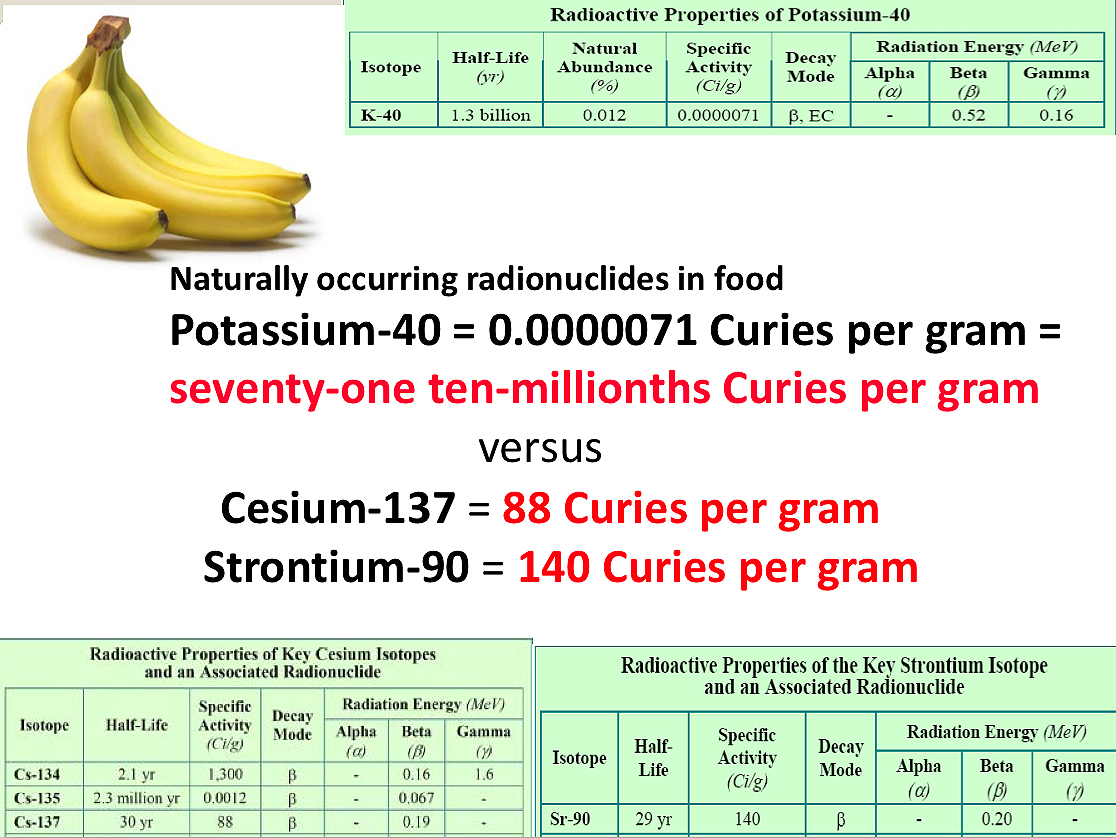
Sometimes these man-made radionuclides are compared to naturally occurring radionuclides, such as Potassium-40, which is always found in bananas and other fruits. However this is a false comparison since naturally occurring radioactive elements are very weakly radioactive. In the lab chart the radioactivity is described as the “specific activity”. Note that Potassium-40 has a specific activity of 71 ten millionths of a Curie per gram. Compare that to the 88 Curies per gram for Cesium-137. This is like comparing a stick of dynamite to an atomic bomb.

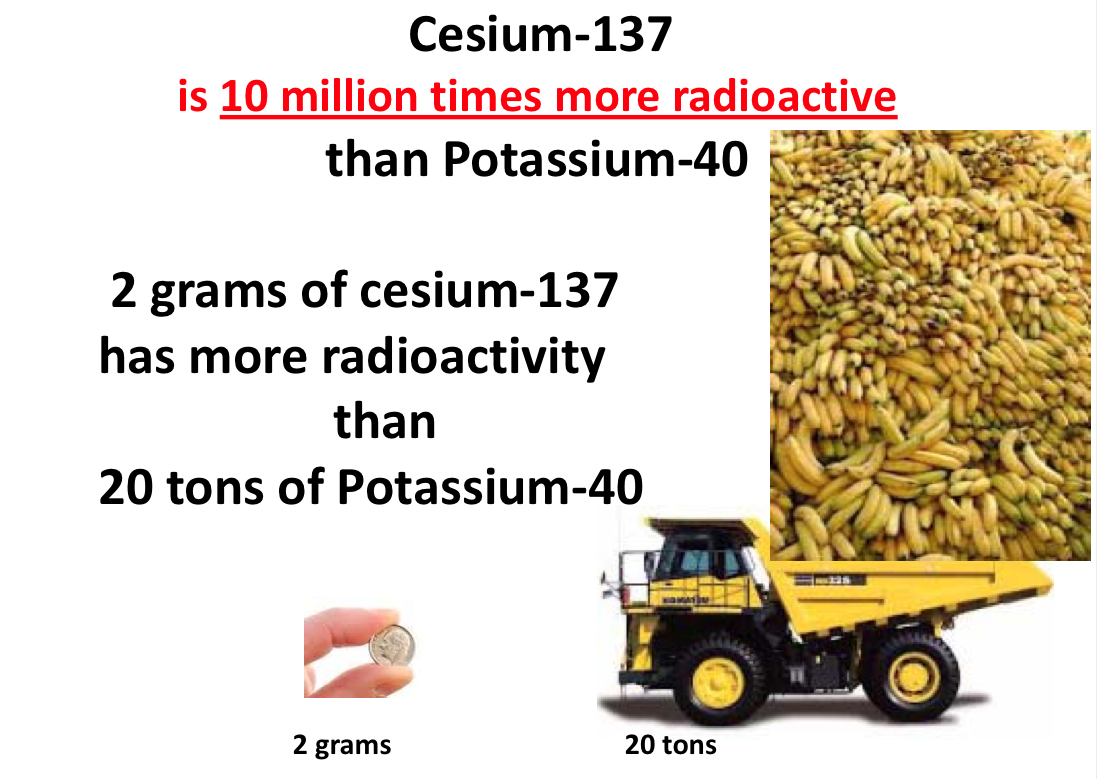
Highly-radioactive fission products such as Cesium-137 and Strontium-90 emit 10 to 20 million times more radiation per unit volume than does Potassium-40. So which one of these would you rather have in your bananas?

Cs-137 10 million times more radioactive than Potassium-40

It is in fact the amount of Cesium-137 deposited per square kilometer of land that defines the degree to which an area is classified as being too radioactive to work or live. One may get an idea of the extreme toxicity of Cesium-137 by considering how little of it is required to make a large area of land uninhabitable.

Chernobyl: Cs-137 contamination

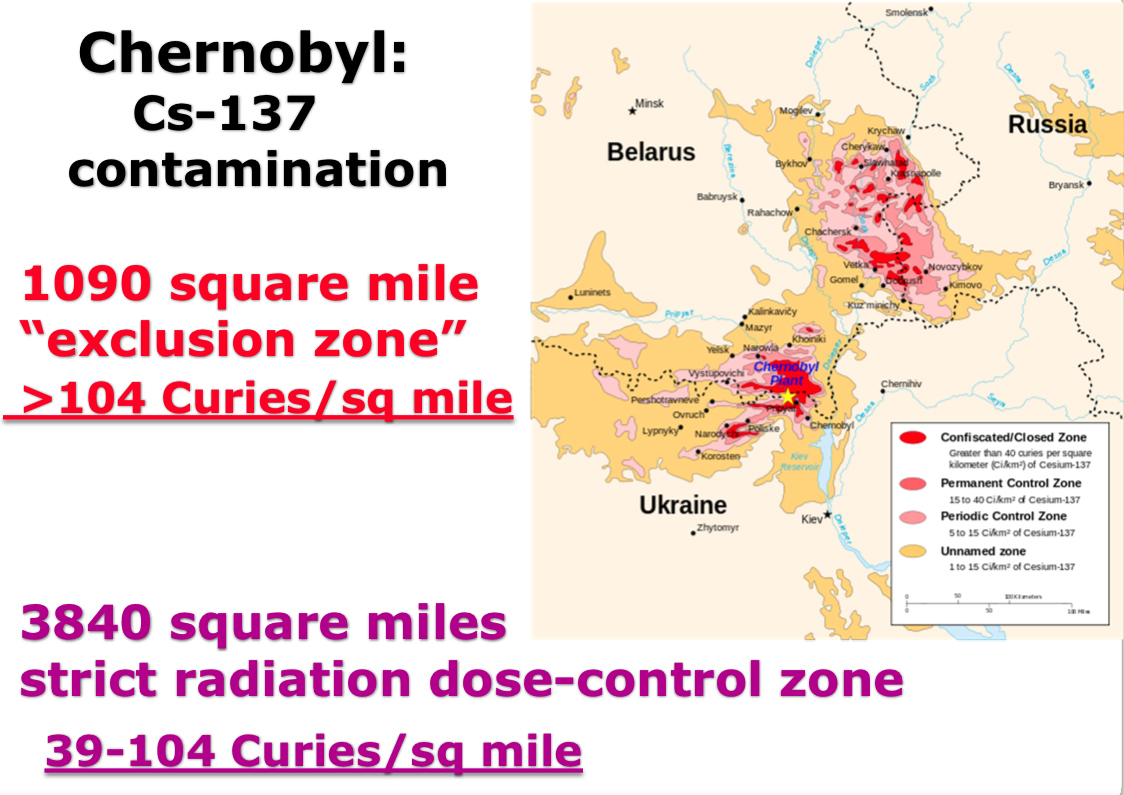
The lands that were grossly contaminated by the destruction of the Chernobyl nuclear power plant are classified by the number of Curies of radiation per square kilometer. There were 3840 square miles of land contaminated with 15 to 40 Curies of radiation per square kilometer. These lands are considered strict radiation dose-control zones.

Chernobyl: Cs-137 contamination
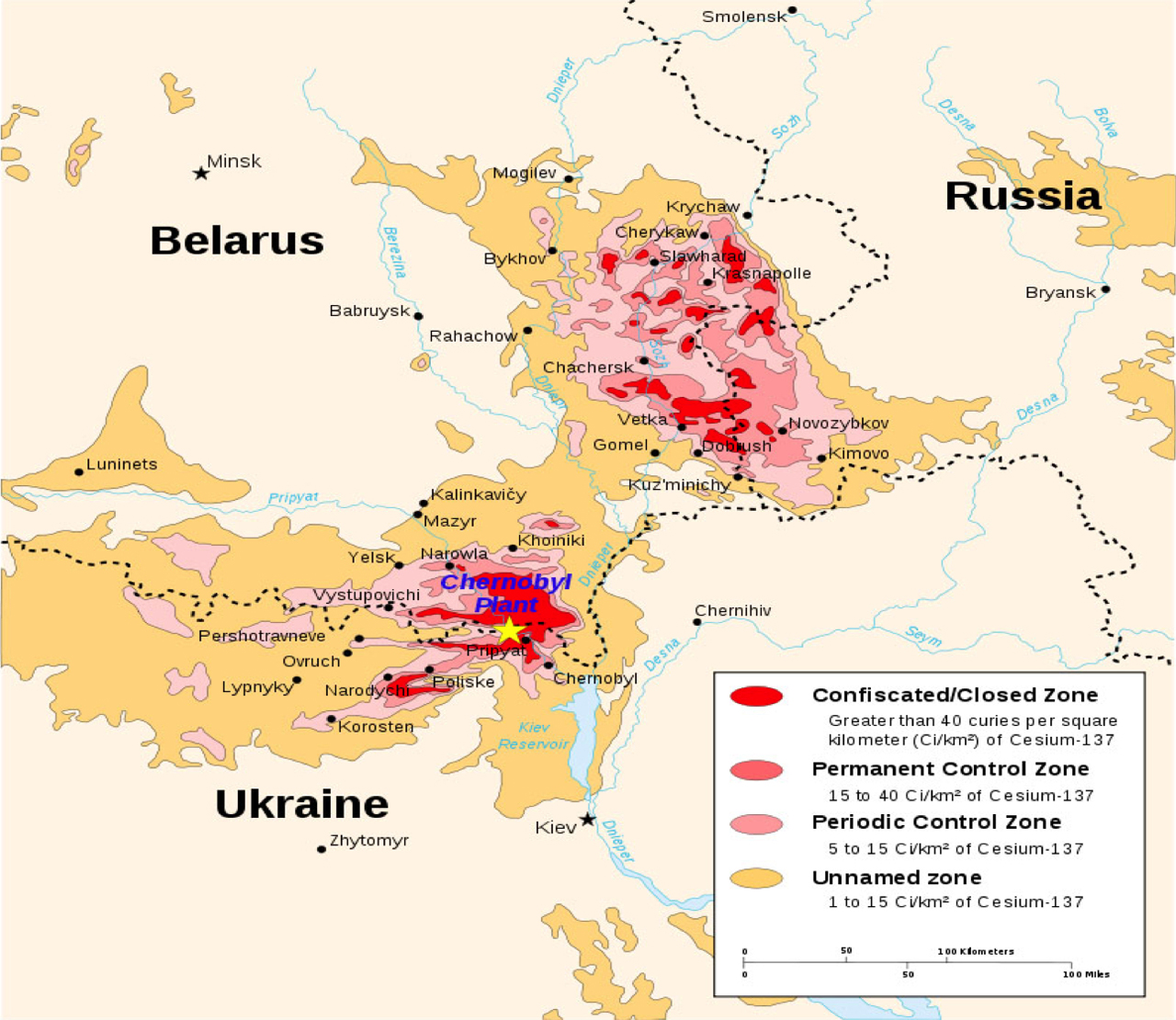
High Resolution Map Detail

The 1100 square mile uninhabitable exclusion zone that surrounds the destroyed Chernobyl reactor has greater than 40 Curies of radioactivity per square kilometer. For those more familiar with square miles, that would be 104 Curies per square mile.

Consider again that one gram of Cesium-137 has 88 Curies of radioactivity.

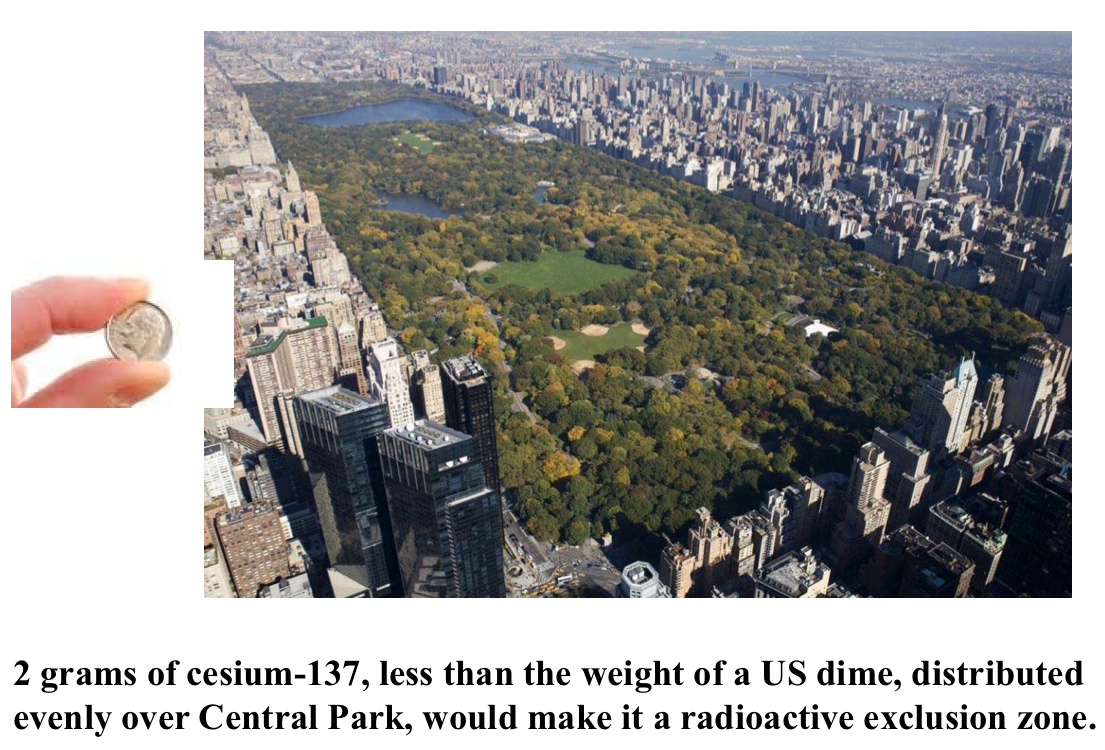
Thus, as little as one third of a gram of Cesium-137, made into microparticles and distributed as a smoke or gas over an area of one square kilometer, will make that square kilometer uninhabitable.

2 grams of Cs-137 - less than the weight of a US dime, distributed evenly over CentralPark, would make it a radioactive exclusion zone

Less than two grams of Cesium-137, a piece smaller than an American dime, if made into microparticles and evenly distributed as a radioactive gas over an area of one square mile, will turn that square mile into an uninhabitable radioactive exclusion zone. Central Park in New York City can be made uninhabitable by 2 grams of microparticles of Cesium-137. Hard to believe, isn’t it?

Remember, these nuclear poisons are lethal at the atomic level. There are as many atoms in one gram of Cesium-137 as there are grains of sand in all the beaches of the world. That’s 1021 atoms—10 to the 21st power. 1480 trillion of them or 1.48 times 10 to the 12th power are disintegrating every second, releasing invisible nuclear energy. So this works out to about one and a half million disintegrations per second per square meter. We can see how this works then.

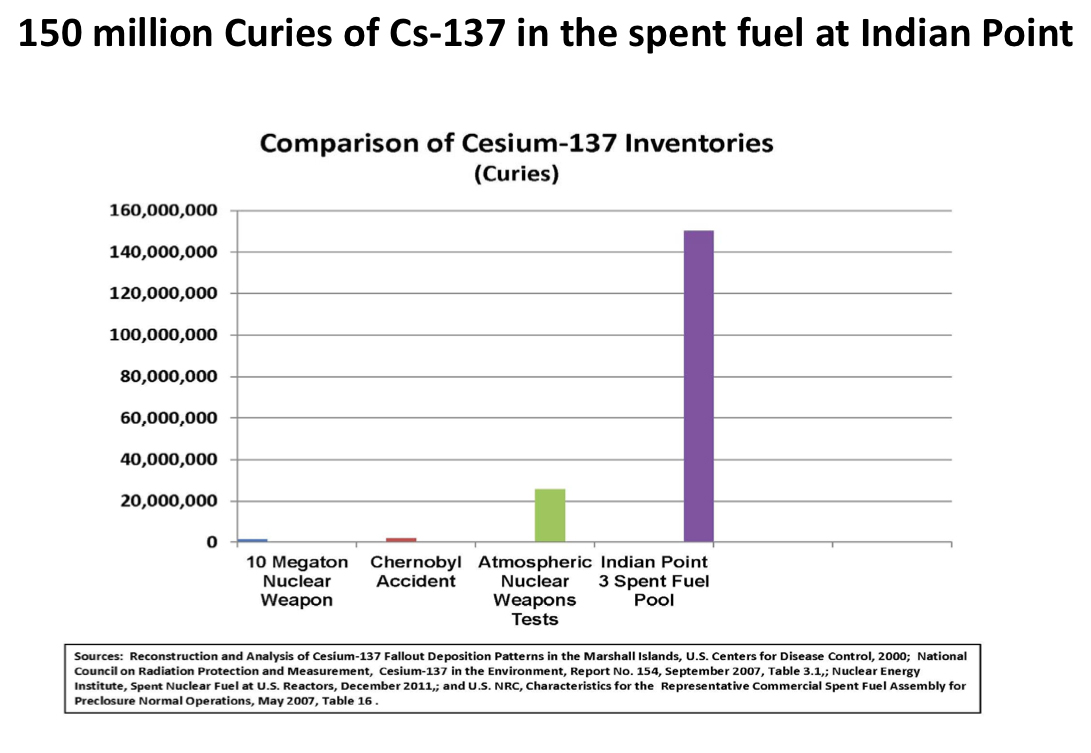
150 million Curies Cs-137 in the spent fuel at Indian Point. Sources: Reconstruction and Analysis of Cesium-137 Fallout Deposition Patterns in the Marshall Islands, U.S. Centers for Disease Control, 2000; National Council on Radiation Protection and Measurement, Cesium-137 in the Environment, Report No. 154, September 2007, Table 3.1,; Nuclear Energy Institute, Spent Nuclear Fuel at U.S. Reactors, December 2011,; and U.S. NRC, Characteristics for the Representative Commercial Spent Fuel Assembly for Preclosure Normal Operations, May 2007, Table 16.

Note the immense inventories of Cesium-137: 150 million Curies that are located in the nearby spent fuel pool at Indian Point Nuclear Power Plant which is about 40 miles from here by road and less than that as the radioactive cloud flies. Many of the 104 US commercial nuclear reactors and power plants have more than 100 million Curies of Cesium-137 in their spent fuel pools. This is many times more than in the spent pools at Fukushima.

So now that we have some idea of the extreme toxicity of Cesium-137, let’s look at the extent of the contamination of the Japanese mainland.

Fukushima Explosion, March 11, 2011

It is now known that the reactors 1, 2, and 3 at Fukushima Daiichi all melted down and melted through the steel reactor vessels within a few days following the earthquake and tsunami of March 11, 2011. This was not made public by either TEPCO or the Japanese government for two months.

Editor‘s note: this transcript was created from the broadcast quality audio recording program featuring Steven Starr produced by Maria Gilardin in her Fukushima Symposium Mini Series on TUC Radio. Starting with the PDF file in the March 11 Documents tab of < http://www.totalwebcasting.com/view/?id=hcf#>, the text below was fashioned using Maria’s Introduction and Mr. Starr’s actual presentation. (All highlighted text in the original PDF – e.g., underlining, italics, bold – is represented below as underlined text.) The slides were generated from copy generously provided by Mr. Starr. I am grateful for the assistance of Steven Starr and Maria Gilardin in assembling this presentation.

http://www.ratical.org/radiation/Fukushima/StevenStarr.html


Nevada’s atomic test legacy: underground aquifers are radioactive

…polluted 1.6 trillion gallons of water…About a third of the [underground atomic] tests were conducted directly in aquifers…

Federal drinking water standards in 2009 when this article was written

..For alpha particles, the standard is 15 picocuries per liter; for long-term radionuclides, it’s 50 picocuries per liter

radioactivity in the water reaches millions of picocuries per liter.

From Los Angeles Times

Nevada’s hidden ocean of radiation

by Ralph Vartabedian
November 13, 2009

YUCCA FLAT, NEV. — A sea of ancient water tainted by the Cold War is creeping deep under the volcanic peaks, dry lake beds and pinyon pine forests covering a vast tract of Nevada.

Over 41 years, the federal government detonated 921 nuclear warheads underground at the Nevada Test Site, 75 miles northeast of Las Vegas. Each explosion deposited a toxic load of radioactivity into the ground and, in some cases, directly into aquifers.

When testing ended in 1992, the Energy Department estimated that more than 300 million curies of radiation had been left behind, making the site one of the most radioactively contaminated places in the nation.

During the era of weapons testing, Nevada embraced its role almost like a patriotic duty. There seemed to be no better use for an empty desert. But today, as Nevada faces a water crisis and a population boom, state officials are taking a new measure of the damage.

——————————

For The Record
Los Angeles Times Wednesday, November 18, 2009 Correction
Nevada radiation: An article in Friday’s Section A about contaminated water at the Nevada Test Site said the federal drinking water standard for radiation is 20 picocuries per liter. There are actually three standards, depending on the type of radiation: For alpha particles, the standard is 15 picocuries per liter; for long-term radionuclides, it’s 50 picocuries per liter; and for short-lived tritium, it’s 20,000 picocuries per liter. The article also said the test site is northeast of Las Vegas; it is northwest.

—————————-

They have successfully pressured federal officials for a fresh environmental assessment of the 1,375-square-mile test site, a step toward a potential demand for monetary compensation, replacement of the lost water or a massive cleanup.

“It is one of the largest resource losses in the country,” said Thomas S. Buqo, a Nevada hydrogeologist. “Nobody thought to say, ‘You are destroying a natural resource.’ “

In a study for Nye County, where the nuclear test site lies, Buqo estimated that the underground tests polluted 1.6 trillion gallons of water. That is as much water as Nevada is allowed to withdraw from the Colorado River in 16 years — enough to fill a lake 300 miles long, a mile wide and 25 feet deep.

At today’s prices, that water would be worth as much as $48 billion if it had not been fouled, Buqo said.

Although the contaminated water is migrating southwest from the high ground of the test site, the Energy Department has no cleanup plans, saying it would be impossible to remove the radioactivity. Instead, its emphasis is on monitoring.

Federal scientists say the tainted water is moving so slowly — 3 inches to 18 feet a year — that it will not reach the nearest community, Beatty, about 22 miles away, for at least 6,000 years.

Still, Nevada officials reject the idea that a massive part of their state will be a permanent environmental sacrifice zone.

Access to more water could stoke an economic boom in the area, local officials say. More than a dozen companies want to build solar electric generation plants, but the county cannot allow the projects to go forward without more water, said Gary Hollis, a Nye County commissioner.

The problem extends beyond the contamination zone. If too much clean water is pumped out of the ground from adjacent areas, it could accelerate the movement of tainted water. When Nye County applied for permits in recent years to pump clean water near the western boundary of the test site, the state engineer denied the application based on protests by the Energy Department.

(The department did not cite environmental concerns, perhaps to avoid acknowledging the extent of the Cold War contamination. Instead, federal officials said the pumping could compromise security at the test site, which is still in use.)

“Those waters have been degraded,” said Republican state Assemblyman Edwin Goedhart of Nye County, who runs a dairy with 18,000 head of livestock. “That water belongs to the people of Nevada. Even before any contamination comes off the test site, I look at this as a matter of social economic justice.”

Continue reading

Knock, knock, is anyone home at the EPA?

The Bridgeton/West Lake Superfund site is a radioactive disaster adjoining St. Louis, Missouri.

From Center for Health, Environment & Justice

February 15, 2016

EPA has gone dark. McCarthy is awaiting the end of her term and no one is protecting the American citizens or our environment.

It is outrageous that Administrator Gina McCarthy refuses to acknowledge the citizens living near the Bridgeton/West Lake Superfund site. What is wrong with her? Just Moms STL wrote a letter requesting a meeting in May of 2015 and never even received an acknowledgement that they asked for a meeting. They traveled to Washington, DC anyway in hopes of seeing McCarthy after their federal delegation of senators and congress representatives sent a letter to encourage McCarthy to meet with them. The community received nothing from the office of the Administrator. Not a call, a letter or even an e-mail saying she had a prior commitment or was on travel.

A second letter was sent this past fall to say the community leaders are planning to travel to Washington, D.C. in February and would she please meet with them to discuss the Superfund site which has been mismanaged by her regional staff. Again there was silence. I personally called every day but one in the month of January and February leading up to the date that local people were traveling to D.C. On many occasions when I called, all I received was a voice mail message that asked me to leave a message and someone would get back to me. I left message after message and no one, not a single person from the agency returned my call.

On a few occasions I actually talked to a woman who answered the phone. She was courteous and respectful and always promised to deliver the message to scheduling department. “Someone will call you back soon.” But no one ever called. The citizens living around the site began a telephone campaign to McCarthy’s office. It was only a week until they travel to D.C. and no one provided an answer if McCarthy would meet or not. The community sold cupcakes, brownies, t-shirts, and worked hard to raise the funds to visit D.C. and meet with the Administrator to explain what was going on from their perspective.

With a slim chance of meeting with McCarthy, now two years since their first request for a meeting was made, they climbed on a plane and came to D.C. While there they met with their congressional delegation, allies in the field but never had a meeting with McCarthy. Also they were never denied a meeting; it was deafeningly silent. My goodness if the answer is “NO” then say so. To say nothing is irresponsible, inexcusable and further victimizing the victims.

I stood outside of McCarthy’s office at 9 a.m. the last day of the groups visit. From the sidewalk I called her office and explained that local leaders are downstairs and waiting for a response from McCarthy before they need to leave for the airport. The public relations office sent down a two young people to receive the letter the community had for McCarthy, outlining their concerns. They apologized that McCarthy wasn’t available to meet. She couldn’t have told the citizens before they left St. Louis that she couldn’t meet? It is not a big request to ask for a simple yes or no of availability.

My take away . . . fire McCarthy. My tax dollars should not be spent on someone who works in government and ignores the citizens of the United States. All she had to do on both occasions is say I’m sorry I’ve got a previous engagement. Common courtesy should be a requirement of federal employment.

http://chej.org/2016/02/knock-knock-is-anyone-home-at-epa/